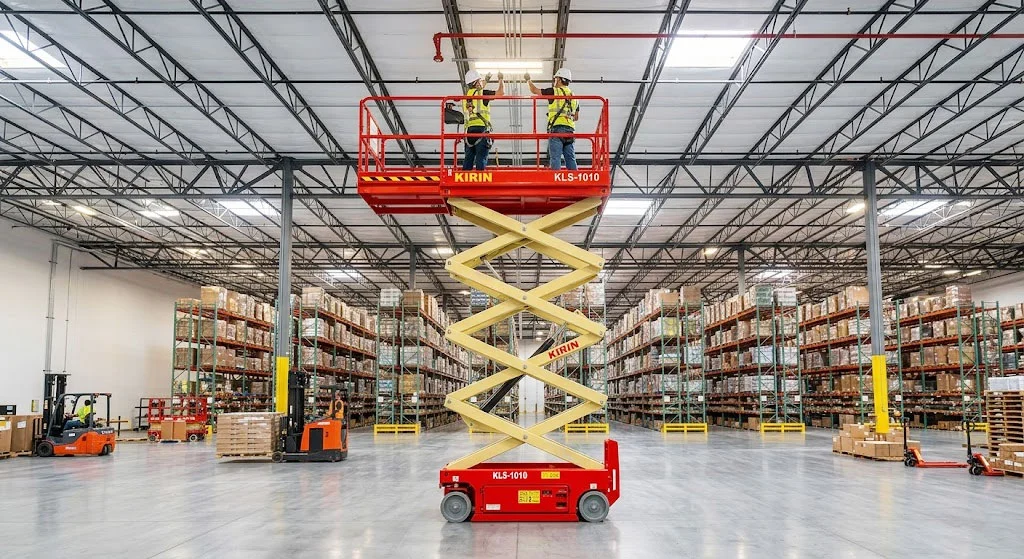
Choosing the right aerial work platform is the difference between a job well done and a safety hazard. Whether you are painting a warehouse ceiling or installing HVAC systems on a high-rise construction site, understanding the technical specifications of your equipment is paramount.
In this comprehensive guide, we explore the critical metrics of these machines, focusing heavily on scissor lift height, width, weight, and slope capabilities to help you make an informed decision for your next project.
What is a Scissor Lift?
Definition and Basic Function
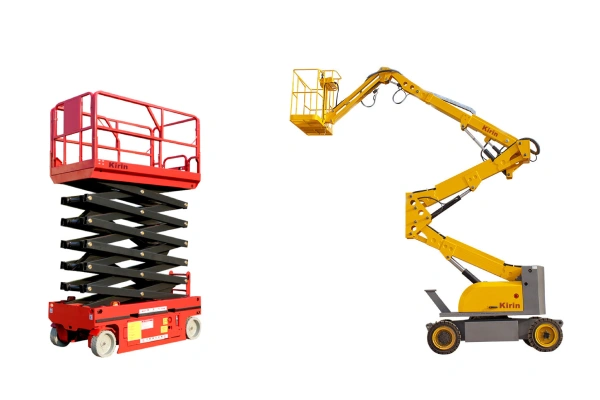
A scissor lift is a type of mobile elevated work platform (MEWP) designed to move personnel and equipment in a vertical direction. Unlike boom lifts, which can extend outward, scissor lifts move strictly up and down using a linked, folding support system.
How Scissor Lifts Work The “scissor” mechanism consists of a series of crossed tubes that work in a pantograph fashion. When pressure is applied to the outside of the lowest set of supports, the “X” patterns elongate, pushing the platform upward. This movement is typically powered by hydraulic cylinders or electric linear actuators.
Key Components of a Scissor Lift
- The Platform: The work area where operators and tools reside.
- The Scissor Stack: The assembly of folding arms that determines the scissor lift height.
- The Base: The chassis that houses the motor, fuel/battery, and wheels.
- The Controls: Located on the platform for operator use and at the base for emergency lowering.
Common Industries That Use Scissor Lifts
You will find these machines in almost every industrial sector, including:
- Construction: For electrical, plumbing, and drywall installation.
- Warehousing: For inventory management and overhead lighting repair.
- Entertainment: For setting up stage lights and sound equipment.
- Retail: For high-shelf restocking and signage.
Types of Scissor Lifts
Not all lifts are built for the same environment. Categorizing them helps in determining the necessary scissor lift height and power source.
- Electric Scissor Lifts: Designed for indoor use, these feature non-marking tires and quiet, emission-free operation. They are the standard for maintenance and retail.
- Rough Terrain Scissor Lifts: Built for the outdoors, these feature heavy-duty tires, 4-wheel drive, and high-performance engines (often diesel or dual-fuel) to handle uneven ground.
- Hydraulic Scissor Lifts: These use pressurized fluid to lift the platform. While common, they are increasingly being replaced by electric-drive models for better efficiency.
- Compact Indoor Models: These are designed with a narrow width of a scissor lift to fit through standard doorways and navigate tight aisles.
Understanding Scissor Lift Height
When planning a project, the most important specification is the scissor lift height. If you choose a machine that is too short, you can’t reach the work; if it’s too high, you’re paying for unnecessary machine weight and size.
What “Scissor Lift Height” Really Means
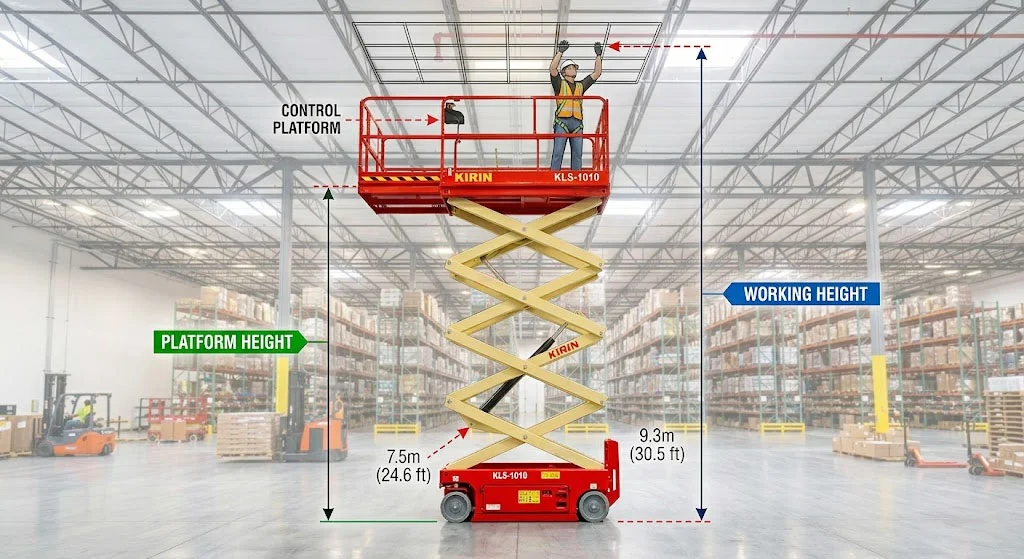
There is often confusion regarding scissor lift height terminology. It is vital to distinguish between two specific measurements:
- Platform Height: The distance from the ground to the floor of the platform when fully extended.
- Working Height: The height an average worker can reach while standing on the platform. This is typically calculated as the scissor lift platform height plus six feet.
Common Scissor Lift Height Ranges
Different jobs require different levels of reach. Here are the industry-standard categories:
- Mini Scissor Lifts (10–20 ft): These are ideal for low-ceiling maintenance, such as changing bulbs in an office or working on residential foyers.
- Standard Indoor Lifts (20–40 ft): This is the most common scissor lift height range. These are used extensively in warehouses and big-box retail stores.
- Rough Terrain Lifts (40–60+ ft): These massive machines are used for exterior cladding, window installation on multi-story buildings, and heavy industrial construction. The scissor lift max height for specialized rough terrain models can occasionally exceed 60 feet.
How to Choose the Right Lift Height
Selecting the correct scissor lift working height involves measuring your target work area and subtracting the height of the person performing the task.
- Indoor Ceiling Work: A standard scissor lift height of 19 to 26 feet covers most commercial ceilings.
- Outdoor Construction Projects: Often require a scissor lift reach height of 40 feet or more to reach the second or third story of a building.
- Warehouse Maintenance Tasks: Requires a scissor lift maximum height that matches the highest pallet rack or light fixture.
- Electrical and HVAC: Frequently uses an adjustable height scissor lift that can navigate between floor levels easily.
Safety Considerations for Lift Height
The higher you go, the greater the risk.
- Fall Protection: OSHA requires guardrails, and many companies mandate personal fall arrest systems (PFAS) once the scissor lift platform height exceeds a certain level.
- Wind Limitations: At higher elevations, wind can catch the platform like a sail. Most indoor-rated lifts have a zero-wind speed rating, meaning they cannot be used outside if even a light breeze is present.
- Stability Concerns: As the scissor lift heights increase, the center of gravity shifts. Always ensure the lift is on a level surface before ascending.
Scissor Lift Width Explained
While scissor lift height gets you to the work, the width determines if you can even get the machine into the building.
Standard Width Dimensions
The width of scissor lift models varies significantly:
- Narrow Lifts: Typically 30 to 32 inches wide, designed to fit through a standard 36-inch commercial door.
- Standard Lifts: Usually 46 to 48 inches wide, offering more stability for higher scissor lift max height extensions.
- Wide-Body Models: Found in rough terrain categories, these can be 70 to 90 inches wide to provide a larger platform area and better stability on soil.
Why Width Matters
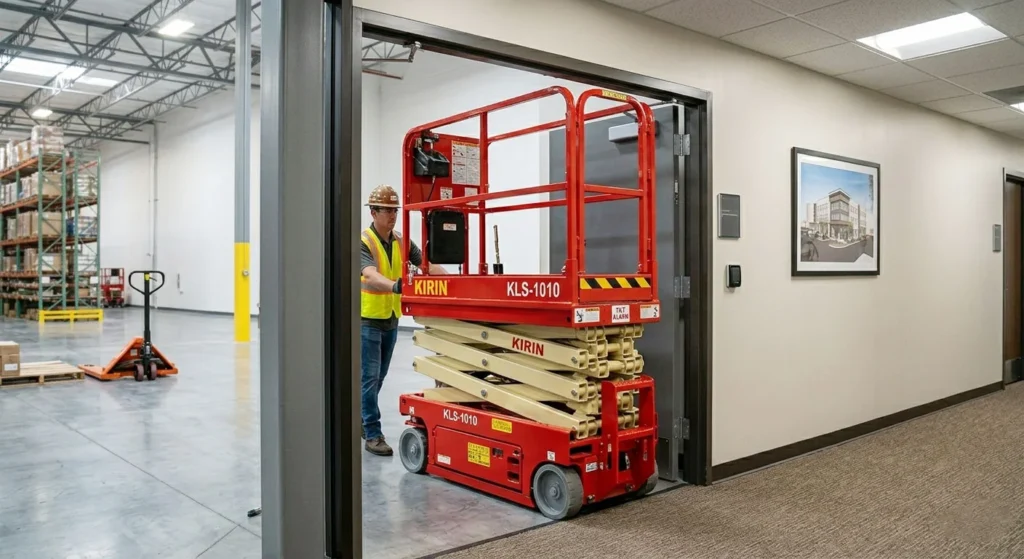
- Doorway Access: A narrow scissor lift width is essential for “slab” lifts that move from room to room.
- Aisle Navigation: In narrow-aisle warehouses, a standard scissor width lift might be too bulky to allow other equipment to pass.
- Transport: The scissor lift sizes width will determine if the machine can fit on a standard utility trailer or if a wide-load permit is required for transport.
Compact vs. Wide Scissor Lifts
- Compact Advantages: Better maneuverability and the ability to fit into elevators.
- Wide Benefits: Larger scissor lift platform height stability and the ability to hold more people and materials (higher “deck” capacity).
Scissor Lift Weight and Load Capacity
Average Scissor Lift Weight
The weight of the machine (curb weight) is distinct from its lifting capacity.
- Electric Lifts: Usually weigh between 2,000 and 5,000 lbs.
- Rough Terrain Lifts: Can weigh 10,000 to 15,000 lbs due to heavy engines and outriggers.
- Factors: The scissor lift height is a primary factor; more steel in the scissor stack means a heavier machine.
Platform Capacity vs. Machine Weight
The “rated load” is how much weight you can safely put on the platform.
- Single-person lifts: Usually capped at 500 lbs.
- Multi-person lifts: Can handle 1,000 to 2,500 lbs, allowing for several workers and heavy tools.
- Note: Exceeding the platform capacity while at the scissor lift maximum height is a leading cause of tip-overs.
Ground Pressure and Floor Limits
You must ensure the floor can support the machine.
- Indoor Flooring: High-rise office floors or decorative tile may crack under a 3,000-lb electric lift.
- Outdoor Terrain: Heavy rough terrain lifts may sink into soft mud, requiring “cribbing” or outrigger pads.
Understanding Scissor Lift Slope Ratings
Operating a scissor lift on slope surfaces is one of the most dangerous things an operator can do.
What Is a Slope Rating? The slope rating (or gradeability) is the maximum incline a lift can climb or operate on. This is usually expressed as a percentage.
Typical Scissor Lift Slope Limits
- Driving/Climbing: Most lifts can climb a 25% to 35% grade while in the stowed (lowered) position.
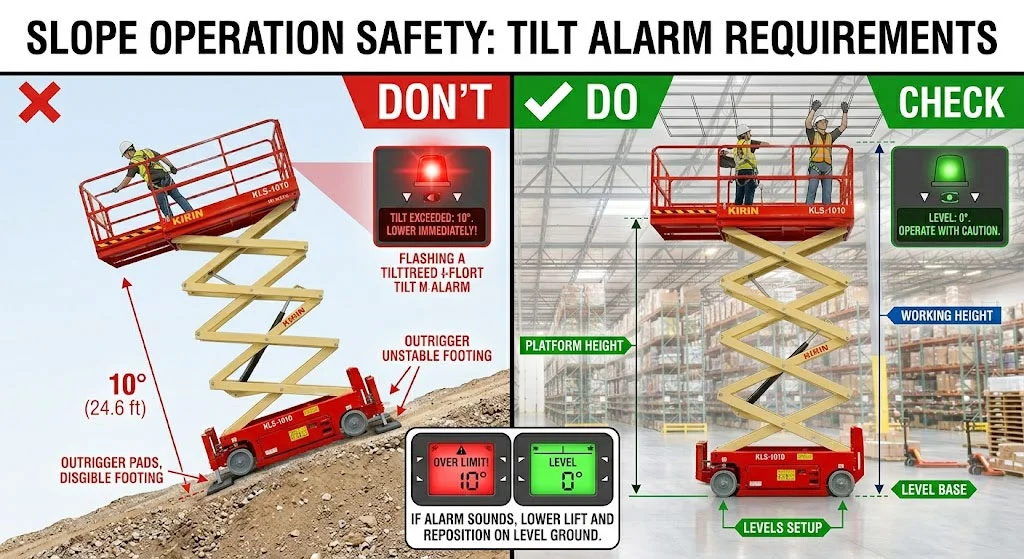
- Leveling: Most machines have a scissor lift maximum slope for operation of only 1.5 to 3 degrees. If the ground is steeper than this, the lift will trigger a tilt alarm and cut off lifting functions.
Safe Operation on Inclines Never attempt to extend to the full scissor lift height if the machine is not level. For a scissor lift for sloped floor applications, you must use a model equipped with automatic leveling outriggers.
Comparing Scissor Lift Sizes by Application
| Application | Recommended Scissor Lift Height | Recommended Width |
| Retail Shelf Stocking | 15–19 ft | 30 in (Narrow) |
| Warehouse Lighting | 26–32 ft | 32–46 in |
| Exterior Window Wash | 40–50 ft | 60+ in (Rough Terrain) |
| HVAC Duct Install | 20–26 ft | 46 in (Wide Platform) |
Scissor Lift Dimension Chart
Note: These are general averages. Always check the specific scissor lift height specs provided by the manufacturer (e.g., Kirin Lift).
| Model Type | Max Platform Height | Machine Width | Machine Weight |
| Micro Electric | 13 ft | 30 in | 1,600 lbs |
| Narrow Electric | 19 ft | 32 in | 2,700 lbs |
| Standard Electric | 26 ft | 46 in | 4,200 lbs |
| High-Reach Electric | 40 ft | 47 in | 6,200 lbs |
| RT (Rough Terrain) | 53 ft | 90 in | 14,000 lbs |
Key Factors to Consider Before Buying or Renting
Jobsite Requirements
Does the floor have a weight limit? Do you need to pass through a standard door? These questions dictate the width of a scissor lift and the weight class you need.
Transportation and Storage
If you are buying, consider where the lift will be stored. A machine with a high scissor lift minimum height (the height when folded down) might not fit in a standard garage or storage container.
Rental vs. Purchase Decisions
For a one-time project requiring a specific scissor lift reach height, renting is more cost-effective. However, if you perform frequent maintenance at a standard scissor lift height, purchasing may save money over time.
Scissor Lift Safety Tips
- Inspect the Site: Check for overhead power lines and floor holes.
- Check the Tilt Alarm: Never bypass safety sensors when operating a scissor lift max slope.
- Wind Awareness: Do not operate at the scissor lift maximum height outdoors if winds exceed 28 mph (check your manual for specific limits).
- No Climbing: Never stand on the guardrails to gain extra scissor lift working height.
- Pinch Points: Keep hands inside the platform rails when elevating the scissor stack.
Frequently Asked Questions About Scissor Lift Height
How high can a scissor lift go?
The scissor lift max height for most common electric models is around 40 feet. However, specialized rough terrain scissor lifts can reach heights of 60 feet or more.
What is the difference between platform height and working height?
The scissor lift platform height is the distance from the floor to the platform deck. The scissor lift working height is the platform height plus approximately 6 feet (the reach of the worker).
How wide is a standard scissor lift?
A standard scissor lift height model used indoors is typically between 30 and 46 inches wide.
How much does a scissor lift weigh?
Weight varies by scissor lift height specs. A small 19-foot lift weighs about 2,700 lbs, while a 50-foot rough terrain model can weigh over 15,000 lbs.
Can a scissor lift be used on a slope?
You can drive a stowed lift on a slope, but you cannot safely extend to the scissor lift platform height unless the machine is level. Check the scissor lift maximum slope rating in your operator’s manual.
What size scissor lift do I need?
Measure the highest point you need to reach. Subtract 6 feet to find your required scissor lift platform height. Then, measure the narrowest door or aisle the lift must pass through to determine the required scissor lift width.
Conclusion
Understanding the nuances of scissor lift height, width, weight, and slope is essential for jobsite efficiency and personnel safety. By matching the scissor lift height specs to your specific environment—whether it’s a cramped warehouse aisle or a rugged construction site—you ensure that your team can work confidently and effectively.
Always prioritize safety, respect the scissor lift height restrictions of your specific model, and never operate on a slope that exceeds the manufacturer’s recommendations. With the right machine, no task is out of reach.
If you have more questions about selecting the perfect scissor lift height for your next project, or if you need a detailed quote on our latest models, our team is ready to assist you. You can reach us directly via Email: info@klingtec.com or send us a message on WhatsApp: +86 188 6686 3188. We look forward to helping you elevate your business to new heights!