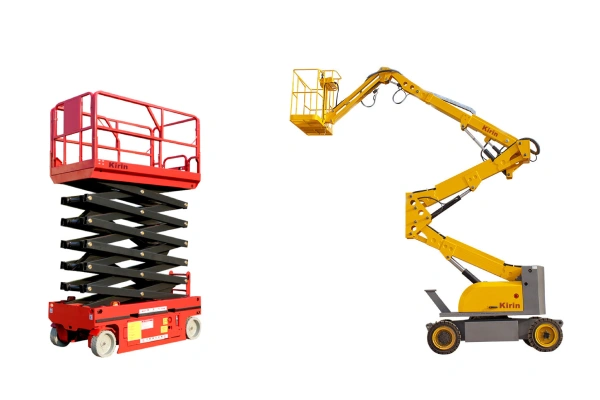
In the world of construction, warehousing, and facility maintenance, efficiency is often measured by how well your equipment fits the environment. Choosing the right aerial work platform (AWP) isn’t just about reaching the ceiling; it’s about navigating narrow aisles, fitting through standard doorways, and ensuring the floor can support the machine’s weight.
This comprehensive guide dives deep into scissor lift dimensions, helping you understand the technical specifications required to select the perfect lift for your next project.
What Are Scissor Lift Dimensions?
When we talk about the dimensions of a scissor lift, we aren’t just referring to how high it goes. These machines are complex pieces of engineering with multiple spatial footprints that change depending on whether they are in operation or “stowed” (folded down). Understanding these measurements is the first step toward jobsite safety and efficiency.
Key Measurements Explained
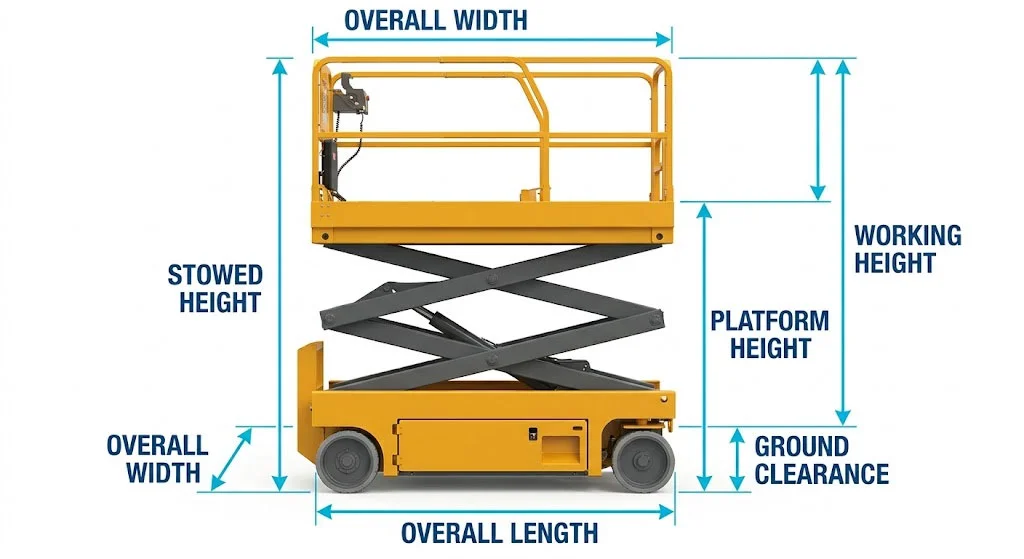
To accurately compare models, you need to speak the language of the manufacturer’s spec sheet. Here are the primary scissor lift dimensions you will encounter:
- Platform Height: This is the measurement from the ground to the floor of the platform when fully extended. It is the most common way lifts are categorized (e.g., a “19-foot lift”).
- Working Height: A crucial distinction! Working height is typically calculated by adding 6 feet (approximately 2 meters) to the platform height. This represents the height a person of average stature can comfortably reach with their hands while standing on the platform.
- Overall Machine Width: The distance between the outermost points of the chassis. This determines if the lift can fit through a standard door or down a narrow warehouse aisle.
- Machine Length: The distance from the front to the back of the chassis. This affects the turning radius and how much floor space the unit occupies when parked.
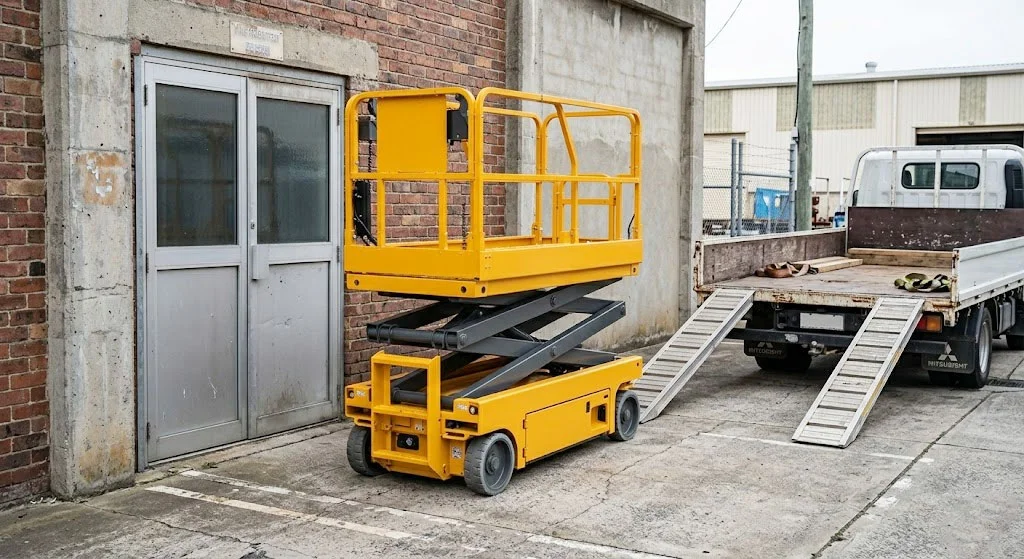
- Stowed Height: The height of the machine when the scissor stack is completely collapsed and the guardrails are up. Many models offer “folding rails” to further reduce the electric scissor lift lowered dimensions for passing through low-clearance doorways.
- Platform Extension Size: Most modern lifts feature a slide-out deck. This provides additional horizontal reach and increases the workspace for tools and multiple workers.
- Ground Clearance: The distance between the bottom of the chassis and the ground. This is vital for rough terrain models that must navigate over debris or uneven soil.
- Weight Capacity: Also known as the “rated load,” this is the maximum weight (workers + tools + materials) the lift can safely carry.
Why Dimensions Matter
Why should you obsess over a few inches? Because the wrong dimensions of scissor lift can halt a project entirely.
- Accessing Tight Spaces: In modern “High-Bay” warehouses, rack aisles are getting narrower to maximize storage. A lift that is even 2 inches too wide is unusable.
- Indoor vs. Outdoor Applications: Indoor lifts need to be compact and non-marking, while outdoor lifts need a wider footprint for stability on wind-swept jobsites.
- Transportation and Storage: Knowing the dimensions of a scissor lift ensures it will fit on your trailer or in your storage container.
- Jobsite Safety Compliance: Exceeding the rated capacity or using a lift with a footprint too small for the wind conditions can lead to tip-overs.
Standard Scissor Lift Sizes and Categories
Scissor lifts are generally categorized by their size and intended environment. Each category has a “standard” range of scissor lift dimensions.
Mini Scissor Lifts
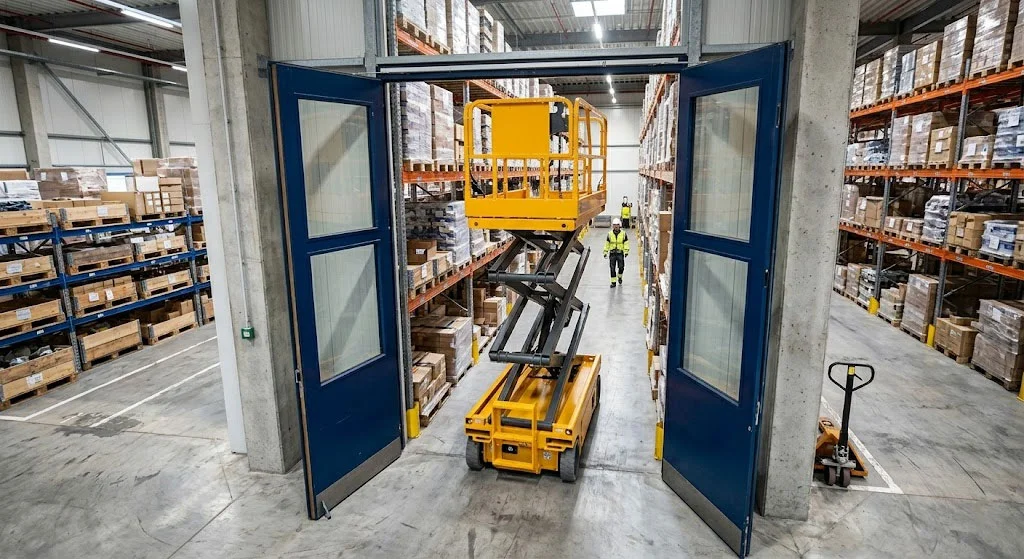
These are the “lightweights” of the industry. Often used in hospitals, schools, and offices, they have a platform height of 10 to 15 feet. Their most significant advantage is their width, often as narrow as 30 inches, allowing them to pass through standard interior doors and fit into passenger elevators.
Mid-Size Scissor Lifts
This is the most popular category. It includes the ubiquitous 19 feet scissor lift dimensions and 26′ scissor lift dimensions. These machines balance reach with portability, usually featuring a width of 32 to 46 inches. They are the workhorses of electrical, HVAC, and plumbing contractors.
Large Rough Terrain (RT) Scissor Lifts
Built for the mud and grit of early-stage construction, RT lifts have massive scissor lift dimensions. They feature wide bases (up to 90 inches or more), high ground clearance, and outriggers for leveling on uneven dirt.
Common Scissor Lift Dimensions Chart
To help you visualize the differences, here is a comparison of typical specifications for the most common models used in the industry today.
Typical Size Comparison Table
| Model Class | Platform Height | Working Height | Width (Approx) | Stowed Height (Rails Up) |
| Mini / 1330 | 13 ft (4m) | 19 ft (5.8m) | 30 in (0.76m) | 80 in (2.03m) |
| 19 ft Class | 19 ft (5.8m) | 25 ft (7.6m) | 32 in (0.81m) | 83 in (2.11m) |
| 26 ft Class | 26 ft (7.9m) | 32 ft (9.8m) | 32-46 in | 89 in (2.26m) |
| 32 ft Class | 32 ft (9.7m) | 38 ft (11.6m) | 46 in (1.17m) | 98 in (2.49m) |
| Rough Terrain | 40-50+ ft | 46-56+ ft | 70-90 in | 100+ in |
Compact vs. Full-Size Models
When looking at electric scissor lift dimensions, you’ll often see “Compact” versions of taller lifts.
- Compact Models:
- Pros: Fits through doors; fits in elevators; easier to transport.
- Cons: Usually have a lower weight capacity and smaller platform area.
- Industries: Data centers, retail maintenance, and interior finishing.
- Full-Size Models:
- Pros: Larger decks for more materials; higher weight capacity (often 1,000 lbs+).
- Cons: Require more floor space; may be too wide for standard hallways.
- Industries: Industrial construction, large-scale HVAC installation, and steel framing.
Indoor vs. Outdoor Scissor Lift Dimensions
A common mistake is assuming that a lift with a 26-foot reach is safe for all 26-foot jobs. Scissor lift dimensions are often tied to their “wind rating.”
- Indoor Lifts: These machines are designed for flat, level surfaces (slopes less than 2-3 degrees). Because they don’t have to contend with wind, they can be narrower. Many electric scissor lift dimensions are optimized for “zero-turn” inside tight corridors.
- Outdoor Lifts: These require a wider footprint or “outriggers” to prevent the machine from tipping in the wind. A lift rated for “Outdoor Use” may have a significantly wider chassis than an indoor-only model of the same height.
Note: Some modern machines are “Dual Rated,” meaning they can be used indoors at one height and outdoors at a lower, safer height.
How to Choose the Right Scissor Lift Dimensions
Choosing based on height alone is a recipe for project delays. Follow this checklist to ensure your dimensions of a scissor lift are compatible with your site:
Evaluate Your Working Height Needs
Don’t just measure the ceiling. Measure the specific point where the work happens. If you are installing a light fixture inside a recessed ceiling, you need to account for that extra distance. Always aim for a platform height that puts the work at chest level for the operator.
Consider Workspace Restrictions
Measure the narrowest point the lift must pass through. If you have a 32-inch door, a 32-inch lift might be too tight of a squeeze once you account for the door’s hardware and the operator’s hands on the controls.
Weight Capacity Requirements
If you are lifting heavy ductwork or bundles of conduit, a compact lift might not cut it. Check the scissor lift dimensions against the deck capacity. Remember: a larger platform extension often has a lower weight capacity when extended than the main deck.
Terrain and Surface Conditions
For indoor work, check the “Floor Loading” specification. This tells you if the floor (especially on upper stories) can handle the “Point Load” of the tires. For outdoor work, ensure the hydraulic scissor lift dimensions include enough ground clearance to avoid bottoming out on a curb or rock.
Important Scissor Lift Specifications Beyond Dimensions
While scissor lift dimensions are the physical footprint, these technical specs determine the machine’s performance:
- Power Source:
- Electric: Best for indoors; quiet; no emissions.
- Diesel/Dual Fuel: Best for outdoors; more torque for climbing slopes.
- Platform Extensions: Usually add 3 to 5 feet of horizontal workspace. This is vital for reaching over stationary machinery.
- Lift Speed and Drive Capabilities: Some lifts can be driven while at full height (usually only on perfectly level ground), which significantly speeds up work.
- Safety Features: Look for “Pothole Protectors.” These are metal plates that deploy when the lift is raised, reducing the scissor lift dimensions between the chassis and the floor to prevent a tip-over if a wheel hits a hole.
Common Mistakes When Selecting Scissor Lift Sizes
Even experienced foremen make these mistakes when considering dimensions of scissor lift units:
- Choosing height based only on platform height: Always remember the “Working Height” is the real-world utility.
- Ignoring width restrictions: Forgetting to measure the width of the elevator door is the #1 reason for equipment returns.
- Overlooking load capacity: Thinking a “bigger” lift always holds more weight. Sometimes a tall, narrow lift has a lower capacity than a short, wide one.
- Forgetting transport dimensions: Ensure your delivery truck can clear the bridge or the warehouse gate. Check the electric scissor lift lowered dimensions before booking transport.
- Using outdoor lifts indoors: While safe, they are often too bulky and heavy for delicate indoor flooring.
Maintenance Tips Related to Scissor Lift Dimensions
The physical integrity of your lift ensures the dimensions remain safe and functional.
Tire and Wheel Inspection
Worn-out tires can actually change the scissor lift dimensions slightly and, more importantly, affect the leveling sensors. Ensure non-marking tires are free of gouges that could cause instability.
Platform Inspection
Check that the platform extensions slide smoothly. If the tracks are bent, the dimensions of a scissor lift’s workspace are effectively cut in half.
Hydraulic System Maintenance
For a hydraulic scissor lift dimensions are maintained by the pressure in the cylinders. Any leak can cause “platform drift,” where the height slowly decreases during use—a major safety hazard.
Frequently Asked Questions About Scissor Lift Dimensions
What is the average width of a scissor lift?
For indoor electric models, the average width is 32 inches. For rough terrain models, the average width is between 69 and 90 inches.
How tall is a scissor lift when fully lowered?
The electric scissor lift lowered dimensions (stowed height) typically range from 78 to 95 inches. With guardrails folded down, many can be reduced to under 80 inches to fit through standard doors.
What is the difference between working height and platform height?
Platform height is the distance from the ground to the floor of the lift. Working height is the platform height plus 6 feet, representing where the worker’s hands can reach.
Which scissor size lift is best for warehouses?
The 19 feet scissor lift dimensions (32 inches wide) are the industry standard for warehouses because they fit through doors and provide enough height for most racking systems.
How much weight can a scissor lift hold?
Most standard electric lifts hold 500 to 1,000 lbs. Larger hydraulic models and rough terrain lifts can hold upwards of 1,500 to 2,500 lbs.
Conclusion
Navigating the various scissor lift dimensions is essential for any successful project. Whether you are looking at scissor lift dimensions in meters for an international project or comparing 3 point scissor lift dimensions for specialized agricultural use, the goal remains the same: safety and accessibility.
By understanding the relationship between platform height, machine width, and stowed dimensions, you can avoid the costly mistake of renting or purchasing a machine that doesn’t fit your jobsite. Always consult the manufacturer’s specific manual for the most accurate hydraulic scissor table lift dimensions and weight limits before operation.
When in doubt, measure twice and consult with an expert. If you need help determining which dimensions of a scissor lift are best suited for your specific application, our team is here to help. For technical specifications, pricing, or custom equipment needs, feel free to reach out to us at info@klingtec.com or send us a message on WhatsApp: +86 188 6686 3188. Your timeline (and your safety) depends on having the right tool for the job.