In the world of aerial work platforms, efficiency and precision are the names of the game. When you are working in a cramped warehouse, a busy retail floor, or a narrow industrial aisle, a standard telescopic boom is often too bulky to get the job done. This is where mast boom lifts come into play. These specialized machines offer a unique blend of vertical height and horizontal reach, all within a footprint small enough to fit through a standard doorway.
In this comprehensive guide, we will dive deep into everything you need to know about mast boom lifts, from their core features and various types to the essential safety protocols required for boom lift operator training.
What Are Mast Boom Lifts?
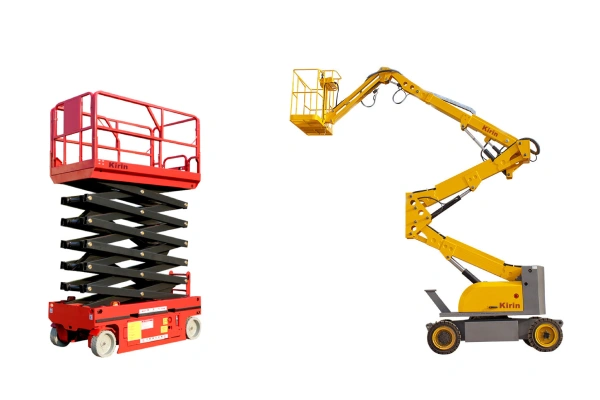
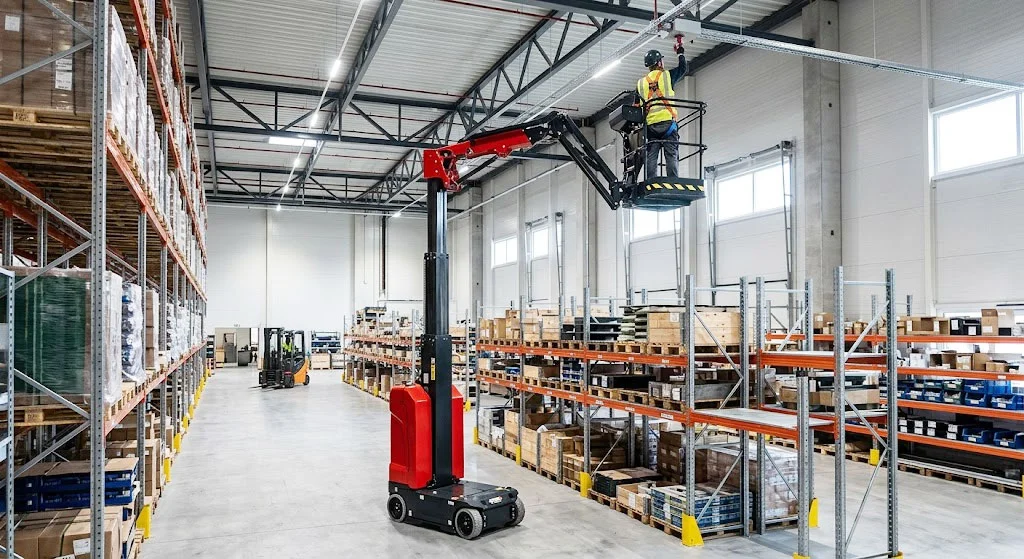
Mast boom lifts are a specific category of aerial work platform (AWP) designed for vertical elevation and limited horizontal outreach. Unlike traditional scissor lift, which only moves straight up and down, mast boom lift features a vertical mast topped with a small jib. This jib allows the platform to rotate and reach over obstacles, making it much more versatile than a standard vertical lift.
The primary appeal of mast boom lifts lies in their compactness. They are often categorized as compact boom lifts because they are designed to operate in tight, congested spaces where larger equipment simply cannot maneuver. Whether it’s changing light fixtures in a shopping mall or performing maintenance on overhead piping in a factory, mast boom lifts provide the “up and over” capability that keeps modern facilities running smoothly.
Types of Mast Boom Lifts
Not every job site is the same, which is why mast boom lifts come in several configurations to suit different environments.
Electric Mast Boom Lifts
Most mast boom lifts used in commercial settings are electric mast boom lifts. These machines are powered by high-capacity battery packs, making them ideal indoor boom lifts. Because they produce zero emissions and operate with very little noise, an indoor electric boom lift is the gold standard for hospitals, schools, and offices. Their non-marking tires also ensure that polished floors remain pristine during maintenance tasks.
Self-Propelled Mast Boom Lifts
A self-propelled model allows the operator to drive the machine while the platform is elevated (within certain height safety limits). This is a massive productivity booster. Instead of descending, getting off the machine, and pushing it to the next spot, the operator can simply drive the mast boom lifts to the next light fixture or shelf. These are frequently used in large-scale warehousing operations.
Push-Around Mast Lifts
For lighter-duty tasks or sites with strict weight restrictions, push-around models are an excellent choice. These are often the most small indoor boom lift options available. While they lack a drive motor for transit, they are incredibly lightweight and can be easily moved by a single person. Once in position, the mast extends vertically to provide a stable work platform.
Key Features of Mast Boom Lifts
What makes mast boom lifts stand out in the crowded market of lifting equipment? It comes down to their specialized engineering:
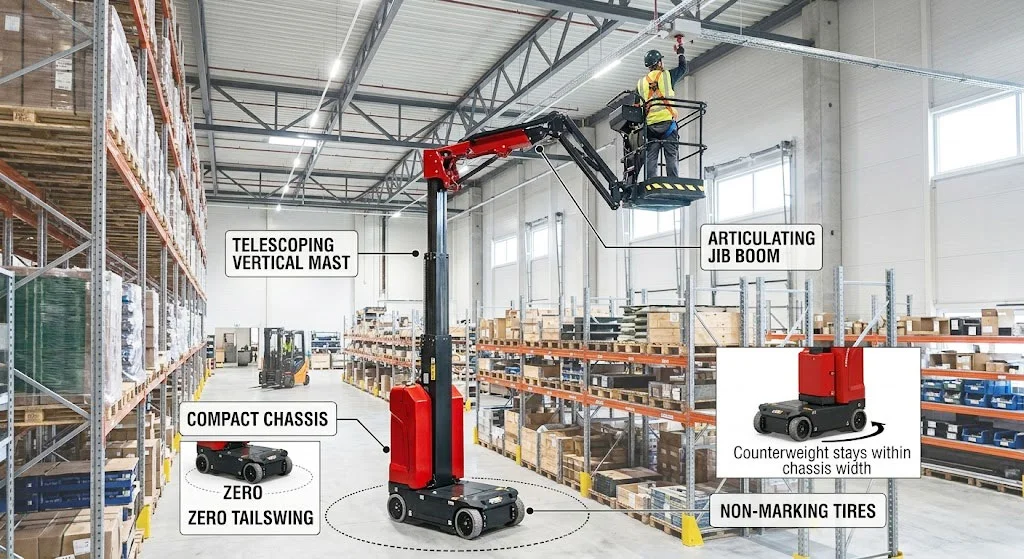
- Zero Tailswing: Most mast boom lifts are designed so that the counterweight does not extend beyond the chassis when the mast rotates. This allows operators to work in narrow aisles without fear of hitting walls or shelving behind them.
- Jib Boom Versatility: The “boom” part of mast boom lifts is the articulating jib. This small arm provides the necessary “reach” to get over pipes, ducts, or machinery.
- Compact Dimensions: With widths often as narrow as 30 to 40 inches, these compact boom lifts can fit through standard single or double doors and travel inside freight elevators.
- Proportional Controls: High-quality mast boom lifts feature smooth, proportional controls for both drive and lift functions, allowing for the “millimeter-perfect” positioning required in delicate environments.
- Non-Marking Tires: Standard on most indoor boom lifts, these tires prevent scuffs on resin, tile, or gym floors.
Benefits of Using Mast Boom Lifts
Choosing mast boom lifts over ladders, scaffolding, or larger boom lifts offers several distinct advantages:
- Increased Productivity: Setting up scaffolding takes hours. A small indoor boom lift can be driven to the site and raised in seconds.
- Access to Tight Spaces: In many modern warehouses, aisles are getting narrower to maximize storage. Mast boom lifts are the only powered access solution that can navigate these “VNA” (Very Narrow Aisle) environments while still offering horizontal reach.
- Operator Comfort: Working from a stable platform with integrated tool trays is significantly safer and less fatiguing than balancing on a ladder for eight hours.
- Versatility: While they are primarily indoor boom lifts, many models are rated for outdoor use on smooth, level surfaces, making them great for exterior window cleaning or signage repair.
How to Operate Mast Boom Lifts Safely
Safety is the most critical aspect of operating any aerial equipment. Because mast boom lifts have a high center of gravity when extended, they require a disciplined approach.
Boom Lift Operator Training
Before anyone touches the controls, they must undergo formal boom lift operator training. This training covers machine inspection, load capacities, and emergency descent procedures. OSHA and other regulatory bodies require that operators are “authorized and competent,” meaning they have been trained on the specific make and model of the mast boom lifts they are using.
Pre-Operation Inspection
Every shift should begin with a “walk-around” inspection. Look for:
- Leaking hydraulic fluid.
- Cracks in the mast or jib.
- Tire damage or debris.
- Proper function of emergency stop buttons.
Stability and Ground Conditions
Mast boom lifts are designed for use on firm, level surfaces. Even a slight incline can lead to a tip-over if the mast is fully extended. Always check the floor for holes, slopes, or debris that could destabilize the machine.
Fall Protection
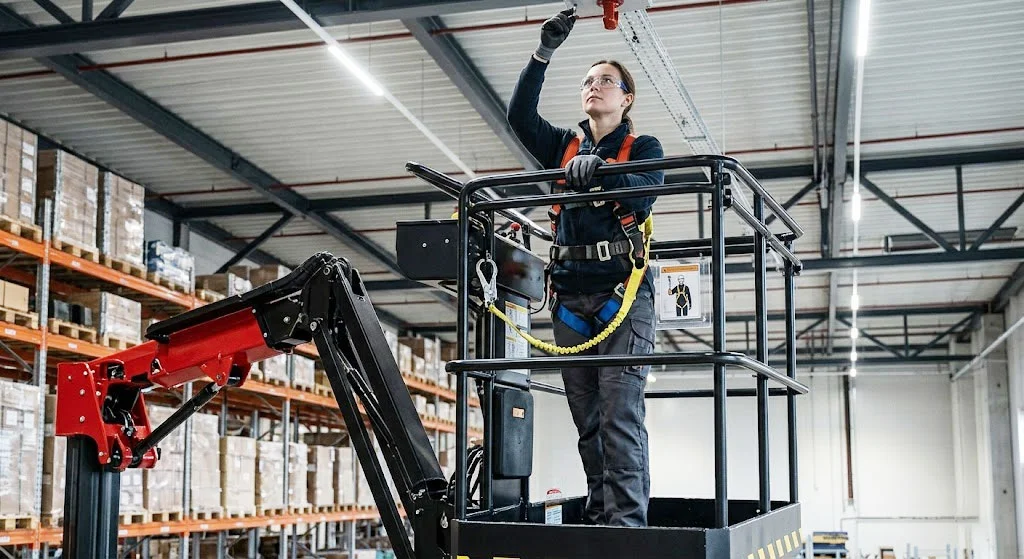
Even though mast boom lifts have guardrails, operators must wear a full-body harness and a lanyard attached to the designated anchor point in the platform. This prevents the “catapult effect,” where a sudden jolt at the base can whip the operator out of the basket.
Maintenance Tips for Mast Boom Lifts
To ensure your mast boom lifts remain reliable and have a long service life, a strict maintenance schedule is non-negotiable.
| Component | Maintenance Action | Frequency |
| Batteries | Check water levels and clean terminals for electric mast boom lifts. | Weekly |
| Hydraulic System | Inspect hoses for chafing and check fluid levels. | Monthly |
| Mast Chains/Cables | Lubricate and check for proper tension and wear. | Quarterly |
| Annual Inspection | Full structural and mechanical certification by a technician. | Annually |
Properly maintaining your indoor electric boom lift not only ensures safety but also preserves the resale value of the equipment.
Choosing the Right Mast Boom Lift
With so many mast boom lifts on the market, selecting the right one can be a challenge. Consider these factors:
- Working Height vs. Platform Height: Remember that “working height” is usually 6 feet above the “platform height.” If you need to reach a 30-foot ceiling, you need a lift with at least a 24-foot platform height.
- Horizontal Outreach: Do you need to reach over a machine? Check the jib specifications of the mast boom lifts you are considering.
- Weight Capacity: Calculate the weight of the operator plus all tools and materials. Most compact boom lifts have a capacity between 350 and 500 lbs.
- Environment: If you are working in a “clean room” or food processing plant, you will need a small indoor boom lift with specific hydraulic fluids and non-marking components.
Common Mistakes to Avoid
Even experienced pros can make mistakes when using mast boom lifts. Avoid these common pitfalls:
- Overloading the Platform: Exceeding the weight limit can cause the lift to tip or the hydraulic system to fail.
- Using the Lift as a Crane: Never hang loads from the outside of the basket or the jib. Mast boom lifts are designed for vertical personnel lifting only.
- Ignoring Wind Speeds: If using mast boom lifts outdoors, always check the manufacturer’s maximum wind speed rating. A small indoor boom lift can act like a sail in high winds.
- Bypassing Safety Features: Never “tape down” a deadman switch or bypass an tilt-sensor. These features are there to save your life.
- Neglecting Training: Assuming that because you can drive a scissor lift, you can drive mast boom lifts is a dangerous mistake. The jib and mast physics are entirely different.
Conclusion
Mast boom lifts are the unsung heroes of the modern industrial and commercial world. By providing a compact, clean, and versatile solution for high-altitude work, they allow businesses to maintain their facilities with minimal disruption. Whether you are investing in an indoor electric boom lift for your warehouse or seeking boom lift operator training for your team, understanding the nuances of these machines is key to a productive work site.
When used correctly, mast boom lifts offer a level of access that straight mast boom lifts or ladders simply cannot match. If you are looking for the ideal equipment to optimize your facility’s safety and efficiency, our team of technical experts is ready to help you find the perfect fit. For detailed specifications, 3D renderings, or pricing on our latest models, please reach out to us via Email at info@klingtec.com or send us a message on WhatsApp at +86 188 6686 3188.
Stay safe, stay trained, and keep reaching higher.
FAQs
What is the difference between a scissor lift and a mast boom lift?
While both provide vertical elevation, a scissor lift only moves straight up. Mast boom lifts feature a rotating mast and a jib, allowing for horizontal reach over obstacles. Mast boom lifts also generally have a smaller footprint.
Can I use an indoor electric boom lift outside?
Most indoor boom lifts are designed for flat, level surfaces like concrete. Some models are “dual-rated” for outdoor use, but you must check the manual for wind speed limitations and ground requirements.
Do I need a license to operate mast boom lifts?
In most jurisdictions, you do not need a “driver’s license,” but you do need a certification card (like an IPAF PAL card or an OSHA-compliant certificate) proving you have completed boom lift operator training.
How high can mast boom lifts reach?
Typical compact boom lifts offer working heights ranging from 15 feet to 33 feet. For anything higher, you might need to look into larger straight mast boom lifts or articulating booms.
Are mast boom lifts easy to transport?
Yes! Because they are compact boom lifts, they can often be transported on a standard trailer or even inside a medium-sized van, depending on the model’s weight and height.
By integrating mast boom lifts into your fleet, you are choosing efficiency and safety for all your “up and over” challenges. Remember to always prioritize boom lift operator training to ensure that every job is completed without incident. Whether it’s a small indoor boom lift for a retail store or a heavy-duty electric mast boom lift for a factory, the right equipment makes all the difference.