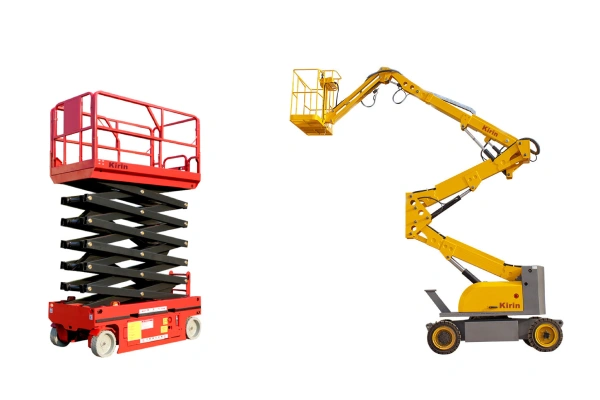
In the world of aerial work platforms, finding the right balance between height, reach, and footprint is often a challenge. If you are working in a crowded warehouse or a narrow retail aisle, a massive articulating boom is too bulky, and a scissor lift lacks the “up and over” capability needed to reach over obstacles. This is where the mast boom lift shines.
In this comprehensive guide, we will answer the fundamental question: what is a mast boom lift? We will also explore its mechanics, benefits, and how it stacks up against other equipment to help you determine if it’s the right tool for your next project.
What Is a Mast Boom Lift?
To understand what is a mast boom lift, you have to visualize a hybrid. It combines the vertical simplicity of a person lift with the functional versatility of a boom lift.
Clear Definition of a Mast Boom Lift
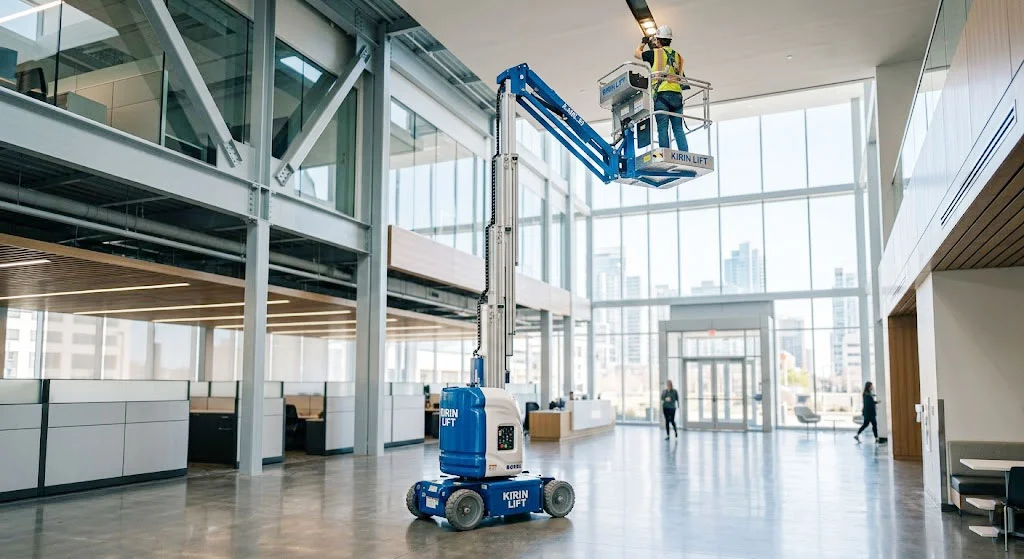
A mast boom lift is a compact aerial work platform designed primarily for vertical elevation, featuring a telescopic mast and a small articulating jib (boom) at the top. It is engineered to provide “up and over” access in confined spaces where larger machines cannot maneuver.
Vertical Mast and Small Jib
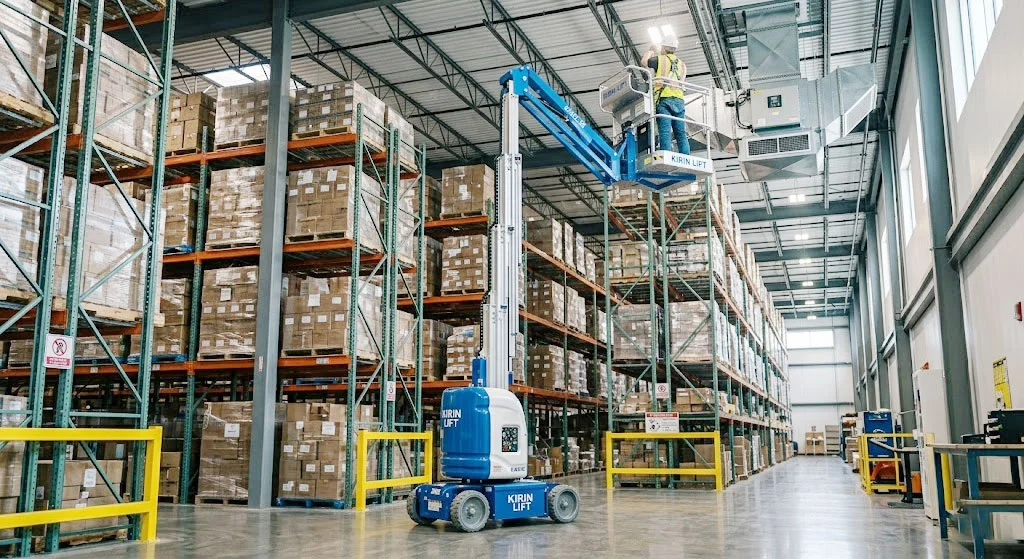
The core of the machine is the vertical mast boom lift structure. Unlike traditional booms that extend diagonally, the mast moves straight up. At the top of this mast is a rotating turntable and a short, articulating arm called a jib. This jib allows the operator to reach over pipes, ductwork, or shelving, providing a small but crucial amount of horizontal outreach.
How It Differs from Traditional Boom Lifts
Traditional boom lifts (telescopic or articulating) are designed for significant horizontal reach and high-capacity outdoor work. They have large footprints and heavy counterweights. In contrast, when asking what is a mast boom lift, the answer usually emphasizes its “zero tailswing” and compact chassis. It doesn’t need a wide area to rotate, making it much more surgical in its application than its larger cousins.
Key Concept: Compact Vertical Reach
The defining characteristic of the mast boom lift is providing vertical reach with limited horizontal outreach. It is the “specialist” of the aerial lift world—perfect for when you need to go high but stay within a tiny footprint.
How Does a Mast Boom Lift Work?
The engineering behind a mast boom lift is a marvel of efficiency. It is designed to maximize height while minimizing weight and size.
Basic Working Mechanism
The machine operates on a hydraulic system powered by an electric motor. The base houses the heavy batteries and the hydraulic pump, which acts as the counterweight to keep the machine stable even when the platform is fully extended.
Vertical Mast Extension
The mast typically consists of several interlocking sections. As the operator initiates the “up” command, hydraulic cylinders push these sections upward. Because the mast is vertical, the center of gravity remains relatively centered over the wheelbase, which is why a mast boom lift can be so much lighter than a standard boom lift.
Jib/Boom Articulation
Once the mast reaches the desired height, the operator can use the jib. This small boom can move up and down (luffing) and, in many models, the entire mast assembly can rotate 360 degrees. This allows the operator to position the basket precisely over an obstacle.
Power Sources
Most electric mast boom lifts are battery-powered (usually 24V or 48V systems). This makes them ideal for indoor use as they produce zero emissions and operate with very little noise. They are designed to be plugged into a standard outlet overnight to provide a full day of operation.
Controls and Operation Basics
The controls are usually found in the platform (basket). They consist of a joystick for drive and steer functions and a series of toggle switches or a touchscreen for mast elevation and jib movement. Modern mast boom lifts feature proportional controls, meaning the harder you push the stick, the faster the machine moves, allowing for incredibly smooth and precise positioning.
Safety Systems Overview
Safety is paramount when working at heights. A mast boom lift is equipped with:
- Tilt Sensors: Alarms that sound if the machine is on an unsafe incline.
- Overload Sensors: Prevents operation if the weight in the basket exceeds the rated capacity.
- Emergency Lowering: A manual valve that allows the platform to be lowered in the event of a power failure.
- Pothole Protectors: Metal guards that deploy when the mast is raised to prevent the machine from tipping if it drives into a small hole.
Key Features of a Mast Boom Lift
When considering what is a mast boom lift, it is the specific feature set that usually seals the deal for facility managers and contractors.
- Compact Design: With a width often as narrow as 3 feet, these lifts can fit through standard doorways and navigate narrow aisles.
- Lightweight Structure: Because they lift vertically, they don’t require the massive weight of a traditional boom. This makes them safe for use on sensitive flooring (like gym floors or decorative tiles).
- Vertical Lift with Horizontal Reach: You get the height of a vertical lift with the “reach over” capability of a boom.
- Non-marking Tires: Almost all electric mast boom lifts come standard with non-marking rubber tires to ensure indoor floors remain pristine.
- Zero Tailswing: This is a huge feature. When you rotate the mast, no part of the machine sticks out past the footprint of the chassis. This prevents accidental collisions with walls or racks.
- Quiet Operation: Being battery-powered, they are perfect for use in hospitals, schools, or offices where noise must be kept to a minimum.
Common Uses of Mast Boom Lifts
Where exactly would you use a mast style boom lift? Their versatility makes them a favorite in several industries.
Indoor Maintenance
This is the “bread and butter” of the mast boom lift. Whether it’s changing LED ballasts in a high-ceilinged office or repairing HVAC ductwork above a production line, the ability to reach over machinery is invaluable.
Warehouse Operations
In modern “big box” warehouses, space is money. A vertical mast boom lift can navigate aisles that are too narrow for a scissor lift. It allows technicians to reach the very top of racking systems to perform inventory checks or repair sprinkler heads.
Retail Store Setup and Signage
Ever wonder how those massive holiday displays get hung in shopping malls? A 33′ mast boom lift is often the tool of choice. Its compact size allows it to move around clothing racks and kiosks without requiring the store to be completely rearranged.
Facility Management
For large-scale facilities like airports, stadiums, or universities, a mast boom lift is a permanent fixture in the maintenance department. It is easily transported in a standard freight elevator, allowing one machine to service multiple floors.
Mast Boom Lift vs. Other Aerial Lifts
To truly grasp what is a mast boom lift, it helps to compare it to the alternatives.
Mast Boom Lift vs. Scissor Lift
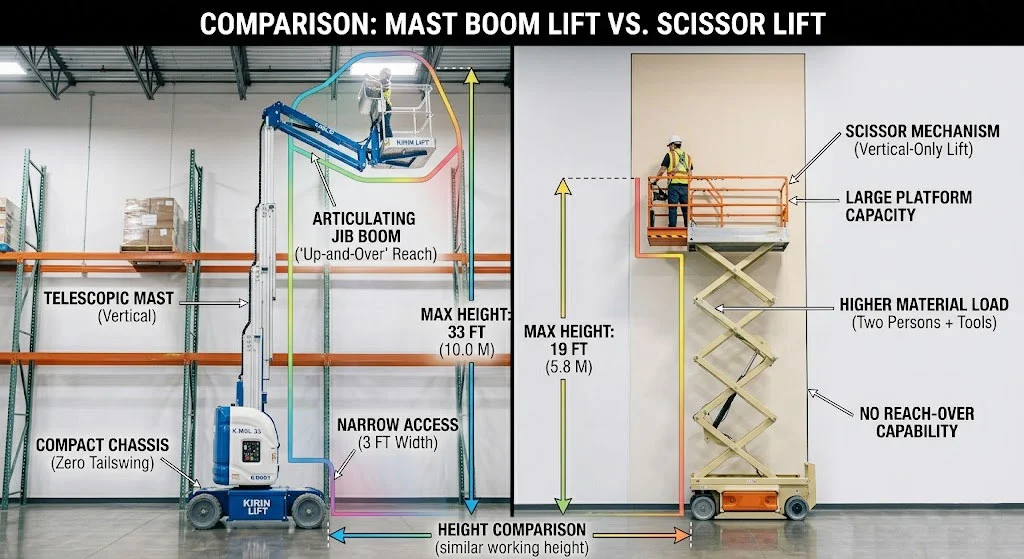
- Reach: A scissor lift only goes straight up. If there is a desk or a machine in the way, you can’t reach the wall. A mast boom lift can “reach over” that obstacle.
- Footprint: While both are compact, the mast boom generally has a smaller “stowed” footprint and better maneuverability in tight corners.
Mast Boom Lift vs. Articulating Boom Lift
- Size: An articulating boom is much larger and heavier. It is designed for outdoor construction.
- Weight: A mast boom lift is light enough for mezzanine levels; an articulating boom would likely crash through the floor.
Mast Boom Lift vs. Vertical Mast Lift
The “Vertical Mast Lift” is the “straight-up” version. The straight mast boom lift (which is a bit of a misnomer, as “straight mast” usually refers to the vertical section) lacks the articulating jib. If you only need to go straight up to a ceiling, a vertical mast lift is fine. If you need to reach over something, you need the mast boom lift.
Advantages of Using a Mast Boom Lift
Why choose this specific machine? The advantages are clear:
- Ideal for Confined Spaces: The combination of a narrow chassis and zero tailswing makes it the king of tight spots.
- Increased Precision: The articulating jib allows for “surgical” positioning. You can get exactly where you need to be without repositioning the entire base.
- Lower Operating Costs: Because they are electric and have fewer massive structural components than large booms, maintenance costs are significantly lower.
- Easy Transport: Many models are light enough to be transported on a small trailer or even a large van, and most fit through standard double doors.
- Floor Protection: Their lightweight nature and non-marking tires make them the only choice for finished indoor environments.
Limitations to Consider
No machine is perfect for every job. When asking what is a mast boom lift good for, you must also ask what it cannot do.
- Limited Horizontal Outreach: While the jib is helpful, it usually only offers about 10 to 15 feet of reach. If you need to reach 30 feet across a gap, you need a full-sized articulating boom.
- Lower Platform Capacity: Most mast boom lifts are designed for one person and their tools (typically around 440 lbs / 200 kg). If you need two people and heavy materials, a scissor lift is better.
- Terrain Constraints: These are primarily indoor machines. They have low ground clearance and solid tires, meaning they will get stuck or tip on gravel, mud, or uneven dirt.
How to Choose the Right Mast Boom Lift
If you’ve decided that a mast boom lift is the solution, consider these factors before buying or renting:
Working Height Requirements
Standard models like a 33′ mast boom lift are popular for most warehouses. However, always check the “platform height” vs. “working height” (working height is usually platform height plus 6 feet).
Platform Capacity
Check the weight of your heaviest technician plus their tools. Do not exceed the rated capacity, as the safety sensors will disable the lift.
Power Type
While most are electric mast boom lifts, some hybrid models exist for sites that don’t have consistent access to charging. However, for 95% of users, the battery-powered version is the gold standard.
Space Constraints
Measure your narrowest door and your tightest aisle. Ensure the machine’s “stowed width” and “turning radius” fit your specific environment.
Safety Tips for Operating a Mast Boom Lift
- Wear a Harness: Even though you are moving vertically, a “catapult effect” can happen if the base hits a bump. Always wear a full-body harness and lanyard attached to the designated anchor point.
- Inspect the Ground: Ensure the floor is level and capable of supporting the machine’s weight.
- Check Overhead: Always look up for power lines, sprinklers, or ceiling fans before elevating.
- No “Surfing”: Never drive the machine at full height unless the manual explicitly states it is rated for it, and even then, only on perfectly smooth surfaces.
- Training: Ensure the operator is IPAF or OSHA certified for this specific category of equipment.
Maintenance and Care
To keep your mast boom lift running for years, follow these simple steps:
- Battery Maintenance: Check water levels in lead-acid batteries weekly and never leave them discharged for long periods.
- Hydraulic Checks: Inspect hoses for leaks and ensure the fluid level is topped off.
- Clean the Mast: Dust and debris can cause the mast sections to bind. Keep the sliding surfaces clean and lightly lubricated as per the manufacturer’s specs.
- Annual Inspection: Have a qualified technician perform a “thorough examination” every 6 to 12 months.
Conclusion
So, what is a mast boom lift? It is the ultimate precision tool for modern indoor maintenance and warehousing. By providing a vertical lift with just enough horizontal reach to overcome obstacles, it fills a gap that scissor lifts and large boom lifts simply cannot. Whether you are managing a retail giant or maintaining a high-tech manufacturing plant, the mast boom lift offers the safety, maneuverability, and efficiency you need to get the job done.
At Kirin Lift, we specialize in high-quality aerial work platforms designed to elevate your business. Our range of Mast Boom Lifts is engineered for durability and ease of use.
Ready to reach new heights? Contact us today!
Email: info@klingtec.com, WhatsApp: +86 188 6686 3188
FAQs
Can a mast boom lift be used outdoors?
Generally, they are designed for indoor use on flat, level surfaces. Some models are rated for outdoor use on “firm, level ground,” but they should never be used in high winds or on soft soil.
How high can a mast boom lift go?
Most common models range from 20 feet to a 33′ mast boom lift. Some specialized industrial models can go slightly higher, but 30–33 feet is the industry standard for this machine type.
Is a mast boom lift better than a scissor lift?
It depends on the job. If you need to reach over an obstacle, the mast boom lift is better. If you need to lift two people and heavy equipment straight up, a scissor lift is the better choice.
Do I need a special license to operate one?
Yes, in most jurisdictions, you need an aerial work platform (AWP) certification (like an IPAF PAL card or OSHA-compliant training) to operate a vertical mast boom lift on a job site.