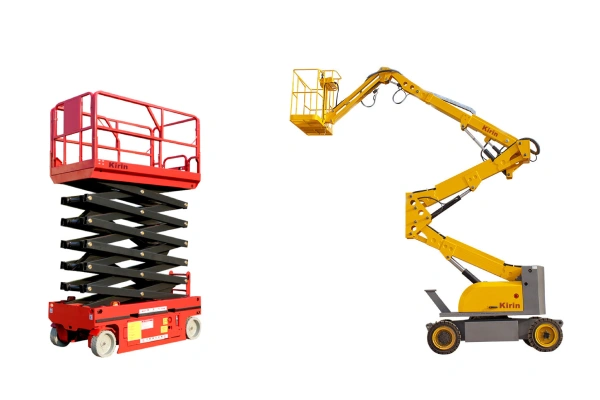
Operating heavy machinery at height is one of the most high-risk tasks on any construction, maintenance, or industrial job site. Among these machines, aerial work platforms—specifically boom lifts—are indispensable for reaching incredible heights and awkward angles. However, real-world job sites are rarely as flat, smooth, and predictable as a freshly poured concrete warehouse floor.
More often than not, operators face slopes, gradients, ditches, gravel, mud, and uncompacted soil. This brings up a critical safety question for project managers, safety coordinators, and equipment operators alike: Is it okay to use a boom lift on uneven ground?
Operating a boom lift on uneven ground requires a deep understanding of physics, equipment design, and safety protocols. Failing to respect the limitations of your machine on unlevel terrain can quickly lead to catastrophic accidents, including tip-overs, structural failure, and fatal falls.
This comprehensive guide covers everything you need to know about navigating uneven terrain with a boom lift. We will explore the mechanics of stability, the best types of equipment for the job, critical safety protocols, and how to avoid the common mistakes that lead to workplace disasters.
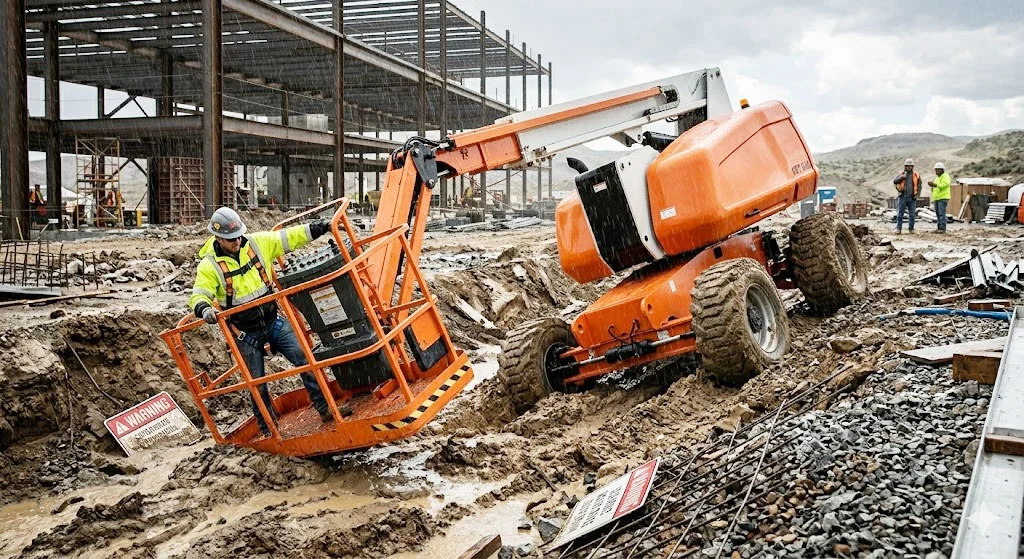
What Happens When a Boom Lift Is Used on Uneven Ground?
When you operate a boom lift on uneven ground, you are fighting against the fundamental laws of physics. Understanding exactly what happens to the machine when the surface beneath its tires is unlevel is the first step toward preventing a major workplace accident.
Why Stability Is Critical for Boom Lifts
The stability of a boom lift relies entirely on its center of gravity remaining within the footprint of its chassis. When the lift is on perfectly flat ground, the weight of the machine is evenly distributed across its tires or tracks. The heavy counterweight at the base balances out the weight of the platform, the operator, and the extended boom.
However, as the boom extends upward and outward, the center of gravity shifts drastically. If the base of the machine is tilted even by a few degrees due to uneven ground, that shift is magnified exponentially at the platform level. A minor 3-degree tilt at the ground level can translate into a massive, dangerous displacement of the platform when the boom is extended 60, 80, or 100 feet in the air. If the center of gravity moves outside the machine’s tipping axis, the lift will tip over.
Common Problems Caused by Uneven Terrain
Operating a boom lift on uneven ground without proper precautions can cause several severe mechanical and structural problems:
- Tip-Overs: This is the most dangerous consequence. A tip-over almost always results in severe injury or death for the operator in the basket and anyone working underneath the machine.
- Structural Stress: When the chassis is tilted, the forces applied to the boom components, turntable, and hydraulic cylinders become uneven. This uneven stress can twist the boom structure, damage hydraulic seals, or cause mechanical components to fail under load.
- Traction Loss: Slopes and uneven surfaces reduce the contact patch between the tires and the ground. If one or more wheels lose traction, the machine can slide down a slope out of control.
- Drive and Steer Malfunctions: Many modern boom lifts feature built-in interlocks. If the machine detects that it is out of its safe leveling parameters, it may automatically shut down or restrict certain drive and lift functions, leaving operators stranded mid-air.
Warning Signs the Ground Is Unsafe
Operators must always stay highly alert to environmental cues that indicate the surface cannot support a boom lift. Key warning signs include:
- Visible Cracks in the Soil
- Pooling Water or Mud
- Presence of Unconsolidated Fill Dirt
- Proximity to Trenches, Ditches, or Retaining Walls
Can You Safely Use a Boom Lift on Uneven Ground?
The short answer is yes, but only with the correct equipment and strict safety precautions.
You cannot simply drive any standard boom lift onto a slope or a bumpy field and expect it to perform safely. Safe operation of a boom lift on uneven ground depends on three core pillars:
- Machine Capability: The lift must be explicitly rated by the manufacturer to handle the specific terrain and slope angle you are encountering.
- Site Preparation: The ground must be thoroughly evaluated, and if necessary, modified or stabilized using mats, cribbing, or grading equipment to ensure it can support the weight of the machine.
- Operator Expertise: The operator must be fully trained, certified, and aware of the machine’s exact slope limits, sensor alerts, and emergency procedures.
Types of Boom Lifts Best Suited for Uneven Ground
Choosing the right tool for the job is essential when dealing with challenging terrain. Standard industrial boom lifts with smooth, solid rubber tires are designed strictly for concrete slabs and paved surfaces. For unpaved or irregular surfaces, you must utilize specialized equipment designed for boom lift stability on rough terrain.
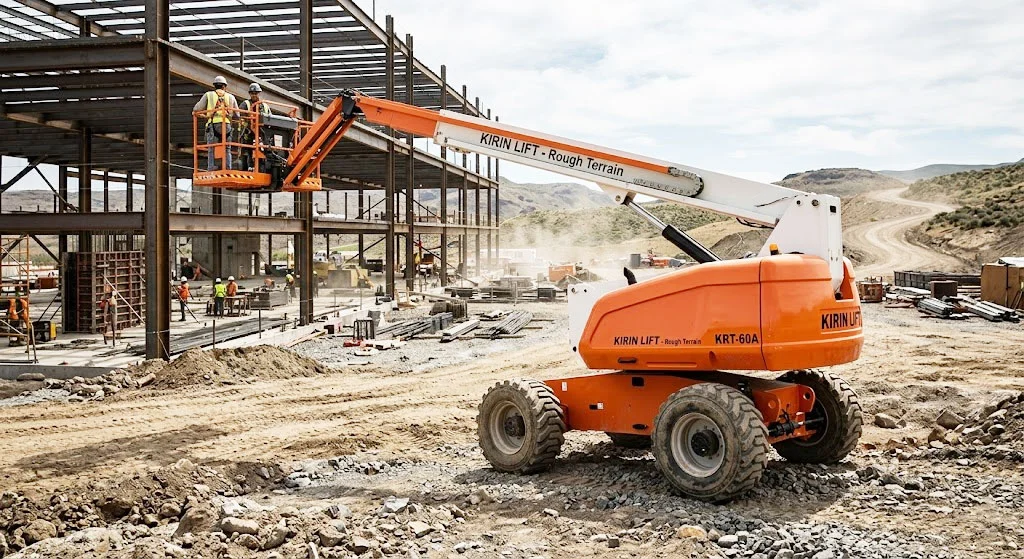
Rough Terrain Boom Lifts
A rough terrain boom lift is engineered from the ground up to handle mud, gravel, sand, and unlevel job sites. These machines feature rugged, foam-filled or pneumatic tires with deep treads designed to grip loose material.
Furthermore, a rough terrain boom lift typically includes four-wheel drive (4WD), oscillating axles, and high ground clearance. The oscillating axles are particularly important because they allow the wheels to move up and down independently over bumps while keeping the chassis relatively stable and maintaining maximum tire contact with the ground.
Articulating Boom Lifts vs. Telescopic Boom Lifts
When dealing with a boom lift on uneven ground, the style of the boom itself changes how the machine interacts with the environment:
- Articulating Boom Lifts (“Knuckle Booms”): These lifts have multiple sections that bend or “hinge,” allowing the operator to reach up, over, and around obstacles. Because they offer precise control over the platform’s positioning without requiring the entire machine to move, they are ideal for tight spaces with uneven ground. You can position the base on the safest, flattest spot available and use the articulating joints to reach over unlevel or hazardous areas.
- Telescopic Boom Lifts (“Stick Booms”): These lifts extend straight out like a telescope. They offer incredible horizontal outreach and height. However, because the boom is a straight line, extending a telescopic boom on a slope shifts the center of gravity rapidly. Telescopic lifts require extreme caution on gradients, as their tipping axis is reached more quickly when extending horizontally over the low side of a slope.
Track-Mounted Boom Lifts
For the most challenging, soft, or highly uneven ground, track-mounted boom lifts (often referred to as “crawler” or “spider” lifts) provide the ultimate solution. Instead of wheels, these machines utilize wide rubber tracks that distribute the massive weight of the machine over a large surface area.
This drastically reduces the ground pressure, preventing the lift from sinking into soft mud, sand, or turf. Many track-mounted lifts also feature independent, articulating outriggers that can be deployed on radically uneven steps or slopes to level the chassis completely before lifting the boom.
Key Factors to Check Before Operating a Boom Lift on Uneven Ground
Before driving a boom lift on uneven ground, you must conduct a thorough risk assessment. Skipping this step is a direct violation of safety protocols and a leading cause of aerial lift accidents. Check the following critical factors before turning on the engine:
| Factor to Check | What to Look For | Safety Action Required |
| Manufacturer’s Slope Rating | The maximum slope angle (usually expressed in degrees or percentages) the machine can handle. | Check the operator manual and the serial plate on the chassis. Never exceed this limit. |
| Ground Bearing Capacity (GBC) | The ability of the soil or surface to support the weight of the lift without sinking. | Consult a site engineer or use a soil penetrometer. Compare the soil’s GBC against the machine’s maximum wheel load. |
| Underground Hazards | Hidden voids that could collapse under heavy weight. | Identify the location of septic tanks, sewer lines, utility vaults, and recently backfilled trenches. |
| Tilt Alarm Functionality | The built-in safety sensor that alerts the operator when the chassis is unlevel. | Test the tilt alarm during the pre-start inspection to ensure it sounds when the machine exceeds its safe angle. |
| Weather and Environmental Conditions | Recent or active weather events that alter ground stability. | Assess if heavy rain has turned firm soil into mud, or if high winds will increase the tipping risk on a slope. |
Safety Tips for Using a Boom Lift on Uneven Ground
Adhering to strict boom lift safety tips is non-negotiable when working on challenging terrain. If your job site requires navigating a boom lift on slope configurations or bumpy ground, integrate these protocols into your daily operations.
Conduct a Pre-Operation Site Inspection
Before the machine even moves, walk the entire path the lift will travel and the exact area where it will be positioned. Look for hidden drop-offs, potholes, soft dirt, overhead power lines, and debris. Document any hazards and establish clear boundaries using cones or safety tape to keep the lift away from unstable edges.
Use Outriggers and Stabilizers Properly
If your boom lift is equipped with outriggers or stabilizers, they must be fully deployed according to the manufacturer’s instructions. Outriggers lift the weight of the machine off its wheels and expand its footprint, drastically increasing boom lift stability.
Always use heavy-duty outrigger pads or cribbing blocks under the feet, especially on uneven soil or asphalt, to distribute the load and prevent the outriggers from sinking into the ground.
Keep the Boom Retracted While Moving
Never drive a boom lift across uneven ground with the boom elevated or extended. Driving on rough terrain causes the basket to bounce and sway violently. If the boom is extended, these dynamic forces can easily exceed the machine’s tipping threshold or throw the operator out of the basket. Always completely lower and retract the boom into its stowed position before traveling over rough or unlevel surfaces.
Wear Proper Fall Protection Equipment
A sudden dip of a wheel into a small pothole can act like a catapult at the platform level, violently jerking the basket. Operators must always wear a full-body harness with a safety lanyard attached to an approved anchor point inside the platform. This Personal Fall Arrest System (PFAS) or fall restraint system ensures that if the machine encounters a sudden lurch on uneven ground, the operator remains safely inside the basket.
Avoid Exceeding Slope Limits
Every machine has an absolute boom lift maximum slope rating determined by its engineers. This rating is typically between 20% and 45% (approximately 11 to 24 degrees) for rough terrain models, and significantly less for standard models.
Never guess the angle of a hill by eye. Use a digital inclinometer or a slope-measuring app to find the exact gradient before attempting to drive or operate a boom lift on slope zones.
Common Mistakes to Avoid
Even experienced operators can fall into bad habits or make assumptions that lead to disaster when handling a boom lift on uneven ground. Avoid these critical mistakes at all costs:
Ignoring Manufacturer Terrain Recommendations
Assuming that a machine can handle a surface just because it looks tough is a recipe for disaster. Never operate a standard electric slab lift on gravel or dirt, and never assume a rough terrain boom lift is invincible. Always check the exact specifications outlined in the machine’s operation and safety manual.
Operating on Soft or Wet Ground
A surface that feels firm when you walk on it can behave like quicksand under a 15,000-pound piece of machinery. Rain, high water tables, or poor drainage can make soil highly unstable. If the lift’s tires begin to sink more than an inch or two into the ground, stop immediately and move the machine to a stable surface.
Overloading the Platform
Every lift has a strict weight capacity that includes the operator, their tools, and all materials in the basket. Overloading the platform shifts the center of gravity higher and further outward. When combined with the tilt caused by an uneven surface, an overloaded platform completely bypasses the machine’s safety margins, causing an instant tip-over.
Skipping Daily Equipment Inspections
If a level sensor, limit switch, or tilt alarm is broken, an operator will have no warning when the machine enters a dangerous tipping state. Skipping the daily pre-start mechanical and safety checklist means you are flying blind on uneven ground.
Using Indoor Boom Lifts Outdoors
Indoor boom lifts are designed for flat, level concrete surfaces and have zero wind-load ratings. Using them outdoors on unpaved, unlevel surfaces—where they are exposed to wind, slopes, and unpredictable terrain—is incredibly dangerous and a direct OSHA violation.
How to Improve Stability on Uneven Terrain
If your job site features challenging topography, you do not have to just cross your fingers and hope for the best. There are practical engineering steps you can take to improve boom lift stability and create a much safer working environment.
Ground Preparation Techniques
Before bringing the boom lift into the area, invest time in preparing the ground:
- Grading: Use a bulldozer or skid steer to level out severe bumps, slopes, and ruts.
- Compaction: Run a heavy roller or plate compactor over loose soil or gravel to increase its load-bearing capacity.
- Mud Mats and Timber Cribbing: Lay down heavy-duty steel plates, synthetic mud mats, or thick timber mats over soft or irregular ground to create a rigid, flat track for the lift to drive and operate on.
Choosing the Right Tires
The tires are the only point of contact between the lift and the uneven ground. Ensure your machine has the optimal tire setup for the site conditions:
- Foam-Filled Tires: These are highly recommended for rough terrain because they cannot go flat when driving over sharp rocks, nails, or rebar, maintaining a consistent ride height and preventing sudden tilting due to a blown tire.
- High-Flotation Tires: Extra-wide tires distribute the machine’s weight over a larger area, making them ideal for sandy or sandy-loam soils where standard tires would sink.
Using Spotters and Safety Personnel
When driving or positioning a boom lift on uneven ground, the operator’s visibility of the ground immediately around the tires is often severely limited. Always utilize a trained ground spotter. The spotter can watch the tires, monitor ground compression, keep an eye on changing slope angles, and alert the operator instantly if a wheel is about to encounter a hidden hazard or drop-off.
Boom Lift Alternatives for Extremely Uneven Ground
Sometimes, a standard boom lift is simply the wrong tool for an exceptionally rugged or steep environment. If your risk assessment shows that using a boom lift for uneven ground on your specific site exceeds safety margins, consider these alternative equipment solutions:
Scissor Lifts with Leveling Features
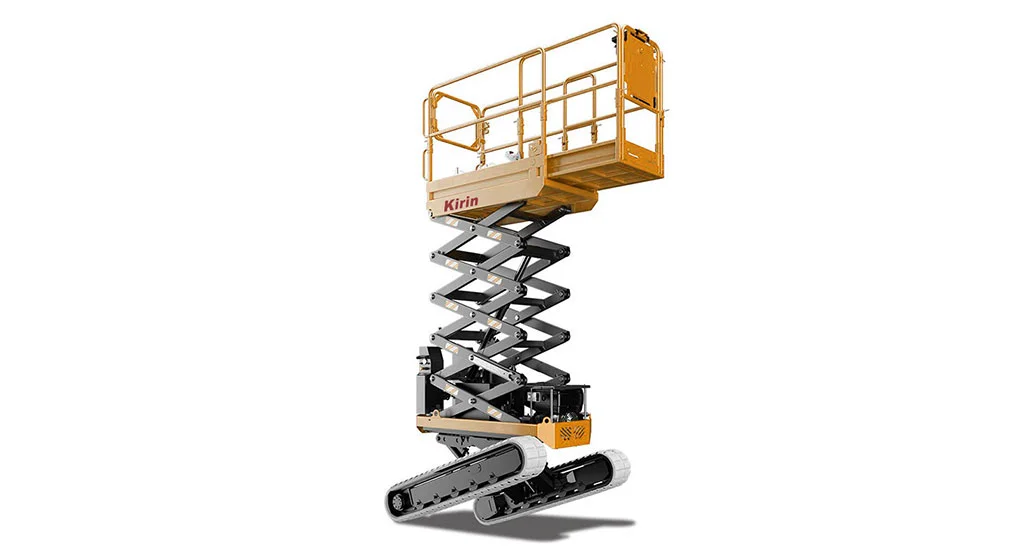
While scissor lifts generally have lower ground clearance and smaller slope tolerances than boom lifts, certain specialized rough-terrain scissor lifts come equipped with hydraulic leveling outriggers. These allow you to drive the machine onto an uneven slope, deploy the outriggers to level the entire chassis perfectly, and then lift the platform straight up.
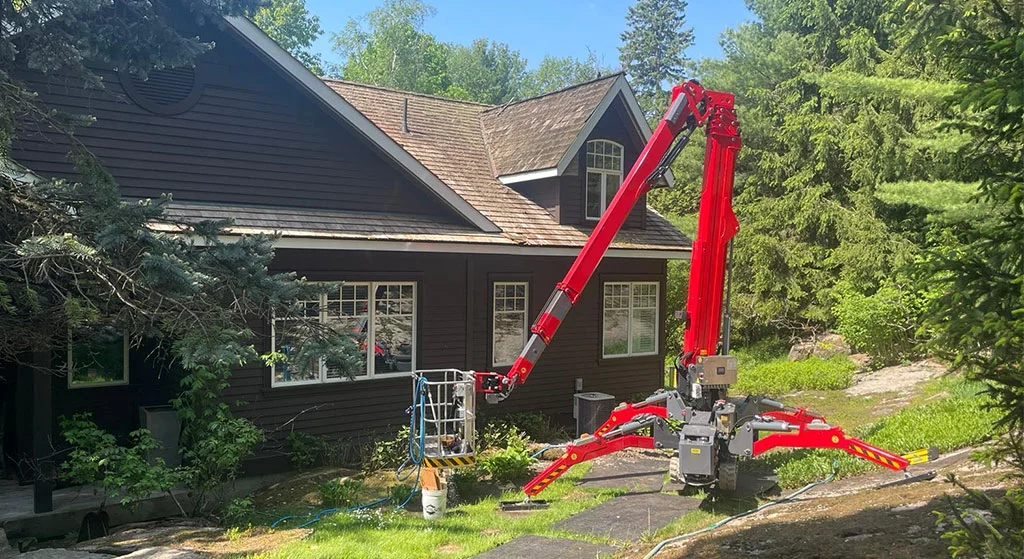
Spider Lifts
Spider lifts are ultra-lightweight, compact articulating boom lifts mounted on tracks. Their defining feature is a set of four spider-like hydraulic outriggers that can extend wide and drop down at varying heights. A spider lift can be positioned on steep hillsides, staircases, or terraced gardens, leveling its base perfectly while the tracks remain suspended on unlevel surfaces.
Scaffolding or Telehandlers
For areas where heavy machinery cannot safely navigate or stabilize, traditional modular scaffolding can be erected and leveled precisely using adjustable screw jacks on solid mudsills. Alternatively, if you only need to lift materials rather than personnel, a rough-terrain telehandler (telescopic forklift) with frame-leveling capabilities may be a safer, more stable choice.
Frequently Asked Questions About Boom Lifts on Uneven Ground
Can a boom lift tip over on uneven ground?
Yes, absolutely. Tip-overs are one of the leading causes of fatalities involving aerial lifts. When a boom lift is tilted on uneven terrain, its center of gravity shifts outside its stable footprint. If the boom is extended while the base is unlevel, the tipping risk increases exponentially, leading to a catastrophic loss of stability.
What is the maximum slope a boom can handle?
The boom lift maximum slope varies by make and model, but most specialized rough terrain boom lifts can safely navigate slopes between 30% and 45% (roughly 17 to 24 degrees) only when the boom is fully lowered and stowed. When it comes to actually elevating the boom, most machines require the chassis to be nearly perfectly level—typically within 3 to 5 degrees of absolute flat—before the boom can be safely extended. Always read your specific machine’s manual.
Are rough terrain boom lifts safer?
A rough terrain boom lift is vastly safer and more effective on unpaved surfaces than a standard slab lift due to features like four-wheel drive, high clearance, foam-filled rugged tires, and oscillating axles. However, they are still bound by the laws of physics. They are only safer if operated within the precise slope and weight limits defined by the manufacturer.
Can outriggers make a boom lift level?
Yes, if the boom lift is equipped with them. Hydraulic outriggers are designed to extend outward and downward, lifting the machine’s tires off the ground. By adjusting individual outriggers, you can level the chassis completely on uneven terrain. However, you must always ensure that the ground beneath the outrigger pads is stable and supported by proper cribbing blocks to prevent sinking.
Is it safe to use a boom lift in muddy conditions?
Operating a boom lift on uneven ground that is also muddy is highly risky. Mud reduces tire traction, causing slipping, and severely lowers the ground’s bearing capacity, which can cause one side of the machine to sink suddenly. If muddy conditions cannot be avoided, you must use a track-mounted lift or lay down heavy steel or synthetic mud mats to stabilize the machine’s path.
Can you use a towable boom lift on uneven ground?
Using a towable boom lift on uneven ground requires extreme caution. Towable lifts (or pull-behind lifts) lack the heavy, rigid chassis weight of self-propelled models and rely entirely on manual or hydraulic outriggers for stability. You can use a towable boom lift on uneven ground only if the built-in outriggers have enough travel to level the chassis perfectly, and if the ground under the outrigger jacks is highly stable and protected against sinking. Never unhitch or operate a towable lift on a steep incline where it could roll out of control.
Conclusion
Navigating a boom lift on uneven ground is a task that should never be taken lightly. While modern technology has provided us with highly capable rough terrain boom lift models designed to handle rugged landscapes, the safety of the operation ultimately relies on human preparation, judgment, and strict adherence to protocol.
Never bypass safety features, always respect the boom lift maximum slope ratings, thoroughly inspect your job site terrain daily, and ensure your operators are fully trained and equipped with proper fall protection. By prioritizing boom lift stability and taking the time to prepare the ground or select alternative equipment when necessary, you can keep your job site safe, efficient, and accident-free.
If you have questions about choosing the right equipment for your challenging project or need expert advice on maintaining boom lift safety tips on rugged terrain, the team at Kirin Lift is here to help. Contact our aerial lift specialists today via email at info@klingtec.com or connect with us directly on WhatsApp at +86 188 6686 3188 to find the safest, most reliable lifting solutions for your next job.