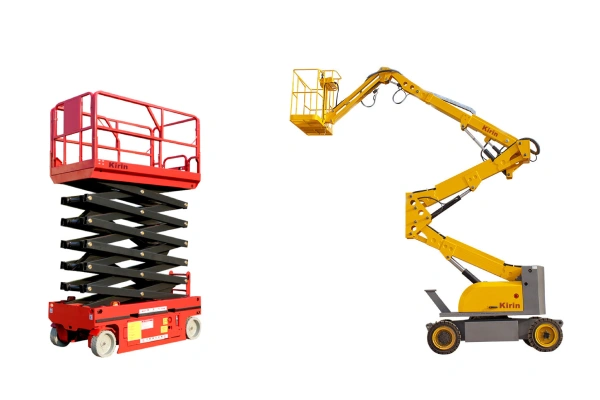
In the fast-paced environments of construction sites, warehouses, and industrial facilities, efficiency is everything. When you need to relocate a piece of heavy equipment like a scissor lift, it can be tempting to use the tool closest at hand: a forklift.
But is lifting a scissor lift with a forklift actually safe, or are you looking at a major safety violation and a catastrophic accident waiting to happen?
This comprehensive guide breaks down the rules, risks, and regulations regarding moving a scissor lift with a forklift. We will dive deep into OSHA compliance, manufacturer guidelines, and step-by-step procedures to ensure your job site stays efficient without sacrificing worker safety.
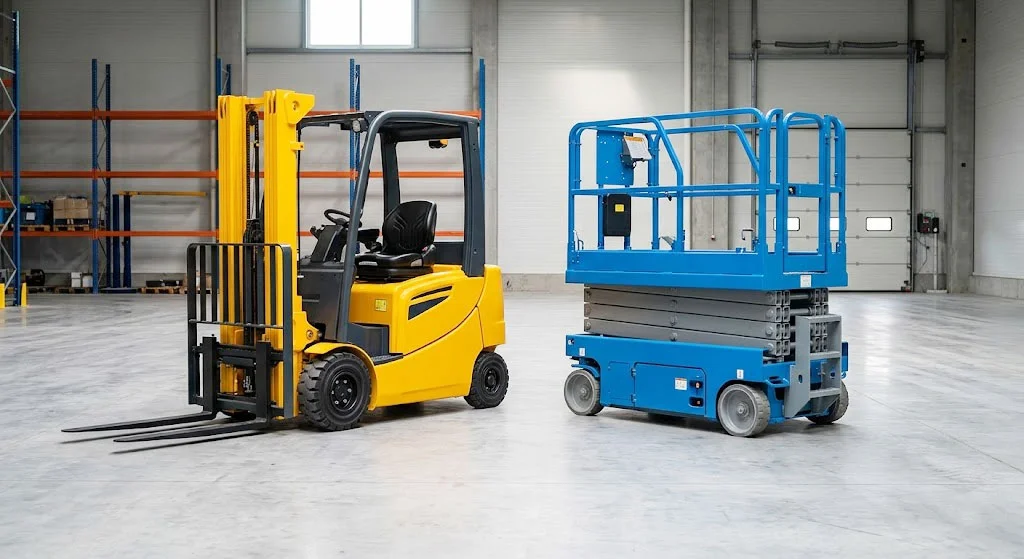
Can You Safely Lift a Scissor Lift with a Forklift?
The short answer is yes, but only under highly specific conditions. You cannot simply drive any forklift up to any scissor lift, shove the forks under the chassis, and tilt back. Scissor lifts are incredibly heavy, densely packed machines with a high and shifting center of gravity. Attempting to lift one incorrectly can cause the scissor lift to slide off the forks, tip the forklift over, or structurally damage both machines.
To safely accomplish lifting a scissor lift with a forklift, two primary conditions must be met:
- The scissor lift manufacturer must have explicitly designed the unit with dedicated forklift pockets or designated lifting points.
- The forklift being used must have a rated load capacity that safely exceeds the total weight of the scissor lift.
If either of these conditions is missing, picking a scissors lift up with a forklift is highly dangerous and strictly forbidden by site safety protocols.
OSHA Regulations Related to Lifting a Scissor Lift with a Forklift
The Occupational Safety and Health Administration (OSHA) does not have a single, isolated clause that reads, “You cannot use a forklift on a scissor lift.” Instead, OSHA regulates this practice through a combination of its Powered Industrial Trucks standard (29 CFR 1910.178) and Aerial Lifts standard (29 CFR 1926.453).
Here is how OSHA regulations govern lifting a scissor lift with a forklift:
- Manufacturer Compliance (1910.178(a)(4)): OSHA states that modifications and additions which affect capacity and safe operation shall not be performed by the customer or user without manufacturers’ prior written approval. If you lift a scissor lift in a way the manufacturer did not intend, you are violating this standard.
- Safe Load Handling (1910.178(o)(1)): Only stable or safely arranged loads shall be handled. Caution shall be exercised when handling off-center loads. Because scissor lifts have uneven weight distribution, they are inherently unstable unless secured via approved manufacturer points.
- The General Duty Clause (Section 5(a)(1)): This requires employers to provide a workplace free from recognized hazards. Attempting an unapproved, rigged lift with heavy machinery constitutes a recognized hazard. If an accident occurs while improperly lifting a scissor lift with a forklift, OSHA will issue severe citations under this clause.
Manufacturer Guidelines for Transporting Scissor Lifts
Before you even think about moving a scissor lift with a forklift, you must consult the operator’s manual for both specific machines. Manufacturers spend millions of dollars engineering safety protocols. If the manual says a specific model cannot be forklifted, then that is the absolute final word.
Approved Forklift Pockets and Lifting Points
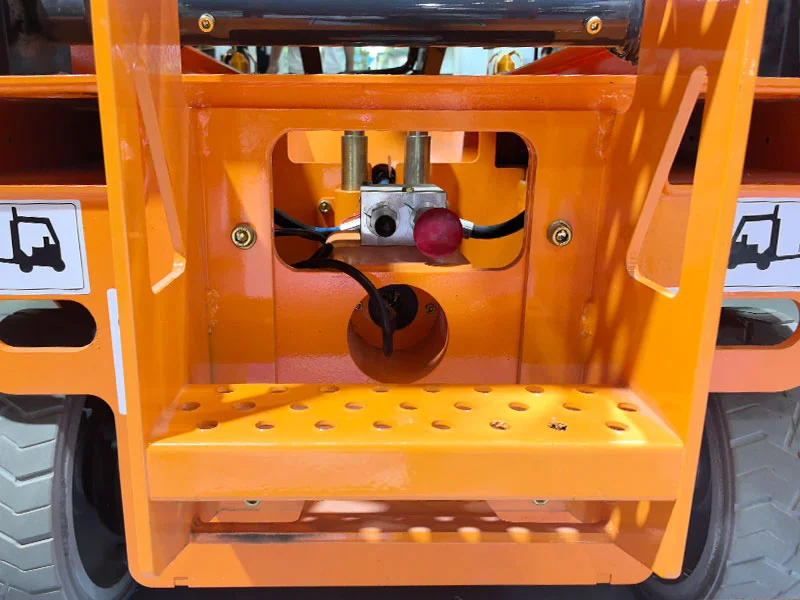
Most modern, compact electric scissor lifts are designed with built-in forklift pockets. These are heavy-duty, steel rectangular tubes welded directly into the lowest frame of the chassis.
Critical Safety Rule: You must only insert forklift tines into these designated pockets.
Never attempt to lift a scissor lift by placing the forks under the fiberglass or plastic component trays, the hydraulic tank, the steering linkage, or the extending ladders. Doing so will instantly crush vital components, potentially rupturing hydraulic lines or causing a sudden drop.
Furthermore, rough-terrain scissor lifts (larger, diesel-powered units) often do not have forklift pockets due to their immense size and weight. Instead, they feature heavy-duty tie-down and rigging lift lugs intended for cranes and transport trailers, meaning can you pick up a scissor lift with a forklift becomes a definitive “no” for these larger models.
Major Risks of Lifting a Scissor Lift with a Forklift
Ignoring protocols when lifting a scissor lift with a forklift opens the door to severe workplace accidents. Understanding these risks is crucial for every equipment operator.
| Risk Factor | Potential Consequence |
| Tip-Overs | Scissor lifts are incredibly bottom-heavy to prevent them from tipping over when extended. However, when raised on forklift tines, their high center of gravity shifts rapidly. A slight bump or turn can tip the forklift or cause the scissor lift to slide off. |
| Structural Damage | Placing forks anywhere other than approved pockets can warp the scissor stack chassis, bend steering cylinders, or crush delicate electrical control modules hidden inside side compartments. |
| Crush Hazards | If the scissor lift slips off the tines during transport, nearby ground workers are at extreme risk of catastrophic or fatal crush injuries. |
| Rigging Failure | Trying to use chains or straps wrapped around forklift tines to lift a scissor lift can result in catastrophic rigging failure if the straps slip along the smooth steel forks. |
Safe Procedures for Lifting a Scissor Lift with a Forklift
If you have verified compliance, checked the manuals, and are ready to proceed with lifting a scissor lift with a forklift, follow these rigid step-by-step safety procedures:
Step 1: Verify Weight and Capacity
Check the data plate on the scissor lift for its gross weight. Then, check the load chart on the forklift. Ensure the forklift’s capacity at the specific load center is well above the weight of the scissor lift. Remember, a scissor lift is wide, which pushes the load center further out than a standard pallet.
Step 2: Prepare the Scissor Lift
- Lower the platform completely.
- Ensure the platform extension deck is fully retracted and securely locked.
- Turn off the engine/power switch and remove the key.
- Close and latch all side compartment trays and doors.
- Ensure there are no loose tools, materials, or debris left on the platform.
Step 3: Align and Insert the Forks
- Adjust the spacing of the forklift tines to match the exact width of the approved forklift pockets on the scissor lift.
- Drive forward slowly, centering the forklift perfectly with the scissor lift.
- Insert the forks fully into the pockets until the back of the tines touches the frame of the scissor lift.
Step 4: Secure the Load
If recommended by the manufacturer, use heavy-duty safety chains or ratchet straps to secure the scissor lift frame to the forklift carriage. This prevents the machine from sliding forward or backward during braking or sudden stops.
Step 5: Lift and Transport Low
- Lift the scissor lift only a few inches off the ground—just high enough to clear any ground obstacles.
- Tilt the forklift mast back slightly to cradle the load securely against the carriage.
- Travel at walking speed. Avoid sudden turns, sharp braking, or uneven terrain. Always travel in reverse if the scissor lift blocks your forward visibility.
Best Alternatives to Lifting a Scissor Lift with a Forklift
Just because you can perform picking a scissors lift up with a forklift doesn’t always mean you should. There are often much safer, more practical alternatives available on a job site.
1. Drive It (If Distance Permits)
If you are simply moving the scissor lift across a flat warehouse floor or concrete slab, the safest method is always to drive it under its own power. Ensure the path is clear of potholes, debris, or overhead obstructions.
2. Use a Dedicated Transport Trailer or Flatbed
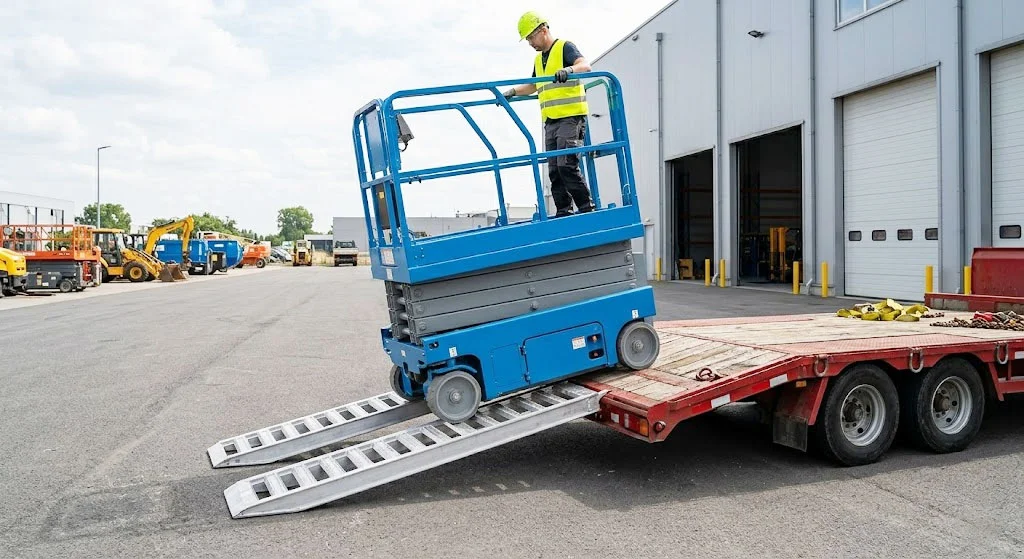
For moving across rough terrain, exterior job sites, or long distances, utilizing a ramp-equipped utility trailer or tilt-bed flatbed truck is vastly superior. This eliminates the stability risks associated with elevating the unit on a forklift.
3. Towing (Model Specific)
Some scissor lifts feature a free-wheeling valve or brake release disconnect that allows them to be safely towed over short distances at low speeds. Check your manual to see if your unit supports this feature.
Common Mistakes to Avoid
When field crews get in a hurry, safety mistakes happen. Avoid these critical errors when moving a scissor lift with a forklift:
- Lifting from the Side: Never attempt to pick up a scissor lift from the side unless it features explicitly designated side forklift pockets. Most pockets are strictly front-to-back or back-to-front.
- Using Too-Short Forks: The forks must extend through the entire body of the scissor lift pockets. Short forks create a severe pivot point, which can collapse the pocket structure or cause the lift to tilt off the end of the tines.
- Leaving a Worker on the Platform: It should go without saying, but never allow anyone to stand on the scissor lift platform while it is being raised or transported by a forklift.
- Ignoring a Slanted Gradient: Attempting to lift or carry a scissor lift across a ramp or sloped surface with a forklift drastically alters the center of gravity, making a tip-over almost guaranteed.
Forklift vs. Trailer Transport: Which Is Safer?
When evaluating how to move equipment across an expansive job site, safety managers often weigh forklifts against trailers.
While lifting a scissor lift with a forklift is highly convenient for quick, short-distance adjustments on a smooth concrete floor, it ranks much lower on the safety spectrum compared to trailer transport.
Trailers distribute the weight across multiple axles, lower the center of gravity closer to the ground, and offer mechanical tie-down winches. Forklifts, by contrast, rely entirely on counterweights and hydraulics to keep a highly concentrated, top-heavy load balanced in mid-air. For any distance greater than a quick repositioning across a room, a trailer or flatbed is always the safer operational choice.
Safety Checklist Before Moving a Scissor Lift
Before executing a move, have your team run through this quick safety checklist to ensure all protocols for lifting a scissor lift with a forklift are strictly met:
- Manual Checked: Has the operator verified that the manufacturer approves forklift transport for this model?
- Pockets Identified: Are the forks aligned perfectly with designated, welded forklift pockets?
- Weight Verified: Is the forklift capacity higher than the gross weight of the scissor lift?
- Platform Lowered: Is the scissor lift platform completely lowered, retracted, and cleared of debris?
- Key Removed: Is the scissor lift powered off with keys removed to prevent accidental startup?
- Path Inspected: Is the travel path flat, clear of personnel, and free of steep inclines or drops?
- Forks Fully Inserted: Do the forklift tines pass completely through the pockets to support the entire frame?
Frequently Asked Questions About Lifting a Scissor Lift with a Forklift
Is lifting a scissor lift with a forklift OSHA compliant?
Yes, it is OSHA compliant only if you follow the manufacturer’s specific instructions, utilize designated forklift pockets, and operate a forklift with a rated load capacity capable of safely handling the weight. Deviating from manufacturer guidelines violates OSHA standard 1910.178.
Can all scissor lifts be lifted with forklifts?
No. Many larger, rough-terrain scissor lifts do not feature forklift pockets due to their immense weight and physical dimensions. They must be moved via trailers, flatbeds, or rigged from overhead crane lifting lugs.
Where are forklift pockets located on a scissor lift?
Typically, forklift pockets are integrated into the bottom of the main steel chassis frame, accessible from either the front or rear of the machine. They look like rectangular steel tubes. Check your manual to confirm their exact placement.
Should the platform be raised during transport?
Absolutely not. The platform must be completely lowered and retracted. Moving a scissor lift with an elevated platform on a forklift shifts the center of gravity dangerously high, creating an extreme risk of a catastrophic tip-over.
What forklift size is needed to move a scissor lift?
The forklift size depends entirely on the weight of the scissor lift, which can range from 2,000 lbs for small electric models to over 15,000 lbs for large rough-terrain units. Always check the data plates of both machines; your forklift’s rated capacity at the required load center must comfortably exceed the scissor lift’s total weight.
Conclusion
Ultimately, lifting a scissor lift with a forklift is a permissible and efficient practice, provided you respect the engineering limitations of both machines. Treat the scissor lift not as a standard pallet of materials, but as a highly specialized, heavy, and off-center piece of machinery.
Always check your manuals, ensure you are utilizing the designated forklift pockets, verify your forklift’s lifting capacity, and keep your transport speeds low. By following these strict safety guidelines, you can ensure your job site remains highly productive while protecting your valuable equipment and, most importantly, your crew.
If you have additional questions about proper material handling, equipment transportation guidelines, or finding the right high-quality lift solutions for your facility, our support team is ready to help. Reach out to us directly via Email at info@klingtec.com or message us on WhatsApp at +86 188 6686 3188 for professional guidance and technical specifications.