When it comes to working at heights, scissor lifts are some of the most versatile, reliable, and heavily utilized pieces of equipment on construction sites, in warehouses, and across manufacturing facilities. However, because they elevate workers several stories into the air, they come with inherent risks. Every year, preventable accidents occur due to tip-overs, falls, and electrical shocks.
To keep workers safe and companies out of legal trouble, the Occupational Safety and Health Administration (OSHA) enforces strict safety standards. Navigating these rules can be challenging because OSHA categorizes scissor lifts differently than other aerial platforms.
This comprehensive compliance guide breaks down everything you need to know about OSHA regulations for scissor lifts, covering training requirements, daily inspections, safe operation practices, and how to avoid costly penalties.
What Are OSHA Regulations for Scissor Lifts?
To stay compliant, you must first understand how OSHA views this equipment. Many employers mistakenly assume that scissor lifts are governed under the same rules as boom lifts or cherry pickers.
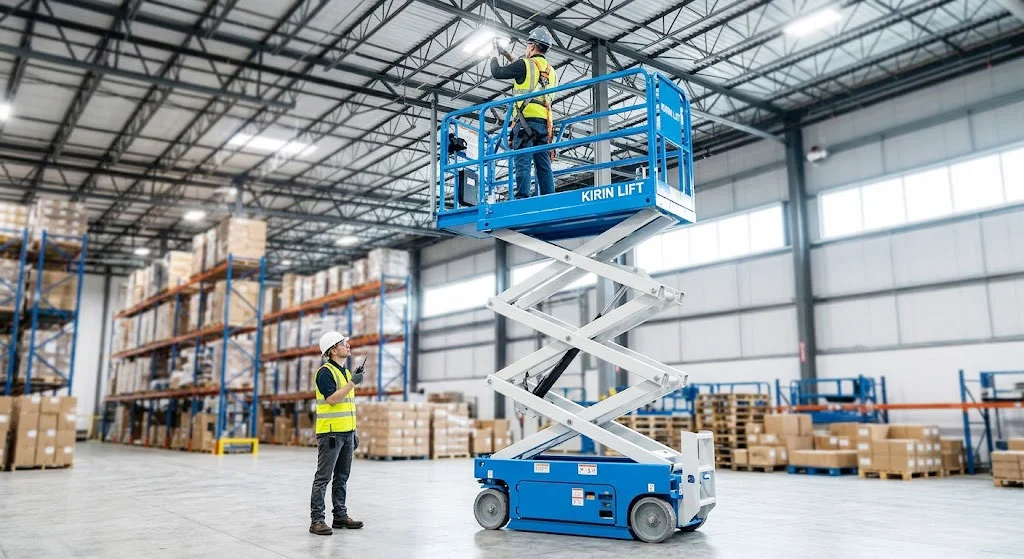
OSHA does not explicitly classify scissor lifts as “aerial lifts” under the specific standard 29 CFR 1926.453. Instead, because the lifting mechanism moves vertically directly above the base, OSHA regulates scissor lifts under its general Scaffolding standards (29 CFR 1926.451 and 29 CFR 1926.452).
Essentially, an osha scissor lift is viewed as a mobile, mechanically powered scaffold. OSHA regulations for scissor lifts are designed to ensure that employers provide a stable working environment, comprehensive operator education, well-maintained machinery, and proper protective equipment to prevent catastrophic workplace injuries.
Key OSHA Standards for Scissor Lift Safety
Because scissor lifts fall under the scaffolding umbrella, compliance requires adhering to a blend of general construction, general industry, and specific subpart regulations. Here are the core legal standards you must implement:
OSHA Standard 1926.453 for Aerial Lifts
While scissor lifts are legally classified as scaffolds, OSHA frequently refers employers back to 29 CFR 1926.453 (Aerial Lifts) and ANSI (American National Standards Institute) design standards for manufacturing guidance. If a machine’s design crosses over into boom-like functionality (such as having an articulating arm), it immediately triggers 1926.453 requirements. For standard vertical scissor platforms, however, Subpart L (Scaffolds) takes precedence.
OSHA Walking-Working Surfaces Standard
For general industry settings (such as manufacturing plants or distribution warehouses), 29 CFR 1910 Subpart D governs walking-working surfaces. This standard dictates that the platform floor must be kept clean, dry, and free of debris or structural defects that could cause an operator to slip, trip, or fall while executing tasks from an elevated position.
OSHA Fall Protection Requirements
Falls are the leading cause of fatalities in the construction sector. Under 29 CFR 1926.451(g), anyone working on a scaffold platform elevated 10 feet or more above a lower level must be protected from falling. For scissor lifts, the primary line of defense required by osha scissor lift requirements is a fully compliant, manufacturer-installed guardrail system.
Electrical Safety Regulations
Scissor lifts often position workers close to overhead utilities, ceiling framework, and exposed wiring. Under 29 CFR 1926.400, employers must ensure operators maintain safe approach distances from energized power lines. Electrocution risks are incredibly high when working with metal structures at height, making strict adherence to electrical clearance boundaries vital.
OSHA Training Requirements for Scissor Lift Operators
You cannot simply hand an employee a set of keys and point toward a mobile scaffold. Employers are legally obligated to provide comprehensive safety instruction before anyone steps onto a platform.
Who Needs Scissor Lift Training?
According to osha rules for scissor lifts, anyone who operates the machinery, or works as a passenger/occupant on the elevated platform, must undergo training. Additionally, maintenance personnel who service the units and supervisors who oversee work at heights must understand the hazards involved to maintain a safe job site.
What OSHA-Compliant Training Should Include
To meet osha scissor lift certification requirements, your training curriculum must address:
- The nature of structural, fall, and electrical hazards.
- The correct procedures for dealing with electrical hazards and operating near overhead lines.
- How to handle fall protection systems and guardrails.
- The maximum load capacity (weight limits) of the specific lift model.
- Manufacturer instructions, warnings, and limitations outlined in the equipment manual.
Hands-On Training vs. Classroom Training
A compliant training program cannot happen solely on a computer screen or via a video. OSHA mandates a two-part educational approach:
- Classroom/Theoretical Training: Covering physics, load capacities, regulations, and hazard recognition.
- Hands-On Practical Evaluation: A qualified instructor must physically observe the trainee perform pre-start checks, control operations, and demonstrate safe driving maneuvers on the actual machine.
How Often Should Operators Be Retrained?
While an initial certification doesn’t automatically expire annually, OSHA requires retraining under several conditions:
- The operator is observed using the lift in an unsafe manner.
- An accident or near-miss occurs involving the machinery.
- The workplace environment changes, presenting new hazards.
- The company transitions to a different type or model of scissor lift.
Pre-Operation Inspection Requirements
Neglecting mechanical maintenance is a direct path to catastrophic structural failure. OSHA mandates that equipment must be verified as safe before every single work shift.
Daily Inspection Checklist
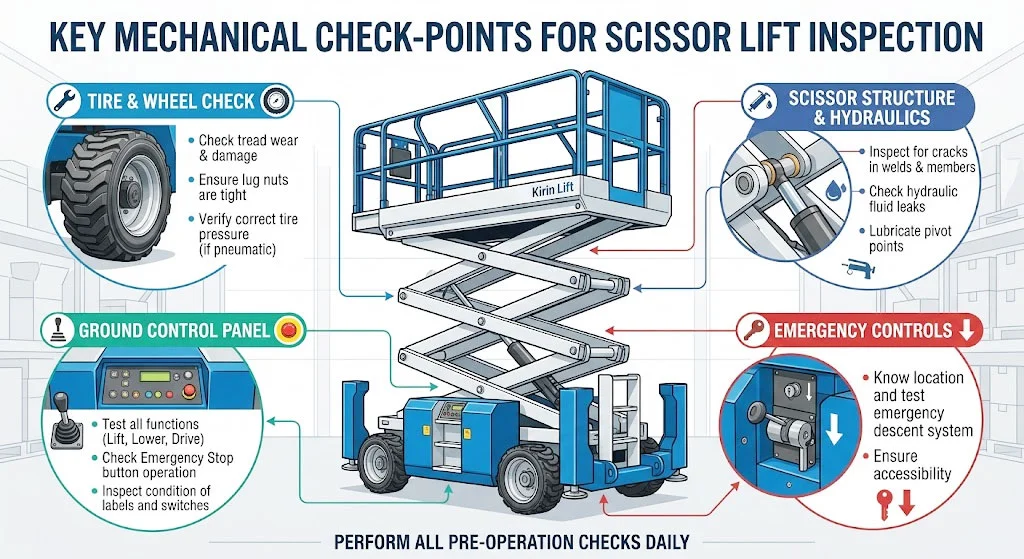
Before starting up an osha scissor lift, operators must perform a thorough visual and functional inspection. The daily checklist should evaluate:
| Component Category | Specific Inspection Items |
| Fluid Levels | Check engine oil, hydraulic fluid, fuel, and coolant levels. Look for leaks. |
| Mechanical System | Inspect the scissor mechanisms, pins, rollers, and structural welds for cracks. |
| Operational Controls | Test the emergency stop buttons, lower/raise controls, and backup alarms. |
| Safety Systems | Verify guardrail pins are locked, mid-rails are secure, and gates close automatically. |
| Tires & Wheels | Look for chunking, punctures, loose lug nuts, or low tire pressure (if pneumatic). |
Workplace Inspection Before Use
An inspection isn’t limited to the machine itself. Operators must survey the surrounding workspace for environmental hazards, including:
- Drop-offs, holes, slope variances, bumps, or floor debris.
- Overhead obstructions, ceiling structures, and high-voltage power lines.
- Inadequate surface support capabilities (floor load limits).
- Pedestrian traffic and blind corners.
- Wind conditions and impending severe weather.
Why Documentation Matters
If an accident occurs and an OSHA investigator steps onto your property, undocumented safety checks are treated as if they never happened. Maintaining a written or digital log of daily inspections shields your company from liability and creates a clear track record of proactive safety compliance.
OSHA Rules for Safe Scissor Lift Operation
Safe operation requires strict discipline. If operators bypass built-in safety mechanisms or ignore environment protocols, the risk of tip-overs escalates drastically.
Proper Mounting and Dismounting Procedures
Workers must always maintain three points of contact (two hands and one foot, or two feet and one hand) when entering or exiting the platform. Never jump from a platform, and never attempt to climb up or down the outer scissor cross-braces.
Platform Capacity and Load Limits
Every scissor lift has a strict weight capacity limitation determined by the manufacturer. This limit includes the combined weight of the operators, their tools, replacement parts, and materials. Overloading shifts the machine’s center of gravity, which heavily degrades stability and increases structural collapse risks.
Traveling While Elevated
Driving a lift while the platform is extended requires extreme caution. Many models automatically slow down to a “creep speed” when raised, but operators must actively watch for ground hazards. Small potholes or tools on the floor can act as a fulcrum, throwing an elevated machine completely off balance.
Safe Positioning Practices
Lifts must be positioned appropriately to avoid pinning hazards. Operators must ensure their bodies, hands, and heads are clear of overhead beams, joists, and architectural features while raising the platform to prevent crushing injuries.
Prohibited Scissor Lift Practices
To keep your job site safe, enforce a zero-tolerance policy for these dangerous habits:
- Never use milk crates, ladders, or planks on top of the platform to gain extra height.
- Never lean over the guardrails to reach a workspace.
- Never modify or bypass safety interlocks, limit switches, or alarms.
- Never use a scissor lift as a crane to lift external loads.
Fall Protection and Guardrail Compliance
One of the most heavily debated topics in construction safety is: Does OSHA require a harness in a scissor lift?
According to official osha scissor lift harness requirements, if the lift is equipped with a fully compliant, manufacturer-approved guardrail system that is completely closed and functioning, a personal fall arrest system (PFAS)—such as a harness and lanyard—is not mandatory under federal law. The guardrails themselves serve as the primary fall protection system.
Important Caveat: While federal OSHA regulations for scissor lifts may not legally mandate a harness if guardrails are sound, many general contractors, facility owners, and state-level OSHA programs (like Cal/OSHA) enforce rules that are stricter than federal guidelines. If your company policy or site rules dictate that you must tie off, you must attach your lanyard only to the manufacturer-designated anchor point inside the platform—never around the outer guardrails.
OSHA Regulations for Scissor Lifts on Uneven Ground
Scissor lifts are inherently top-heavy machines. When elevated, their susceptibility to tipping increases exponentially if the base is not perfectly level.
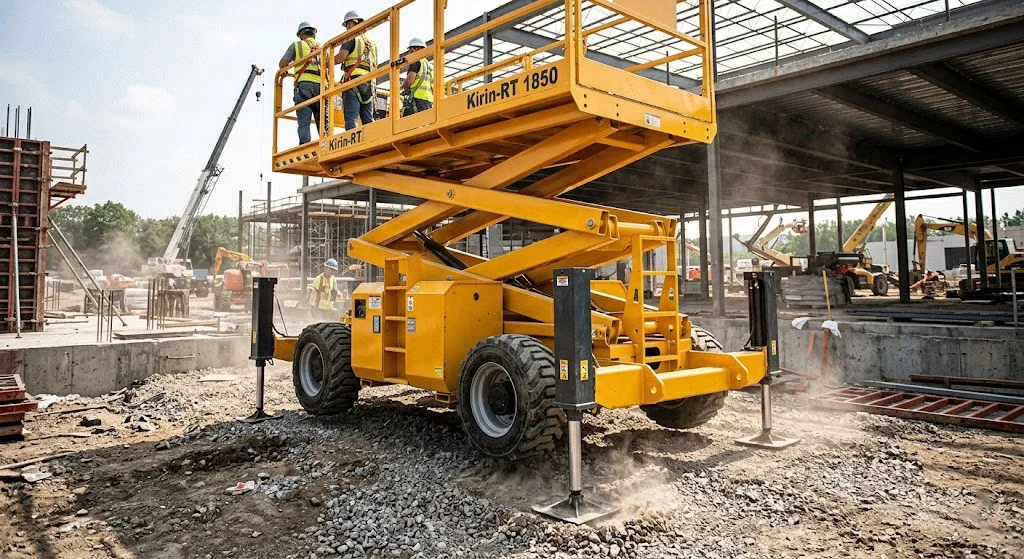
- Firm, Level Surfaces: OSHA demands that scissor lifts only be operated on firm, flat, level surfaces capable of supporting the weight of the machine and its maximum load capacity.
- Outriggers and Leveling Jacks: If the work area features a minor slope, you must use a lift model equipped with stabilizing outriggers or hydraulic leveling jacks. These devices must be fully deployed according to manufacturer instructions before the platform rises.
- Wind Speed Thresholds: Outdoor operations add the hazard of wind load. High winds act as a sideways force against an elevated platform. While OSHA doesn’t state a universal maximum wind speed number in its text, it references manufacturer specs. Most manufacturers set a strict osha wind speed limit for working at height at 28 mph (45 km/h). Never raise a scissor lift outdoors if winds exceed this threshold.
Common OSHA Violations Related to Scissor Lifts
Failing to comply with OSHA regulations for scissor lifts can result in severe financial penalties, stop-work orders, and devastating legal battles. The most common scissor-lift-related citations issued by field inspectors include:
- Missing or Modified Guardrails: Operating with removed gates, chains left unhooked, or bent rails.
- Lack of Documented Operator Training: Allowing uncertified personnel to run the equipment.
- Exceeding Rated Load Capacities: Stacking heavy construction materials on platforms designed purely for personnel.
- Improper Driving While Elevated: Moving across uneven dirt, gravel, or debris-strewn floors while raised.
- Bypassing Safety Switches: Overriding weight sensors or tilt alarms to get a job done faster.
Best Practices for OSHA Compliance
Developing a robust safety culture requires moving past the absolute bare minimum legal text. Implement these proactive management strategies to protect your workforce:
- Implement a Digital Key/Tagout System: Keep lift keys locked away so that only certified, trained operators can check them out.
- Conduct Daily Tool-Box Talks: Spend 5 minutes every morning reviewing specific fall prevention techniques, job site site-specific hazards, and wind conditions.
- Establish a Zero-Debris Zone: Keep the driving lanes of your facility or job site completely clear of debris, cords, and trash that could disrupt a lift’s wheelbase.
- Conduct Spot Audits: Have safety managers perform unannounced site walk-throughs to verify that inspections are being completed and that workers are practicing proper mounting procedures.
How ANSI Standards Support OSHA Regulations
While OSHA provides the foundational legal law of the land, they frequently rely on the American National Standards Institute (ANSI) and the International Powered Access Federation (IPAF) to establish specific technical design criteria.
The standard ANSI A92.20 dictates rigorous manufacturing criteria for design, safe calculations, and stability testing of mobile elevating work platforms (MEWPs). When OSHA inspects a job site, they use ANSI guidelines to interpret whether an employer is maintaining equipment to the highest recognized industry standards. Purchasing and renting equipment that explicitly meets current ANSI benchmarks ensures your fleet is legally defensible and physically secure.
Choosing OSHA-Compliant Scissor Lifts
Selecting the right machine for your specific application is paramount for structural safety. When sourcing equipment, evaluate these three elements:
- Terrain Rating: Choose a Slab Scissor Lift (solid rubber tires) for flat concrete interior floors, or a Rough Terrain Scissor Lift (heavy-duty tread, four-wheel drive) for muddy, uneven outdoor construction sites.
- Power Source Requirements: Use electric-powered lifts indoors to avoid toxic carbon monoxide buildup from internal combustion engines. Reserve diesel or gas-powered models exclusively for outdoor, well-ventilated settings.
- Built-in Safety Infrastructure: Prioritize machines equipped with automated tilt sensors, pothole protection systems, smooth proportional controls, and clear, easily accessible lanyard anchoring points.
Frequently Asked Questions About OSHA Regulations for Scissor Lifts
Does OSHA require certification for scissor lift operators?
Yes. Employers must verify that all operators have successfully completed an instructional safety course that includes classroom concepts, hazard recognition, and a documented, hands-on performance evaluation.
Are harnesses mandatory on scissor lifts?
Under federal OSHA regulations for scissor lifts, a personal fall arrest system (harness and lanyard) is not mandatory if the lift’s guardrail system is fully intact, closed, and compliant. However, many job sites and specific employer rules choose to enforce stricter mandates that require them.
Can scissor lifts be used outdoors?
Yes, provided the specific scissor lift model is rated by the manufacturer for outdoor application. Outdoor-rated units account for wind variables, whereas indoor-only units can easily tip over if hit by an outdoor gust of wind.
How often should scissor lifts be inspected?
Scissor lifts must undergo two distinct types of inspections: a pre-operation inspection at the beginning of every single work shift, and an intensive periodic mechanical inspection performed by a qualified mechanic at least once a year.
What is the OSHA fine for scissor lift violations?
OSHA fines vary depending on severity. Serious violations can carry penalties exceeding $15,000 per infraction, while intentional, “willful” violations can skyrocket past $150,000 per instance, along with potential criminal charges if negligence results in a fatality.
Can workers drive a scissor lift while elevated?
Yes, but only if the manufacturer’s instructions explicitly permit driving while extended and the equipment is traveling over a firm, completely flat, debris-free surface.
Conclusion
Mastering OSHA regulations for scissor lifts is an absolute necessity for any business operating at heights. By treating these versatile machines with the same safety respect as structural scaffolding, implementing ironclad pre-operation inspections, providing thorough hands-on training, and keeping guardrail systems intact, you can effectively eliminate the vast majority of aerial workspace hazards.
Investing in compliance isn’t just about avoiding steep financial fines—it’s about building a sustainable workplace environment where every single employee goes home safely at the end of their shift.
If you are looking to upgrade your fleet with reliable, fully compliant aerial equipment, or if you have questions about choosing the right machinery for your next project, the team at Kirin Lift is here to help. Reach out to our heavy machinery specialists today via email at info@klingtec.com or connect with us directly on WhatsApp at +86 188 6686 3188. Check your fleet, update your training records, and keep safety at the forefront of your operations.