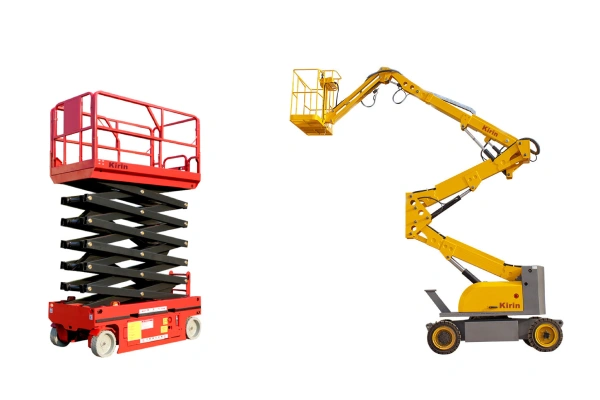
Whether you work in commercial construction, facility maintenance, or industrial warehousing, heavy equipment safety and efficiency rely on exact definitions. When renting or purchasing aerial equipment, one question frequently arises for fleet managers, safety coordinators, and operators alike: what category is a self-propelled boom lift?
Understanding the precise self-propelled boom lift category is not just a matter of semantics. It dictates operator training mandates, legal compliance under regulatory frameworks like OSHA and ANSI, and on-site job deployment rules.
Historically, industry professionals clustered all elevated platforms under the blanket term “Aerial Work Platforms” (AWPs). However, updated international engineering and safety standards have overhauled the boom lift classification landscape. Today, these machines are officially categorized using a more precise framework based on how they move and where their platform can extend.
This comprehensive guide unpacks the official classification systems, exploring how regulatory bodies define a mewp boom lift, why its grouping matters, the engineering traits that define its category, and how to select the right equipment for your job site.
What Is a Self-Propelled Boom Lift?
Before analyzing the regulatory boom lift classes, it helps to understand exactly what makes this machine unique compared to other heavy equipment.
Definition of a Self-Propelled Boom Lift
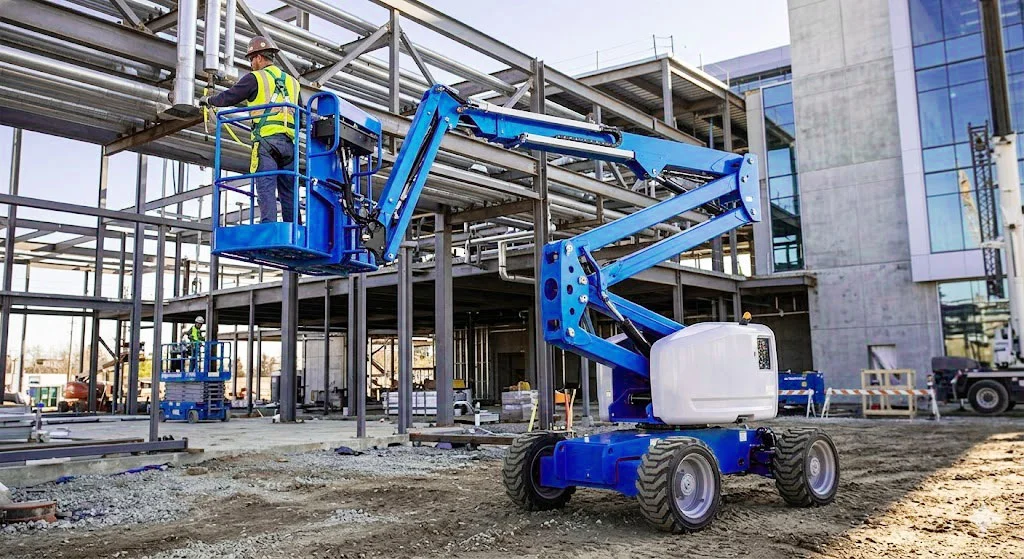
A self-propelled boom lift is an integrated mobile machine engineered to elevate personnel, tools, and limited materials to overhead work areas. Unlike towable or truck-mounted lifts, a self-propelled unit can be driven and steered directly across a job site by an operator standing within the elevated work basket.
Main Components of a Self-Propelled Boom Lift
A modern self-propelled unit relies on a tightly engineered architecture of four core components:
- The Base / Chassis: The heavy, wheeled or tracked foundational frame that houses the drive drivetrain, steering mechanisms, and counterweights.
- The Turntable: A rotating assembly mounted to the chassis that allows the upper structure to swing (often a full 360 degrees) to position the basket without moving the base.
- The Boom Structure: The mechanical arm assembly (either interlocking straight sections or hinged, folding sections) that extends upward and outward.
- The Work Platform / Basket: The secure enclosure equipped with guardrails, integrated harness anchor points, and a full set of primary driving and lifting controls.
Common Industries That Use Self-Propelled Boom Lifts
Because they provide exceptional reach over obstacles, these versatile machines are staples across major industries:
- Commercial Construction: For steel erection, exterior cladding installation, and glazing.
- Industrial Maintenance: For servicing overhead piping, HVAC infrastructure, and electrical grids in large factories.
- Aviation and Shipbuilding: For reaching high hulls, fuselages, and wing structures during assembly or painting.
- Entertainment and Media: For positioning high-altitude stadium lighting, audio systems, and movie cameras.
What Category Is a Self-Propelled Boom Lift?
To answer the core question—what category is a self-propelled boom lift?—we have to look at modern equipment engineering standards. If you are searching for the exact self-propelled boom lift category, the definitive answer is that it is classified as a Group B, Type 3 Mobile Elevating Work Platform (MEWPs) under modern ANSI/CSA guidelines.
Self-Propelled Boom Lifts as Mobile Elevating Work Platforms (MEWPs)
In recent years, American National Standards Institute (ANSI) standards (specifically ANSI A92) aligned with international ISO standards. This change retired the old term “Aerial Work Platform” (AWP) and replaced it with Mobile Elevating Work Platform (MEWP). Under this system, any machine designed to move workers to an elevated position belongs to the MEWP asset class.
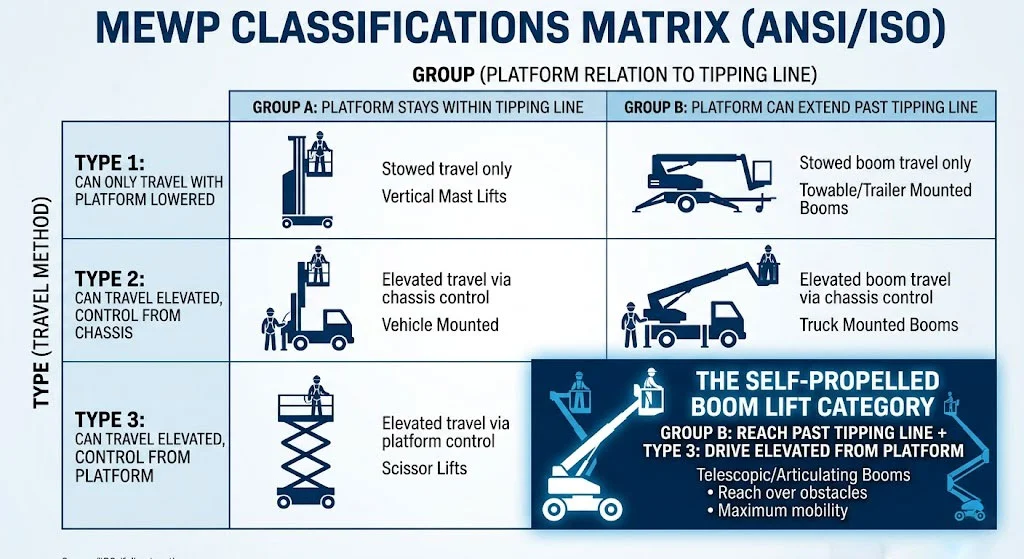
Group and Type Classification System
The modern MEWP system breaks machines down into two distinct axes: Groups (which determine where the platform can go relative to the wheels) and Types (which determine how the machine travels).
- Group A: Lifts where the center of the platform always stays inside the machine’s tipping lines (e.g., standard vertical scissor lifts). The basket moves straight up and down.
- Group B: Lifts where the platform can extend beyond the machine’s tipping lines or wheels. All boom lifts fall into Group B because their mechanical arm can reach out horizontally over obstacles.
Next, the classification looks at how the machine moves across the ground:
- Type 1: The machine can only be driven or moved when the platform is completely lowered (stowed position).
- Type 2: The machine can be driven while elevated, but the driving controls are located on the chassis/base rather than in the basket.
- Type 3: The machine can be driven and steered while the platform is elevated, using a control console inside the basket.
Why Self-Propelled Boom Lifts Are Classified as Group B Type 3
When we look at how these machines function on a real-world job site, it becomes clear why they sit squarely in the Group B Type 3 category:
- They are Group B because their articulating or telescopic arms project workers horizontally away from the machine’s physical base, shifting the center of gravity outward.
- They are Type 3 because the operator can fully drive, steer, and reposition the machine chassis across the ground while standing inside the elevated basket.
Understanding that a mewp boom lift belongs to Group B Type 3 is critical for safety managers. It means operators must hold a specific, validated certification for this exact boom lift class before they are legally allowed to operate it on a job site.
Types of Self-Propelled Boom Lifts
Within the broader Group B Type 3 classification, machines are divided by their structural arm design and power systems. This creates sub-categories tailored to specific work environments.
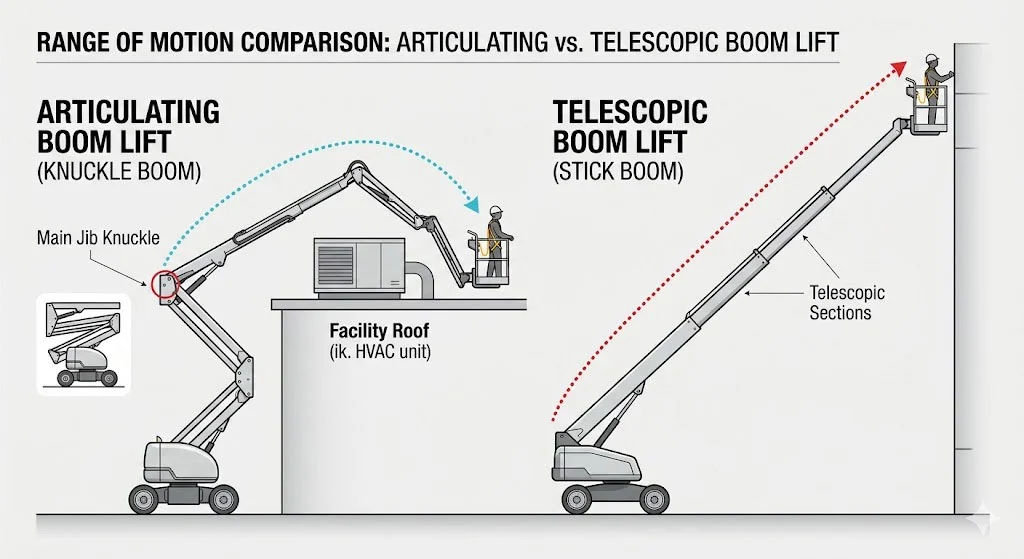
Articulating Boom Lifts
Often called “knuckle booms,” articulating lifts feature an arm built with multiple hinged sections that fold and bend.
- The Advantage: This design allows the platform to achieve an “up-and-over” reach, maneuvering around complex indoor roof trusses, facility piping, or tight outdoor architectural structures.
- Best For: Complex maintenance environments where a straight line of sight to the work area is blocked by obstacles.
Telescopic Boom Lifts
Commonly known as “stick booms,” telescopic lifts feature a straight mechanical arm that extends outward in a telescoping fashion via internal hydraulic cylinders.
- The Advantage: These machines prioritize maximum horizontal outreach and ultimate working height. They have a wider overall footprint to maintain stability at extreme extension.
- Best For: Open-air construction sites, bridge work, and high-rise masonry where workers need maximum reach from a single ground position.
Electric Self-Propelled Boom Lifts
Powered by heavy-duty industrial battery banks, electric models offer zero-emission operation.
- The Advantage: They run quietly and eliminate exhaust fumes, making them ideal for indoor warehouses, schools, and hospitals. They generally feature non-marking solid rubber tires to protect finished floors.
Diesel Self-Propelled Boom Lifts
Engineered for rugged outdoor environments, these machines feature high-torque internal combustion diesel engines.
- The Advantage: They include aggressive four-wheel-drive (4WD) systems, oscillating axles, and heavy lug tires designed to navigate mud, sand, and unpaved construction grades.
OSHA and ANSI Standards for Self-Propelled Boom Lifts
Operating within the Group B Type 3 boom lift classification comes with strict legal and safety oversight. In the United States, safety is governed by a partnership between OSHA (the law enforcer) and ANSI (the standard setter).
Under the updated ANSI A92 standards, there are clear requirements that apply directly to this specific self-propelled boom lift category:
- Safe-Use Plans: Every job site using a Group B Type 3 MEWP must have a written, site-specific safe-use plan that includes a comprehensive risk assessment.
- Supervisor Training: It isn’t just the person in the basket who needs training. Anyone directly supervising a boom lift operator must complete formal MEWP supervisor training covering machine selection and hazard mitigation.
- Mandatory Fall Protection: Because Group B lifts can bounce or tip when moving over ground obstacles, OSHA standard 1926.502 mandates that every person in the basket must wear a full-body harness attached to an approved lanyard anchor point at all times.
Key Features That Define the Category of a Self-Propelled Boom Lift
If you are inspecting a piece of machinery on a job site and trying to determine its formal boom lift class, look for these defining structural and functional indicators:
| Feature | Engineering Attribute | Classification Impact |
| Dual Control Consoles | Master switches on the base; full drive/steer joystick controls inside the basket. | Explicitly defines the machine as a Type 3 MEWP. |
| Outriggerless Stability | Relies on heavy internal counterweights within the rotating turntable rather than stabilizing pads. | Confirms it can travel while elevated across smooth or rough terrain. |
| Horizontal Extension | Boom arm can extend outward horizontally, past the physical tires of the chassis. | Places the asset firmly inside Group B. |
Advantages of Self-Propelled Boom Lifts
Choosing a machine within the self-propelled Group B category provides distinct operational advantages over scissor lifts, scaffolding, or truck-mounted booms:
- Unmatched Site Mobility: Because the operator can drive the machine from the basket, there is no need to lower the platform, climb down to the ground, move a truck or tow vehicle, and reset outriggers just to advance 5 feet along a wall.
- Up-and-Over Accessibility: Articulating models let workers reach over obstacles like structural walls, parapets, or factory machinery, accessing spots that vertical lifts cannot reach.
- High Ground Clearance: Rough-terrain self-propelled models are built with excellent under-chassis clearance and active oscillating axles, allowing them to traverse mud and ruts without getting stuck.
Common Applications for Self-Propelled Boom Lifts
Where do you find these machines working? Their unique capability to travel while extended makes them indispensable for specific, high-demand tasks:
- Utility and Electrical Infrastructure: Repairing overhead power lines, mounting transformers, and maintaining streetlights.
- Exterior Building Care: High-rise window washing, industrial pressure washing, and structural masonry repairs.
- Horticulture and Tree Care: Trimming dense tree canopies over homes, fences, or commercial assets where ground space is limited.
- HVAC and Ductwork Installation: Lifting heavy sections of ventilation ducting up into the exposed ceilings of massive fulfillment centers and warehouses.
How to Choose the Right Self-Propelled Boom Lift
Selecting the wrong machine within this category can lead to project delays or serious safety hazards. When planning a rental or purchase, walk through these four practical criteria:
- Maximum Working Height vs. Platform Height: Remember that “working height” is generally calculated by adding 6 feet (the average reach of a standing human worker) to the actual physical “platform height” of the basket. Always rent or buy based on the physical platform limit.
- Horizontal Outreach Demands: If you need to park the machine 40 feet away from a structure to reach over a ditch or an awning, a telescopic stick boom is often required. If you are working close to a wall but need to clear a high pipe, choose an articulating model.
- Ground and Terrain Conditions: Assess the work surface. Will the lift operate on flat, indoor concrete? Go with a compact electric model with non-marking tires. Is it operating on a sloped, muddy construction site? Specify a diesel 4WD rough-terrain unit.
- Basket Weight Capacity: Always calculate the total combined weight of your operators, heavy tools, and materials. Standard boom baskets hold between 500 to 1,000 lbs. Overloading the basket will trigger modern ANSI safety sensors, locking out all machine functions.
Common Mistakes When Using Self-Propelled Boom Lifts
Because Group B Type 3 lifts feature a shifting center of gravity, operating errors can quickly turn dangerous. Avoid these critical site mistakes:
- Driving at Speed While Elevated: While Type 3 machines are designed to move while raised, they should only creep at slow speeds on flat, uniform surfaces. Driving over a curb or a deep pothole while fully extended can create a catapult effect, throwing workers from the basket.
- Using the Boom as a Crane: Boom lifts are engineered exclusively to lift personnel and their direct hand tools. Never wrap chains or straps around the basket or the boom structure to hoist heavy external loads from the ground.
- Ignoring Wind Speed Ratings: Most outdoor self-propelled boom lifts are strictly rated for maximum wind speeds of 28 mph (12.5 m/s). Operating in higher winds converts the large surface area of the basket and boom into a sail, risking a catastrophic machine tip-over.
Frequently Asked Questions About What Category Is a Self-Propelled Boom Lift
Is a self-propelled boom lift considered a MEWP?
Yes. Under the modernized ANSI A92 and ISO standards, all aerial work platforms (AWPs) have been reclassified as Mobile Elevating Work Platforms (MEWPs). A self-propelled boom lift sits squarely within this overarching asset classification.
What is the difference between Group A and Group B MEWPs?
The core difference lies in horizontal reach. A Group A machine (like a scissor lift) keeps the work platform directly over the center of the machine’s chassis at all times, moving only vertically. A Group B machine (like a boom lift) features an arm that allows the platform to extend horizontally outward, far beyond the machine’s wheel lines and tipping axis.
Are self-propelled boom lifts classified as aerial lifts?
Yes, “aerial lift” is the traditional regulatory term used by OSHA (specifically within standard 29 CFR 1926.453). While the manufacturing industry has transitioned to the term MEWP, OSHA still uses aerial lift interchangeably in its enforcement language.
Do operators need certification to use a self-propelled boom lift?
Absolutely. OSHA regulations and ANSI standards mandate that anyone operating a self-propelled boom lift must complete a formal certification course. This training must include a classroom safety review, a written exam, and a hands-on practical operating evaluation for Group B Type 3 equipment.
What industries commonly use self-propelled boom lifts?
They are used anywhere workers need to safely reach high places over obstacles. Common fields include commercial building construction, industrial factory maintenance, aviation assembly, shipyard operations, tree care, and stadium entertainment setups.
Conclusion
When managing a modern job site, clear answers keep people safe. If someone asks you what category is a self-propelled boom lift, you can confidently tell them it is a Group B Type 3 Mobile Elevating Work Platform (MEWP).
Its classification tells you exactly how it behaves: it can reach out horizontally far beyond its wheels (Group B), and it can be driven and steered directly from the basket while fully extended in the air (Type 3). By understanding this self-propelled boom lift category, you ensure your team selects the correct machine, maintains strict OSHA and ANSI compliance, and provides the exact training required to keep your crew safe while working at height.
At Kirin Lift, we understand that finding the right equipment configuration is vital for your project’s productivity and safety. If you are looking to acquire reliable, high-performance lifting solutions tailored to your unique industrial requirements, our expert team is here to help. For custom specifications, product catalog inquiries, or detailed quotes, please feel free to reach out directly to our global support office:
- Email: info@klingtec.com
- WhatsApp: +86 188 6686 3188
Prioritize proper asset classification, ensure your operators are fully certified, and leverage the flexible reach of high-quality self-propelled boom lifts to safely optimize your high-altitude projects.