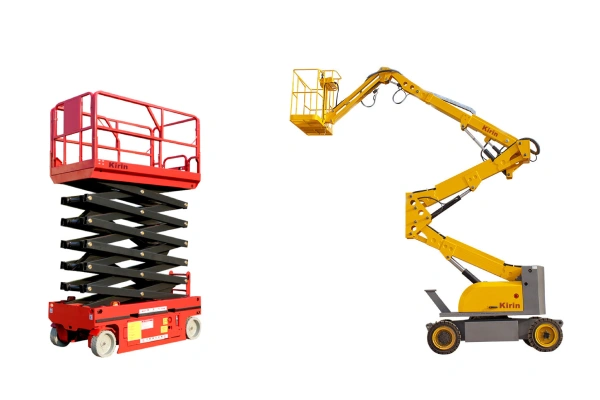
In modern industrial, construction, and maintenance projects, safely and efficiently reaching high-altitude work zones is a critical priority. Among the wide array of aerial work platforms available today, the self-propelled boom lift stands out as an incredibly versatile, productive, and reliable choice.
Whether you need to navigate around complex indoor structural beams, reach over heavy factory machinery, or traverse rugged, unpaved outdoor jobsites, understanding the capabilities of self-propelled boom lifts can fundamentally transform how your team handles high-altitude tasks.
This comprehensive guide breaks down exactly what a self-propelled boom lift is, how it operates, its distinct types, and the key advantages it brings to your jobsite operations.
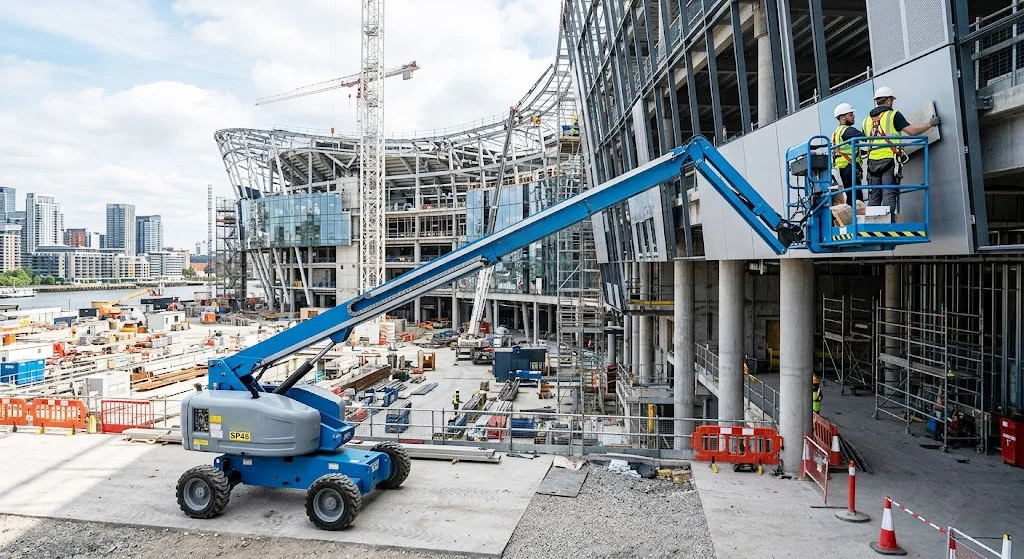
What Is a Self-Propelled Boom Lift?
A self-propelled boom lift is an advanced aerial work platform engineered to elevate personnel, tools, and materials to precise vertical and horizontal locations while retaining the ability to drive across the ground under its own power. Unlike traditional access equipment, a self-propelled boom lift does not require a secondary towing vehicle or an integrated truck chassis to move from point A to point B on a jobsite.
How It Differs from Towable or Truck-Mounted Boom Lifts
Understanding where a self-propelled boom lift fits into the aerial machinery landscape requires a quick comparison with alternative configurations:
- Towable Boom Lifts: These machines must be hitched to a truck or SUV to be transported between locations. Once on-site, they rely on manual positioning and the deployment of wide outriggers before lifting can occur. They lack internal drive motors for cross-site transit.
- Truck-Mounted Boom Lifts: Mounted directly onto a commercial truck bed, these units are excellent for rapid transit via public highways. However, they possess a massive footprint, lack granular maneuverability in tight industrial spaces, and require the truck engine to run constantly to power the hydraulic lifts.
- Self-Propelled Boom Lifts: These platforms integrate the drive chassis, power plant, and lifting structure into a single, cohesive machine. They offer unmatched localized mobility, allowing operators to relocate the entire machine without packing up the boom or stepping off the platform.
How Operators Drive and Elevate the Machine from the Platform
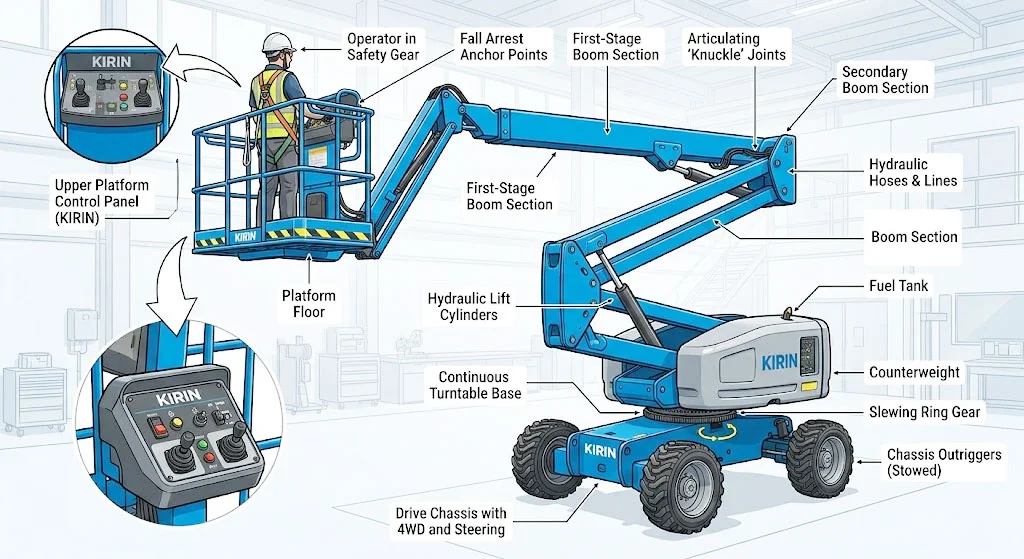
The defining characteristic of a modern self-propelled boom lift is total control from aloft. The operator stands safely inside the aerial basket and uses an ergonomic control console equipped with joysticks and toggle switches.
From this elevated vantage point, the operator can simultaneously steer, drive forward or backward, rotate the turntable, and extend or retract the boom arm. This eliminates the time-wasting process of lowering the basket, climbing down to a truck cab, driving forward a few feet, and re-elevating.
How Does a Self-Propelled Boom Lift Work?
The seamless operation of a self-propelled boom lift relies on a sophisticated integration of mechanical, hydraulic, electrical, and digital systems working in perfect harmony.
Explanation of Hydraulic and Electric Systems
At the heart of every self-propelled boom lift is a high-pressure hydraulic network. An internal combustion engine or a high-capacity electric motor drives a hydraulic pump. This pump forces specialized hydraulic fluid through high-strength hoses to various cylinders and hydraulic motors.
- Cylinders control the lifting, telescoping, and articulating movements of the boom arm.
- Hydraulic Motors (or direct electric drive motors) turn the wheels to propel and steer the chassis across the ground.
Driving, Steering, Lifting, and Extending Functions
The control logic allows for multi-function operation. When the operator pushes the primary joystick forward, electrical signals travel down a wiring harness within the boom to the hydraulic valves on the chassis, directing fluid to the drive wheels. Proportional controls ensure that the further the joystick is pushed, the faster or more smoothly the self-propelled boom lift responds, allowing for ultra-precise positioning down to the millimeter.
Ground Controls vs. Platform Controls
Every professional self-propelled boom lift features dual control stations:
- Platform Controls: Located inside the basket, this is the primary control station used during daily operations for driving, steering, and positioning.
- Ground Controls: Located on the base chassis, this panel serves as a secondary control layout. It is primarily used for pre-operation safety inspections, equipment maintenance, and emergency override situations. If an operator aloft becomes incapacitated, ground crew members can use the chassis controls to safely lower the basket.
Safety Sensors and Stabilization Systems
To prevent tipping or structural overstrain, a self-propelled boom lift is packed with automated safety systems:
- Tilt Sensors: Detect if the chassis is operating on an incline exceeding safe design limits, triggering an audible alarm and restricting certain hazardous movements.
- Load-Sensing Systems: Continuously weigh the basket contents to ensure operators do not exceed the rated platform capacity.
- Pothole Protectors: Mechanical plates on electric indoor models that automatically deploy close to the ground when elevated, preventing a tip-over if a wheel accidentally rolls into a floor depression.
Types of Self-Propelled Boom Lifts
To tackle diverse jobsite challenges, self-propelled boom lifts are manufactured in several distinct structural variations. Selecting the correct type ensures maximum efficiency and safety for your specific project.
Articulating Self-Propelled Boom Lift
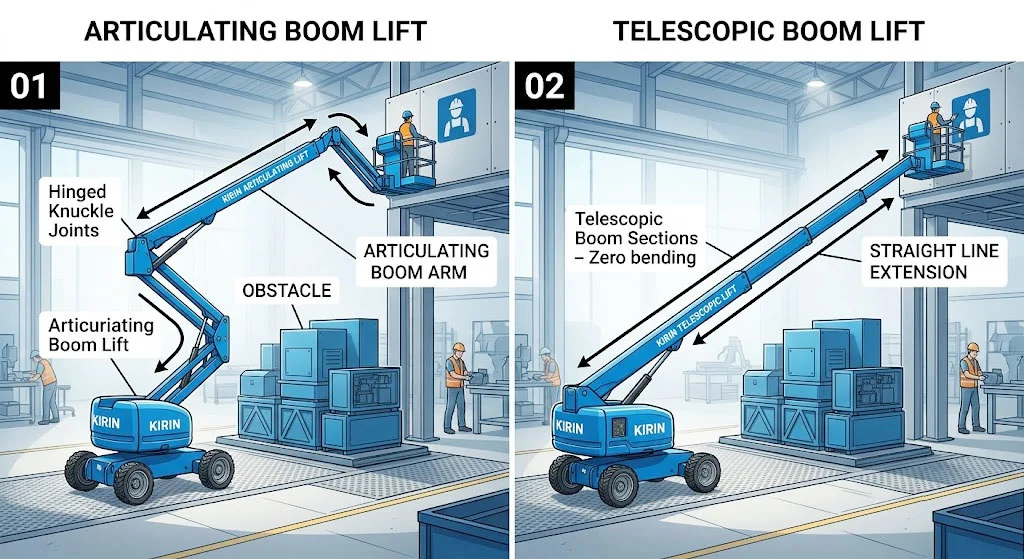
A self-propelled articulating boom lift features a lifting arm constructed with multiple hinged sections. These hinges allow the boom to bend, flex, and “knuckle” over obstacles.
- The “Up-and-Over” Advantage: This design is specifically engineered for jobsites where you need to reach a high work area that is blocked by ground-level obstacles like walls, storage racks, pipes, or machinery.
- Maneuverability: A self-propelled articulated boom lift equipment setup offers a compact turning radius and precise basket articulation, making it perfect for complex industrial maintenance environments.
Telescopic Self-Propelled Boom Lift
Often referred to as “stick” or “straight” lifts, self-propelled telescopic boom lifts feature a straight boom arm that extends directly outward and upward via telescoping internal sections.
- Maximum Reach: If your project requires raw height and outstanding horizontal outreach, self-propelled telescopic boom lifts are the definitive industry standard.
- Speed and Direct Access: They extend quickly in a straight line, making them highly efficient for open-air construction sites, shipyards, and exterior building facades where there are no major intermediate obstructions.
Electric Self-Propelled Boom Lift
Designed primarily for indoor applications, cleanrooms, and urban jobsites, an electric self-propelled boom lift runs entirely on heavy-duty industrial battery banks.
- Environmental Friendliness: They produce absolutely zero exhaust emissions, making them fully compliant with indoor air quality regulations.
- Surface Protection: These machines almost always come equipped with solid, non-marking rubber tires to ensure that polished concrete, epoxy, or tiled facility floors remain completely free of black scuff marks.
Rough Terrain Self-Propelled Boom Lift
When a project takes you off the paved pavement and into raw, unimproved dirt, mud, or gravel, a rough terrain self-propelled boom lift is required.
- Robust Drivetrain: These units feature heavy-duty four-wheel drive (4WD) systems, oscillating axles for maintaining tire-to-ground contact, and deep-tread luggage tires.
- Gradeability: They possess high ground clearance and exceptional gradeability (often up to 45%), allowing them to climb steep, unpaved jobsite ramps and muddy hillsides effortlessly.
Main Features of a Self-Propelled Boom Lift
When looking at a high-quality self-propelled boom lift for sale, you will notice several standard engineering elements designed to maximize jobsite performance:
- 360-Degree Continuous Turntable Rotation: Allows the upper structure to spin completely around in a circle, providing a massive working envelope without needing to reposition the drive chassis.
- Proportional Control Joysticks: Delivers smooth, responsive control over driving speed and boom movements, reducing basket sway at high altitudes.
- Jib Boom Extension: Many premium models include a short, articulating arm section near the basket (a jib) that provides an additional 4 to 6 feet of localized articulation up, down, or sideways for ultra-precise basket placement.
- AC Power to Platform: Integrated internal wiring routes electrical power from the ground generator or battery bank directly to an outlet in the basket, letting workers plug in power tools safely without dangling cords.
Advantages of Using a Self-Propelled Boom Lift
Investing in or deploying a self-propelled boom lift offers profound operational advantages over traditional ladders, scaffolding, or non-propelled lifts. Let’s look closer at the 7 powerful benefits that make this machine indispensable:
- Unrivaled Jobsite Mobility: Because the machine is driven directly from the elevated basket, repositioning takes seconds. Workers never have to waste energy climbing up and down to adjust the lift’s location.
- True “Up-and-Over” Clearance: Using a self-propelled articulating boom lift allows your crew to easily clear complex physical barriers, cantilever over storage structures, and work directly above permanent facility assets.
- Enhanced Worker Safety: Standing in an enclosed steel basket with integrated fall-protection anchor points is significantly safer than working from traditional extension ladders or staging scaffolding.
- Significant Reduction in Labor Costs: Tasks that used to require a multi-person crew days to build, adjust, and tear down scaffolding can now be accomplished by a single operator in a fraction of the time.
- Versatile Multitasking Capabilities: With options ranging from indoor electric units with non-marking tires to diesel 4×4 rough terrain monsters, there is a configuration optimized for every conceivable work environment.
- High Weight and Tool Capacities: Dual-capacity designs allow modern platforms to lift multiple workers along with heavy toolboxes, replacement parts, and installation materials up to the work zone simultaneously.
- Compact Layouts and Small Footprints: Despite their impressive vertical reach, these lifts are engineered to fold down into highly compact stowed configurations, allowing them to pass through standard industrial doors and maneuver within narrow facility aisles.
Common Applications of Self-Propelled Boom Lifts
The incredible utility of self-propelled boom lifts makes them staples across a wide array of global industries:
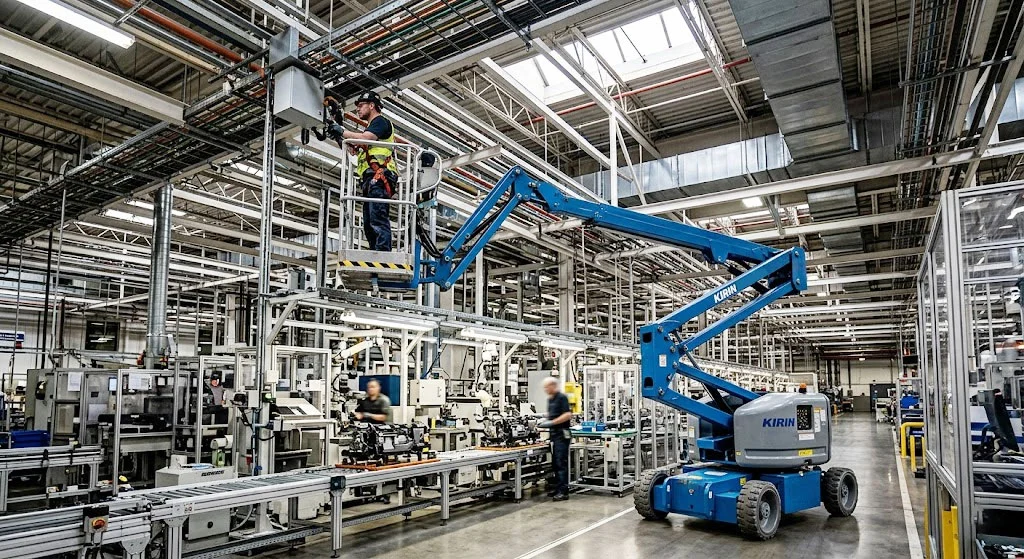
- Industrial Manufacturing Facilities: Used extensively for overhead crane maintenance, overhead pipe runs, HVAC ductwork servicing, and facility light fixture replacements above running assembly lines.
- Commercial Construction Projects: Crucial for structural steel erection, exterior wall cladding installation, glazing, and architectural painting.
- Shipyards and Aerospace Hangars: Facilitates the close-up inspection, sanding, painting, and structural maintenance of massive container ships and commercial aircraft fuselages.
- Municipal Infrastructure and Utility Work: Essential for public bridge inspections, street light repair networks, highway sign installations, and seasonal urban decorations.
- Warehousing and Logistics Centers: Utilized for high-bay rack assembly, facility maintenance, and roof-level fire sprinkler system inspections.
Self-Propelled Boom Lift vs. Other Aerial Lifts
To understand what category is a self-propelled boom lift, it helps to see how it stacks up directly against other common aerial lift alternatives:
| Lift Type | Vertical Reach | Horizontal Outreach | Obstacle Clearance | Mobility Profile |
| Self-Propelled Boom Lift | Excellent (Up to 180+ ft) | Outstanding | Excellent (Articulating models) | Highly Mobile (Driven from basket) |
| Scissor Lift | Moderate (Up to 60 ft) | None (Vertical Only) | Poor (Must sit directly under work) | Mobile (Vertical only) |
| Vertical Mast Lift | Low to Moderate | Very Limited | Poor | Compact & Lightweight |
| Towable Boom Lift | Moderate | Good | Moderate | Restricted (Requires towing vehicle) |
Important Safety Tips for Operating a Self-Propelled Boom Lift
Operating heavy machinery at significant heights demands strict adherence to rigorous safety protocols to protect operators and ground crews alike.
- Wear Appropriate Personal Protective Equipment (PPE): All operators inside a boom basket must wear a full-body safety harness attached via an approved energy-absorbing lanyard to designated anchor points in the platform.
- Conduct Thorough Pre-Operation Inspections: Every shift must begin with a visual and functional inspection of the lift. Check hydraulic fluid levels, look for structural cracks, inspect tire integrity, and verify that all ground and platform emergency stop buttons function correctly.
- Evaluate Ground Conditions Before Driving: Always inspect the travel path for hidden drop-offs, structural floor soft spots, hidden potholes, slippery debris, or uncompacted soils that could compromise stability.
- Maintain Safe Distance from Overhead Power Lines: Electrocution is a major hazard. Always maintain a minimum clearance distance of 10 feet (3 meters) from active overhead power lines, increasing the distance for higher-voltage transmission systems.
- Never Exceed the Rated Platform Capacity: Always calculate the combined weight of the operators, their personal tools, and all installation materials before lifting to ensure the total does not cross the machine’s safety threshold.
How to Choose the Right Self-Propelled Boom Lift
Selecting the ideal lift requires evaluating several specific variables unique to your project site.
Determine Working Height Requirements
Always calculate both your maximum target height and your required horizontal outreach. Keep in mind that “working height” is generally calculated by adding 6 feet (the average reach of a standing human worker) to the machine’s maximum platform height.
Evaluate Jobsite Conditions
Will the machine be operating strictly indoors on delicate flooring, or outdoors on unpaved terrain? Indoor jobs require clean, quiet electric models with non-marking tires, while outdoor sites require the high ground clearance and aggressive 4WD tread of rough terrain models.
Consider Platform Capacity
Ensure the lift you select can handle your expected crew size and tool load. If you are frequently lifting heavy structural components or large pipe sections, look for specialized dual-capacity models that offer enhanced basket weight thresholds.
Select the Appropriate Power Source
Match the power plant to your operational schedule and ventilation access. If you need continuous, multi-shift outdoor operation without stopping to plug into an electrical grid, diesel is optimal. For overnight indoor facility maintenance, choose zero-emission electric battery units.
Review Reach and Maneuverability Needs
If you are working in an open field with clear access to an exterior wall, a telescopic boom lift provides direct, high-speed vertical scaling. However, if you are maneuvering through a dense factory floor filled with structural columns and running machinery lines, an articulating model is absolutely vital.
Maintenance Tips for Self-Propelled Boom Lifts
Routine preventative maintenance ensures your material handling equipment operates reliably, retains its long-term value, and remains fully safe for operators.
- Regular Hydraulic Oil Analysis: Check hydraulic fluid levels daily and inspect for clarity. Clouded or dark fluid indicates contamination or thermal breakdown and requires a prompt fluid and filter swap.
- Grease Pivot Points and Slewing Rings: Keep all boom hinge pins, cylinder ends, and the main turntable slewing ring thoroughly lubricated according to manufacturer instructions to minimize friction and prevent premature structural wear.
- Battery Bank Upkeep: For electric models, verify battery electrolyte levels regularly (for flooded lead-acid variants), clean terminal connections to prevent corrosion, and avoid deep-discharge cycles that shorten battery life.
- Schedule Authorized Annual Structural Inspections: Beyond daily operational checks, ensure your lifts undergo thorough annual structural and functional safety inspections performed by certified, factory-trained heavy machinery technicians.
Frequently Asked Questions About Self-Propelled Boom Lifts
What is the difference between a boom lift and a self-propelled boom lift?
A standard boom lift is a broad category that includes towable units and truck-mounted units that cannot move on their own while extended. A self-propelled boom lift is an independent unit that integrates the drive chassis, allowing operators to fully drive, steer, and maneuver the machine directly from the elevated work basket.
How high can a self-propelled boom lift reach?
Depending on the specific make and model configuration, telescopic variants can achieve maximum platform heights ranging from compact 30-foot units all the way up to massive, high-reach industrial models that exceed 180 feet (55 meters).
Can self-propelled boom lifts be used indoors?
Yes, absolutely. Electric-powered models are purpose-built for indoor environments. They use high-capacity battery power to operate silently with zero tailpipe emissions, and feature solid non-marking rubber tires to protect pristine warehouse and showroom floors.
Do operators need certification to use a self-propelled boom lift?
Yes. Because operating high-altitude aerial work platforms involves inherent safety risks, regional safety regulations (such as OSHA in the United States or international CE/IPAF standards) strictly require all operators to complete formalized training and obtain a valid equipment certification before operating the machinery.
What industries commonly use self-propelled boom lifts?
They are used daily across a wide spectrum of industries including commercial construction, industrial manufacturing, facility property management, aviation maintenance, shipbuilding, warehousing, and municipal utility infrastructure management.
Conclusion
A high-quality self-propelled boom lift represents one of the most impactful investments an organization can make in its high-altitude operational efficiency, worker safety, and overall jobsite productivity. By matching the right style of lift—whether articulating or telescopic, diesel or electric—to your facility’s unique operational needs, you can easily conquer your toughest accessibility challenges.
Contact Us
Are you looking for a dependable, high-performance self-propelled boom lift for sale customized to your business requirements? Our expert engineering team is standing by to help you choose the ideal lifting equipment solution for your operations.
- Email: info@klingtec.com
- WhatsApp: +86 188 6686 3188