When tackling home improvement projects, most homeowners immediately reach for a trusty extension ladder or set up a shaky aluminum stepladder. While ladders have been the standard for generations, they come with built-in limitations: constant repositioning, a lack of stability, minimal workspace, and a high risk of falls. If you are preparing for extensive renovations, deep maintenance, or ambitious DIY projects, there is a safer, more efficient alternative that professionals use every day: mini scissor lifts.
Whether you are painting a double-height ceiling, cleaning out complex gutter systems, or installing heavy light fixtures, mini scissor lifts provide a stable, spacious, and elevated platform that fundamentally transforms how you work. In this comprehensive guide, we will explore everything you need to know about using a mini scissor lift for home environments, why they outperform traditional tools, and how to select the perfect model for your upcoming projects.
What Are Mini Scissor Lifts?
Before diving into their practical applications, it helps to understand exactly what these machines are. A mini scissor lift is a compact, motorized aerial work platform designed to move personnel and equipment vertically. Unlike large industrial lifts seen on major construction sites, a miniature scissor lift is engineered with a smaller footprint, allowing it to navigate residential spaces, fit through standard interior doorways, and operate safely on residential flooring or terrain.
How mini scissor lifts work
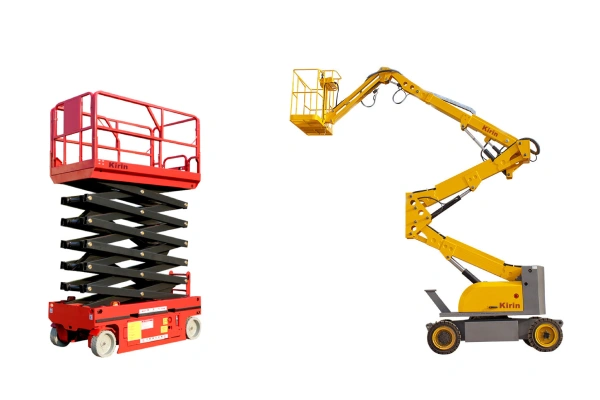
The core mechanism of a mini scissor lift relies on a linked, folding assembly of crisscross supports, known scientifically as a pantograph. When mechanical, hydraulic, or electrical pressure is applied, these linked supports unfold in a scissor-like motion, pushing the platform straight up. Because the lift moves strictly on a vertical plane, it requires very little horizontal space to operate, making mini scissor lifts incredibly predictable and easy to position.
Common Types of Mini Scissor Lifts
Not all mini scissor lifts are identical. Depending on your home’s layout and the nature of your projects, you will encounter a few primary variations:
- Electric mini scissor lifts: Powered by rechargeable battery packs, an electric mini scissor lift is the gold standard for residential environments. A mini electric scissor lift operates quietly, emits zero emissions, and utilizes non-marking rubber tires to protect delicate hardwood, tile, or laminate flooring.
- Hydraulic mini scissor lifts: These models use liquid fluid pressure to actuate the lifting mechanism. While some rely on manual foot pumps (often seen in a static mini scissor lift table used for workshop mechanics), motorized hydraulic versions offer smooth ascent and descent controls.
- Compact indoor models vs. rough-terrain models: Compact indoor mini scissor lifts prioritize a slim profile and tight turning radiuses, allowing them to glide down residential hallways. Conversely, rough-terrain mini scissor lifts feature heavier chassis, wider wheelbases, deeper tire treads, and sometimes gas or diesel engines to navigate uneven backyard turf, gravel, or mud.
Typical Lift Heights and Capacities
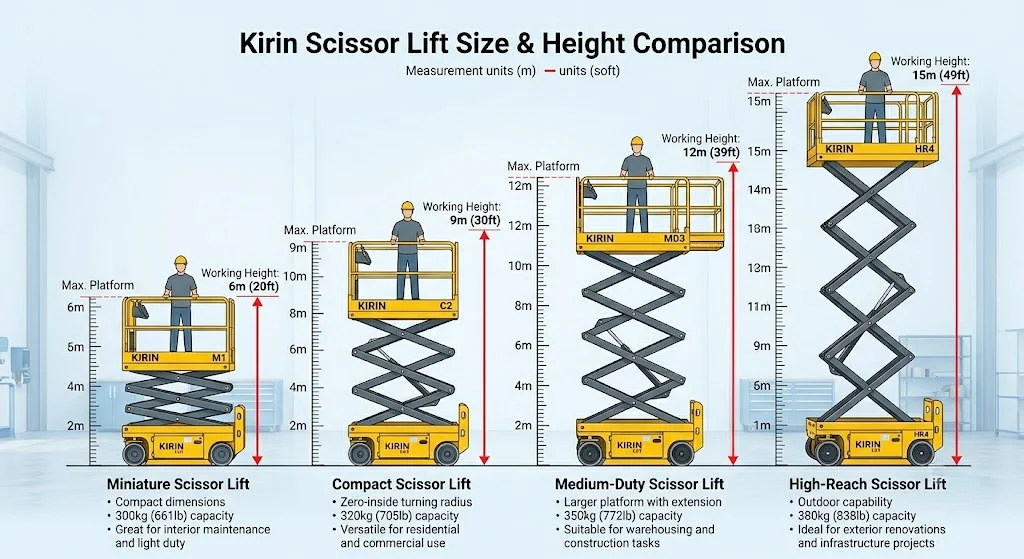
Don’t let the “mini” designation fool you. A standard residential-grade mini scissor lift typically offers platform heights ranging from 10 to 19 feet. When you factor in the height of the human operator standing on the deck, this translates to a working reach of roughly 16 to 25 feet—more than enough to handle standard two-story residential ceilings and rooflines. Despite their compact frames, these machines regularly boast weight capacities between 500 and 600 pounds, allowing two adults and their heavy toolkits to ascend simultaneously.
Why Mini Scissor Lifts Are Ideal for Home Improvement Projects
Upgrading from a ladder to a drivable mini scissor lift yields immediate benefits in safety, comfort, and speed. Here is why homeowners are increasingly choosing mini scissor lifts over old-school solutions.
Compact Size for Tight Spaces
The standout feature of a mini scissor lift for home applications is its spatial agility. Many models feature an overall width of just 30 to 32 inches. This means you can drive the lift directly through a standard 36-inch residential front door, roll it into a bedroom, or maneuver it through a tight garage layout without scraping your drywall.
Improved Safety Compared to Ladders
According to global health and safety statistics, falls from ladders are among the leading causes of severe residential injuries. Working on a ladder requires constant balancing, limits your movement, and forces you to hold tools with one hand while gripping a rung with the other. Mini scissor lifts completely eliminate this hazard. The operator stands flat-footed on a slip-resistant metal deck, entirely surrounded by heavy-duty steel guardrails and integrated toe-boards. You can work with both hands completely free, eliminating the vertigo and fatigue associated with prolonged ladder use.
Increased Efficiency and Productivity
Think about how much time you waste climbing down a ladder, picking it up, shifting it three feet to the right, and climbing back up just to paint a fresh strip of wall. With a drivable mini scissor lift, you never have to descend to reposition. Using simple joystick controls on the platform, you can drive the machine forward, backward, and steer into a new position while remaining fully elevated (on flat, level surfaces). Furthermore, the spacious platform acts as a mobile workbench, letting you bring your paint cans, power saws, drywall sheets, and drills up with you in a single trip.
Cost-Effective Equipment Option
While the upfront mini scissor lift price is higher than a standard ladder, these machines are incredibly cost-effective when analyzing project timelines. By cutting your working time in half, a mini scissor lift minimizes the duration of equipment rentals or prevents you from needing to hire expensive professional contractors for tasks you can now safely handle yourself.
Top Home Improvement Tasks for Mini Scissor Lifts
The sheer adaptability of mini scissor lifts makes them useful across an extensive array of residential renovations. Here are some of the top home improvement tasks where a miniature scissor lift excels:
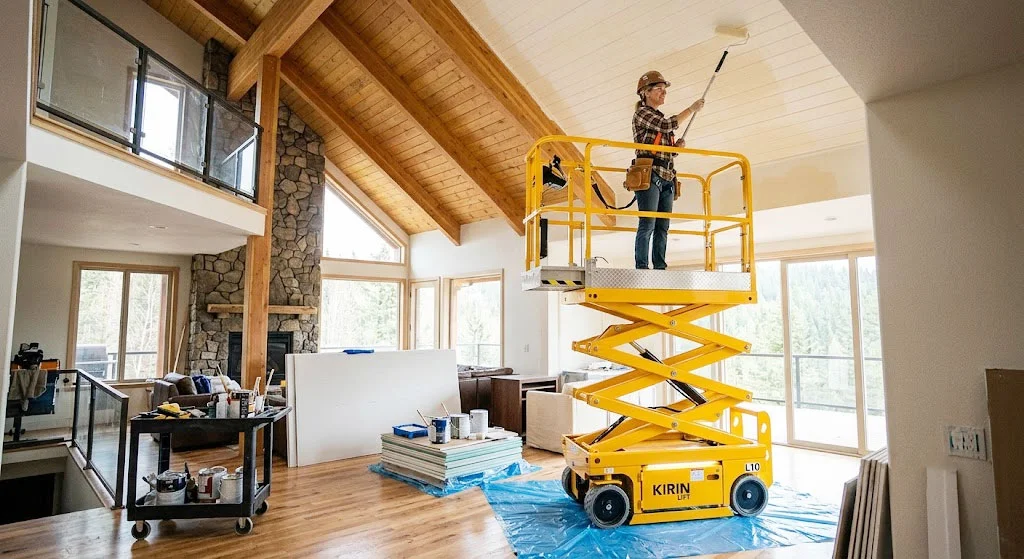
- Interior Painting and Drywalling: Painting vaulted ceilings, grand entryways, or multi-story stairwells is notoriously difficult. A mini electric scissor lift allows you to roll smoothly along a wall, applying paint evenly without the stop-and-start pattern caused by ladders. It also provides the perfect platform for holding heavy sheets of ceiling drywall in place during installation.
- HVAC Ductwork and Ventilation: Installing or repairing heating, ventilation, and air conditioning ducts requires precision and two-handed labor. A lift keeps you perfectly leveled with your ceiling joists, making it easy to seal joints, hang ducting, and install register vents safely.
- Lighting and Ceiling Fan Installation: Hanging heavy crystal chandeliers, tracking architectural lighting, or mounting large ceiling fans requires strength and stability. Mini scissor lifts allow you to lift the fixture onto the platform, ride up with it, and take your time wiring it without straining your neck or losing your balance.
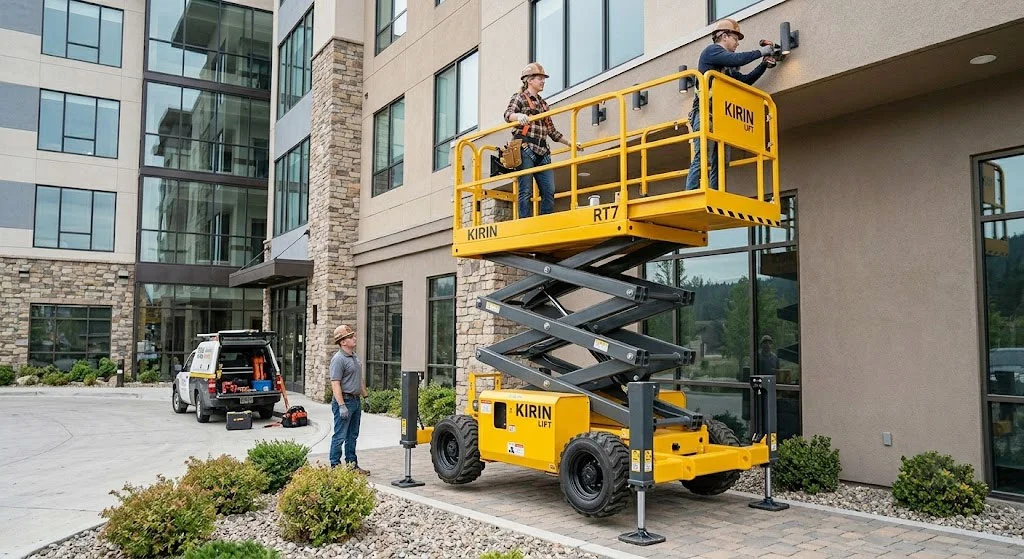
- Window Cleaning and Leaf Gutter Maintenance: On the exterior of your home, an outdoor-rated mini scissor lift allows you to wash second-story windows safely or clear stubborn debris out of your gutters without leaning precariously over a roof edge.
- Tree Pruning and High-Level Landscaping: For homes with managed trees or high hedgerows, a rough-terrain lift provides a rock-solid foundation for operating pole saws and trimming back branches that threaten your roofline or power lines.
Indoor vs. Outdoor Use of Mini Scissor Lifts
Understanding where and how you will use your machine is critical, as indoor and outdoor environments present entirely different structural challenges.
Best Indoor Applications
Indoors, the priority is protecting your home’s finished surfaces. An electric mini scissor lift is absolutely mandatory here. Because they run entirely on battery power, they emit zero carbon monoxide or noxious fumes, ensuring your indoor air quality remains safe. Their solid rubber, non-marking tires prevent black scuff marks on floors. They are perfect for great rooms, indoor basketball courts, home theaters, and renovated barns.
Outdoor Performance Considerations
When moving outdoors, the main adversary is the ground condition. Standard residential driveways and concrete patios are excellent surfaces for indoor-style compact lifts. However, if you need to drive onto grass, dirt, or gravel, an indoor lift can easily sink or tip. Outdoor-rated or rough-terrain mini scissor lifts utilize wider tires, higher ground clearance, and advanced four-wheel braking systems to maintain stability on slightly imperfect or soft surfaces.
Choosing the Right Lift for Your Environment
To guarantee you pick the right machine, evaluate these three specific elements:
| Factor | Indoor Focus | Outdoor Focus |
| Platform Size | Narrow decks (30-inch width) to clear doors and furniture. | Wider decks, often with slide-out extension decks for extra tool space. |
| Lift Height | Typically matches your highest ceiling (10 to 15 feet is standard). | Often requires higher reach (15 to 20+ feet) to clear gutters and roof peaks. |
| Power Source | Strictly mini electric scissor lift battery power to prevent emissions. | Battery power (for quiet zones) or small gas engines for rough terrain. |
Key Features to Look for in Mini Scissor Lifts
If you are browsing market listings or checking rental inventories, keep a close eye on these vital specifications to ensure you choose a high-performing model.
Platform Height and Reach
Always look closely at the distinction between “Platform Height” and “Working Height.” If a mini scissor lift lists a platform height of 12 feet, its working height is roughly 18 feet (assuming a 6-foot tall person standing on it). Never buy or rent a machine that forces you to stand on your tip-toes or overextend your arms to reach the target area.
Weight Capacity
Calculate the combined weight of yourself, any assistants joining you on the deck, and the maximum weight of your heaviest tools and materials. Ensure your chosen miniature scissor lift has a rated capacity that leaves at least a 10% to 15% safety buffer.
Mobility and Maneuverability
Look for a drivable mini scissor lift that features a zero-inside turning radius. This means the machine can rotate completely on its own axis, allowing you to turn tight corners in narrow residential corridors or around tightly packed garage shelving.
Safety Features
Modern mini scissor lifts should never skimp on safety mechanisms. Demand models equipped with:
- An emergency stop button both on the platform controller and the ground base.
- An automatic pothole protection system, which deploys steel plates near the ground to prevent the lift from tipping if you accidentally drive over a floor vent or dip.
- Tilt sensors and alarms that sound loudly if the chassis is out of level.
- A manual lowering valve to safely bring the platform down if the battery completely dies.
Battery Life and Charging
For electric models, ensure the machine uses a deep-cycle battery configuration that provides a full day of intermittent operation (typically 6 to 8 hours of active use). Look for units with integrated, smart chargers that plug directly into a standard 110V residential wall outlet.
Safety Tips for Operating Mini Scissor Lifts at Home
While mini scissor lifts are exponentially safer than ladders, they are still heavy pieces of industrial machinery. Operating one safely at home requires strict adherence to a few fundamental rules:
- Inspect the Site First: Before turning on the machine, look up. Check for ceiling fans, dangling light fixtures, and low-hanging outdoor power lines. On the ground, check for loose cords, floor vents, or soft patches of earth.
- Keep the Deck Clear: It is easy to accumulate trash, cut drywall scraps, and loose screws on your platform. Keep your workspace tidy to eliminate tripping hazards while you are elevated.
- Never Use Make-Shift Boosters: If you cannot reach a spot, do not place a plastic milk crate, step stool, or bucket inside the scissor lift basket to gain extra height. This completely bypasses the guardrail protection and can easily lead to a fatal fall.
- Wear Appropriate Personal Protective Equipment (PPE): Always wear a hard hat when operating the lift around overhead structural beams, and wear sturdy, closed-toe shoes with slip-resistant soles.
Renting vs. Buying Mini Scissor Lifts
For the average homeowner, deciding whether to rent or purchase a lift comes down to budget and project duration.
When to Rent
If you are doing a one-off home renovation—such as painting your entire interior before moving in, or spending a weekend installing a new HVAC layout—renting is your best bet. Local equipment yards offer daily, weekly, and monthly rates. Renting ensures you get a modern, perfectly maintained machine, and the rental company handles the heavy transportation to and from your home.
When to Buy
If you own a small hobby farm, a massive estate, multiple rental properties, or run a dedicated home-based workshop, buying your own unit makes long-term sense. Having a dedicated mini electric scissor lift parked in your garage means you can handle property maintenance instantly without rushing against a rental clock.
Understanding the Price Structure
The mini scissor lift price varies dramatically based on condition and features. A brand-new, premium commercial-grade mini electric scissor lift can cost anywhere from $5,000 to $10,000. However, the used market is filled with well-maintained fleet units ranging from $2,000 to $4,500. Alternatively, if you only need an elevated material helper for your garage workshop, a manual hydraulic mini scissor lift table can be purchased for a few hundred dollars.
Common Mistakes to Avoid When Using Mini Scissor Lifts
To keep your home improvement project running smoothly, make sure you don’t fall victim to these common operational oversights:
Exceeding Weight Limits
It can be tempting to load up multiple bundles of heavy roofing shingles or stack dozens of 2×4 lumber boards onto the platform. Overloading a mini scissor lift strains the electric motors or hydraulic valves, which can trigger automatic system shut-offs or cause the machine to lose balance.
Using the Lift on Uneven Ground
Scissor lifts are designed for purely vertical extension. If the base of the machine is parked on a noticeable slope or uneven patch of yard, extending the platform shifts the center of gravity drastically skyward, creating a severe tip-over risk. Always ensure the ground level indicator reads perfectly flat before ascending.
Ignoring Maintenance Requirements
If you own your lift, skipping routine checks is dangerous. Batteries must be filled with distilled water periodically, hydraulic fluid lines must be inspected for pinhole leaks, and pivot points need regular greasing to prevent structural binding.
Operating in Unsafe Weather Conditions
When working outdoors, wind is your greatest enemy. A high platform acts like a sail. Most mini scissor lifts have strict maximum wind speed ratings (often around 28 mph), above which they must never be raised. Additionally, avoid rain or icy conditions that make the metal platform deck slick.
Conclusion
When it comes to home maintenance and DIY renovations, your safety and efficiency should always be your top priorities. While ladders will always have a small place in the utility closet for quick, low-level tasks, they simply cannot match the stability, security, and sheer productivity of modern mini scissor lifts.
By investing in a rental or purchasing a dedicated mini scissor lift for home use, you eliminate the exhausting physical strain of ladder climbing, minimize your injury risks, and gain a versatile, elevated workspace that helps you complete your home improvement dreams quickly and professionally.
At Kirin Lift, we are dedicated to providing high-quality, reliable, and compact lifting solutions tailored to your unique workspace needs. If you have any questions about selecting the perfect model for your home or business, or if you would like a personalized quote, our team is always ready to assist you.
Get in Touch With Us:
- Email: info@klingtec.com
- WhatsApp: +86 188 6686 3188
FAQ Section
What are mini scissor lifts used for?
Mini scissor lifts are highly versatile aerial platforms used to safely elevate people and tools for overhead tasks. Common residential uses include interior painting, hanging drywall, installing ceiling fans, repairing roof gutters, mounting holiday lights, and trimming trees.
Are mini scissor lifts safe for indoor use?
Yes, provided you use an electric mini scissor lift. Because they run on battery power, they produce zero toxic emissions and operate quietly. Most indoor models also feature solid, non-marking tires designed specifically to protect household flooring from damage.
How high can mini scissor lifts reach?
Most residential-sized mini scissor lifts feature maximum platform heights between 10 and 19 feet. When adding the height of the operator standing on the machine, they offer a comfortable working reach of roughly 16 to 25 feet.
Can homeowners rent mini scissor lifts?
Absolutely. Most major commercial equipment rental yards and select home improvement centers rent mini scissor lifts to homeowners on daily, weekly, or monthly bases, and will frequently arrange delivery right to your driveway.
What is the difference between mini scissor lifts and ladders?
Ladders require constant physical climbing, offer a tiny foot placement area, require one hand for balancing, and must be moved manually every few feet. A drivable mini scissor lift offers a large, fully enclosed steel safety cage, carries hundreds of pounds of tools, and can be driven and repositioned smoothly while elevated.
How much weight can mini scissor lifts hold?
While weight ratings vary by specific model, a standard miniature scissor lift can typically hold between 500 and 600 pounds. This provides more than enough structural capacity for two average-sized adults to work together alongside their heavy tool belts and building supplies.