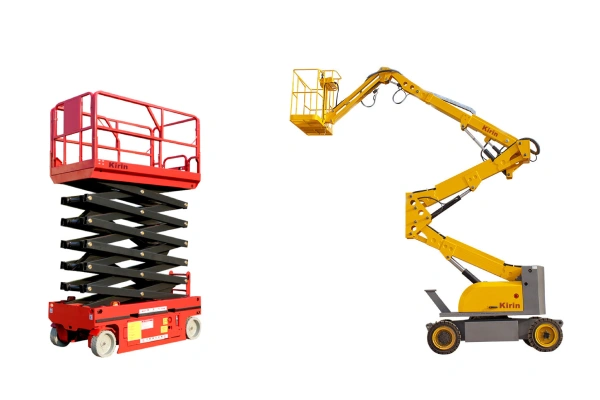
A rough terrain scissor lift is the ultimate solution for demanding job sites where standard equipment simply can’t perform. In the world of heavy machinery and aerial work platforms, one size certainly does not fit all. If you have ever tried to navigate a standard slab lift across a muddy construction site or a gravel-strewn landscape, you know exactly why specialized equipment exists.
These robust machines are the workhorses of the outdoor construction and maintenance industries. They are engineered specifically to provide a stable, elevated platform in environments where the ground is anything but level. In this comprehensive guide, we will dive deep into what makes a rough terrain scissor lift unique, how it differs from its indoor counterparts, and the 7 proven factors you need to know to choose the right one for your specific project needs.
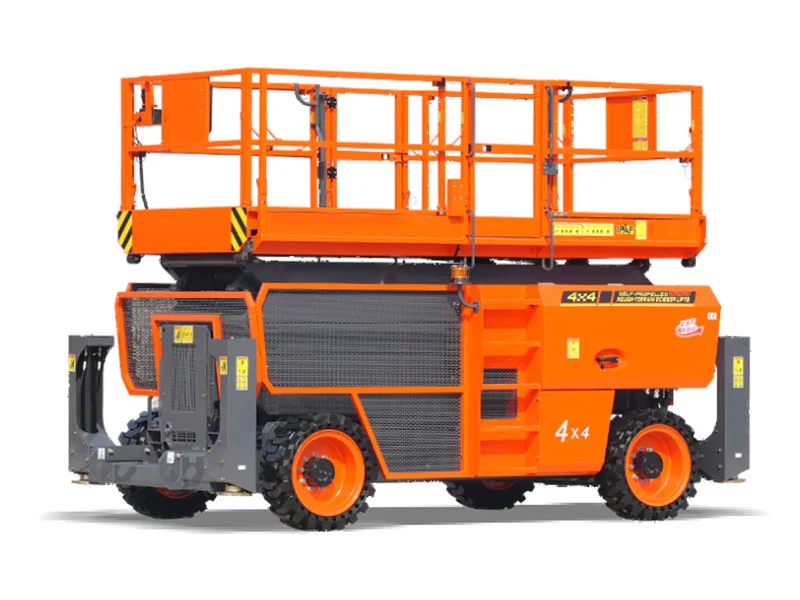
Key Features of Rough Terrain Scissor Lifts
While a standard scissor lift is built for smooth, finished concrete floors, a scissor lift is designed for the “wild.” Manufacturers build these units with high ground clearance and reinforced chassis to withstand the vibrations and stresses of uneven earth. Here are the primary features that define them:
Heavy-Duty Tires
Standard lifts often use non-marking, solid rubber tires. In contrast, rough terrain scissor lift tires are deep-treaded and usually foam-filled or pneumatic. These tires provide the necessary traction to climb over debris, navigate through soft soil, and grip slippery slopes. Because they are puncture-resistant (thanks to foam filling), you don’t have to worry about a stray nail on a job site bringing your operations to a halt.
Four-Wheel Drive (4WD)
Traction is the name of the game. Most rough terrain scissor lift models come standard with 4WD, allowing them to climb grades of up to 40% or 50%. This power ensures that the machine can move between work zones without needing to be towed or transported by another vehicle.
Outriggers/Leveling Jacks
One of the most critical safety features of a rough terrain scissor lift is the inclusion of hydraulic outriggers. When the ground is uneven, the machine cannot safely extend its platform. Outriggers act as “legs” that deploy from the base to level the machine on a slope, ensuring the center of gravity remains stable even when the platform is at full height.
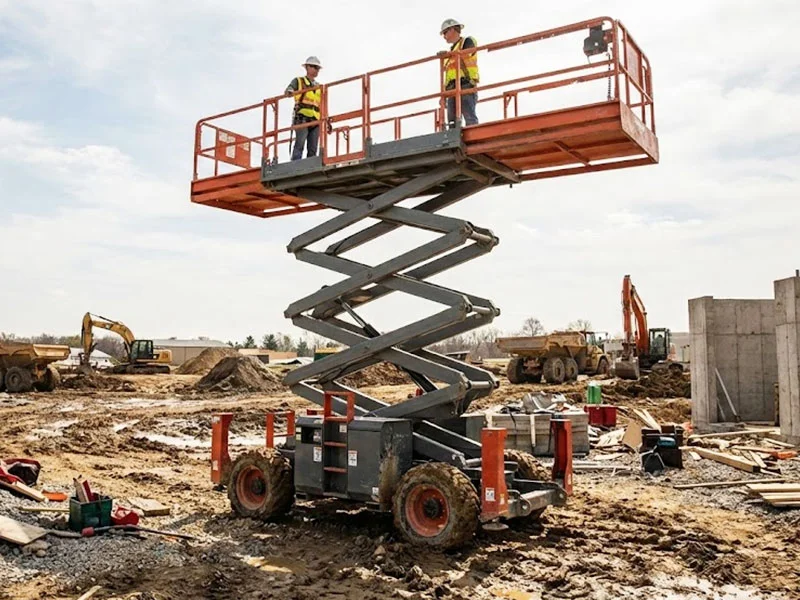
Oscillating Axles
To maintain maximum contact with the ground, many RT lifts feature an oscillating axle. This allows the wheels to move up and down independently to follow the contour of the terrain. By keeping all four rough terrain scissor lift tires on the ground, the machine maintains superior traction and stability while driving.
Power Sources: Diesel vs. Electric RT Lifts
When selecting a rough terrain scissor lift, the power source is a major factor in performance and site compatibility.
Diesel/Dual Fuel
Traditionally, the rough terrain scissor lift has been powered by internal combustion engines, usually diesel. These engines provide high torque and the raw power needed for heavy lifting and steep grades. Dual-fuel models (Gas/LPG) offer flexibility, allowing operators to switch to propane for cleaner emissions if they need to drive the unit through a large, well-ventilated warehouse.
Electric RT Lifts
The industry is shifting toward “green” solutions. A modern electric rough terrain scissor lift or a compact rough terrain scissor lift powered by lithium-ion batteries offers several advantages:
- Quiet Operation: Ideal for job sites near residential areas or hospitals.
- Zero Emissions: Allows for use in semi-enclosed spaces.
- Reduced Maintenance: Fewer moving parts than a diesel engine.
What are the Applications of a Rough Terrain Scissor Lift?
Where exactly would you use a rough terrain scissor lift? Their versatility makes them essential for various industries:
- General Construction: From framing and roofing to installing HVAC systems on new builds where the slab hasn’t been poured yet.
- Infrastructure Maintenance: Inspecting bridges, repairing stadium lights, or maintaining power lines.
- Agriculture and Landscaping: Trimming high trees, maintaining large greenhouses, or repairing barn roofs.
- Special Events: Setting up outdoor stages, lighting rigs, and sound systems on grassy or gravel fields.
- Industrial Facilities: Large-scale exterior maintenance, such as painting or window cleaning on massive factory complexes.
If your workspace involves mud, sand, gravel, or unfinished dirt, the scissor lift is your primary tool for reaching heights safely.
Rough Terrain vs. Standard Scissor Lifts
It is a common mistake to think these machines are interchangeable. They are built for entirely different “ecosystems.”
| Feature | Standard Scissor Lift | Rough Terrain Scissor Lift |
| Ideal Surface | Flat concrete, indoor floors | Dirt, gravel, mud, uneven slopes |
| Tires | Solid, non-marking | Lug-tread, foam-filled/pneumatic |
| Drive | Usually 2WD | 4WD with oscillating axles |
| Platform Size | Narrower, for tight aisles | Large, often with dual extension decks |
| Capacity | Lower (personnel focused) | Higher (material + personnel focused) |
If you need to fit through a standard doorway, a narrow rough terrain scissor lift might be required, but generally, RT lifts have a wider footprint to provide greater stability.
Safety Considerations for Off-Slab Lifting
Safety is paramount when elevating workers 30 to 60 feet in the air on unpaved ground. Using a rough terrain scissor lift requires specialized training and constant vigilance.
Ground Conditions
Before operating a rough terrain scissor lift, the operator must perform a “ground walk.” You need to look for hidden hazards like sinkholes, utility trenches, or soft spots caused by recent rain. Even with outriggers, if the ground beneath one leg gives way, the risk of a tip-over increases exponentially.
Wind Speeds
Because these lifts are used outdoors, wind is a major factor. Every rough terrain scissor lift has a maximum wind speed rating (usually around 28 mph). High-profile machines act like sails; never exceed the manufacturer’s wind limits, even if the ground is perfectly level.
Fall Protection
OSHA and international safety standards require the use of personal fall arrest systems (PFAS). While the guardrails on a rough terrain scissor lift provide primary protection, a harness and lanyard attached to an approved anchor point are non-negotiable for off-slab work where bounces and jolts are common.
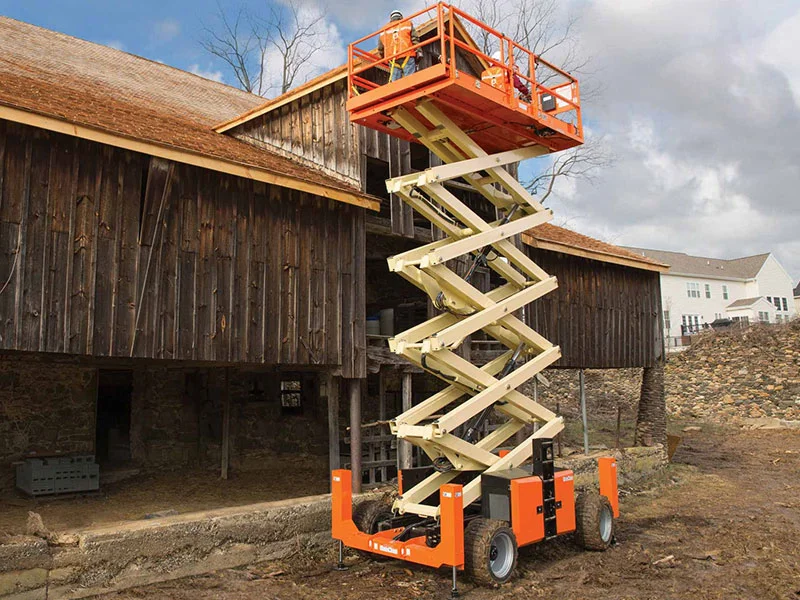
What To Consider When Choosing A Rough Terrain Scissor Lift
When you are ready to rent or buy, ask yourself the following questions to ensure you get the right machine:
- Weight Capacity: How much can a rough terrain scissor lift hold? Most models handle between 1,000 lbs and 2,500 lbs. If you are lifting heavy steel beams or large teams, look for a “high capacity” model.
- Platform Size: Do you need a compact rough terrain scissor lift for tight spaces, or a wide deck for multiple workers?
- Reach Height: Determine your maximum working height. Remember that “working height” is usually 6 feet above the “platform height.”
- Space Constraints: If you are working in an alleyway but the ground is gravel, a narrow rough terrain scissor lift will give you the RT capabilities with a slimmer profile.
Conclusion: Choosing the Right Lift for Your Project
A rough terrain scissor lift is more than just a piece of machinery; it is an investment in productivity and safety. By providing a stable platform on unstable ground, these lifts allow your team to work faster and with more confidence. Whether you opt for a powerful diesel unit or a quiet electric rough terrain scissor lift, understanding the terrain and your load requirements is the key to success.
Assess your job site, check your ground conditions, and choose a lift that offers the 4WD power and stability your project deserves.
FAQs
How much can a rough terrain scissor lift hold?
Capacity varies by model. A compact rough terrain scissor lift might hold around 1,000 lbs, while larger, heavy-duty models can hold up to 2,500 lbs or more, accommodating several workers and their tools.
Can I use a rough terrain scissor lift indoors?
Yes, but with caveats. Diesel models emit fumes, so they require massive ventilation. If you need indoor RT capabilities, an electric rough terrain scissor lift is the best choice to avoid noise and air pollution.
What makes a narrow rough terrain scissor lift different?
A narrow rough terrain scissor lift is designed to provide the high-traction tires and 4WD of an RT lift but with a chassis width as small as 5 feet. This is perfect for work between closely spaced buildings or in narrow outdoor aisles.
Do rough terrain scissor lift tires need air?
Most modern rough terrain scissor lift tires are foam-filled. This means they look like pneumatic tires but are filled with a specialized polyurethane foam, making them “flat-proof” while still providing a cushioned ride over rocks.