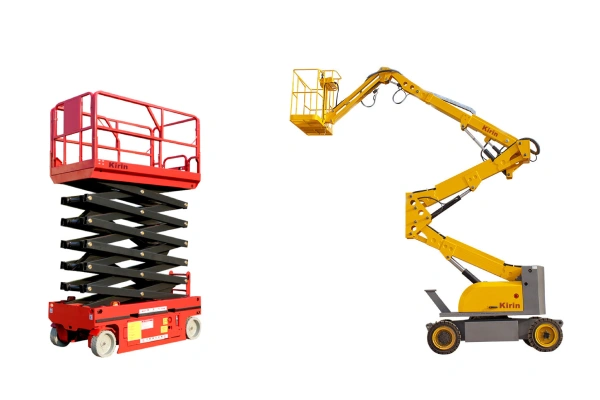
In the world of construction, facility maintenance, and warehousing, reaching elevated work areas safely and efficiently is not just a convenience—it’s a necessity. The right aerial work platform (AWP) can be the difference between a project completed on time and budget, and one plagued by delays and safety concerns. Among the most versatile and essential AWPs is the mobile scissor lift.
A mobile scissor lift provides a stable, vertically rising platform that allows personnel, tools, and materials to be safely lifted to working height. Its namesake “scissor” mechanism—a series of interconnected, folding supports—provides the platform with exceptional stability and high load-bearing capacity. At Kirin Lift, we understand that one size does not fit all. Our comprehensive line-up of mobile scissor lift models is designed to meet the unique challenges of diverse job sites.
This guide will break down five key types of mobile scissor lifts offered by Kirin Lift, helping you pinpoint the perfect piece of machinery to maximize productivity and safety on your next project. We’ll delve into the specifications, ideal applications, and distinct advantages of each model type, ensuring you make an informed decision when investing in a mobile scissor lift or mobile scissor lift table.
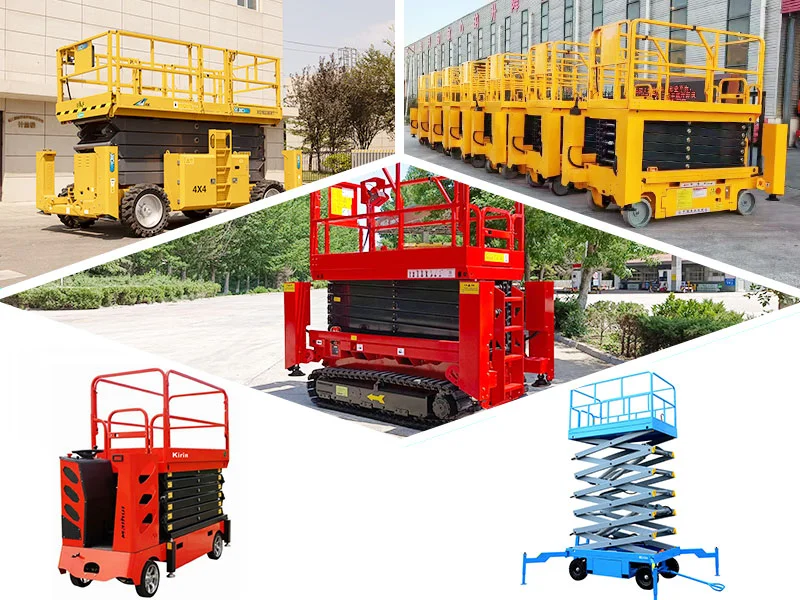
The flexibility and stability of the mobile scissor lift have made it an indispensable tool across a myriad of industries. From stocking high shelves in a warehouse to installing structural steel on a construction site, the ability to quickly and safely elevate a work crew is paramount.
Kirin Lift specializes in providing high-quality, reliable, and innovative lifting solutions. We categorize our mobile scissor lift offerings into distinct types, each optimized for specific operating environments and power requirements. Whether you require a compact, fume-free solution for sensitive indoor environments or a rugged, high-capacity machine for challenging outdoor terrains, there is a Kirin Lift model built for the job.
Our mobile scissor lifts are engineered with safety as the top priority, featuring robust guardrails, anti-overload sensors, emergency descent systems, and interlocks to ensure maximum stability at all working heights. By understanding the core differences between the models outlined below, you can select a mobile scissor lift that aligns perfectly with your operational needs, optimizing workflow and enhancing job site safety. Remember, choosing the right equipment is the first step toward a successful project.
Type 1: The Self-Propelled Electric Mobile Scissor Lift (The Indoor Specialist)
The Self-Propelled Electric Mobile Scissor Lift represents the pinnacle of indoor access technology. These compact, battery-powered units are the workhorses of warehouses, retail environments, office buildings, and clean industrial settings.
Key Features and Specifications
- Power Source: Deep-cycle batteries provide quiet, zero-emission operation. This eliminates the risk of harmful fumes, making them essential for poorly ventilated indoor spaces or environments with strict air quality standards (like hospitals or food processing plants).
- Mobility: Self-propelled means the operator can drive and steer the lift from the platform, even at full elevation in some models, significantly reducing repositioning time. This capability boosts productivity by 50-90% compared to traditional scaffolding.
- Tires: Typically fitted with solid, non-marking tires to protect sensitive indoor flooring, such as polished concrete, epoxy, or tile.
- Dimensions: Characterized by a narrow, compact chassis (often designed to fit through standard doorways and down narrow aisles), offering excellent maneuverability and a tight turning radius.
- Working Height & Capacity: Generally offer lower to mid-level working heights (e.g., up to 45 feet) and moderate platform capacities, ideal for one or two workers plus their tools.
Ideal Applications
The electric mobile scissor lift excels in tasks where cleanliness, low noise, and maneuverability are critical:
- Facility Maintenance: Changing light fixtures, painting, installing signage, and general overhead repairs in commercial or educational buildings.
- Warehousing & Logistics: Inventory picking, stock replenishment, and high-level shelf maintenance. A global industrial mobile scissor lift table variant can be used for precise load positioning.
- Mechanical & Electrical: Installing HVAC ductwork, fire suppression systems, and electrical conduits above drop ceilings.
- Retail: Setting up elaborate window displays or stocking high-level shelves in large stores and shopping malls.
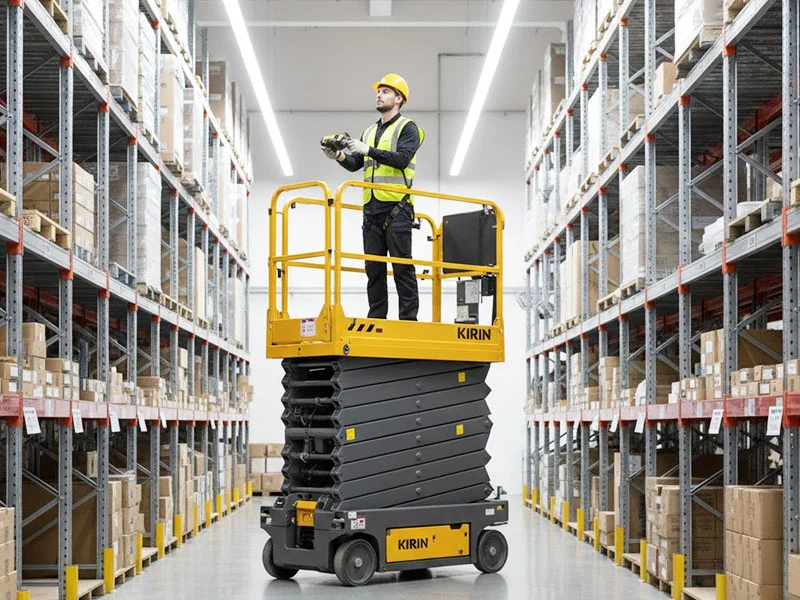
Kirin Lift Advantage
Kirin Lift’s electric models often feature proportional controls for smooth, precise movement and lifting, as well as smart diagnostics for easy maintenance. The long-lasting battery life ensures the machine can operate through an entire shift without needing a recharge, maximizing uptime. The compact footprint makes them the superior choice over bulkier alternatives, making the mobile electric scissor lift the mobile scissor lift of choice for indoor applications.
Type 2: The Rough Terrain Mobile Scissor Lift (The Outdoor Workhorse)
When your job site is unpaved, uneven, or sloped, you need a machine that can handle rugged conditions without sacrificing stability—that’s the Rough Terrain Mobile Scissor Lift. These are the preferred choice for commercial construction, infrastructure, and heavy-duty industrial environments.
Key Features and Specifications
- Power Source: Typically powered by diesel, gas, or a dual-fuel (LPG/Gas) engine, providing the necessary torque and power for outdoor operation and driving up inclines. Electric or hybrid rough terrain options are also available for sites requiring reduced emissions.
- Drive System: Equipped with heavy-duty features like four-wheel drive (4WD) and positive traction control to deliver superior grip and power on challenging surfaces like mud, sand, gravel, and rough soil.
- Tires: Large, aggressive-tread, foam-filled or air-filled tires provide maximum traction and puncture resistance.
- Gradeability: Engineered with a high gradeability rating (often 30% to 50%), allowing the mobile scissor lift to safely climb and operate on slopes.
- Stabilization: Many models include automatic leveling outriggers to ensure the platform is perfectly horizontal before elevation, a critical safety feature on uneven ground.
- Capacity & Reach: Offer some of the highest platform capacities and working heights (up to 60+ feet) within the mobile scissor lift family, accommodating multiple workers and heavy construction materials.
Ideal Applications
The Rough Terrain Mobile Scissor Lift is indispensable for any outdoor task on unfinished ground:
- Structural Construction: Steel erection, installation of exterior cladding, and roofing.
- Infrastructure: Bridge maintenance, utility work, and road construction.
- Industrial Plants: Maintenance and installation of equipment on large, unpaved factory grounds.
- Exterior Building Work: Window installation, façade painting, and masonry repairs on mid-to-high-rise structures before final landscaping.
Kirin Lift Advantage
Kirin Lift’s Rough Terrain mobile scissor lifts are built with a robust, reinforced chassis and weather-resistant components to withstand harsh environments. The combination of powerful engines, advanced hydraulic systems—which power the lifting mechanism and drive wheels, making this a powerful hydraulic mobile scissor lift—and automatic leveling ensures maximum safety and performance, no matter how challenging the ground conditions are.
Type 3: The Semi-Electric or Push-Around Mobile Scissor Lift (The Cost-Effective Solution)
For projects with limited budget, infrequent use, or those where the work areas are close together, the Semi-Electric or Push-Around Mobile Scissor Lift provides a highly economical and practical solution. This model type is a bridge between the fully manual mobile scissor lift and the completely self-propelled unit.
Key Features and Specifications
- Movement: These lifts are manual mobile scissor lifts for horizontal movement, meaning the operator must push the machine from one location to the next. Some are designed to be towable by a light vehicle or truck.
- Lifting Power: The lifting and lowering function is typically powered by a small electric motor or battery-powered hydraulic mobile scissor lift system. This is the “semi-electric” component—power assist for the hardest part of the job.
- Cost Efficiency: Lower upfront cost and minimal maintenance compared to self-propelled models, as the drive system is much simpler or non-existent.
- Weight & Compactness: Generally lighter and more compact than self-propelled counterparts, making them easier to transport on a small trailer.
- Stabilization: Often rely on manual outriggers or stabilizers that must be deployed before the platform can be raised, ensuring safety during the lift cycle.
Ideal Applications
This mobile scissor lift is best suited for environments where the lift needs to be moved occasionally, but the work itself requires electric-powered vertical access:
- Small Warehouses & Shops: Interior maintenance, light-duty installation work, or inventory tasks in single locations.
- Office Buildings & Schools: Spot maintenance where the platform only needs to be raised and lowered once per location, before being manually pushed to the next.
- Rental Fleets: An economical option for short-term rental use where mobility is secondary to vertical reach.
- Vehicle Maintenance (Mobile Car Scissor Lift Variant): A smaller, highly specialized variant of the push-around or hydraulic mobile scissor lift is the mobile car scissor lift, designed for auto shops to raise a car for underbody maintenance.
Kirin Lift Advantage
Kirin Lift’s Semi-Electric lifts are an excellent entry point into elevated work. They combine the economic benefit of manual transport with the efficiency and precision of a powered lift system. They are simple to operate, easy to maintain, and a highly safe alternative to ladders or towers for tasks that require only occasional repositioning.
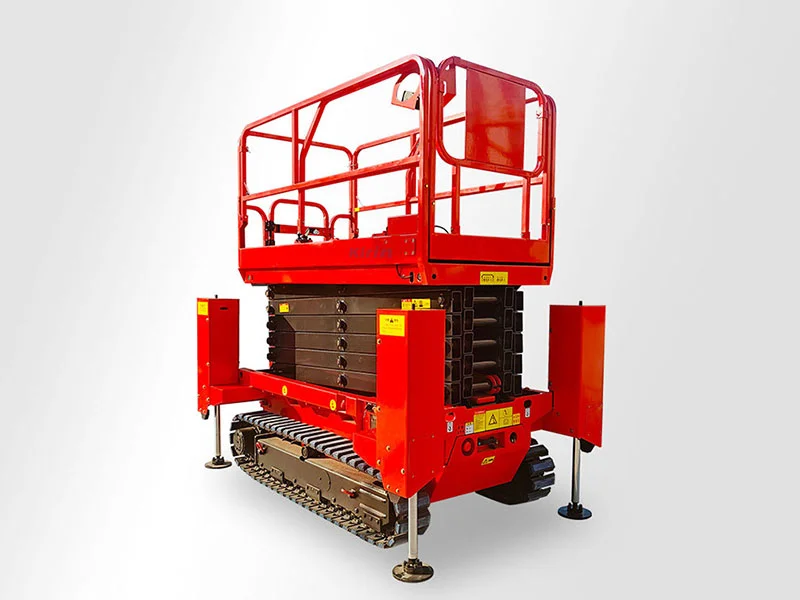
Type 4: Tracked Scissor Lift (The Extreme Terrain Navigator)
Taking the concept of a Rough Terrain Mobile Scissor Lift one step further, the Tracked Scissor Lift, also known as a Crawler Scissor Lift, replaces traditional wheels with continuous rubber or steel tracks. This specialized design offers unparalleled stability and traction on the most challenging, delicate, or remote ground conditions.
Key Features and Specifications
- Ground Contact: The tracks spread the machine’s weight over a much larger surface area, significantly reducing ground pressure. This is crucial for extremely soft surfaces like mud, sand, or delicate grounds like historical courtyards or golf courses.
- Traction & Stability: The continuous track system provides superior grip and the ability to navigate over large obstacles, ruts, or severely uneven terrain that would immobilize a wheeled machine.
- Leveling: Often equipped with advanced, fully automatic self-leveling systems that can compensate for dramatic ground slopes, ensuring the platform remains safe and level for the operator.
- Size & Power: Typically larger, heavier machines powered by diesel or dual-fuel engines to drive the track system and the hydraulic mobile scissor lift mechanism.
Ideal Applications
The Tracked Mobile Scissor Lift is reserved for the toughest environments:
- Landscaping & Tree Services: Working on soft grass, soil, or sloped parkland without causing significant damage to the ground.
- Utilities: Accessing remote power lines or infrastructure sites where no road exists.
- Oil & Gas/Mining: Operating on highly challenging, uneven, or muddy industrial sites.
- Slope Work: Construction and maintenance on steep embankments or hillsides.
Kirin Lift Advantage
Kirin Lift’s Tracked models are designed for extreme versatility and safety. The crawler system, combined with a high-performance hydraulic mobile scissor lift system, allows for operations in environments where no other type of mobile scissor lift could perform. They offer the ultimate solution for companies that operate in diverse and unpredictable outdoor conditions.
Type 5: Mobile Scissor Lift with Steering Control (The Productivity Booster)
The Mobile Scissor Lift with Steering Control is an evolution of the traditional push-around lift, incorporating battery-assisted movement and precise steering to eliminate manual pushing, drastically improving efficiency on medium-sized indoor and outdoor projects.
Key Features and Specifications
- Steering Mechanism: Unlike the fully self-propelled lift that often uses joysticks and a complex drive system, this model uses a simpler, motor-driven wheel assembly and a dedicated steering mechanism (often a simple tiller or steering wheel).
- Maneuverability: It offers a faster and easier way to move the mobile scissor lift table than manual pushing. The DC-powered steering and drive system works on a principle similar to a battery-powered pallet jack, making it easy for a single worker to operate and reposition the unit.
- Efficiency: It significantly shortens the time required for work shifts between locations, making it a “productivity booster” for sites where the work is spread across a large, flat area.
- Hybrid Operation: The lifting is typically still electric-powered, creating a highly efficient, single-operator machine that saves labor costs.
Ideal Applications
This model is perfect for large, flat-surface environments where manual pushing is too strenuous but a full self-propelled unit is overkill or too costly:
- Exhibition Halls & Arenas: Setting up lights, sound, and decorations for events, requiring continuous, fast repositioning.
- Large Retail Backrooms & Distribution Centers: Moving along lengthy aisles for inventory and maintenance.
- Factory Floors: Routine machine maintenance and assembly line work over a wide, flat area.
- Aircraft Hangers: Maintenance and inspection of large equipment where rapid repositioning is necessary.
Kirin Lift Advantage
The Kirin Lift Mobile Scissor Lift with Steering Control is an ideal middle ground. It maintains the cost-effectiveness and relatively lightweight nature of the semi-electric model while adding a crucial layer of powered mobility. This model enhances worker safety by removing the physical strain of manual moving while retaining the clean, electric-powered lift capabilities.
Choosing the Right Model for Your Job Site
Selecting the perfect mobile scissor lift requires a systematic evaluation of your job site requirements, which we call the 4 T’s of Lift Selection:
| Factor | Self-Propelled Electric | Rough Terrain | Semi-Electric/Push-Around | Tracked Lift | With Steering Control |
| Terrain | Smooth, level concrete/slab | Uneven, gravel, dirt, slopes | Smooth, flat floors | Extreme mud, sand, slopes, delicate surfaces | Smooth, flat floors (large area) |
| Task Height | Low to Mid-Level (up to 45 ft) | Mid to High-Level (up to 60+ ft) | Low to Mid-Level (manual setup) | Mid to High-Level (stable on slopes) | Low to Mid-Level |
| Timing/Mobility | Continuous, fast repositioning (driveable at height) | Continuous, fast repositioning (driveable at height) | Intermittent repositioning (manual push) | Continuous repositioning (excellent traction) | Frequent repositioning (motor-assisted) |
| Total Cost/Power | Medium to High (Battery/Electric) | High (Diesel/Hybrid Power) | Low (Manual drive, Electric lift) | High (Specialized Track System) | Low to Medium (Battery-assisted) |
When consulting with Kirin Lift, be prepared to answer the following questions to help us guide you to the correct mobile scissor lift model:
- Environment: Will the lift be used primarily indoors, outdoors, or both? Are the floors finished and sensitive, or is the ground rough and uneven?
- Height & Capacity: What is the maximum working height required, and how much weight (personnel + tools + materials) must the platform safely hold?
- Frequency of Movement: How often does the lift need to be moved? Is it stationary for long periods, or does it need to be repositioned constantly throughout the day?
- Access: Are there narrow doorways, aisles, or height restrictions you must clear?
By analyzing the answers to these questions in the context of our five mobile scissor lift types, Kirin Lift can provide a recommendation that ensures maximum productivity, cost-efficiency, and, most importantly, worker safety. Remember that every model, from the specialized mobile car scissor lift to the heavy-duty Rough Terrain unit, is a significant investment, and choosing the right tool is key.
Conclusion
The modern job site demands equipment that is safe, efficient, and perfectly matched to the application. The mobile scissor lift is an essential piece of this puzzle, offering a stable and versatile access solution for nearly any elevated task. Kirin Lift’s diverse range of mobile scissor lift models—from the nimble Self-Propelled Electric to the rugged Tracked unit—ensures that you never have to settle for a machine that is ‘close enough.’
Investing in a high-quality mobile scissor lift from Kirin Lift means investing in safety, productivity, and the smooth operation of your business. Our commitment is to provide a complete lifting solution, whether you need a compact electric mobile scissor lift for a warehouse or a powerful hydraulic mobile scissor lift for a massive construction project. We provide the expertise and the equipment to lift your operations to new heights.
FAQs
What is the main difference between a mobile scissor lift and a boom lift?
A mobile scissor lift (including a mobile scissor lift table) only moves vertically, offering a larger and more stable platform with higher capacity. A boom lift (articulating or telescopic) offers both vertical and horizontal reach, allowing it to navigate around obstacles, but typically has a smaller platform and lower weight capacity. For straight-up access and maximum workspace, the mobile scissor lift is the preferred choice.
Can an electric mobile scissor lift be used outdoors?
Generally, yes, but only on firm, level surfaces. They are not designed for uneven, rough terrain, which is the domain of the Rough Terrain or Tracked models. Always check the manufacturer’s guidelines for maximum wind speed and ground slope tolerance.
What safety features should I look for in a mobile scissor lift?
Essential safety features include: Pothole Protection (to prevent tilting if a wheel drops into a hole), Emergency Stop buttons (on both the platform and ground controls), Tilt Sensors (which prevent lifting if the machine is on an unsafe slope), Guardrails, and an Emergency Descent System (for safe lowering during a power failure). All Kirin Lift mobile scissor lift models come standard with comprehensive safety systems.
Is a hydraulic mobile scissor lift better than an electric one?
Hydraulic refers to the lifting mechanism (which uses pressurized fluid), while electric typically refers to the power source (a battery/motor). Most mobile scissor lifts are hydraulic mobile scissor lifts where the pump is powered by a battery (electric) or an engine (diesel/gas). Electric-powered lifts are favored for indoor use due to zero emissions and quiet operation.