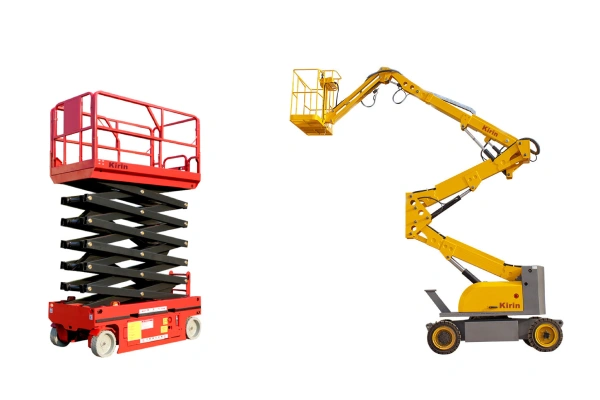
In the world of aerial work platforms, few machines offer the versatility and precision of knuckle boom lifts. Whether you are navigating a crowded construction site, performing maintenance in a high-density warehouse, or pruning trees over a residential fence, these machines—formally known as articulating boom lifts—are the “Swiss Army Knives” of the lifting industry.
Understanding the nuances of knuckle boom lift is essential for project managers, facility owners, and equipment operators alike. Choosing the wrong lift can lead to project delays, increased costs, or safety hazards. This guide provides an in-depth look at everything you need to know about knuckle boom lifts in 2026, ensuring you select the right tool for your specific application.
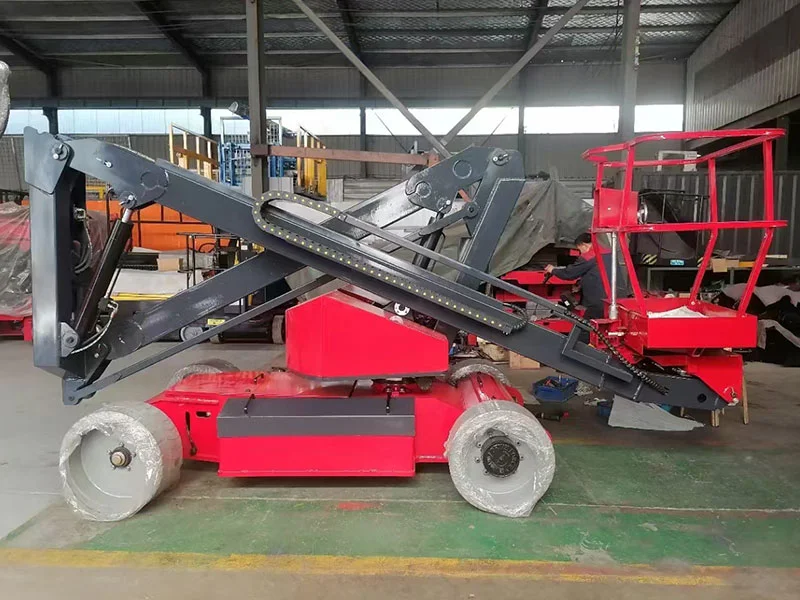
What exactly makes the knuckle boom lift so special? Unlike a standard vertical lift, a knuckle boom features multiple sections that “articulate” or bend. These joints (the “knuckles”) allow the platform to move around obstacles such as ductwork, structural columns, or power lines.
The primary appeal of the knuckle boom lift is its “up-and-over” capability. While other lifts move in straight lines, knuckle boom lifts can reach a height, bend over an obstruction, and then extend further to reach a precise work area. As urban environments become more congested and indoor facilities more complex, the demand for knuckle boom lifts continues to rise across the globe.
Knuckle Boom Lifts vs. Telescopic Booms
Before diving into the specific types of knuckle boom lifts, it is vital to understand how they differ from their closest cousins: telescopic (straight) boom lifts.
The Articulating Difference
Knuckle boom lifts are designed for flexibility. Their multiple boom sections can be positioned independently, allowing the operator to navigate complex 3D spaces. If your work site has “tight squeezes” or requires you to reach a spot behind a permanent fixture, knuckle boom lifts are your best bet.
The Telescopic Advantage
Telescopic booms, on the other hand, extend in a straight line like a telescope. They generally offer greater horizontal outreach and higher maximum heights than a knuckle boom lift. However, they have a much larger “footprint” and require a clear line of sight to the work area.
| Knuckle Boom Lifts | Telescopic Boom Lifts |
| Articulating (Multi-jointed) | Straight (Telescopic) |
| Up-and-Over positioning | Maximum reach and height |
| Crowded sites / Indoor use | Open spaces / High-rise construction |
| High | Moderate |
Main Types of Knuckle Boom Lifts
Not all knuckle boom lifts are created equal. They are categorized primarily by their power source and chassis design, which dictates whether they are suitable for indoor use, rugged outdoor terrain, or delicate flooring.
Electric Knuckle Boom Lifts
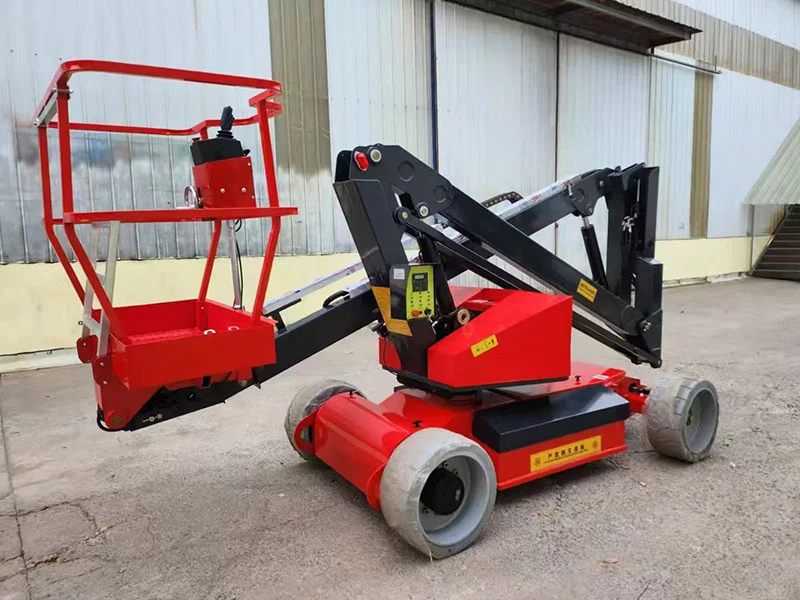
Electric knuckle boom lifts are the workhorses of the indoor maintenance and warehousing industries. Powered by high-capacity battery packs, these machines produce zero emissions and operate with minimal noise.
- Best For: Shopping malls, hospitals, factories, and airports.
- Key Features: Non-marking tires (to protect finished floors) and compact frames that fit through standard double doors.
- Pro Tip: In 2026, lithium-ion technology has become the standard for electric knuckle boom lifts, offering faster charging times and longer duty cycles than older lead-acid models.
Diesel/IC Knuckle Boom Lifts
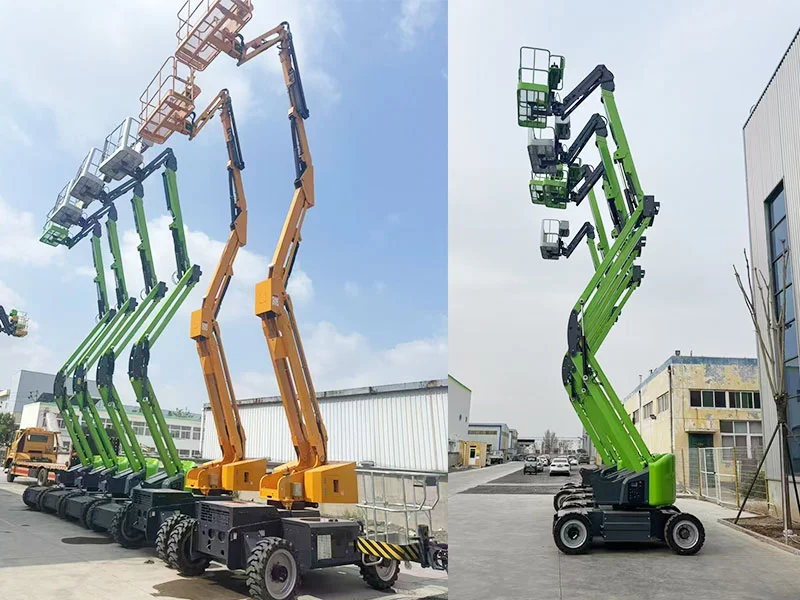
When the job moves outdoors to uneven ground or muddy construction sites, Internal Combustion (IC) knuckle boom lift takes over. These are typically powered by diesel engines and feature heavy-duty four-wheel drive (4WD) systems.
- Best For: Exterior construction, bridge inspections, and industrial shipyards.
- Key Features: High ground clearance, oscillating axles for stability on rough terrain, and powerful lift capacities.
- Performance: These knuckle boom lifts can handle steeper grades (gradeability) than their electric counterparts.
Hybrid Knuckle Boom Lifts
The “best of both worlds” option. Hybrid knuckle boom lifts utilize a smaller diesel engine paired with an electric motor and battery bank.
- Versatility: You can use the electric mode for indoor tasks to avoid fumes and switch to the diesel engine for outdoor travel or to recharge the batteries while working.
- Efficiency: They significantly reduce fuel consumption and carbon footprints, making them a popular choice for “green” construction projects.
Towable & Spider Lifts
For specialized applications, these unique versions of knuckle boom lifts offer portability and extreme accessibility.
- Towable Lifts: Can be hitched to a standard pickup truck, making them ideal for contractors who move between multiple sites in a single day.
- Spider Lifts: These are ultra-compact knuckle boom lifts that travel on tracks rather than wheels. They feature “outriggers” that look like spider legs, allowing them to set up on stairs or soft landscaping where a traditional heavy lift would sink.
Key Specifications to Consider
When renting or purchasing knuckle boom lifts, you must look beyond the “total height.” Several geometric factors determine if the machine can actually reach your target.
Platform Height vs. Working Height
- Platform Height: The maximum height the floor of the bucket can reach.
- Working Height: Usually calculated as the Platform Height plus 6 feet (the average reach of a human worker).
- Example: If your task is at 50 feet, you need knuckle boom lifts with at least a 44-foot platform height.
Horizontal Outreach
This is the distance the boom can extend horizontally from the center of the turntable. For knuckle boom lifts, horizontal outreach is often more critical than vertical height, as it determines how far “across” an obstacle you can reach.
Up-and-Over Clearance
This specific metric defines the maximum height of an obstacle that the knuckle (the main joint) can clear while still extending the upper boom section forward. This is the defining characteristic of knuckle boom lifts.
Weight Capacity
Don’t forget the “unrestricted” vs. “restricted” capacity.
- Unrestricted: The weight the lift can carry throughout its entire range of motion.
- Restricted: A higher weight limit that is only safe when the boom is within a specific, narrower envelope of movement. Always factor in the weight of the operator, their tools, and any materials (like glass panels or pipes) being lifted.
Safety and Maintenance Essentials
Operating knuckle boom lifts involves significant risk if safety protocols are ignored. Because these machines can move in so many directions, the risk of “crushing” or “tipping” is higher than with static lifts.
Pre-Operation Checks
Every shift must begin with a thorough inspection of the knuckle boom lifts.
- Hydraulics: Check for leaks in the hoses and cylinders.
- Controls: Ensure both the ground controls and platform controls are responsive.
- Tires/Tracks: Look for debris, cuts, or low pressure.
- Safety Decals: Ensure all danger/warning signs are legible.
Safety Features
Modern knuckle boom lifts come equipped with:
- Tilt Alarms: Sounds if the chassis is on an unsafe incline.
- Load Sensors: Prevents the boom from extending if the weight limit is exceeded.
- Anti-Entrapment Bars: A physical bar or electronic sensor that stops the lift if the operator is pressed against an overhead obstacle.
Operator Training
It is not enough to simply “know how to drive.” In most jurisdictions, operating knuckle boom lifts requires an OSHA-compliant (or local equivalent) certification. Training covers:
- Fall protection (harness and lanyard requirements).
- Wind speed limitations (most knuckle boom lifts should not be used in winds exceeding 28 mph).
- Electrocution prevention (maintaining a Minimum Approach Distance from power lines).
Conclusion
Choosing from the various types of knuckle boom lifts doesn’t have to be a daunting task. By focusing on your environment (indoor vs. outdoor), the obstacles you need to clear (up-and-over clearance), and your required reach, you can pinpoint the perfect machine for your project.
Knuckle boom lifts offer unparalleled access, allowing work to continue in spaces that were once considered unreachable. Whether you opt for a quiet electric model for a museum renovation or a powerful diesel 4WD for a new stadium build, these machines are the key to efficiency and safety at height.
As technology continues to evolve in 2026, we can expect knuckle boom lifts to become even smarter, with semi-autonomous positioning and even longer battery lives. For now, investing time in understanding the specifications and safety requirements of your lift is the best way to ensure a successful job.
FAQs
Can I drive a knuckle boom lift while the platform is raised?
Most modern knuckle boom lifts allow for “drive at height,” but at a significantly reduced speed. However, this should only be done on flat, level surfaces. Always check the manufacturer’s manual.
What is the average rental cost for knuckle boom lifts?
Prices vary by size and location, but in 2026, a standard 45-foot electric knuckle boom typically rents for $350–$500 per day, while larger diesel models can exceed $800 per day.
Do I need a harness to operate knuckle boom lifts?
Yes. Unlike scissor lifts (where a harness is sometimes optional depending on local regulations), a full-body harness and a specialized lanyard are mandatory in knuckle boom lifts due to the “catapult effect” that can occur if the boom bounces or the wheels hit a pothole.
How do I know if I need a knuckle boom or a scissor lift?
If you only need to go straight up and have plenty of room to park directly under your work area, a scissor lift is cheaper. If you need to reach over an object or move horizontally, you need knuckle boom lifts.