When it comes to working at heights, trailer mounted towable boom lifts have become a game-changer for both efficiency and accessibility. Whether you are a painter reaching a high gable, a facility manager maintaining streetlights, or a homeowner trimming overgrown branches, these machines offer a mobile and cost-effective solution.
However, with great elevation comes great responsibility. The most common question among first-time users and safety managers alike is: Are trailer mounted towable boom lifts safe?
The short answer is: Yes. These machines are designed with rigorous engineering standards and redundant safety systems. However, their safety is not absolute—it is a partnership between the machine’s design and the operator’s adherence to protocol. In this comprehensive guide, we will dive deep into the safety features, risks, and best practices for using trailer mounted towable boom lifts to ensure you stay protected while reaching new heights.
Introduction to Trailer Mounted Towable Boom Lifts Safety
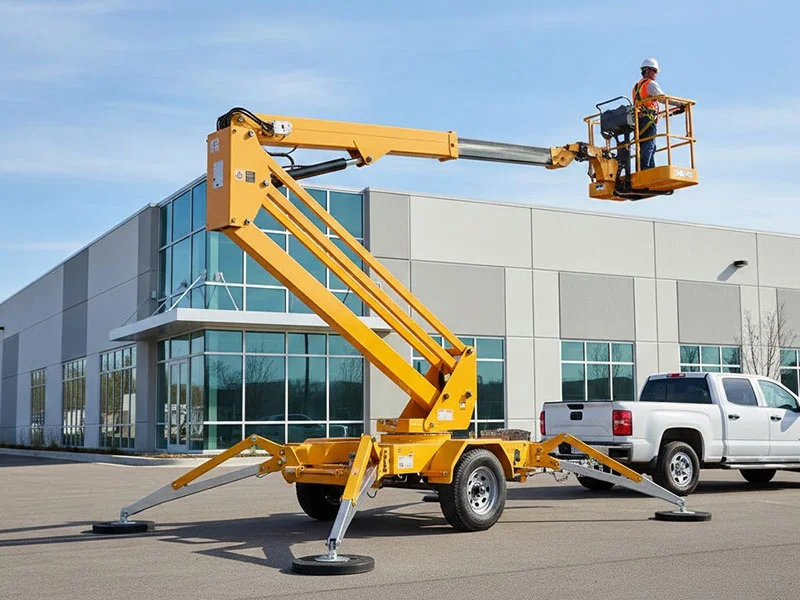
Trailer mounted towable boom lifts, often referred to as “cherry pickers” or “tow behind lifts,” are unique because they combine the reach of a traditional boom lift with the portability of a trailer. Unlike self-propelled units that you must haul on a flatbed, trailer mounted towable boom lifts can be hitched to a standard pickup truck or SUV and driven to the job site at highway speeds.
Because they are lightweight and easy to transport, they are frequently used in residential areas and on sensitive turf where heavier machinery would cause damage. But because they are lighter, their stability depends entirely on their setup. Understanding how trailer mounted towable boom lifts function is the first step in ensuring a safe work environment.
Built-In Safety Features of Towable Boom Lifts
Manufacturers prioritize safety by building multiple layers of protection into the machine. When you operate trailer mounted towable boom lifts, you are supported by several key technologies:
Outriggers & Stabilizers
The most critical safety component of trailer mounted towable boom lifts is the outrigger system. Because the wheelbase of a towable lift is narrow for road travel, it cannot provide a stable enough center of gravity when the boom is extended. Outriggers extend outward from the base, creating a much larger “footprint.” These hydraulic legs lift the wheels off the ground, ensuring the machine’s weight is distributed across a wider, more stable area.
Automatic Leveling Systems
Modern trailer mounted towable boom lifts often come equipped with automatic leveling. With the push of a button, the machine adjusts each outrigger independently to ensure the base is perfectly horizontal. If the base isn’t level, the geometry of the boom changes, which can lead to a dangerous shift in the center of gravity.
Tilt Alarms & Sensors
What happens if the ground shifts or an outrigger sinks during operation? Trailer mounted towable boom lifts are fitted with tilt sensors. If the machine detects a slope greater than its safe operating limit (usually around 3 degrees), an audible alarm will sound, and the system will often “cut out,” preventing the operator from extending the boom further into a dangerous position.
Emergency Descent Controls
In the rare event of an engine failure or a total loss of power while you are 50 feet in the air, trailer mounted towable boom lifts include emergency descent systems. These are usually manual hydraulic valves or battery-powered auxiliary pumps that allow a ground operator—or the person in the basket—to lower the boom safely back to the stowed position.
Load Sensing Technology
Every lift has a maximum capacity, typically ranging from 400 to 500 lbs. Load sensors on trailer mounted towable boom lifts prevent the machine from operating if the weight in the basket (including the operator, tools, and materials) exceeds the manufacturer’s limit. This prevents structural failure or tipping caused by over-leverage.
Common Risks (And Why They Happen)
Even with advanced technology, accidents can occur. Most accidents involving trailer mounted towable boom lifts are caused by human error or environmental factors.
Unstable Ground
This is the number one cause of tip-overs. Trailer mounted towable boom lifts exert significant pressure on the ground through the outriggers. If the ground is soft, muddy, or contains “voids” (like a buried septic tank or a sidewalk with a hollow underside), an outrigger can sink. This creates an immediate tilt that the sensors may not be able to correct in time.
Overloading the Platform
It is easy to underestimate the weight of your equipment. A heavy-duty pressure washer, several cans of paint, and a large operator can quickly approach the limit of trailer mounted towable boom lifts. Overloading puts immense stress on the hydraulic cylinders and can lead to a catastrophic collapse.
Weather Hazards
Wind is the silent enemy of high-altitude work. Because the boom acts like a giant lever, high winds can cause the platform to sway or, in extreme cases, tip the entire unit. Most trailer mounted towable boom lifts are rated for maximum wind speeds of 28 mph (45 km/h). Working in gusts beyond this is a major safety violation.
Electrocution
Because trailer mounted towable boom lifts are often used for tree trimming or utility work, power lines are a constant threat. Electricity can “arc” to the metal boom even if you don’t make direct contact.
Towing Mishaps
The danger doesn’t stop once the boom is lowered. Improperly hitching trailer mounted towable boom lifts can lead to “fishtailing” on the highway or the lift detaching from the vehicle. Always ensure the safety chains are crossed and the hitch is locked and pinned.
Step-by-Step Guide to Safe Operation
To ensure the highest level of safety, follow this protocol every time you use trailer mounted towable boom lifts.
The Pre-Start Inspection
Before you even hitch the lift, do a “walk-around.”
- Check Fluids: Hydraulic oil, fuel, and coolant levels.
- Inspect Tires: Look for cracks, bulges, or low pressure.
- Test Controls: Ensure both the ground controls and the basket controls are responsive.
- Safety Decals: Ensure all warning signs and capacity charts are readable.
Setting Up the Site
Choose your workspace carefully. Look for overhead obstructions like branches or power lines. Ensure the ground is “firm and level.” If you are working on asphalt on a hot day, be aware that outriggers can sometimes “punch through” the softened surface.
Personal Protective Equipment (PPE)
When operating trailer mounted towable boom lifts, a hard hat and high-visibility vest are standard, but the Full-Body Harness is the most important.
Important Note: Always attach your lanyard to the designated anchor point inside the basket. Never “belt off” to a nearby tree or building; if the lift moves, you could be pulled out of the basket.
Deploying Outriggers
Always use “outrigger pads” (also called spreader plates). These large, flat pads are placed under the outrigger feet to distribute the weight over a larger surface area, significantly reducing the risk of sinking into the soil. Ensure all four outriggers are fully extended and the wheels are off the ground.
Training and Regulations
In many regions, operating trailer mounted towable boom lifts requires formal certification. In the United States, OSHA (Occupational Safety and Health Administration) requires that all aerial lift operators be “trained and authorized.”
Training involves:
- Formal Instruction: Reading the manual and understanding the physics of the lift.
- Practical Demonstration: Showing an instructor that you can operate the controls smoothly.
- Site Evaluation: Learning how to identify hazards specific to the job site.
Even if you are a DIYer, many rental yards offer a brief safety orientation. Never operate a lift without reading the specific operator’s manual for that model, as the control layout for trailer mounted towable boom lifts can vary between brands.
Who Should (and Shouldn’t) Use Them?
Professional Contractors
For painters, electricians, and arborists, trailer mounted towable boom lifts are an excellent investment. They are safer than ladders and more versatile than scaffolding. Professionals benefit from the speed of setup and the ability to move the lift between multiple sites in a single day.
Homeowners/DIYers
While rental companies do rent trailer mounted towable boom lifts to homeowners, caution is required. A homeowner may not be used to the “bounce” of a boom at full extension, which can be disorienting. If you have a fear of heights or lack experience with heavy machinery, it is often safer to hire a professional.
Conclusion: The Verdict
Are trailer mounted towable boom lifts safe? When used according to the manufacturer’s guidelines, they are incredibly safe and effective tools. They provide a stable, fenced platform that is far superior to any ladder. However, safety is a choice made every time you set the outriggers and clip in your harness. By respecting the machine’s limits and staying aware of your environment, you can complete your high-altitude tasks with total confidence.
How to buy a safe trailer mounted towable boom lift from Kirin Lift in China?
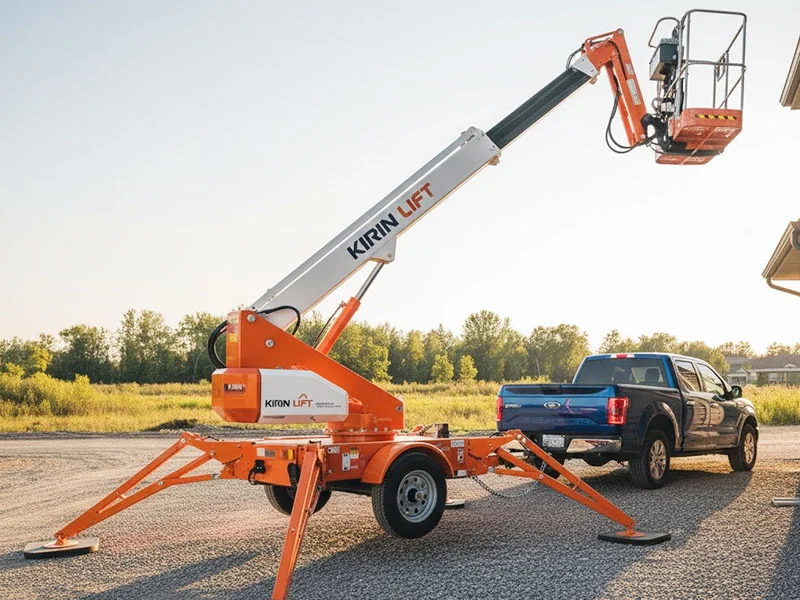
If you are looking to purchase high-quality machinery, Kirin Lift is a leading manufacturer in China known for producing robust trailer mounted towable boom lifts.
We do export all over the world. We already have extensive experience in dealing with other countries. Regardless of your country of origin, we can ship this machine to your destination. Kirin Company can help you with the entire import process. Please contact us soon for more information. Email: info@klingtec.com, Whatsapp:+86 188 6686 3188.
FAQs
Can I drive the lift while it is extended?
No. Trailer mounted towable boom lifts are not “driveable” from the basket. The outriggers must be stowed, and the boom must be lowered before the unit can be moved.
What is the maximum height of a towable boom lift?
Most trailer mounted towable boom lifts reach between 30 and 65 feet, depending on the model.
Do I need a special license to tow it?
Generally, no. Most towable lifts can be pulled by a standard driver’s license, but you must ensure your vehicle’s towing capacity exceeds the weight of the lift (usually 3,000 to 5,000 lbs).
Can I use it on a slope?
You can use it on a slight slope, provided the outriggers can level the base. Most units allow for a few degrees of correction, but never attempt to set up on a steep hill.