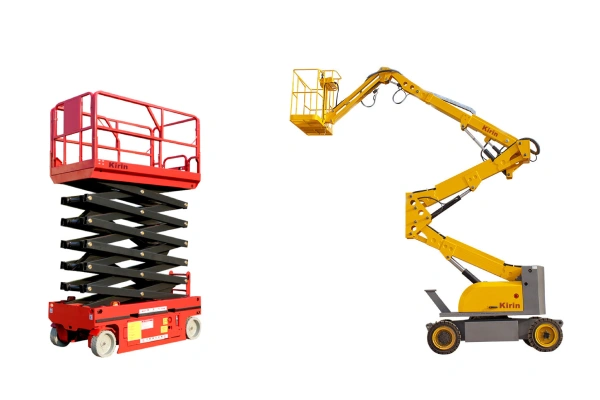
Managing a project that requires working at height can be a logistical puzzle. Whether you are painting a multi-story exterior, trimming trees, or maintaining stadium lights, you need a solution that is both mobile and capable. This is where the towable boom lift—often called a “trailer-mounted boom”—shines. Unlike heavy self-propelled units that require a semi-truck for transport, these lifts can be towed behind a standard pickup or SUV.
However, choosing the wrong machine can lead to safety hazards or project delays. This guide provides a deep dive into towable boom lift specs to help you make an informed decision for your next job.
What a Towable Boom Lift Is
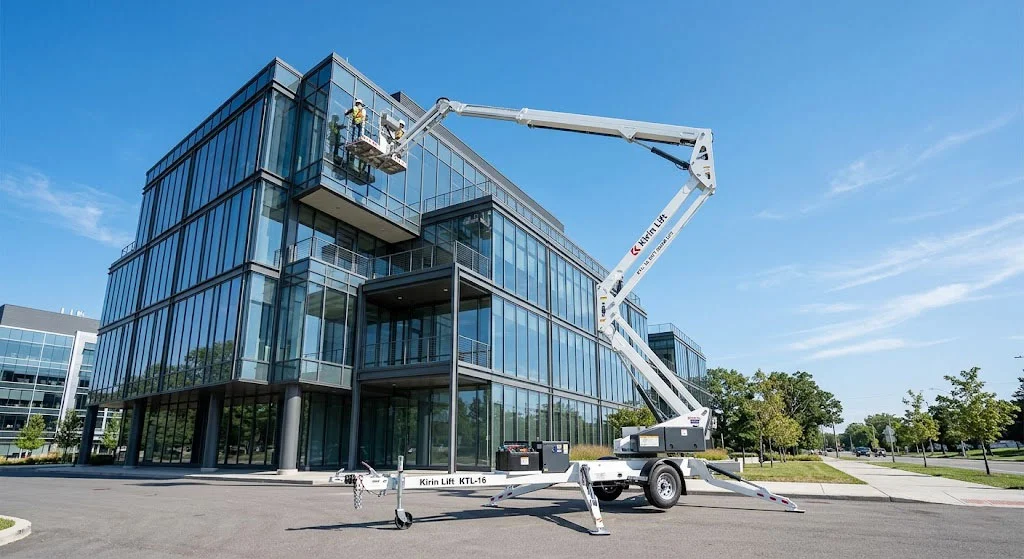
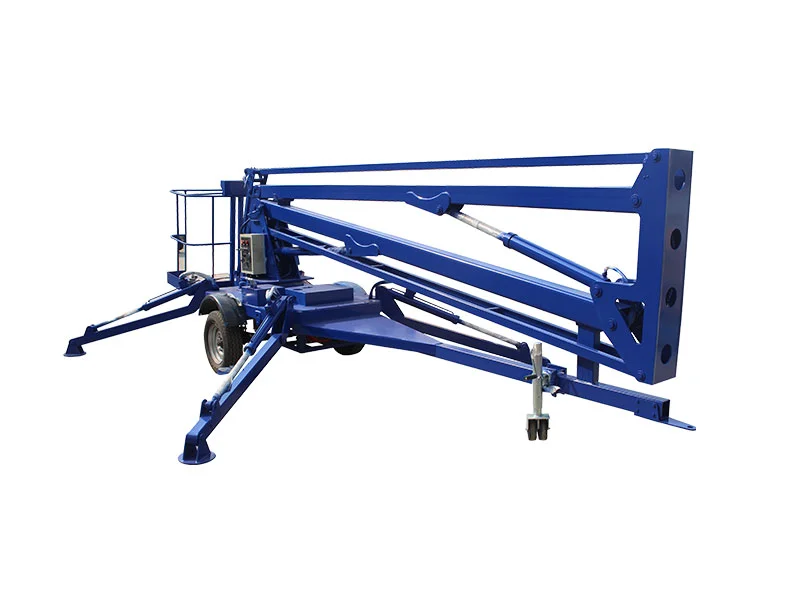
A towable boom lift is a versatile aerial work platform mounted on a trailer chassis. It features an articulating or telescopic arm that extends upward and outward, allowing workers to access hard-to-reach areas. Unlike traditional boom lifts, towables are designed with outriggers for stability, making them significantly lighter and easier to transport.
Why Understanding Towable Boom Lift Specs Matters
Precision is everything in aerial work. If you underestimate the towable boom lift height needed, your crew might end up overreaching—a leading cause of tip-overs. Conversely, if you ignore the towable boom lift weight, you might exceed your vehicle’s towing capacity, damaging your transmission or risking a highway accident. Knowing the specs ensures you have the right tool for the job, the right vehicle for the tow, and the right safety margins.
Common Industries and Applications
- Facility Maintenance: Changing high-bay LED lights or repairing HVAC ducts.
- Landscaping: Precise tree pruning and canopy management.
- Residential Construction: Painting, siding installation, and gutter repair.
- Signage and Advertising: Installing banners or repairing neon signs.
- Events and Media: Positioning cameras or lighting rigs for outdoor venues.
What Are Towable Boom Lift Specs?
Specs (specifications) are the technical measurements that define a machine’s physical limits and operational capabilities. When reviewing towable boom lift specs, you are looking at more than just how high it goes; you are looking at its “working envelope.”
How Specs Affect Performance, Safety, and Productivity
- Performance: Determines if the lift can reach over an obstacle (like a porch) to get to the work area.
- Safety: Ensures the machine remains stable on the specific grade of your job site.
- Productivity: Faster setup times and sufficient platform capacity mean fewer trips up and down.
Differences Between Towable Boom Lifts and Other Aerial Lifts
While self-propelled booms (like “cherry pickers”) can be driven while extended, towable booms must be towed to the spot, leveled with outriggers, and then operated. This makes the towable boom lift weight much lower than self-propelled models, which use heavy counterweights instead of outriggers.
Key Towable Boom Lift Specs Explained
Understanding the terminology is the first step in comparing models like the 50 ft towable boom lift specs against smaller 35-ft versions.
Platform Height
This is the measurement from the ground to the floor of the platform when fully extended. It is the most common “rating” for a lift.
Working Height
A crucial distinction: the working height is typically the platform height plus 6 feet (the average reach of a human worker). For example, a lift with a 34-foot platform height has a 40-foot working height.
Horizontal Outreach
This measures how far the boom can extend sideways from the center of the mast. This is vital when you cannot park the trailer directly under the work area due to landscaping or structures.
Lift Capacity
The towable boom lift capacity refers to the maximum weight the platform can safely hold. Most standard models are rated for 500 lbs, which accounts for two workers and their tools.
Machine Weight
The towable boom lift weight is critical for transport. A typical boom lift average weight for a towable model ranges from 3,000 lbs to 5,000 lbs, making them compatible with Class III hitches.
Overall Width and Dimensions
You must ensure the lift fits through gates or into storage areas. Most towables have a “stowed width” of 5 to 6 feet but require a much wider footprint (up to 12-14 feet) once the outriggers are deployed.
Power Source
Common options include:
- DC Electric: Best for indoor or quiet neighborhood use.
- Gas/Diesel: Better for remote sites without charging access.
- Bi-Energy: Features both an engine and a battery pack for ultimate versatility.
Drive and Towing Requirements
Check the tongue weight and the hitch size (usually 2-inch or 2 5/16-inch). Some models offer “traction drive,” allowing you to move the lift short distances on-site using a remote or platform controls without the truck.
Platform Rotation and Articulation
Articulation allows the boom to “bend” over obstacles. Platform rotation (usually 90 to 180 degrees) lets the worker square up to the wall without repositioning the entire trailer.
Maximum Slope and Gradeability
Since towables use outriggers, they can often be leveled on slopes where a self-propelled lift would be “out of level.” Check the spec for “leveling capability”—usually between 10 and 12 degrees.
Understanding Towable Boom Lift Size Categories
Compact Towable Boom Lifts
- Working Height: 30–40 feet.
- Best For: Single-story residential work and indoor gym maintenance.
- Weight: Often under 3,500 lbs, towable by most SUVs.
Mid-Range Models
- Working Height: 45–55 feet.
- Best For: Two-to-three-story buildings and standard tree care.
- Note: Pay close attention to 50 ft towable boom lift specs, as these are the most popular rental units.
High-Reach Towable Boom Lifts
- Working Height: 60+ feet.
- Best For: Industrial inspections and tall signage.
- Weight: Can exceed 7,000 lbs, requiring a heavy-duty truck (3/4 ton or higher).
Towable Boom Lift Specs Comparison Table
| Model Class | Platform Height | Working Height | Horizontal Outreach | Lift Capacity | Approx. Weight |
| Compact (e.g., JLG T350) | 34′ 5″ | 40′ 5″ | 20′ 2″ | 500 lbs | 3,400 lbs |
| Standard (e.g., Genie TZ-50) | 49′ 6″ | 55′ 6″ | 29′ 2″ | 500 lbs | 4,400 lbs |
| High-Reach (e.g., Niftylift TM64) | 63′ 6″ | 69′ 6″ | 39′ 6″ | 500 lbs | 7,700 lbs |
| Ultra-Light (e.g., Haulotte 3522A) | 35′ | 41′ | 22′ 6″ | 500 lbs | 3,245 lbs |
How to Choose the Right Towable Boom Lift Specs
Match Specs to Job Site Conditions
Measure the distance from where the trailer will sit to the work point. If there is a fence in the way, your horizontal outreach is more important than your vertical height.
Consider Transportation Needs
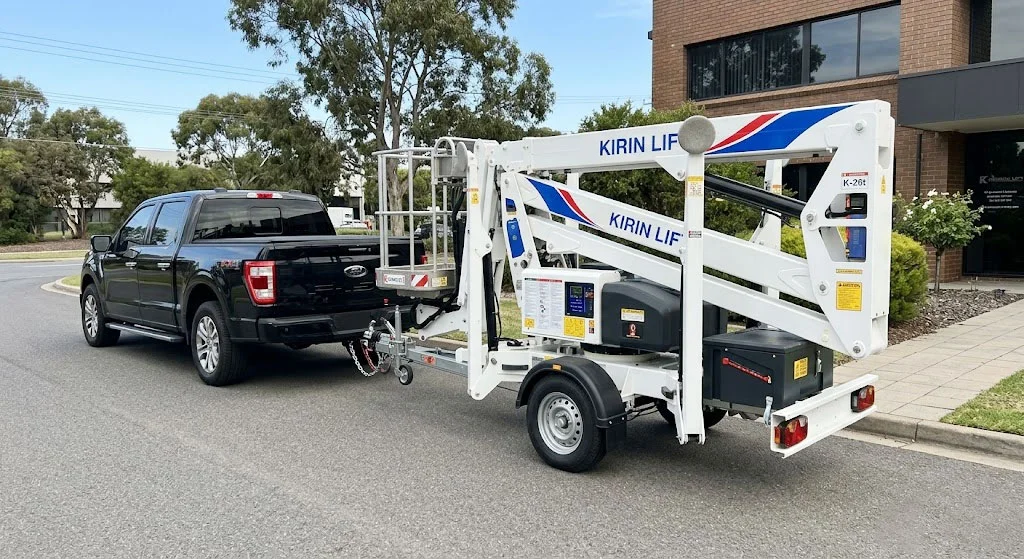
Don’t just look at the towable boom lift weight; check your vehicle’s Gross Combined Weight Rating (GCWR). A loaded truck with a 4,500 lb lift behind it might exceed your tow rating once you add passengers and gear.
Evaluate Safety Requirements
If the ground is soft, you will need outrigger pads to distribute the weight. Check the “Outrigger Footprint” spec to ensure you have enough physical space to set up.
Think About Productivity
If you are moving the lift every 10 minutes, look for a model with “Auto-Leveling Outriggers.” This can save hours of manual cranking over the course of a day.
Common Towable Boom Lift Spec Mistakes to Avoid
- Choosing an insufficient working height: Users often forget that “Platform Height” is not where your head is; it’s where your feet are.
- Ignoring towing capacity: Using a crossover SUV to tow a high-reach lift can lead to dangerous swaying or brake failure.
- Overlooking platform capacity limits: 500 lbs disappears quickly when you have two 200 lb men and 150 lbs of shingles or tools.
- Forgetting terrain limitations: Standard tires on towable lifts are for highway use. If the site is muddy, you may need a specialized model or ground protection mats.
Popular Towable Boom Lift Models and Their Specs
Compact Entry-Level Models: JLG T350
- Platform Height: 34.5 ft
- Weight: 3,400 lbs
- Key Feature: Narrow width allows for easy storage in standard garages.
Mid-Range Professional Models: Genie TZ-50
- Working Height: 55 ft 6 in
- Outreach: 29 ft 2 in
- Key Feature: Known for the “Step-and-Touch” control system which is very intuitive for new operators.
Heavy-Duty High-Reach Models: Niftylift TM64
- Working Height: Nearly 70 ft
- Weight: 7,700 lbs
- Key Feature: Incredible outreach for its class, but requires a heavy-duty tow vehicle.
Towable Boom Lift Safety Considerations
Safety starts with the specs. Always wear a full-body harness with a lanyard attached to the designated anchor point. Because towable lifts are lighter, they can be more susceptible to “the whip effect” if the operator moves the controls too quickly. Always check the wind speed spec—most lifts are rated for a maximum wind speed of 28 mph.
Maintenance Factors That Affect Performance
A lift that isn’t maintained won’t meet its specs. For example:
- Battery Health: Weak batteries in DC models will reduce the lift speed and total “duty cycle” (how long it works on one charge).
- Hydraulic Fluid: Low fluid levels can prevent the boom from reaching its maximum rated height or outreach.
- Tire Pressure: Incorrect pressure affects towing stability and leveling accuracy.
Renting vs. Buying Based on Towable Boom Lift Specs
- Rent if: You only need a specific 50 ft towable boom lift specs for a one-off project. Maintenance and storage are the rental yard’s problem.
- Buy if: You use the lift more than 60-80 days a year. Buying allows you to customize specs (like adding a material hook or air lines to the platform).
Frequently Asked Questions About Towable Boom Lift Specs
What is the average towable boom lift working height?
Most common rentals provide a working height of 40 to 50 feet.
How much weight can a towable boom lift hold?
The industry standard towable boom lift capacity is 500 lbs, though some compact models may be restricted to 440 lbs.
Can a towable boom lift be used indoors?
Yes, provided it is a DC electric or Bi-Energy model. You must also check the “floor loading” specs to ensure the surface can handle the weight of the outrigger points.
What vehicle is needed to tow a boom lift?
For units under 3,500 lbs, a mid-size SUV or 1/2 ton truck (F-150/1500) is usually sufficient. For larger 50-ft models, a 3/4 ton truck is recommended.
Are towable boom lifts safe on slopes?
Yes, as long as the slope does not exceed the “Leveling Capability” (usually 10°–12°). The outriggers must be able to level the chassis completely.
What is the difference between articulated and telescopic models?
Articulated booms have multiple sections that “knuckle,” allowing you to reach up and over obstacles. Telescopic booms extend in a straight line, offering greater horizontal reach but less flexibility.
Conclusion
The towable boom lift specs you choose will ultimately dictate the success and safety of your project. By focusing on the relationship between towable boom lift height, weight, and capacity, you can ensure that you aren’t just getting “a lift,” but the right lift for your specific environment.
Before you sign a rental agreement or a purchase order, always double-check your tow vehicle’s manual and measure your job site’s most challenging reach. If you are still unsure which model fits your needs or need a detailed breakdown of the 50 ft towable boom lift specs for your next big project, our team of experts is ready to help.
For personalized advice or to request a quote on a high-performance lift, feel free to reach out to us at info@klingtec.com or send us a quick message on WhatsApp at +86 188 6686 3188. With the right specs in hand, the sky—or at least 65 feet of it—is the limit.