Whether you are a seasoned contractor, a facility manager, or a DIY enthusiast tackling a massive home renovation, reaching high places safely is a top priority. While scaffolding is cumbersome and ladders are often precarious, the tow behind boom lift has emerged as the gold standard for portable, high-access solutions.
This guide provides a comprehensive deep dive into the technical world of towable aerial work platforms. From understanding complex reach diagrams to choosing the right power source, we have compiled everything you need to know in this ultimate tow behind boom lift spec guide.
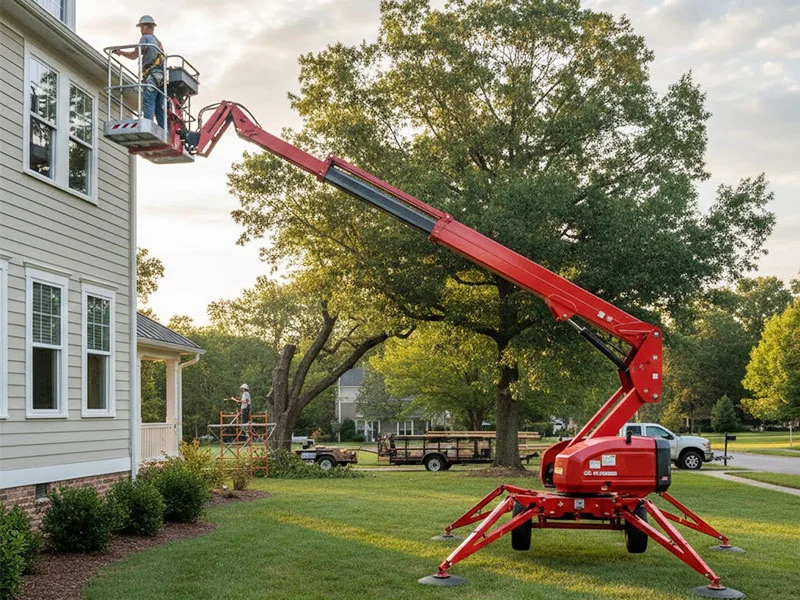
A tow behind boom lift, often referred to as a trailer-mounted boom lift, is a specialized piece of aerial equipment designed to be towed by a standard pickup truck or SUV. Unlike self-propelled boom lifts that require a commercial semi-truck and a flatbed trailer for transport, a tow behind boom lift hitches directly to your vehicle, offering unparalleled mobility and cost-effectiveness.
These machines are the “Swiss Army Knives” of the construction world. They are compact enough to fit through gates and into backyards, yet powerful enough to lift workers and tools up to 65 feet in the air. Because a tow behind boom lift is lighter than its self-propelled counterparts, it is also much gentler on sensitive surfaces like turf, gymnasium floors, or decorative pavers.
Core Specifications Explained
When shopping for or renting a tow behind boom lift, the spec sheet can look like a jumble of numbers. Understanding these core metrics is essential to ensuring you choose a machine that can actually perform the task at hand.
Working Height vs. Platform Height
This is the most common point of confusion.
- Platform Height: This is the distance from the ground to the floor of the bucket when the lift is fully extended.
- Working Height: Manufacturers typically add 6 feet to the platform height to account for the reach of an average human worker.
If your project is at a height of 50 feet, you need a tow behind boom lift with at least a 50-foot working height, not just a 50-foot platform height.
Horizontal Outreach
While vertical height gets you up, horizontal outreach gets you over. If you are painting a house but cannot park the lift directly against the wall due to landscaping, the horizontal outreach tells you how far the arm can extend sideways from the center of the machine.
Lift Capacity
Most tow behind boom lift models have a lift capacity ranging from 440 lbs to 500 lbs. This usually accounts for two adults or one adult with a significant amount of heavy tools and materials. Exceeding this limit will trigger safety sensors and prevent the lift from operating.
Turntable Rotation
How much can the lift spin? Many entry-level models offer 350-degree non-continuous rotation, meaning you have to “unwind” the boom eventually. High-end professional models may offer 360-degree continuous rotation, allowing for more efficient movement on the job site.
Power Options: Choosing Your Engine
The power source of your tow behind boom lift dictates where and how long you can work. Modern engineering has provided three primary options:
- DC Electric (Battery): Ideal for indoor use or quiet residential neighborhoods. These run on deep-cycle batteries and produce zero emissions. The downside is that they require an overnight charge (typically 8–12 hours) to be ready for the next day.
- Gasoline/Diesel: These units are powered by small internal combustion engines (like a Honda or Kubota). They are perfect for remote job sites where electricity isn’t available. They offer “infinite” runtime as long as you have fuel, but they are loud and cannot be used indoors.
- Bi-Energy (Hybrid): The best of both worlds. A hybrid tow behind boom lift features both a battery pack and an engine. The engine can power the lift and simultaneously charge the batteries, making it the most versatile option for contractors who move between indoor and outdoor environments.
Comparison Table: Top Models at a Glance
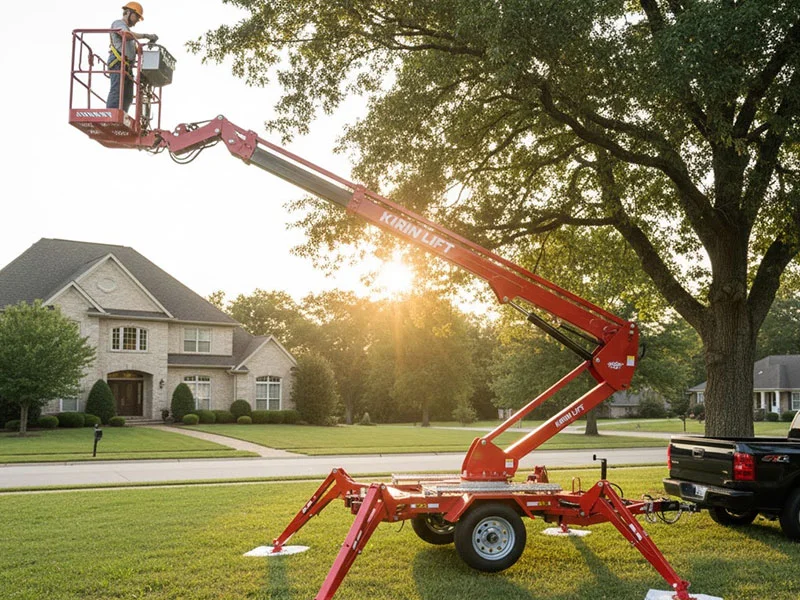
To give you a better idea of the market, here is a comparison of some of the most popular tow behind boom lift models available in 2025.
| Model | Max Working Height | Max Outreach | Weight | Power Source |
| Niftylift TM34 | 40 ft 6 in | 16 ft 6 in | 2,630 lbs | Battery or Gas |
| Genie TZ-34/20 | 40 ft | 18 ft 4 in | 3,150 lbs | DC Electric |
| Haulotte 4527 A | 51 ft | 27 ft | 4,200 lbs | Hybrid/Electric |
| JLG T350 | 41 ft | 20 ft 2 in | 3,400 lbs | Gas or Electric |
| Niftylift TM64 | 69 ft | 39 ft 6 in | 7,700 lbs | Bi-Energy |
Transport & Maneuverability Specs
The “towable” aspect is the primary reason to choose a tow behind boom lift. However, just because it has wheels doesn’t mean every vehicle can pull it.
Stowed Dimensions
Before renting, measure your storage space or the gates on your job site. A standard tow behind boom lift usually has a stowed width of 5′ 6″ to 5′ 9″ and a stowed height of around 6′ 6″. If you are working in tight alleys, these inches matter.
Automatic Leveling
Most modern units come with hydraulic outriggers. High-end models feature automatic leveling, where you simply push a button and the machine levels itself in under 30 seconds. This is a crucial spec if you are working on uneven terrain or slopes up to 12.5 degrees.
Tongue Weight
This is the amount of downward pressure the lift puts on your vehicle’s hitch. A typical tow behind boom lift has a tongue weight between 200 lbs and 300 lbs. Ensure your tow vehicle and hitch (usually a Class 2 or 3) are rated for this specific weight to avoid damaging your suspension.
Considerations for Towable Boom Lift Use
Safety and efficiency go hand-in-hand. When operating a tow behind boom lift, keep these factors in mind:
- Ground Conditions: Even though these lifts are light, the outriggers concentrate a lot of pressure on four small points. Always use outrigger pads if you are working on asphalt, soft soil, or expensive pavers to prevent “punching” through the surface.
- Wind Speed: Because a tow behind boom lift is lighter than a self-propelled unit, it is more susceptible to wind. Most manufacturers forbid operation in winds exceeding 28 mph.
- Hitch Type: Most models require a 2-inch ball hitch. Additionally, ensure your vehicle is equipped with the correct lighting plug (usually a 7-pin flat or 4-pin round) to power the trailer brakes and signal lights during transport.
- Operator Training: While you don’t need a Commercial Driver’s License (CDL) to tow one, OSHA still requires operators to be trained and certified.
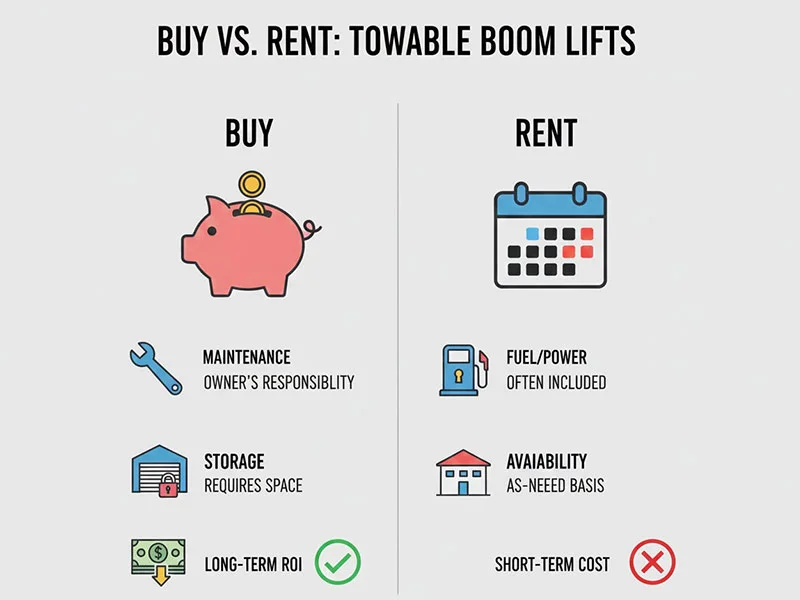
Buying vs. Renting: Which makes sense for you?
Deciding whether to purchase or rent a tow behind boom lift depends on your “Utilization Rate.”
When to Rent
Renting is the most popular option for one-off projects like painting a house, cleaning gutters, or seasonal tree trimming.
- Cost: Roughly $250–$500 per day.
- Pros: No maintenance worries, no storage required, and you can get the exact height you need for that specific job.
When to Buy
If you are a contractor using the lift more than 2–3 times a month, buying a tow behind boom lift can be a great investment.
- Cost: New units range from $25,000 to $70,000. Used units can be found for $12,000 to $30,000.
- Pros: Tax benefits (Section 179 deductions), immediate availability, and long-term ROI.
Conclusion
The tow behind boom lift is an essential tool for anyone needing to work safely at height without the logistical nightmare of heavy machinery. By focusing on key specs like working height, horizontal outreach, and power source, you can ensure that your next project is both safe and efficient.
When you choose a tow behind boom lift, you aren’t just buying or renting a machine; you are investing in the ability to reach new heights on your own terms. Always prioritize safety, check your vehicle’s towing capacity, and refer back to this guide whenever you are in doubt about the technical requirements of your equipment.
FAQs
Can I tow a tow behind boom lift with a car?
Most cars are not rated for the 3,000+ lb weight of a boom lift. You typically need a mid-sized SUV or a half-ton pickup truck (like an F-150 or Silverado) with a proper tow package.
Do I need a harness to use a tow behind boom lift?
Yes. OSHA and ANSI standards require the use of a full-body harness and a lanyard attached to the designated anchor point inside the platform at all times.
How fast can I tow a tow behind boom lift?
Most manufacturers rate their trailers for a maximum speed of 65 mph. Towing faster can cause “trailer sway,” which is extremely dangerous.
Can I use a tow behind boom lift on a slope?
Yes, but only within the limits of the outriggers. Most units can level themselves on slopes up to 10–12 degrees. Never attempt to use the lift if the leveling sensors indicate the machine is not stable.
How often does a tow behind boom lift need maintenance?
You should perform a “pre-start” inspection before every use. Professionally, these machines require a detailed annual inspection by a qualified mechanic to remain compliant with safety regulations.