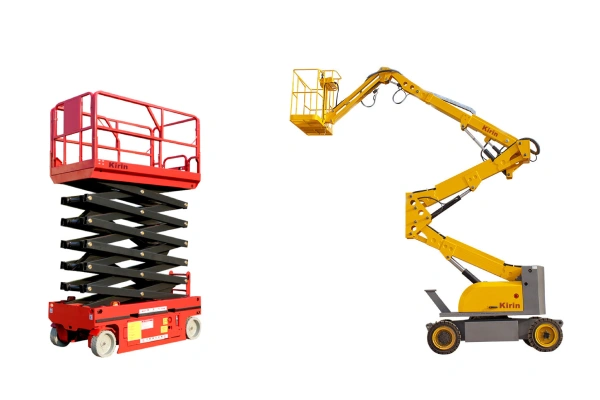
When a project requires reaching heights that a standard ladder or scissor lift simply cannot touch, professionals turn to straight boom lifts. Also known as telescopic boom lifts or “stick booms,” these machines are engineered for maximum vertical and horizontal reach.
Unlike other aerial lifts that fold or knuckle, straight boom lifts extend outward and upward in a single, direct line. This design makes them the go-to choice for tasks requiring extreme height and the ability to work at a distance from the base of the machine. In this guide, we will explore why straight boom lifts are the backbone of the construction and maintenance industries.
What Are Straight Boom Lifts?
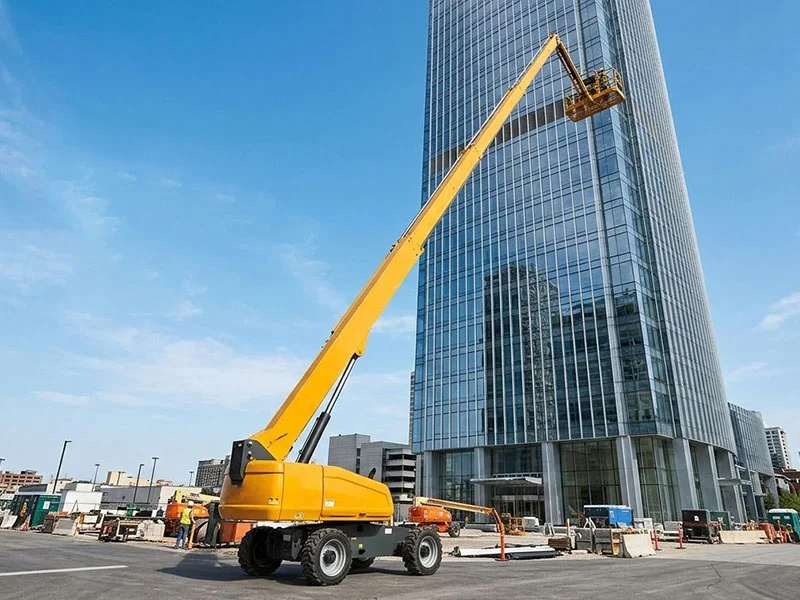
Straight boom lifts are aerial work platforms that feature a single, telescopic mast that extends straight out from the base. The boom is mounted on a rotating turntable, allowing the operator to position the platform in a 360-degree radius.
The primary characteristic of telescopic boom lifts is their “telescoping” ability. The boom consists of multiple sections that slide inside one another, allowing the machine to reach incredible heights while maintaining a relatively compact footprint when retracted. Because straight boom lifts do not have the multiple joints found in articulating lifts, they offer superior stability and higher weight capacities at full extension.
Key Features of Straight Boom Lifts
What sets straight boom lifts apart from other equipment? Here are the defining features:
- Telescopic Extension: The ability to push the boom straight out is the hallmark of straight boom lifts.
- 360-Degree Rotation: Most models feature a continuous or non-continuous 360-degree turntable for precise positioning.
- Active Oscillation: Many telescopic boom lifts designed for outdoor use feature oscillating axles to maintain traction on uneven ground.
- Four-Wheel Drive: To navigate rugged construction sites, high-performance straight boom lifts often come equipped with 4WD and foam-filled or rough-terrain tires.
- Platform Jibs: Many modern telescopic boom lifts include a small “jib” at the end of the boom, providing an extra 5–6 feet of movement to help operators “fine-tune” their position near the work surface.
Types of Straight Boom Lifts
The “best” lift depends entirely on where you are working. Manufacturers categorize straight boom lifts primarily by their power source.
Diesel Straight Boom Lifts
Diesel-powered straight boom lifts are the workhorses of the construction industry. These machines are built for high-capacity, outdoor use. They offer the highest torque and power, making them ideal for driving up ramps or through muddy job sites. If you are operating an 80′ straight boom lift on a raw land development project, diesel is likely your power source of choice.
Electric Straight Boom Lifts
For indoor applications or noise-sensitive environments, electric telescopic boom lifts are essential. They run on high-capacity battery packs and produce zero emissions. While they typically have lower reach heights than their diesel counterparts—often seen in the 40′ straight boom lift or 45′ straight boom lift range—they are perfect for warehouses, hangars, and shopping malls.
Hybrid Straight Boom Lifts
Hybrid straight boom lifts offer the best of both worlds. They use a small diesel engine to charge a battery pack or power the lift directly, allowing for both indoor and outdoor versatility. These are increasingly popular as environmental regulations become stricter in urban centers.
Straight Boom Lifts vs. Articulating Boom Lifts
Choosing between straight boom lifts and articulating (knuckle) boom lifts is one of the most important decisions a project manager can make.
Structural Differences
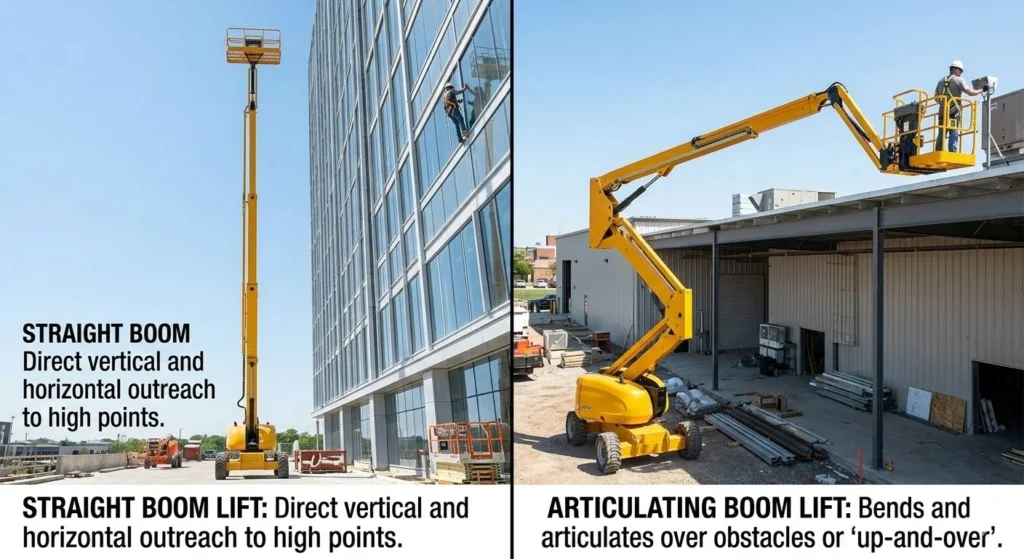
A straight boom lift has one boom that extends in a straight line. An articulating lift has multiple sections that “fold,” allowing it to bend over obstacles.
Movement Flexibility Comparison
Articulating lifts offer “up-and-over” capability, which is great for reaching over a roof or a machine. However, straight boom lifts offer much faster extension. If you have a clear line of sight to your target, telescopic boom lifts are significantly more efficient.
Working Environment Suitability
- Straight Boom Lifts: Best for wide-open spaces, high-rise exteriors, and projects requiring maximum horizontal outreach.
- Articulating Boom Lifts: Best for cramped spaces and indoor maintenance where you need to navigate around rafters or ductwork.
Reach Capability Comparison
When it comes to pure height, telescopic boom lifts win. While articulating lifts struggle with stability at extreme heights, a 135 straight boom lift can reach nearly 14 stories high with remarkable steadiness.
When to Choose Each Type
Select straight boom lifts when you need:
- Maximum height and horizontal reach.
- Speed in reaching the work area.
- Simple operation in an unobstructed environment.
Common Applications of Straight Boom Lifts
Construction Projects
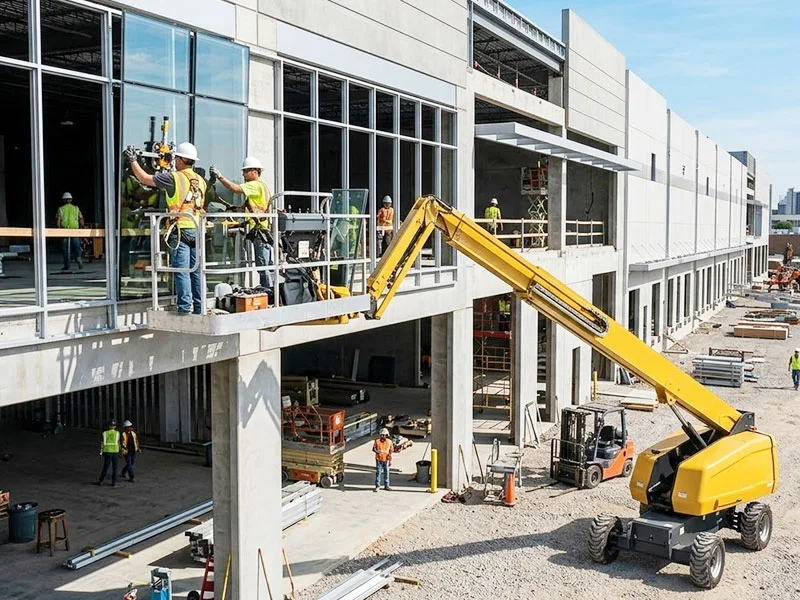
From steel erection to exterior glazing, telescopic boom lifts are the primary tool for high-rise construction. A 60′ straight boom lift is often the “goldilocks” size for mid-sized commercial buildings.
Building Maintenance
Washing windows, painting, and repairing facades on tall buildings require the stability that only straight boom lifts can provide.
Industrial Facilities
In shipyards and refineries, telescopic boom lifts allow workers to reach over large pipes or hulls to perform welding and inspections.
Telecommunications and Utilities
Installing 5G antennas or repairing power lines often requires the reach of a 65′ straight boom lift. The speed of straight boom lifts allows utility crews to move from pole to pole quickly.
Infrastructure Projects
Bridge inspections and stadium lighting repairs rely heavily on the extended outreach of large telescopic boom lifts.
Advantages of Using Straight Boom Lifts
Extended Horizontal Reach
The greatest advantage of telescopic boom lifts is horizontal outreach. If you cannot park the machine directly under your work area—perhaps due to a ditch or a delicate sidewalk—a straight boom lift can reach “out” across the obstacle better than any other lift type.
Faster Access to High Work Areas
Because the mechanism is a simple telescope, telescopic boom lifts can be deployed and retracted much faster than articulating lifts, which require the operator to manage multiple joints.
Improved Worker Safety
Straight boom lifts provide a very stable platform. At heights of 80 feet or more, minimizing “sway” is crucial for worker confidence and safety.
Reduced Need for Scaffolding
Setting up scaffolding is time-consuming and labor-intensive. Straight boom lifts can be driven into place and raised in minutes, saving thousands of dollars in labor costs.
High Productivity for Large Projects
With larger platforms and faster lift speeds, straight boom lifts allow crews to spend more time working and less time repositioning the equipment.
Key Specifications to Consider
Before renting or buying, you must understand the technical specs of telescopic boom lifts:
- Maximum Working Height: This is typically 6 feet higher than the platform height (to account for a person’s reach). An 80 straight boom lift usually has a platform height of 80 feet and a working height of 86 feet.
- Horizontal Outreach: How far the boom can extend sideways. This is often the most critical spec for straight boom lifts.
- Platform Capacity: Standard capacity is usually around 500 lbs (two workers plus tools), but “High Capacity” straight boom lifts can handle up to 1,000 lbs.
- Lift Speed: How many seconds it takes to reach full height.
- Power Source: Diesel for outdoors, Electric for indoors.
- Terrain Capability: Look for “Rough Terrain” (RT) models if the site isn’t paved.
| Model Size | Platform Height | Horizontal Reach (Approx) |
| 40 ft straight boom lift | 40 ft | 33 ft |
| 60 ft straight boom lift | 60 ft | 50 ft |
| 80 ft straight boom lift | 80 ft | 71 ft |
| 135 straight boom lift | 135 ft | 80 ft |
Safety Tips for Operating Straight Boom Lifts
Safety is paramount when operating straight boom lifts.
- Fall Protection: Always wear a full-body harness with a lanyard attached to the designated anchor point in the platform.
- Ground Conditions: Ensure the ground is firm and level. A straight boom lift can tip if the ground collapses under a tire at full extension.
- Wind Speed: Never operate straight boom lift in wind speeds exceeding the manufacturer’s limit (usually around 28 mph).
- Look Up: Always check for overhead power lines. Maintain a minimum distance of 10 feet from energized lines.
- No Climbing: Never use a ladder or bucket inside the platform of telescopic boom lifts to get extra height.
Maintenance and Inspection
To keep straight boom lifts running safely, a rigorous maintenance schedule is required.
Daily Inspection Procedures
Before every shift, operators must perform a walk-around of the telescopic boom lifts. Check for hydraulic leaks, cracked welds, tire pressure, and ensure all controls (both ground and platform) are functional.
Hydraulic System Maintenance
Straight boom lifts rely entirely on hydraulics. Fluid levels should be checked daily, and hoses should be inspected for bulging or fraying.
Lubrication and Mechanical Checks
The “wear pads” inside the telescoping sections of telescopic boom lifts must be kept clean and lubricated to prevent the boom from “chattering” or sticking.
Battery and Engine Care
For diesel straight boom lifts, regular oil changes and filter replacements are a must. For electric models, ensure battery terminals are clean and water levels are topped off.
Scheduled Professional Inspections
OSHA and ANSI require annual inspections of all telescopic boom lifts by a qualified mechanic to ensure structural integrity.
How to Choose the Right Straight Boom Lift
Evaluate Working Height Requirements
Don’t just guess. Measure the height of your project. If your work is at 55 feet, a 60 straight boom lift is perfect. If you are working at 38 feet, a 40′ straight boom lift will suffice.
Consider Job Site Conditions
Is the ground mud or concrete? If you are on a finished slab indoors, you need non-marking tires on electric telescopic boom lifts. If you are on a construction site, you need a diesel 4WD model.
Determine Load Capacity Needs
Are you just painting (one person, one bucket), or are you installing heavy windows? If you have heavy materials, look for high-capacity straight boom lifts.
Decide Between Electric or Diesel Models
Indoor = Electric. Outdoor = Diesel. It’s usually that simple, though hybrids are becoming an excellent middle-ground.
Budget Considerations
A 135 straight boom lift costs significantly more to rent and transport than a 40 straight boom lift. Always choose the smallest machine that can safely do the job.
Straight Boom Lift Costs
The cost of straight boom lifts varies by size and duration.
- Rental Costs: A 40 ft straight boom lift might rent for $250–$400 per day, while a massive 135 straight boom lift can cost over $1,500 per day.
- Purchase Price: A new 60′ straight boom lift can range from $80,000 to $120,000. Used models are available for significantly less but require careful inspection.
Remember to factor in transport costs. Moving an 80′ straight boom lift requires a heavy-duty trailer and professional hauling, which adds to the project’s bottom line.
Conclusion
Straight boom lifts are the ultimate solution for reaching new heights. Their combination of vertical elevation and horizontal outreach makes them superior to almost any other aerial work platform for exterior construction and high-access maintenance. By understanding the differences between a 45′ straight boom lift and a 135 straight boom lift, and by prioritizing safety and maintenance, you can ensure your project is completed on time and without incident.
Whether you are renting or buying, telescopic boom lifts are an investment in productivity. These machines don’t just lift workers; they lift the entire efficiency of a job site.
FAQs
Can I drive a straight boom lift while the platform is raised?
Yes, most straight boom lifts are designed to be “driveable at height,” but they will move at a significantly reduced speed for safety. Always ensure the ground is perfectly level before driving while elevated.
What is the difference between a 60′ straight boom lift and a 65′ straight boom lift?
Aside from the 5 feet of height, a 65′ straight boom lift often includes a jib (a small articulating arm at the end), whereas a standard 60′ straight boom lift may not.
Do I need a special license to operate straight boom lifts?
While you don’t need a driver’s license, OSHA requires that all operators of straight boom lifts be “trained and authorized” by their employer. This usually involves a certification course.
Which is better for wind: straight boom lifts or articulating lifts?
Straight boom lifts generally feel more stable in light winds due to their rigid design, but both types must be lowered if wind speeds exceed the manufacturer’s safety ratings.
Can a 40 straight boom lift fit through a standard door?
Generally, no. Most straight boom lifts are too wide for a standard person door. However, some specialized “compact” or “narrow” models are designed to fit through double-leaf doors.