When you are planning a project that involves working at height, choosing the right aerial platform isn’t just a matter of convenience—it is a critical decision that impacts your safety, your budget, and your timeline. Two of the most common contenders in the world of high-access equipment are the spider lift and the boom lift.
While they might look similar at first glance, these machines are built for very different environments. Choosing between a spider lift vs boom lift requires a deep understanding of your job site’s terrain, the height you need to reach, and the physical constraints of the workspace.
In this comprehensive guide, we will break down the features, advantages, and ideal use cases for both, helping you determine which one is the perfect fit for your next project.
What Is a Boom Lift?
A boom lift, often referred to as a “cherry picker” or a “man lift,” is a type of aerial work platform (AWP) designed to provide both vertical and horizontal reach. It consists of a platform or bucket attached to a hydraulic arm that extends upward and outward from a heavy, wheeled base.
Boom lifts are the workhorses of the construction and industrial sectors. They are engineered to carry workers, tools, and materials to extreme heights with a high degree of stability. Because of their heavy-duty construction, they are typically the go-to choice for large-scale outdoor projects.
Types of Boom Lifts
To understand the spider lift vs boom lift comparison, it is helpful to look at the two primary configurations of traditional boom lifts:
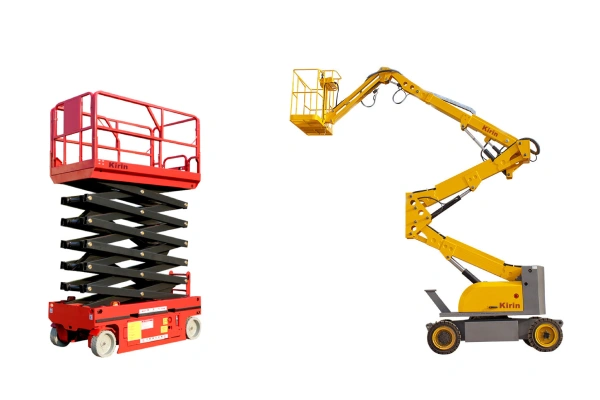
- Telescopic Boom Lifts: Also known as “stick booms,” these feature a straight arm that extends and retracts like a telescope. They offer the greatest horizontal reach of any aerial lift, making them ideal for work on tall buildings or bridge inspections where the machine cannot get close to the structure.
- Articulating Boom Lifts: Often called “knuckle booms,” these have arms with multiple joints (knuckles) that can bend. This allows the operator to reach “up and over” obstacles like walls, roofs, or machinery. They offer more flexibility than telescopic booms but generally have a slightly lower total height capacity.
Common Jobs for Boom Lifts
Traditional boom lifts are most effective in wide-open environments. Common applications include:
- High-rise exterior construction and glazing.
- Steel erection and heavy industrial maintenance.
- Utility line repairs and streetlight maintenance.
- Large-scale signage or billboard installation.
- Shipbuilding and aircraft maintenance.
What Is a Spider Lift?
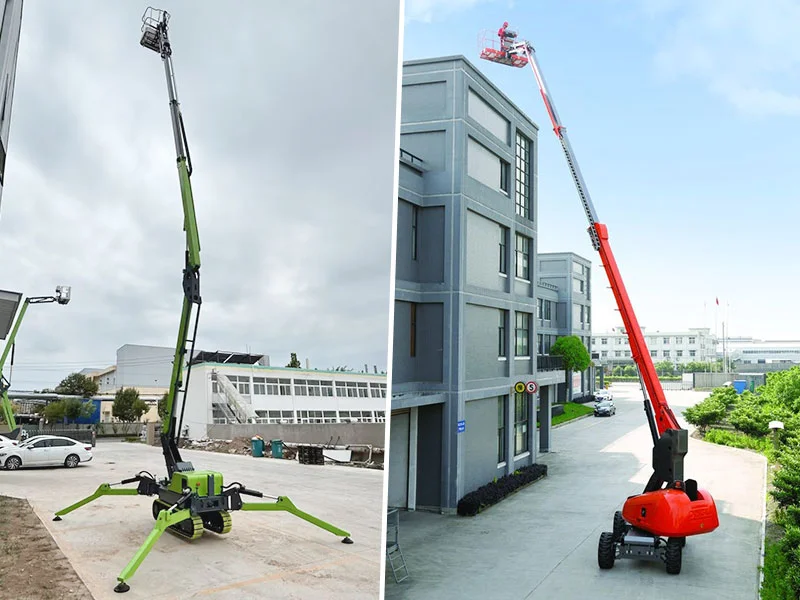
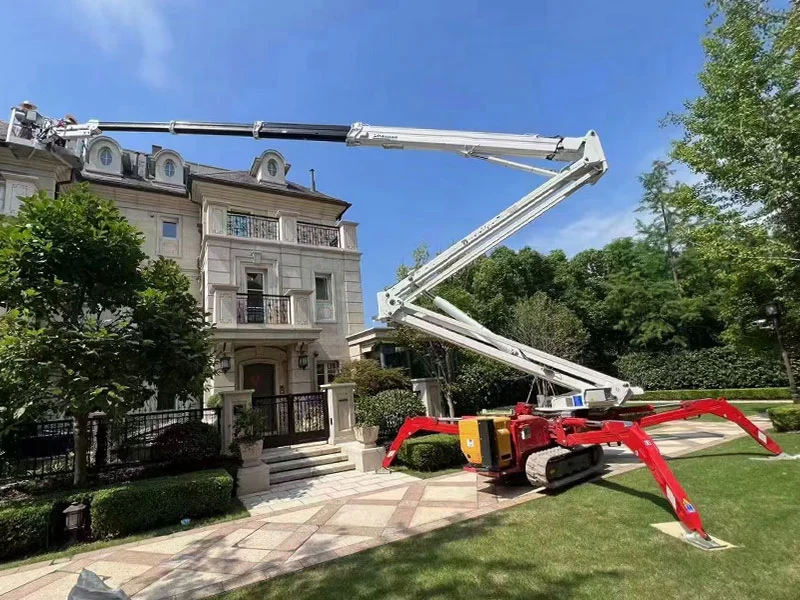
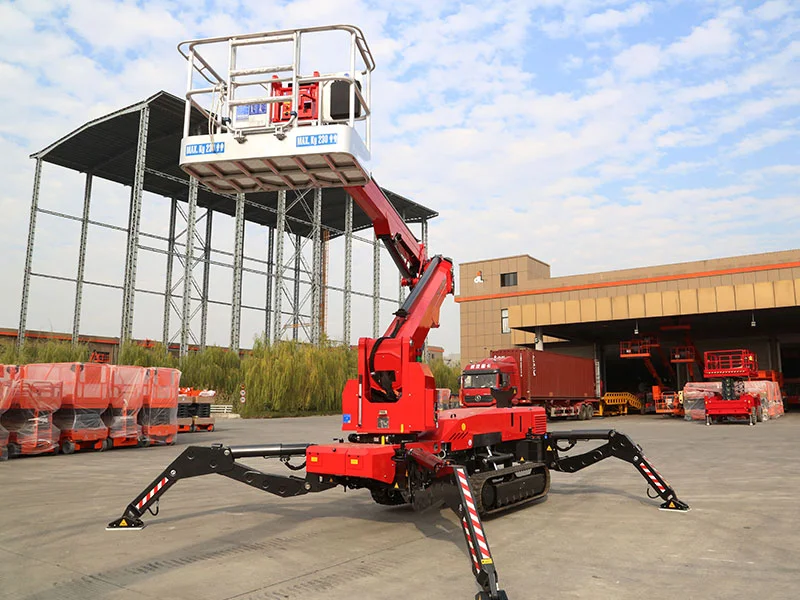
A spider lift is essentially a specialized, compact version of an articulating boom lift. The name comes from its appearance when deployed: instead of a heavy wheeled chassis, it uses four stabilizer “legs” or outriggers that extend from the base to level the machine.
These machines are mounted on rubber tracks rather than wheels, which allows them to traverse rough or delicate terrain that would be impossible for a traditional boom lift. The spider lift is designed for versatility and access, often fitting through standard doorways or narrow gates to reach work areas that larger machines simply cannot access.
How Spider Lifts Work
A spider lift operates by using its rubber tracks to navigate into position. Once the operator reaches the work area, the four outriggers are deployed. These legs can be adjusted independently, allowing the lift to set up on steep slopes, stairs, or uneven ground. The weight of the machine is distributed over a much larger surface area through these outriggers, providing a stable platform while maintaining a low “point load” on the ground.
Common Jobs for Spider Lifts
Spider lifts excel where space is tight and the ground is sensitive. Typical jobs include:
- Tree Care and Landscaping: Arborists use them to navigate narrow backyard gates and work on soft turf without leaving deep ruts.
- Atrium Maintenance: Their ability to fit through double doors makes them the standard for changing lights or cleaning windows in hotel lobbies and shopping malls.
- Historic Restoration: Lightweight spider lifts can be used on old flooring or rooftops where a 20,000-pound boom lift would cause structural damage.
- Facility Management: Ideal for indoor gyms, stadiums, and theaters.
Key Differences: Spider Lift vs Boom Lift
When comparing a spider lift vs boom lift, the decision often comes down to the physical limitations of your site. Here is a breakdown of the key differences that will influence your choice.
How They Reach and Move
Traditional boom lifts are built for “drive-and-reach” efficiency. Most can be driven while the platform is elevated, which is a massive time-saver for tasks like painting a long warehouse wall.
In contrast, a spider lift must be stationary and its outriggers fully deployed before the boom can be raised. While this means more setup time if you need to move frequently, the articulating and telescopic nature of the spider boom provides incredible precision in tight quarters.
Where They Work Best
The spider lift vs boom lift debate is often settled by the terrain.
- Boom Lifts thrive on firm, level ground or packed dirt. While “rough terrain” models exist with 4WD and foam-filled tires, their sheer weight makes them prone to sinking in mud or damaging finished surfaces like pavers or grass.
- Spider Lifts are the kings of versatility. Their rubber tracks can climb stairs and navigate muddy hillsides, and their outriggers allow them to level themselves on a 20-degree incline.
How Much Space Do They Need
Space is perhaps the most significant differentiator. A standard 60-foot boom lift is a massive piece of machinery, often requiring a wide berth for its tail-swing and base.
A spider lift of the same height can often retract its tracks to a width of just 31 to 35 inches. This allows it to pass through a standard interior door or a backyard gate. If your work area is tucked behind a building or inside a courtyard, the spider lift vs boom lift choice becomes clear: only the spider lift will fit.
How Heavy They Are
Weight is a critical factor for indoor work or projects on suspended slabs (like parking garages).
- A 50-foot boom lift can weigh anywhere from 15,000 to 22,000 pounds.
- A 50-foot spider lift typically weighs between 4,500 and 6,500 pounds.
Because the spider lift is significantly lighter and uses tracks and outriggers to spread its weight, it is much safer for use on delicate surfaces like marble, tile, or gym floors.
How They Get Power
Both machines offer various power options, but their standard configurations differ:
- Boom Lifts: Usually powered by large diesel or dual-fuel (Gas/LPG) engines for outdoor use. Electric models are available but are generally smaller and limited to slab-surface work.
- Spider Lifts: Most are “bi-energy” or “hybrid” by default. They often feature a small diesel engine for outdoor travel and an electric motor (plug-in or battery) for silent, emission-free operation indoors.
When to Choose a Spider Lift
You should choose a spider lift if your project involves any of the following constraints:
- Narrow Access: If you need to get through a gate, a doorway, or a narrow alleyway, a spider lift is your only viable option.
- Delicate Surfaces: If you are working on expensive indoor flooring, a manicured lawn, or a rooftop, the low ground pressure of a spider lift prevents damage.
- Uneven Terrain: If the ground is sloped, tiered, or features stairs, the self-leveling outriggers of a spider lift provide a level of safety a wheeled boom lift cannot match.
- Indoor/Outdoor Flexibility: If the job starts outside but requires moving inside a building, the hybrid power and compact size make the spider lift the most versatile tool.
When evaluating the spider lift vs boom lift for specialized trades like arboriculture or facility maintenance, the spider lift is almost always the winner due to its “go-anywhere” capability.
When to Choose a Traditional Boom Lift
A traditional boom lift remains the superior choice for high-production construction and heavy-duty industrial work. You should pick a boom lift when:
- Speed is Priority: If you need to move the machine frequently along a wall or a fence line, the ability to drive while elevated is a huge advantage.
- Extreme Height and Capacity: While spider lifts can reach impressive heights, the tallest telescopic boom lifts can reach over 180 feet and carry higher weight capacities (up to 1,000 lbs in some cases) compared to the standard 500-lb limit of most spider lifts.
- Working on Rough but Level Ground: On a large construction site with plenty of room, a 4WD boom lift is faster and more robust for navigating a site than a tracked machine.
- Long-Term Outdoor Projects: For heavy-duty tasks like steel welding or facade installation on a new build, the durability and simpler setup of a boom lift make it more efficient.
The spider lift vs boom lift choice here leans toward the boom lift if the workspace is expansive and the ground can support the massive weight of the machine.
Conclusion
In the battle of spider lift vs boom lift, there is no single “better” machine—only the right machine for the specific job.
If your priority is extreme reach, high weight capacity, and the ability to cover large distances on a flat construction site, the traditional boom lift is your best bet. It is a powerhouse designed for the rigors of heavy industry.
However, if you are faced with “impossible” access—narrow doors, soft grass, interior atriums, or steep slopes—the spider lift is the clear winner. Its ability to shrink down for transport and then expand its “legs” for stability makes it one of the most versatile pieces of equipment in the rental market today.
By carefully assessing your job site’s ground conditions, entry points, and height requirements, you can make an informed decision that ensures your team works safely and efficiently.
FAQs
Can a spider lift be used on grass?
Yes! In the spider lift vs boom lift comparison, spider lifts are much better for grass. Their rubber tracks and lightweight design distribute weight evenly, meaning they won’t sink or leave ruts like a heavy wheeled boom lift.
Which is safer: a spider lift or a boom lift?
Both are extremely safe when operated by trained professionals. However, spider lifts offer superior stability on uneven ground due to their outriggers, whereas boom lifts are more stable on flat surfaces but can become unstable if driven on a slope beyond their rated capacity.
How do I transport a spider lift vs a boom lift?
A traditional boom lift almost always requires a specialized heavy-duty trailer and a semi-truck due to its weight. Many smaller spider lifts, however, can be transported on a standard flatbed trailer or even towed behind a heavy-duty pickup truck, which can significantly reduce transportation costs.
Are spider lifts more expensive to rent?
Generally, yes. Because spider lifts are specialized pieces of equipment with complex hydraulic leg systems and hybrid power sources, their daily rental rates can be higher than a standard boom lift of comparable height. However, they often save money in the long run by eliminating the need for scaffolding or preventing property damage.