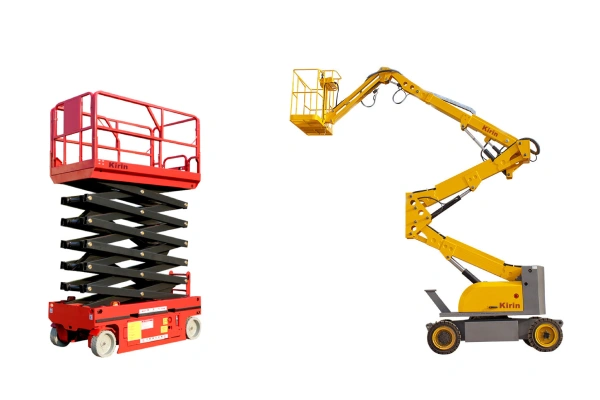
Choosing the right equipment for working at height is a critical decision that impacts your project’s safety, efficiency, and budget. For elevated work, the debate often comes down to two of the most popular access solutions: the scissor lift vs scaffolding. While both serve the fundamental purpose of lifting workers and materials to elevated areas, they operate on vastly different principles and offer distinct advantages and disadvantages.
Making the wrong choice can lead to lost productivity, increased labor costs, and even compromise safety. This comprehensive guide will deep-examine the scissor lift vs scaffolding comparison, breaking down their mechanics, evaluating key comparison factors, and providing real-world scenarios to help you determine which tool is the ultimate champion for your specific aerial work. We aim for a high level of clarity and detail, ensuring you have all the information needed for a well-informed decision.
What Is a Scissor Lift?
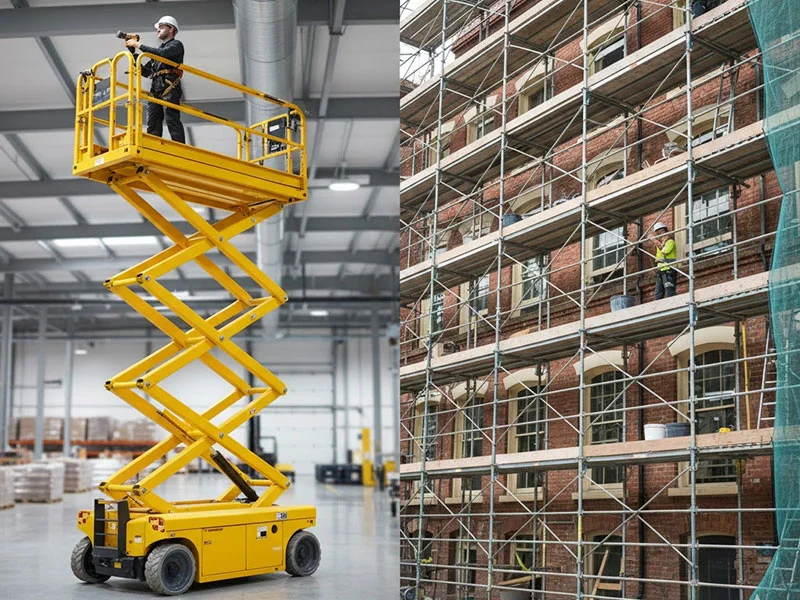
A scissor lift is a type of Mobile Elevated Work Platform (MEWP) designed to move workers and their tools vertically. Its name comes from the crisscross, accordion-like supports—the “scissoring” mechanism—that are hydraulically, electrically, or pneumatically powered to extend and retract the work platform.
Core Characteristics of a Scissor Lift:
- Mobility: Scissor lifts are mounted on wheels and are self-propelled. They can be driven and repositioned from the platform while elevated (though often at a reduced speed), making them excellent for tasks that require frequent movement.
- Vertical-Only Movement: A key distinction is that scissor lifts only move vertically. Unlike boom lifts, they do not have horizontal reach (unless equipped with a small, slide-out platform extension).
- Power Sources:
- Electric/Slab Lifts: Ideal for indoor use, as they are quiet and produce zero emissions. They typically feature non-marking tires for finished floors. They have a more limited height and capacity.
- Diesel/Rough Terrain Lifts: Designed for outdoor and construction sites, featuring larger, foam-filled, or pneumatic tires for uneven ground. They offer higher lift heights and greater weight capacities.
- Safety Features: Modern scissor lifts come with integrated safety mechanisms, including guardrails, non-slip platforms, tilt alarms, and emergency shut-off valves.
Scissor lifts are essentially a highly mobile, powered alternative to fixed platforms, prized for their speed and efficiency.
What Is Scaffolding?
Scaffolding is a temporary, elevated work structure used to support a work crew and materials during the construction, repair, or maintenance of structures. Unlike the self-contained machine that is the scissor lift, scaffolding is a modular system that is assembled on-site.
Core Characteristics of Scaffolding:
- Fixed Structure: Once assembled, traditional scaffolding is stationary and cannot be moved without being completely dismantled and re-erected.
- Customization and Scale: Scaffolding is incredibly versatile. It can be built to reach immense heights (hundreds of feet) and can be configured to fit the specific shape, curvature, and size of virtually any building or structure.
- Work Platform Size: Scaffolding provides a vast, continuous work platform, often spanning the entire length or height of a work area, allowing multiple workers to operate simultaneously with ample space for tools and materials.
- Types of Scaffolding:
- Supported Scaffolding: The most common type, consisting of one or more platforms supported by rigid frames, poles, or posts built up from a foundation.
- Suspended Scaffolding (Swing Stages): Platforms suspended by ropes or cables from an overhead structure, often used on high-rise buildings for window cleaning or façade work.
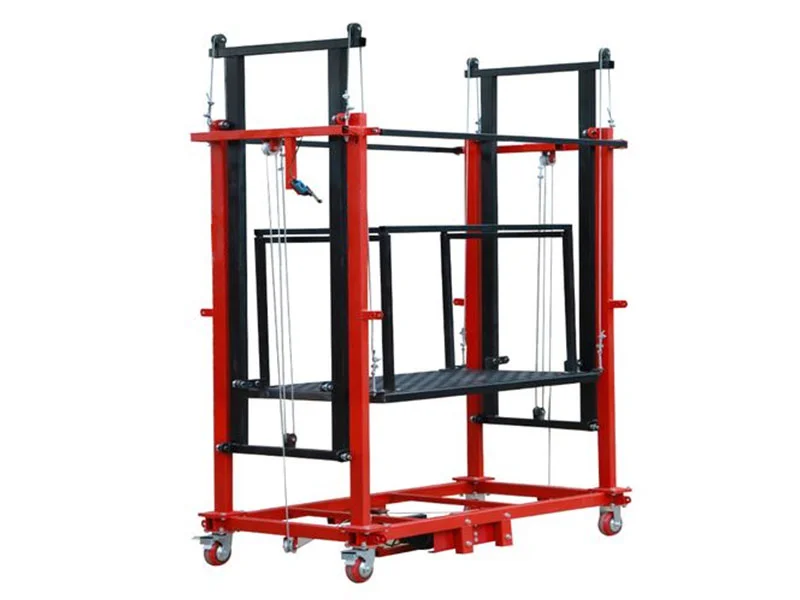
- Mobile Scaffolding (Rolling Towers): Smaller, supported scaffolds on casters that can be manually pushed from location to location.
Scaffolding’s strength lies in its capacity for large, sustained work surfaces and its ability to conform to complex architectural designs and extreme heights.
Scissor Lift vs Scaffolding: Key Comparison Factors
The ultimate winner in the scissor lift vs scaffolding debate depends entirely on the specific requirements of your job. Here is a detailed comparison across the most critical factors:
a. Mobility and Repositioning
- Scissor Lift: Wins. Highly mobile. It can be driven to the worksite, raised in minutes, and then driven to the next position quickly. This is a massive time-saver for tasks requiring frequent location changes, such as installing lights across a warehouse ceiling.
- Scaffolding: Loses. Stationary. Traditional scaffolding requires significant labor and time (hours or even days) to assemble, disassemble, and move to a new location. Even mobile scaffolding requires workers to descend and manually push the structure.
b. Working Height and Reach
- Scissor Lift: Limited. Most standard models reach working heights between 20 and 50 feet (6 to 15 meters), with larger rough-terrain models maxing out around 60 feet (18 meters). They only offer vertical access.
- Scaffolding: Wins. Practically unlimited. Supported scaffolding can be built to incredible heights, making it the only feasible solution for high-rise construction, façade repairs, or major building renovations.
c. Platform Size and Capacity
- Scissor Lift: Limited. Offers a relatively small platform, typically accommodating two or three workers and a modest amount of tools and materials (often 500 to 1,500 lbs). The work area is concentrated.
- Scaffolding: Wins. Expansive. Provides a wide, continuous work platform for an extended area. It can support multiple workers and substantial loads of materials, such as bricks, stucco, and paint cans, making it perfect for sustained, material-intensive work.
d. Setup Time and Productivity
- Scissor Lift: Wins on Setup/Speed. Setup is nearly instantaneous—simply drive it to the spot and raise the platform. This boosts daily productivity immensely by reducing non-work labor time.
- Scaffolding: Loses on Setup, Wins on Sustained Productivity. Setup and teardown are labor-intensive. However, once erected, the large, stable platform can improve the efficiency of tasks like masonry, siding, and exterior painting, as workers have continuous access and don’t need to stop and move equipment constantly.
e. Site Suitability and Surface
- Scissor Lift: Mixed. Electric lifts require flat, level, and often finished surfaces (like concrete slab floors). Rough-terrain diesel lifts can handle uneven ground but are restricted by extreme slopes and very soft earth.
- Scaffolding: Wins. Highly adaptable. With proper outriggers, leveling jacks, and bracing, scaffolding can be built over uneven, sloped, or irregular terrain. It can even be configured to wrap around cylindrical or unusually shaped structures.
f. Cost Analysis
The cost comparison is complex in the scissor lift vs scaffolding debate, as it involves rental/purchase price, labor, and time.
| Factor | Scissor Lift | Scaffolding |
| Initial Rental/Purchase | Higher daily/weekly rental rate. Higher upfront purchase price. | Lower rental/purchase cost for the materials. |
| Labor Cost | Lower. Minimal labor time for setup/teardown. Fewer workers needed. | Higher. Significant, skilled labor time needed for assembly and dismantling. |
| Project Duration | More cost-effective for short-term or mobile tasks due to speed. | More cost-effective for long-term, stationary tasks (e.g., a 6-month façade renovation). |
Ultimately, a scissor lift often offers a better total return on investment for short-duration tasks because of the massive savings on labor hours for setup and movement.
Scissor Lift: Pros and Cons
Choosing between a scissor lift vs scaffolding requires a clear understanding of what a scissor lift brings to the table.
Pros of a Scissor Lift
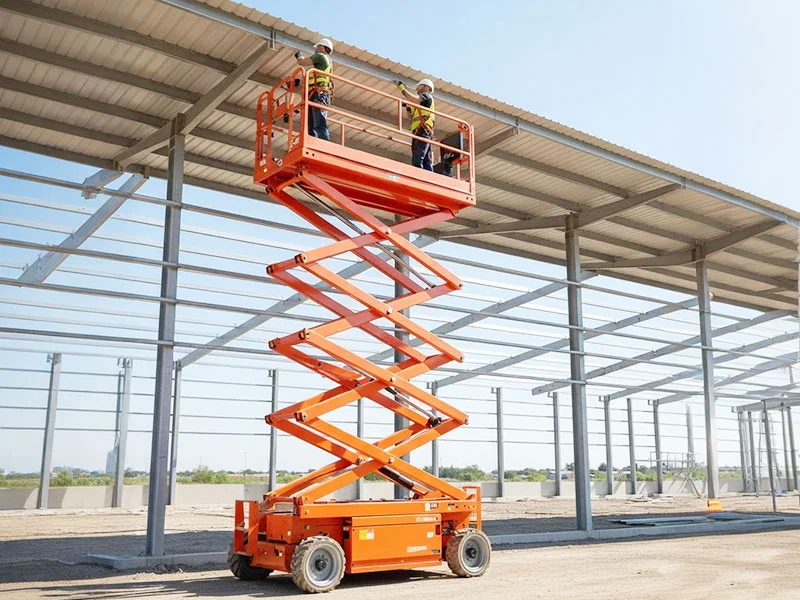
- Rapid Deployment and Mobility: The single biggest advantage. The ability to drive, raise, and reposition quickly makes it a highly efficient tool for dynamic worksites.
- Lower Labor Costs for Setup: Requires only one certified operator and virtually no setup or teardown time, leading to significant savings in non-productive labor hours.
- Integrated Safety: The primary safety features (e.g., guardrails) are built into the platform, and the controls are simple and centralized.
- Compact Footprint: Generally takes up less ground space than a large scaffolding structure, which is crucial in public areas or congested urban sites.
- Indoor Suitability: Electric models are quiet, fume-free, and suitable for internal work in finished or sensitive environments like hospitals, retail stores, or data centers.
Cons of a Scissor Lift
- Limited Vertical Height: The height range is restricted, making it unsuitable for high-rise buildings or tasks above ~60 feet.
- No Horizontal Reach: The platform can only move straight up and down. To reach a spot a few feet away, the entire machine must be lowered, driven, and raised again.
- Small Platform Size: Limits the number of workers and the amount of material that can be safely lifted, potentially slowing down material-intensive tasks.
- Surface Dependency: While rough-terrain models exist, all lifts require a reasonably stable and level surface to operate safely, as tilt alarms will prevent operation on steep slopes.
- Higher Daily/Weekly Rental Cost: The convenience of the powered machine comes with a higher short-term rental price compared to the raw components of scaffolding.
Scaffolding: Pros and Cons
The traditional workhorse of elevated construction, scaffolding, has its own unique place in the scissor lift vs scaffolding rivalry.
Pros of Scaffolding
- Unlimited Vertical and Horizontal Scale: Can be built to accommodate any height and can wrap around an entire building, providing continuous, unhindered access.
- Superior Load Capacity and Workspace: The expansive platform allows for multiple workers, heavy loads of construction materials (like stone or multiple buckets of paint), and various tools, boosting the efficiency of large-scale, material-heavy tasks.
- Adaptable to Complex Shapes and Terrain: Can be customized to conform to irregular architectural designs, curves, and can be stably erected on sloped or uneven ground with proper leveling.
- Cost-Effective for Long-Term, Stationary Jobs: The low material rental cost makes it the most economical choice for projects that span weeks or months in the same location.
- Greater Stability for Delicate/Heavy Work: Offers a rock-solid platform that is ideal for tasks requiring great force or a very stable hand, such as detailed masonry or delicate restorative work.
Cons of Scaffolding
- Extremely Labor-Intensive Setup/Teardown: The assembly and dismantling process is time-consuming, expensive, and requires a dedicated, trained crew—wasting valuable project time.
- Zero Mobility: Once built, it is a fixed structure. Any change in the work location requires full, costly, and time-consuming disassembly and re-assembly.
- Large Footprint: Takes up significant ground space, which can impede public access, vehicle traffic, and material staging on the ground floor.
- Safety is Labor-Dependent: The safety of the structure relies entirely on the quality and correctness of the assembly. Improper erection is a major cause of construction accidents.
- Vulnerability to Weather: Scaffolding platforms can become slick in rain or snow, and large, tall structures are more vulnerable to strong winds and storms, often requiring work stoppage.
When to Choose Which: Real-World Scenarios
The decision between scissor lift vs scaffolding should be driven by a precise evaluation of the job’s unique constraints.
Choose the Scissor Lift When:
High-Mobility Tasks (e.g., Warehouse Light Installation):
- Scenario: Replacing or installing lighting and HVAC components across a large warehouse or retail ceiling, where the work spot changes every 10–20 minutes.
- Why the Lift Wins: Speed and mobility. The operator can raise the platform, complete the work, lower it, drive to the next fixture, and raise it again, all in a fraction of the time it would take to dismantle and move scaffolding. The immediate cost savings from labor greatly outweigh the higher rental price.
Short-Duration Spot Repairs (e.g., Emergency Sign Repair):
- Scenario: A quick, single-location maintenance task, like fixing a gutter, painting a small spot on a façade, or emergency electrical repair on a pole.
- Why the Lift Wins: Instant access. No time is wasted on setup. The lift can be deployed, used, and removed from the site within hours, minimizing disruption.
Indoor/Finished Environment Work (e.g., Shopping Mall Maintenance):
- Scenario: Working on the high ceilings of a finished lobby, atrium, or inside a manufacturing plant.
- Why the Lift Wins: Electric, zero-emission models with non-marking tires are mandatory. They are quiet, clean, and often narrow enough to fit through standard doorways or down narrow aisles, which is something a large scaffolding tower cannot do.
Choose Scaffolding When:
Large-Scale Facade or Masonry Work (e.g., Historic Building Restoration):
- Scenario: Tuckpointing brick, applying stucco, or installing siding across the entire face of a building that is four or more stories high.
- Why Scaffolding Wins: Sustained, continuous access is required. The massive platform allows masons to move laterally across the entire wall without stopping. It can hold hundreds of pounds of bricks, mortar, and tools, supporting long periods of material-intensive work.
Long-Term Projects at Extreme Heights (e.g., High-Rise Construction):
- Scenario: Major structural work, window installation, or painting on any building exceeding 60 feet or where the work will last several months.
- Why Scaffolding Wins: Height and cost-effectiveness over time. Traditional supported scaffolding is the only viable, safe, and regulated solution for reaching extreme heights. The initial setup cost is amortized over the long duration of the project, making it the cheaper option overall.
Complex, Irregular Structures (e.g., Circular Towers or Bridges):
- Scenario: Projects where the work area is curved, has many irregular protrusions, or is on extremely steep terrain.
- Why Scaffolding Wins: Adaptability. Scaffolding is modular and can be built to wrap around, over, and under complex shapes, providing a stable, level platform where a scissor lift’s fixed geometry would fail.
Conclusion
The definitive answer to the scissor lift vs scaffolding question is that neither is objectively “better” than the other; they are simply tools optimized for different jobs.
The scissor lift is the clear winner for speed, mobility, and short-term efficiency on jobs that require frequent repositioning and have flat, accessible surfaces at medium height. It reduces labor, boosts daily productivity, and is generally the modern solution for maintenance and installation work.
Scaffolding is the essential, time-tested solution for large-scale, high-altitude, and long-duration projects that demand a vast, stationary workspace for multiple workers and heavy materials. It is unparalleled in its capacity for load and its ability to adapt to complex architectural forms.
Before committing to one, carefully analyze your project:
- How high do you need to go? (If over 60 feet, scaffolding is likely the answer).
- How often will you need to move? (If frequently, the scissor lift wins).
- How long will the work take? (Short-term favors the lift; long-term favors scaffolding).
By aligning the equipment’s strengths with your project’s specific needs, you will ensure maximum safety, productivity, and profitability.
Scissor Lift vs Scaffolding FAQs
Is a scissor lift considered a type of scaffolding?
According to OSHA (Occupational Safety and Health Administration) regulations, a scissor lift is defined as a mobile-supported scaffold work platform. While mechanically very different from traditional frame scaffolding, they are both categorized under regulations for scaffolds and aerial work platforms used for vertical access.
Do workers need special training to use a scissor lift?
Yes. All operators of scissor lift equipment are legally required to undergo formal training and be certified to operate the specific type of equipment they are using. This is a strict safety requirement.
Is scaffolding safer than a scissor lift?
Neither is inherently safer. Both have high safety records when used correctly and disastrous failure potential when used improperly. A scissor lift’s safety relies on the machine’s engineering and operator competence. Scaffolding’s safety relies on correct assembly, regular inspections, and adherence to load limits. Both require strict adherence to safety protocols.
Which is better for exterior painting on a two-story house?
It depends:
Scissor Lift: Better if the ground is flat and the paint job is small or requires only quick spot-checks. Faster setup and movement.
Scaffolding: Better if the ground is uneven, or if the entire house needs full, continuous, and long-term access, allowing multiple painters to work across a large surface area simultaneously.
How many workers can a typical scissor lift hold?
Most standard scissor lift platforms are designed for a personnel limit of two to three workers, though the specific limit depends on the model’s platform size and its maximum weight capacity (which also includes the weight of all tools and materials). Always check the manufacturer’s plate for the exact capacity.