The modern construction and maintenance industries rely heavily on equipment that can safely and efficiently elevate workers, tools, and materials to significant heights. Among the most common and versatile pieces of aerial work platform (AWP) equipment is the scissor lift. The secret to its remarkable functionality lies in its ingeniously simple, yet highly effective, scissor lift mechanism.
Understanding the fundamental principles of the scissor lift mechanism is crucial for anyone involved in equipment operation, maintenance, or design. This comprehensive guide will dissect the core engineering behind this ubiquitous machine, explore its many applications, and outline the compelling advantages it offers over other lifting technologies.
What is a Scissor Lift Mechanism?
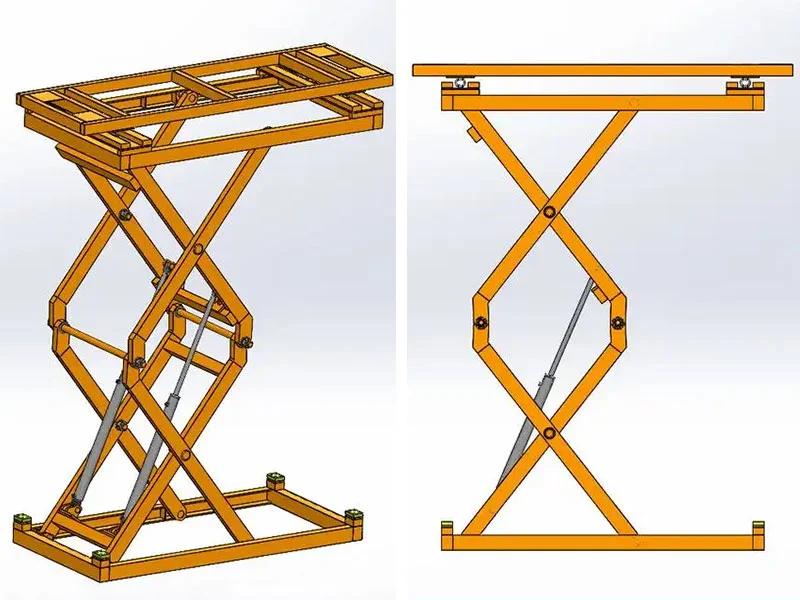
At its heart, a scissor lift mechanism is a type of mechanical linkage designed to achieve vertical motion using a series of crisscrossing, foldable supports. These supports, often referred to as “pantograph” arms, are arranged in an “X” pattern when viewed from the side.
The term scissor lift mechanism perfectly describes its action: as the linkage is extended, the crisscrossed members open up, much like a pair of scissors closing, but in this context, the ‘closing’ action pushes the platform up.
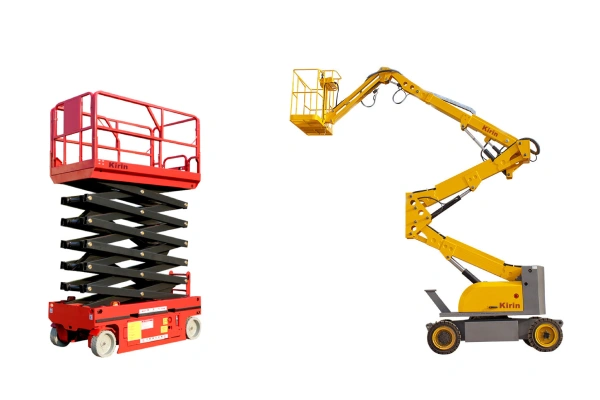
Unlike telescopic boom lifts, which use hydraulic cylinders to push an arm out and up, the scissor lift mechanism converts horizontal force into a pure, vertical lift. This allows the platform to move straight up and down, offering a stable and substantial workspace at height. The simplicity of the scissor lift mechanism contributes to its overall reliability and ease of maintenance.
Key Components of the Scissor Lift
Before diving into the operational mechanics, it’s helpful to identify the core components that make up a functional scissor lift and its scissor lift mechanism:
- Platform (or Deck): The workspace where personnel and materials are secured. It has guardrails for safety.
- Base (or Chassis): The foundation of the machine, housing the power source, controls, wheels, and sometimes outriggers.
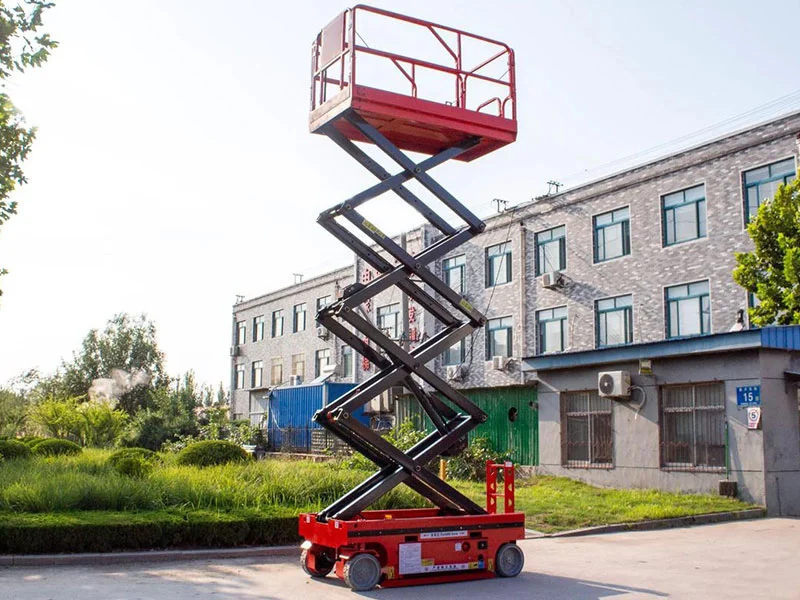
- Pantograph Arms (Scissor Arms): The series of connecting links arranged in the ‘X’ pattern that form the actual scissor lift mechanism. These are pinned at their intersections and ends.
- Cylinders/Actuators: The mechanism that generates the force to move the arms. This is typically a hydraulic scissor lift mechanism (using hydraulic cylinders), an electric scissor lift mechanism (using screw actuators or motors), or a simpler mechanical actuator.
- Control System: The electrical and/or hydraulic system that allows the operator to control the ascent, descent, and sometimes the machine’s travel (drive).
The robust design of the scissor lift mechanism ensures that the platform remains horizontal and stable throughout the entire range of motion, a critical safety feature.
The Core Scissor Lift Mechanism: How It Works
Understanding how does a scissor lift mechanism work is an exercise in applied geometry and mechanical advantage. The principle is based on leveraging a small horizontal movement to produce a much greater vertical movement.
1. The Geometry of the Pantograph
The fundamental unit of the scissor lift mechanism is the pair of crisscrossing arms, pinned at their center. The bottom ends of these arms are connected to the base. Crucially, while one bottom end is typically fixed to a pivot point on the base, the other bottom end rests on a carriage or roller that is free to slide horizontally along the base.
When multiple pairs of arms are stacked—as is common in full-sized lifts—each pair is connected to the one above and below it. The top-most pair of arms is connected to the underside of the platform.
2. The Conversion of Force
The lifting action begins when force is applied to the linkage. This is usually done by extending a powerful actuator, most commonly a hydraulic cylinder, connected across the lowest or middle pair of arms.
- Initial State (Retracted): The arms are folded closely together. The distance between the fixed and sliding pivots at the base is at its minimum. The platform is low.
- Actuation: The hydraulic cylinder pushes its two connecting points apart. Because the arms are pinned together, this horizontal outward push forces the sliding pivot end to move away from the fixed pivot end.
- The Vertical Lift: As the base of the ‘X’ expands horizontally, the entire structure is forced to rise vertically. This is where the magic of the scissor lift mechanism occurs: the horizontal movement is translated into vertical elevation.
- The Role of Multiple Stages: In a multi-stage lift, the expanding action of the lower pair of arms simultaneously pushes the base of the next set of arms outward, causing the cascading effect of the entire linkage extending upwards.
3. Hydraulic vs. Electric Power
The method of generating the required force dictates the lift’s power type:
A. Hydraulic Scissor Lift Mechanism
The most common variant. A motor (either combustion engine or battery-powered electric motor) drives a hydraulic pump. This pump pressurizes hydraulic fluid, which is then directed into one or more robust cylinders.
- Ascent: Fluid is pumped into the cylinder, extending its piston rod. This extension pushes the scissor arms apart, raising the platform.
- Descent: A control valve is opened, allowing the hydraulic fluid to flow out of the cylinder and back into the reservoir. Gravity provides the downward force, and the controlled release of the fluid ensures a smooth, gradual descent.
The hydraulic scissor lift mechanism is prized for its high lifting capacity and robust performance.
B. Electric Scissor Lift Mechanism
These lifts, often smaller, rely on electric power. There are two primary sub-mechanisms:
- Screw Drive/Actuator: A powerful electric motor turns a threaded rod (or lead screw) that is connected to the scissor arms. As the screw rotates, a nut or follower moves along the rod, directly pushing the scissor arms apart. This offers precise control and often better energy efficiency for lighter loads.
- Motor-Driven Pump (Battery-Powered): Many modern compact electric lifts still use a hydraulic scissor lift mechanism, but the pump is powered by a rechargeable battery pack instead of an internal combustion engine. These are ideal for indoor use due to zero emissions and quieter operation.
The elegance of the scissor lift mechanism lies in its ability to provide a large, stable platform while remaining compact when stowed, an essential feature for storage and transport. Understanding how to make a scissor lift mechanism for small applications, such as a small scissor lift mechanism for an adjustable desk, follows these exact same geometric principles, just scaled down and often powered by hand-cranks or small motors.
Types of Scissor Lifts
While the underlying scissor lift mechanism remains the same, the design of the chassis and power source allows for several distinct types, each suited for different environments and tasks.
1. Slab Scissor Lifts (Electric Scissor Lifts)
- Key Characteristics: Non-marking tires, narrow chassis, battery-powered electric scissor lift mechanism (or battery-powered hydraulic pump).
- Best For: Smooth, flat, and hard surfaces. Primarily used indoors for maintenance, electrical work, HVAC installation, and retail inventory management in warehouses. Their compact size makes them ideal for navigating narrow aisles.
2. Rough Terrain Scissor Lifts
- Key Characteristics: Diesel or gas-powered engine, four-wheel drive, durable tires (often foam-filled or pneumatic), high ground clearance.
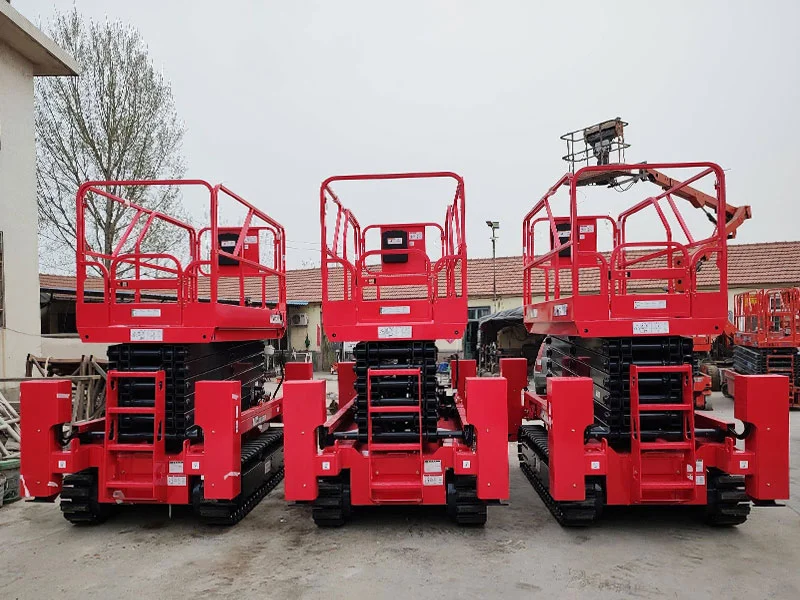
- Best For: Outdoor construction sites, uneven, soft, or rocky ground. They are built with a more rugged frame to handle challenging terrain, and their power system supports heavy-duty, high-capacity lifting. They almost always utilize a powerful hydraulic scissor lift mechanism.
3. Telehandler/Scissor Lift Hybrids
- Key Characteristics: A large platform and the stability of a scissor lift, but mounted on a machine with the reach and rough-terrain capabilities of a telehandler.
- Best For: Construction sites requiring both high capacity and the ability to traverse very difficult, unpaved terrain.
4. Custom/Specialty Scissor Lifts
This category includes everything from extremely large, custom-built industrial lifts to tiny, self-propelled small scissor lift mechanism units used in robotics, ergonomic workstations, and automated storage systems.
Applications of Scissor Lift Mechanisms
The versatility of the scissor lift mechanism makes it indispensable across a vast array of industries.
Construction and Infrastructure
- Exterior Finishing: Installing siding, roofing, and windows on mid-rise buildings.
- Structural Work: Positioning steel beams, concrete forms, and heavy components.
- Bridge Maintenance: Providing a stable platform for inspection and repair beneath or along bridge decks.
Industrial and Manufacturing
- Assembly Line Work: Providing ergonomic access for workers assembling large machinery (e.g., aircraft, trains).
- Inventory Management: Lifting pallets and personnel in automated or manual high-bay warehouses.
- Maintenance: Accessing overhead utilities, lighting, and ventilation systems in large factory spaces.
Entertainment and Events
- Stage Production: Used as dynamic stage elements to quickly raise or lower performers, props, and equipment.
- Venue Setup: Installing temporary lighting, banners, and sound systems in convention centers and stadiums.
Logistics and Shipping
- Dock Lifts: Fixed scissor lifts are used to raise and lower cargo from trucks to dock level, essential for efficient loading and unloading. This is a common application of the stationary hydraulic scissor lift mechanism.
The widespread use is a testament to the safety and functional efficiency of the scissor lift mechanism.
Advantages of Scissor Lift Mechanisms
The design benefits of the scissor lift mechanism translate into significant operational advantages that often make it the preferred choice over other lifting equipment.
1. Superior Platform Capacity
A key strength of the scissor lift is its high lifting capacity. Because the load is distributed across the multiple, geometrically supported ‘X’ linkages, the platform can safely hold heavier weights than a similar-sized boom lift. This means more workers, heavier tools, and larger amounts of material can be lifted in a single cycle.
2. Large, Stable Work Area
The platform of a scissor lift is generally much larger than the basket of a boom lift. The mechanism ensures that the platform remains perfectly level throughout the entire lift, providing a spacious, secure, and stable environment. Many models feature roll-out deck extensions, further increasing the usable working area without compromising the stability of the scissor lift mechanism.
3. Vertical-Only, Straight-Up Lift Path
The vertical-only movement is a major advantage in tight spaces or near obstacles. The machine lifts straight up, eliminating the need to calculate swing radius or horizontal articulation. This makes it ideal for working directly alongside walls, racking, or closely spaced columns.
4. Compact Stowed Size
Despite their impressive reach, the pantograph arms of the scissor lift mechanism fold down compactly into the machine’s base. This smaller footprint when retracted makes them easier to store, transport between job sites, and maneuver through standard doorways or corridors, especially the narrow electric slab models.
5. Durability and Simplicity
The inherent mechanical simplicity of the scissor lift mechanism, particularly the hydraulic scissor lift mechanism used in many large models, means fewer complex moving parts compared to articulated boom lifts. This generally translates to:
- Higher Reliability: Less risk of catastrophic mechanical failure.
- Easier Maintenance: Components are often more accessible and standardized.
- Lower Total Cost of Ownership: Reduced downtime and simpler repair procedures.
6. Power Source Flexibility
As demonstrated by the existence of both robust diesel models and clean, quiet battery-powered electric scissor lift mechanism models, the design is adaptable to diverse power sources, allowing users to select the perfect machine for indoor, outdoor, quiet, or heavy-duty environments.
The unique combination of stability, capacity, and simple operation derived from the scissor lift mechanism is what secures its place as a powerhouse in the aerial work platform market.
Limitations of Scissor Lift Mechanisms
While offering many benefits, the geometric constraints of the scissor lift mechanism also impose certain limitations that must be considered.
1. No Horizontal Reach
The most significant limitation is the lack of “up and over” or horizontal outreach. Because the lift only moves vertically, the platform can only access points directly above the chassis. If the work area is inaccessible from the ground due to an obstacle, a boom lift is required.
2. Maximum Working Height
While powerful, the practical working height of a scissor lift is limited compared to the tallest boom lifts. As the lift height increases, the base needs to be proportionally larger for stability, and the mechanical stresses on the intricate scissor lift mechanism increase exponentially. Scissor lifts typically top out around 50 to 60 feet, whereas boom lifts can exceed 180 feet.
3. Stability and Wind
Although the scissor lift mechanism is inherently stable, the large, box-like platform creates a significant surface area that is susceptible to wind forces at great heights. Safety protocols and design limits are strict, and most scissor lifts cannot be operated outdoors above a certain wind speed (e.g., 28 mph), a limitation that can impact job schedules.
4. Ground Conditions
While rough terrain scissor lifts exist, the machine’s stability is critically dependent on a relatively level setup area. The vertical design offers little tolerance for significant slopes or steep inclines, particularly when fully extended. Operating on overly uneven ground can introduce dangerous lateral stress into the scissor lift mechanism and compromise platform stability.
Comparing Scissor Lifts with Other Lifting Mechanisms
To appreciate the distinct niche of the scissor lift, it’s useful to compare its scissor lift mechanism to the principles of other common AWPs.
| Feature | Scissor Lift | Boom Lift (Telescopic/Articulating) | Mast Lift/Vertical Personnel Lift |
| Lifting Mechanism | Pantograph (X-Arms) linkage: Scissor Lift Mechanism | Hydraulic/Screw cylinders extend rigid/jointed boom sections. | Single or multi-stage mast columns slide telescopically. |
| Movement | Strictly Vertical | Vertical, Horizontal, and Angular (Outreach) | Strictly Vertical |
| Platform Size/Capacity | Large and high capacity (High weight and volume) | Small basket (Low weight, personnel only) | Very small basket (Single person, light tools) |
| Best Use Case | Large, high-volume tasks directly overhead (e.g., ceiling installation) | Reaching up and over obstacles (e.g., working on a roof from the ground) | Quick, low-level access for single personnel (e.g., quick retail maintenance) |
| Complexity | Relatively simple scissor lift mechanism | High mechanical and hydraulic complexity | Moderate complexity, focused on stability of a single mast |
The comparison clearly shows that the scissor lift mechanism is engineered for maximum stability and capacity within a pure vertical range, making it the workhorse for flat, high-volume indoor and outdoor projects.
Conclusion and Call to Action
The scissor lift mechanism is a shining example of efficient mechanical design. By leveraging a simple, geometric principle—the conversion of horizontal force into stable vertical motion—it provides a heavy-duty, safe, and reliable elevated workspace. Whether it’s the quiet, precision of an electric scissor lift mechanism in a warehouse or the brute force of a hydraulic scissor lift mechanism on a construction site, the core ‘X’ linkage remains the unsung hero of countless projects worldwide.
The next time you see one of these platforms at work, you’ll know that its stability and strength are thanks to the elegant geometry of the pantograph arms working in harmony.
Are you planning a project that requires working at height?
Choosing the right machine is the first step toward a safe and efficient job. If your task requires a large, stable work area and a straight vertical lift, a scissor lift is likely your best option.
Contact Kirin Lift Company today to discuss your project needs and determine the best scissor lift model for you—from compact small scissor lifts to large off-road machines!
FAQs About Scissor Lift Mechanisms
What is the main difference between a scissor lift and a boom lift?
The main difference lies in the scissor lift mechanism itself. A scissor lift uses crisscrossing “X” arms (a pantograph) to lift the platform straight up vertically. A boom lift uses one or more articulated or telescopic arms to move the platform both vertically and horizontally, allowing it to reach up and over obstacles. Scissor lifts generally offer greater platform capacity and stability than boom lifts.
How does a DIY scissor lift mechanism work?
A DIY scissor lift mechanism, often used for small-scale projects like adjustable tables or camera stands, operates on the same core principle as a full-sized industrial lift. The ‘X’ arms are linked, and the horizontal expansion of the base (often driven by a manually turned lead screw, a small motor, or a winch) forces the platform to rise vertically. To learn how to make a scissor lift mechanism, you must first master the dimensions and geometry of the ‘X’ linkage to ensure a smooth, stable lift path.
What type of power source is used for a hydraulic scissor lift mechanism?
A hydraulic scissor lift mechanism uses a powerful hydraulic pump to generate the lifting force. This pump is driven by a motor, which can be:
1. Diesel or Gas Engine: Used for large, rough-terrain models (high power, worksite use).
2. Electric Motor (Battery-Powered): Used for slab/indoor models (quiet, zero-emission). The electric motor runs the hydraulic pump, making it a hybrid power system.
Is a scissor lift more stable than a boom lift?
Generally, yes. The scissor lift mechanism distributes the load over a larger footprint and provides direct vertical support through a rigid mechanical linkage. This design makes the scissor lift platform inherently more stable and capable of handling significantly heavier loads than the small basket at the end of a boom.
What safety features are critical for a scissor lift?
Key safety features include:
1. Guardrails: Essential barrier around the platform perimeter.
2. Tilt Sensors: Automatically stop the machine if the chassis angle exceeds a safe limit.
3. Pothole Protection: Deployable bars on slab lifts that prevent the machine from tipping if a wheel falls into a depression while the lift is extended.
4. Emergency Lowering System: A manual override (often a valve on the hydraulic scissor lift mechanism) to safely lower the platform if main power fails.