When it comes to working at heights, the sheer variety of aerial work platforms (AWPs) can be overwhelming. From massive, truck-mounted cranes to rugged scissor lifts, there is a tool for every task. However, for many indoor facilities, retail spaces, and maintenance departments, the best solution isn’t the biggest—it’s the most portable.
The push around boom lift represents a specialized segment of the access equipment industry. Designed for simplicity and maneuverability, these lifts bridge the gap between a standard ladder and a heavy-duty motorized lift. In this guide, we will explore everything you need to know about the push around boom lift, its features, and why it might be the perfect addition to your equipment fleet.
What Is a Push Around Boom Lift?
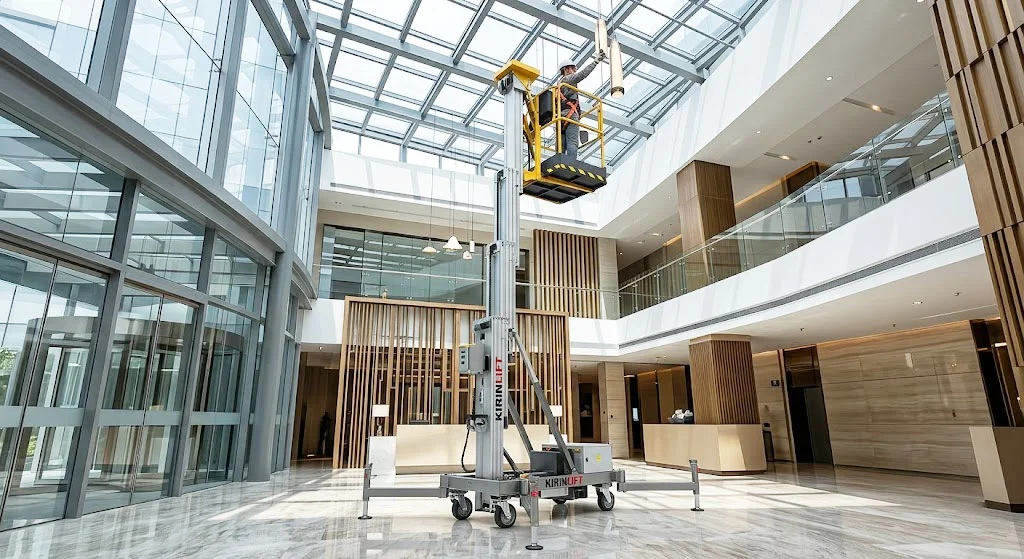
A push around boom lift is a compact, lightweight aerial work platform designed to be moved manually by an operator. Unlike self-propelled lifts that use a drive motor to navigate the work site, push around boom lifts rely on human power for horizontal positioning. Once the unit is in the desired location, it uses a hydraulic or electric system to lift the operator vertically.
These machines are often referred to as “man lifts” or “personnel lifts.” Because they lack heavy drive motors and large battery banks required for propulsion, they are significantly lighter than their self-propelled counterparts. This makes the push around boom lift ideal for use on sensitive flooring, such as in gymnasiums, hospitals, and high-end retail centers.
Key Components of a Push Around Boom Lift
Understanding the anatomy of a push around boom lift helps operators appreciate how these machines balance portability with safety.
Base and Wheels
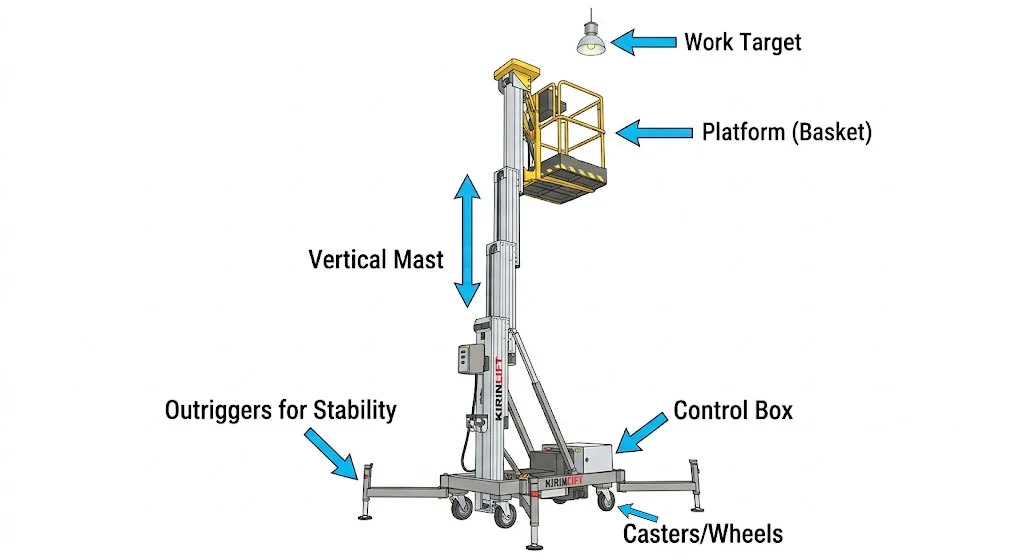
The base is the foundation of the push around boom lift. It is typically constructed from high-strength steel or aluminum. Because the lift must be moved by hand, it is equipped with high-quality, non-marking casters. These wheels allow for 360-degree rotation, enabling the push around boom lift to navigate narrow hallways and tight corners with ease.
Vertical Mast or Boom Arm
The lifting structure of a push around boom lift is usually a telescopic mast. This mast consists of several interlocking sections that slide out as the lift rises. In some specialized models, a small articulating boom arm might be present to provide a slight “up and over” reach, though most push around boom lifts focus primarily on vertical elevation.
Platform (Basket)
The platform is the workspace for the operator. In a push around boom lift, the basket is usually sized for a single person and their tools. It includes guardrails, a toe board to prevent tools from falling, and a lanyard attachment point for fall protection harnesses.
Outriggers for Stability
Because a push around Vertical lift is lightweight, it requires a wider footprint to remain stable at high altitudes. Outriggers are extendable “legs” that the operator deploys before ascending. Many modern push around boom lifts feature interlock systems that prevent the mast from rising unless the outriggers are properly set and leveled.
Control System
The control system is usually dual-functional. There is a base control panel for emergency lowering and a platform control station that allows the operator to raise or lower the basket while in the air.
How Does a Push Around Boom Lift Work?
Operating a push around Vertical lift is straightforward, but it requires a disciplined approach to safety and setup.
Manual Positioning
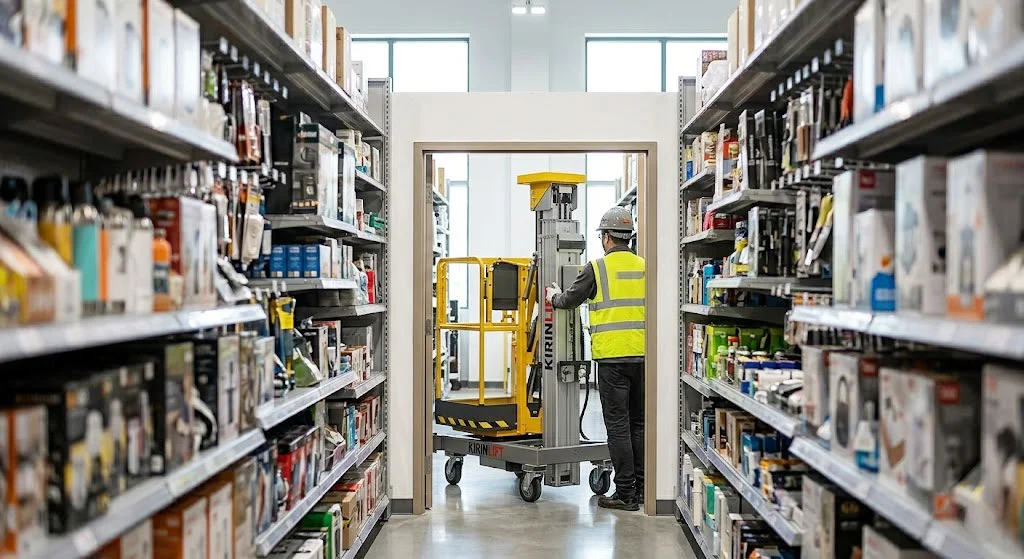
To get to the job site, the operator simply unlocks the brakes and pushes the unit. Because a push around boom lift is designed for a low center of gravity, it is relatively easy for one person to move on a flat, level surface. Its compact dimensions allow it to pass through standard doorways and into passenger elevators.
Setup Process
Once the push around boom lift is under the work area, the setup process begins. This involves:
- Engaging the wheel brakes.
- Deploying the outriggers: The operator inserts the outrigger arms into the base and jacks them down until the lift is level.
- Checking the level indicator: Most push around Vertical lifts have a bubble level or electronic sensor to ensure the machine is not on a tilt.
Lifting Mechanism
The actual lift is powered either by an AC plug-in (using a standard wall outlet) or a DC battery pack. When the operator hits the “up” switch, an electric motor drives a hydraulic pump. This pump sends fluid into the lifting cylinder, extending the mast sections.
Basic Operation Steps
- Inspect the unit for any leaks or damage.
- Push the lift into position.
- Set outriggers and confirm the unit is level.
- Enter the platform and secure the safety harness.
- Use the platform controls to ascend to the desired height.
Common Uses of a Push Around Boom Lift
The versatility of the push around Vertical lift makes it a staple in several industries.
Indoor Maintenance and Repairs
Facilities like schools, churches, and office buildings often have high ceilings with light fixtures, HVAC vents, and smoke detectors that are out of reach for ladders. A push around Vertical lift provides a stable, fenced-in platform that is much safer than a ladder for extended maintenance tasks.
Electrical and Lighting Installation
Electricians frequently use push around boom lifts to run conduit or install LED retrofits in warehouses. The manual boom lift design allows them to get close to walls and into tight spots where a larger scissor lift might not fit.
Warehouse Operations
In smaller warehouses where floor space is at a premium, a push around boom lift can be used for inventory checks or reaching high-level shelving that doesn’t require a full-sized forklift.
Facility Management Tasks
Painting, window cleaning, and hanging seasonal decorations are all made easier with a push around boom lift. Its ability to fit into an elevator means it can be moved between floors in a multi-story building without needing a loading dock or crane.
Advantages of a Push Around Boom Lift
Why choose a push around boom lift over other options? The benefits are numerous:
- Lightweight and Portable: Most push around Vertical lifts weigh between 600 and 1,000 lbs. This allows them to be used on floors with low load-bearing capacities.
- Easy to Transport: You don’t need a heavy-duty trailer to move a push around boom lift. Many models can be loaded into a van or a pickup truck using a simple ramp.
- Cost-Effective: Because they lack complex drive systems, push around boom lifts are significantly cheaper to buy or rent than self-propelled units.
- Suitable for Tight Spaces: Their footprint is much smaller than a scissor lift, making them the king of narrow-aisle access.
- Simple Operation: With fewer moving parts and a simplified control scheme, the learning curve for a push around boom lift is very short.
Limitations of a Push Around Boom Lift
While highly effective, the push around boom lift is not a “one size fits all” solution.
- Limited Working Height: Most push around boom lifts top out at around 30 to 40 feet. If you are working on high-rise exteriors, you will need a larger boom.
- Manual Movement: On a large job site, pushing the lift manually can be tiring. If you need to move the lift every five minutes, a self-propelled unit might be more efficient.
- Lower Load Capacity: These lifts are built for one person and basic tools. If you need to lift heavy materials or two workers, a push around boom lift will not suffice.
- Surface Requirements: A push around Vertical lift must be used on a hard, level surface. They are not designed for gravel, grass, or uneven construction sites.
Push Around Boom Lift vs. Other Aerial Lifts
To decide if a push-around lift is right for you, it helps to compare it to its “cousins.”
Push Around Boom Lift vs. Scissor Lift
A scissor lift can generally hold more weight and multiple people. However, scissor lifts are heavy and often too wide for standard doors. The push-around boom lift is the better choice for single-worker tasks in finished indoor environments.
Push Around Boom Lift vs. Self-Propelled Boom Lift
Self-propelled booms allow you to move the base while the basket is elevated. This is a huge productivity booster but comes with a massive price tag and a much heavier machine. The push around Vertical lift is the “budget-friendly” alternative that focuses on verticality rather than horizontal drive.
Safety Tips for Using a Push Around Boom Lift
Safety should always be the priority when operating a push around boom lift.
- Check for Overhead Obstructions: Always look up for power lines, sprinklers, or ceiling fans before elevating.
- Never Use Without Outriggers: Even if you are only going up a few feet, always deploy the outriggers as specified by the manufacturer.
- Wear Proper PPE: A fall protection harness and hard hat are standard requirements for any push around Vertical lift operation.
- Observe Weight Limits: Never exceed the rated capacity. This includes the weight of the operator plus all tools and supplies.
- Don’t Move While Elevated: It is extremely dangerous to attempt to “scoot” or move a push around boom lift while someone is in the basket. Always descend fully before repositioning.
How to Choose the Right Push Around Boom Lift
When shopping for or renting a push around boom lift, consider these five factors:
1. Working Height Requirements
“Working height” is typically 6 feet above the platform height. If you need to change a bulb at 25 feet, a push around boom lift with a 19-foot platform height will work perfectly.
2. Platform Capacity
Check the data plate. Most push-around vertical lifts support around 300 to 350 lbs. Ensure this covers your body weight and the heaviest tools you plan to use.
3. Indoor vs. Outdoor Use
Most push-around vertical lifts are rated for indoor use only because they are susceptible to wind. If you must use a manual boom lift outdoors, ensure it is specifically rated for wind loads.
4. Power Source
Do you want a push around boom lift that plugs into the wall (AC) or one that runs on a battery (DC)? DC models offer more freedom but require regular charging.
5. Budget Considerations
A push around Vertical lift is an investment. While used models are available, buying new ensures you have the latest safety interlocks and a full manufacturer’s warranty.
Maintenance and Inspection Tips
To ensure your push-around lift remains a reliable asset, follow a strict maintenance schedule.
- Daily Pre-Start Inspection: Check hydraulic fluid levels, battery charge, and the condition of the casters.
- Annual Professional Inspection: Most jurisdictions require a certified technician to inspect the push around boom lift once a year to ensure structural integrity.
- Clean the Mast: Dust and debris can cause the telescopic sections of the push around boom lift to bind. Keep the mast clean and lightly lubricated according to the manual.
- Battery Care: If you have a DC model, keep the batteries topped off with distilled water and never let them sit in a fully discharged state for long periods.
Frequently Asked Questions (FAQs)
What is the maximum height of a push around boom lift?
While it varies by manufacturer, most push around boom lifts offer platform heights between 15 and 40 feet. The total working height is usually about 6 feet higher than the platform floor.
Can one person operate it?
Yes, the push around boom lift is specifically designed for single-person operation. One person can easily push, set up, and operate the lift.
Is it safe for outdoor use?
Generally, no. Because a push around boom lift is lightweight and has a narrow profile, wind can easily tip it over. Only use a push around boom lift outdoors if the manufacturer has explicitly rated it for outdoor wind speeds.
How much does a push around boom lift cost?
New push around boom lifts typically range from $8,000 to $15,000 depending on the height and power options. Used units can often be found for $3,000 to $6,000.
Conclusion
The push around boom lift is an unsung hero of the industrial and commercial world. It provides a level of safety and efficiency that ladders simply cannot match, while remaining affordable and easy to manage. Whether you are managing a large retail space, a school, or a manufacturing plant, the push around boom lift offers a versatile solution for reaching those “just out of reach” places.
By understanding the features, benefits, and safety requirements of the push around boom lift, you can make an informed decision that protects your workers and improves your facility’s productivity. When the job requires a steady hand and a high reach in a tight spot, the push around boom lift is the tool for the job.
The simplicity of the manual boom lift design ensures that maintenance is low and uptime is high. As you look to upgrade your access equipment, don’t overlook the power of the push around boom lift. It is a small investment that yields massive returns in safety and convenience.
If you are looking for high-quality, reliable aerial solutions, our team is ready to help you find the perfect fit for your facility. For more information on our range of push around boom lifts or to receive a personalized quote, feel free to reach out to us directly. You can contact us via Email at info@klingtec.com or send us a message on WhatsApp at +86 188 6686 3188. Let’s take your productivity to new heights together!