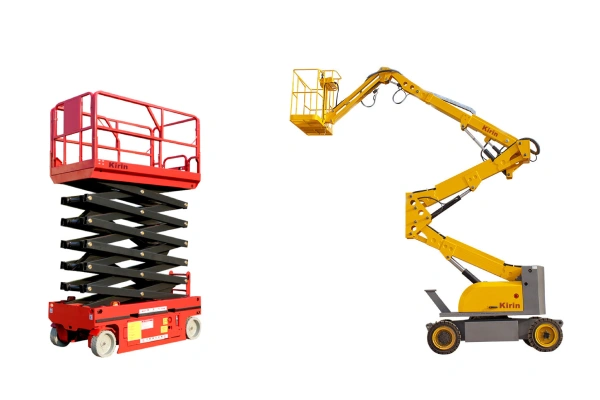
Choosing the right aerial work platform (AWP) is a critical decision for any project manager, facility owner, or contractor. The right choice ensures efficiency and safety, while the wrong choice can lead to costly delays or logistical headaches. Two of the most common solutions for indoor and outdoor height access are the vertical mast lift and the scissor lift.
While both machines serve the primary purpose of getting personnel and tools to elevated areas, they operate on different mechanical principles and excel in different environments. In this guide, we will break down the comparison of mast lift vs scissor lift to help you determine which machine is the best fit for your specific needs.
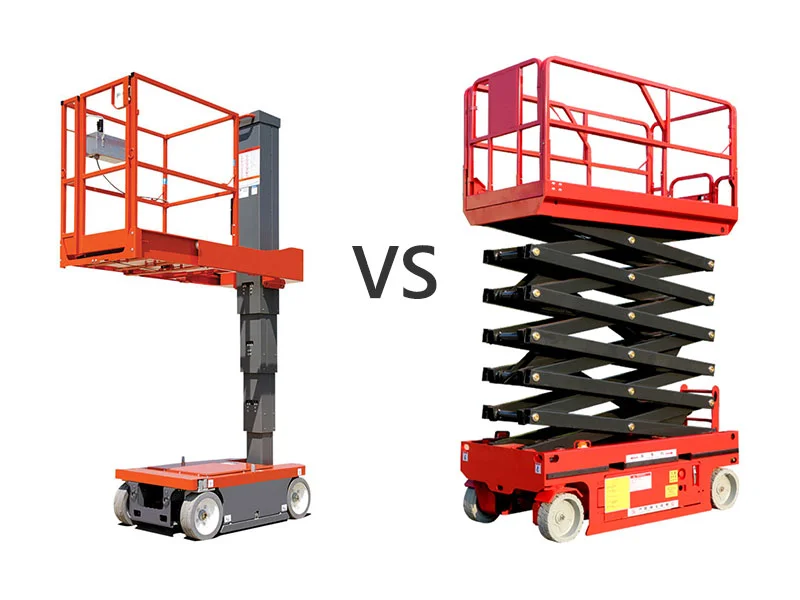
Navigating the world of material handling and aerial access can be daunting. You often find yourself asking: Do I need more platform space or more maneuverability? Is the floor load capacity an issue? How narrow are the aisles I’m working in?
Understanding the nuances of mast lift vs scissor lift capabilities is the first step toward optimizing your job site. While a scissor lift is often the “go-to” for general construction, the vertical mast lift offers a compact precision that is unmatched in tight retail or warehousing environments. This blog explores these differences in depth, ensuring you have the information needed to make an informed rental or purchase decision.
What is a Scissor Lift?
A scissor lift is a type of aerial platform that moves exclusively in a vertical direction. It gets its name from the folding support mechanism—linked, folding supports in a crisscross “X” pattern—known as a pantograph.
How it Works
When pressure is applied to the outside of the lowest set of supports, the “X” pattern elongates, pushing the platform straight up. Because of this design, the base of the machine is usually roughly the same size as the platform, providing a very stable foundation.
Key Characteristics
- Large Platform Area: Scissor lifts generally offer the largest work platforms of any aerial lift. This allows multiple workers and heavy tools to be elevated simultaneously.
- High Weight Capacity: They are built for “heavy lifting” in the aerial world, often supporting between 500 to 2,500 lbs.
- Variety of Power Sources: You can find electric models for indoor use and rough-terrain diesel models for outdoor construction sites.
What is a Mast Lift? (Vertical Mast Lift)
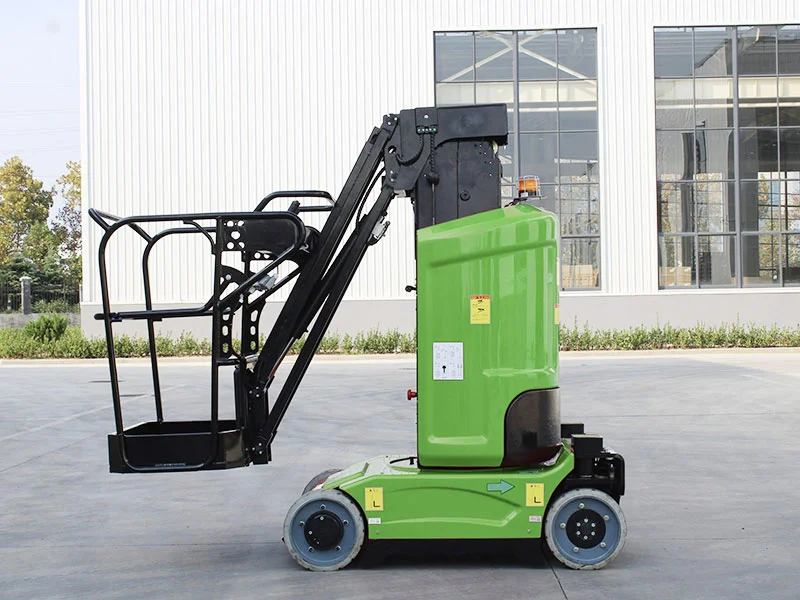
A vertical mast lift, often simply called a “mast lift,” utilizes a telescoping mast to raise the work platform. Unlike the scissor lift’s folding arms, the mast lift functions more like a high-reach forklift for people.
How it Works
The platform is attached to a mast that extends upward. Many modern mast lifts also feature a small “jib” or articulating arm at the top, allowing for a slight horizontal reach over obstacles—a feature most scissor lifts lack.
Key Characteristics
- Ultra-Compact Footprint: These machines are designed to fit through standard doorways and into passenger elevators.
- Low Weight: Because they are smaller, they have a much lower “point load,” making them ideal for sensitive flooring like gymnasiums or tiled lobbies.
- Zero Turning Radius: Most mast lifts are designed to turn on a dime, making them the kings of narrow-aisle navigation.
Key Differences: Mast Lift vs Scissor Lift
When evaluating the mast lift vs scissor lift debate, it helps to look at specific performance metrics.
| Feature | Scissor Lift | Mast Lift |
| Movement | Vertical Only | Vertical (Some have small horizontal jib) |
| Platform Size | Large (Fits 2–4 people) | Small (Usually 1 person) |
| Weight Capacity | High (Up to 2,500 lbs) | Low (Usually 350–500 lbs) |
| Maneuverability | Moderate | Excellent (Tight spaces) |
| Machine Weight | Heavy | Lightweight |
| Extension | Extension decks available | Limited horizontal reach |
Reach and Height
While both can reach heights of 15 to 50 feet, scissor lifts are generally available in “mega” sizes for extreme heights. Mast lifts typically top out around 30 feet, focusing on “low-level access” solutions.
Footprint and Portability
The comparison of mast lift vs scissor lift often comes down to the door. If you need to move the lift through a standard office door or between floors in a standard elevator, the mast lift is usually your only option. Scissor lifts, even “mini” ones, are often too wide or heavy for these tasks.
When to Choose a Scissor Lift
The scissor lift is the “workhorse” of the construction industry. You should choose this option when the following factors are present in your project:
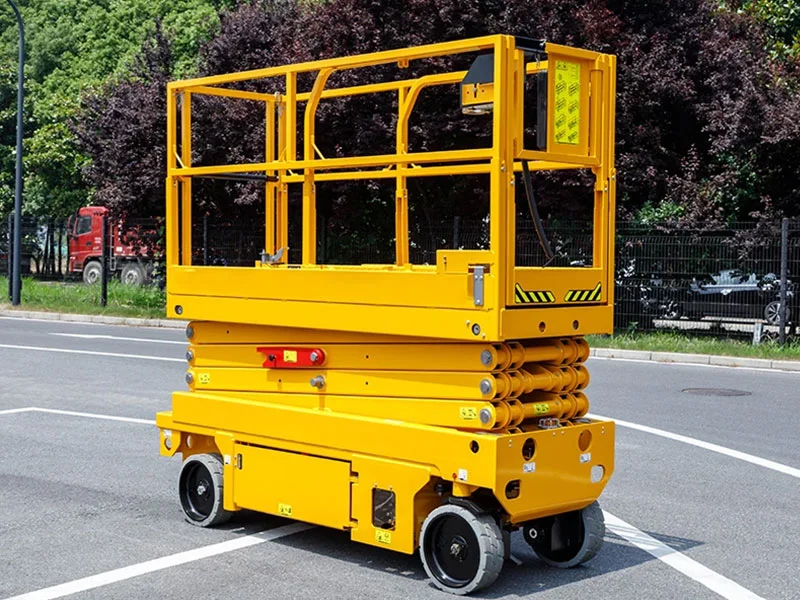
You Need Multiple Workers
If a job requires two people to hold a heavy HVAC duct in place while a third person bolts it in, the mast lift vs scissor lift debate ends quickly. You need the platform real estate and the capacity of a scissor lift.
You Are Working on Rough Terrain
While electric scissor lifts exist for indoor use, “Rough Terrain” (RT) scissor lifts are equipped with four-wheel drive and foam-filled tires. If your job site is a muddy, unfinished construction zone, a mast lift will likely get stuck, whereas an RT scissor lift will thrive.
You Need to Lift Heavy Materials
If you are lifting pallets of bricks, heavy piping, or industrial glass to a second-story installation, the high weight capacity of a scissor lift is non-negotiable.
When to Choose a Mast Lift
In the mast lift vs scissor lift comparison, the mast lift is the “specialist.” It excels in finished environments and tight quarters.
Narrow Aisles and Retail Spaces
In a crowded warehouse or a retail store with narrow aisles, a scissor lift is often too bulky to turn corners. A mast lift’s compact base allows it to navigate around displays and shelving with ease.
Sensitive Flooring
In places like hospitals, schools, or high-end office buildings, the floor may not be rated for the several thousand pounds of a scissor lift. Mast lifts are significantly lighter, reducing the risk of cracking tiles or damaging carpets.
Tasks Requiring “Up and Over” Access
Because some mast lifts include a rotating jib, they are perfect for reaching over a counter or a piece of fixed machinery. A scissor lift can only go straight up, meaning you have to be positioned directly under your work area.
Safety Considerations
Regardless of where you land in the mast lift vs scissor lift decision, safety is paramount. Both machines require specific training and adherence to OSHA (or local regulatory) standards.
- Fall Protection: In a scissor lift, the guardrails often serve as the primary fall protection, though many sites require a harness and lanyard attached to a designated anchor point. In a mast lift, due to the smaller platform and potential for more “sway,” a full-body harness is almost always required.
- Crush Hazards: Operators must be aware of overhead obstructions. Because scissor lifts move more slowly and have a larger “footprint” of risk, “tip-overs” are a concern if the ground isn’t level.
- Stability: Never exceed the weight capacity. In the mast lift vs scissor lift comparison, remember that mast lifts are more susceptible to tipping if pushed or pulled from the platform because of their lightweight base.
Conclusion
The choice between a mast lift vs scissor lift isn’t about which machine is “better” in a general sense, but which is better for your specific environment.
- Choose a Scissor Lift if you have plenty of space, need to lift multiple people, or are working on an unfinished outdoor site.
- Choose a Mast Lift if you are working indoors on finished floors, need to pass through narrow doorways, or are performing maintenance in tight, congested areas.
By weighing the platform capacity, machine weight, and maneuverability of each, you can ensure your team works safely and efficiently. If you are still unsure, consulting with a rental professional can help you visualize how each machine will perform on your specific floor plan.
FAQs
Can a scissor lift be used on a slope?
Most scissor lifts are designed for use on flat, level surfaces. While some Rough Terrain models have “outriggers” or leveling jacks, standard electric scissor lifts will trigger an alarm and cut out if they sense an incline of more than a few degrees.
Is a mast lift more expensive than a scissor lift?
In the mast lift vs scissor lift pricing world, they are often comparable for similar height reaches. However, because mast lifts are more specialized, they can sometimes carry a slight premium in rental markets, though they save money in labor efficiency in tight spaces.
Do I need a license to operate these?
In many regions, you need “Aerial Work Platform” (AWP) or MEWP (Mobile Elevated Work Platform) certification. This typically involves a classroom session and a practical hands-on evaluation.
Which is better for warehouse inventory?
The mast lift is almost always better for warehouse inventory or “order picking” due to its ability to turn in narrow aisles and its ease of operation for a single user.