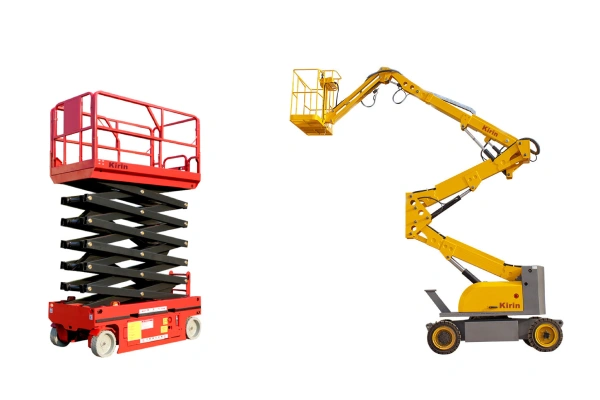
Selecting the right aerial work platform is one of the most critical decisions a project manager, contractor, or facility manager can make. Whether you are painting a high-ceilinged atrium or installing siding on a multi-story commercial building, the equipment you choose dictates your team’s safety, efficiency, and overall project cost.
Among the various types of aerial lifts, the scissor lift remains a staple due to its stability and large platform area. However, not all scissor lifts are created equal. Using an indoor scissor lift on an uneven construction site can lead to mechanical failure or even a tip-over, while using a heavy-duty outdoor scissor lift inside a finished office space can ruin expensive flooring.
In this comprehensive guide, we will explore the nuances of indoor and outdoor scissor lifts, helping you navigate the technical specifications, safety requirements, and selection criteria to ensure your next project reaches new heights safely.
Scissor lifts are a type of mobile elevated work platform (MEWP) that moves vertically. Unlike boom lifts, which can extend outward, scissor lifts use a linked “pantograph” mechanism to move the platform straight up and down. Their primary advantage is the ability to lift multiple workers and heavy materials simultaneously, providing a robust workspace at height.
As industries evolve, the demand for specialized machinery has grown. This has led to the clear distinction between “Slab Lifts” (designed for flat, indoor surfaces) and “Rough Terrain Lifts” (designed for the rigors of the outdoors). Understanding the specific utility of an outdoor scissor lift versus its indoor counterpart is not just a matter of convenience—it is a matter of regulatory compliance and worksite safety.
What Is an Outdoor Scissor Lift?
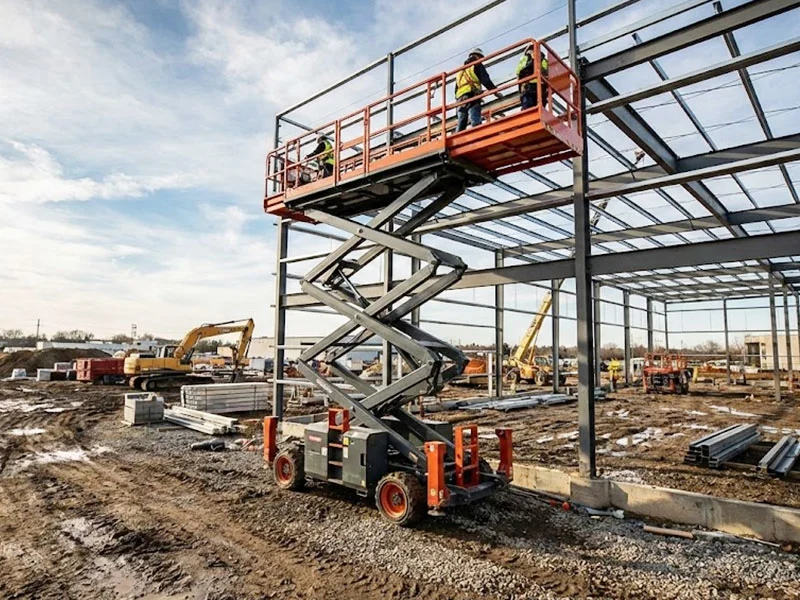
An outdoor scissor lift is a machine specifically engineered to handle the unpredictable conditions of an exterior job site. These machines are often referred to as “Rough Terrain” (RT) scissor lifts. Unlike the sleek, compact models seen in warehouse aisles, an outdoor scissor lift is built for power, stability, and durability.
Key Characteristics of the Outdoor Scissor Lift
The defining feature of a scissor lift for outdoor use is its ability to traverse uneven ground. Here are the components that make an outdoor scissor lift unique:
- Powerful Engines: Most outdoor scissor lifts are powered by Internal Combustion (IC) engines, running on diesel, gasoline, or liquid propane (LPG). This provides the high torque necessary to climb slopes and move through mud or gravel.
- Four-Wheel Drive (4WD): To navigate soft soil or debris-strewn sites, an outdoor scissor lift typically features 4WD and positive traction control.
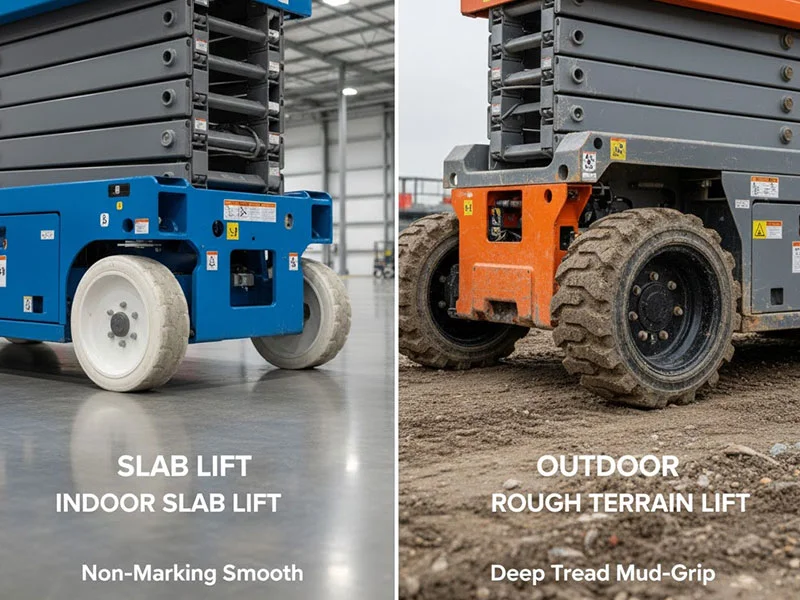
- Heavy-Duty Tires: You won’t find smooth rubber here. An outdoor scissor lift uses foam-filled or pneumatic tires with deep treads designed to grip loose earth.
- Outriggers and Leveling Jacks: Since outdoor ground is rarely perfectly level, the outdoor scissor lift is often equipped with hydraulic outriggers. These “legs” extend to stabilize the machine, ensuring the platform remains level even if the base is on a slope.
- Large Platforms: Because outdoor work often involves heavy materials like steel beams, HVAC units, or stacks of lumber, the outdoor scissor lift generally features a larger platform capacity and deck extensions.
Why You Might Seek an Outdoor Scissor Lift for Sale
If your business frequently handles exterior construction, window installation, or large-scale landscaping, looking for an outdoor scissor lift for sale is often a better long-term investment than constant rentals. An outdoor scissor lift is the workhorse of the job site, capable of operating in rain, wind (within limits), and across unpaved surfaces where a standard lift would simply get stuck.
Understanding Indoor Scissor Lifts
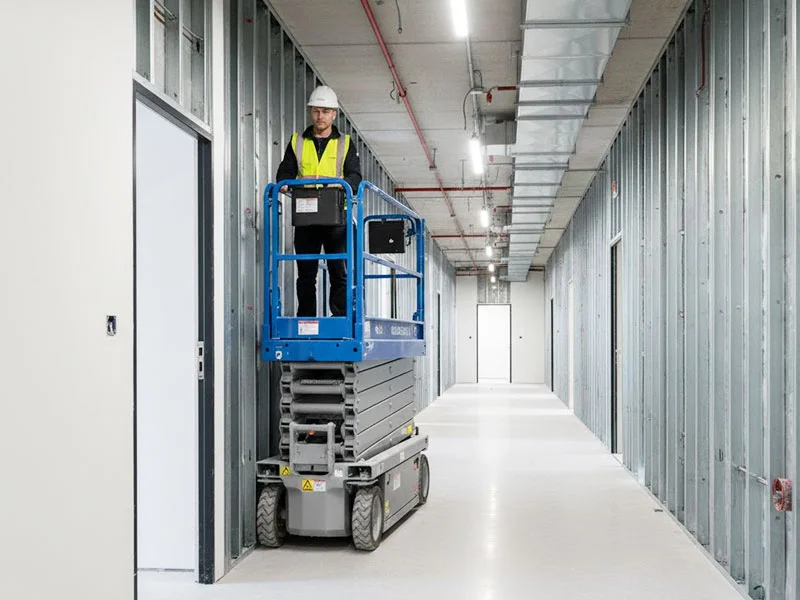
While the outdoor scissor lift is the “rugged off-roader” of the family, the indoor scissor lift is the “precision instrument.” These machines, often called “Slab Scissor Lifts,” are designed to operate on smooth, level surfaces like concrete, tile, or hardwood.
Features of Indoor Scissor Lifts
- Electric Power: Almost every scissor lift for indoor use is battery-powered. This ensures zero emissions, which is a legal and safety requirement for working in enclosed spaces.
- Non-Marking Tires: To protect the aesthetics of a finished building, an indoor scissor lift uses specialized non-marking rubber tires that won’t leave scuffs on polished floors.
- Compact Dimensions: A small scissor lift for indoor use is designed to fit through standard doorways and navigate narrow hallways. Some models are even narrow enough to fit inside freight elevators.
- Quiet Operation: Electric motors produce very little noise, allowing work to continue in occupied buildings like hospitals, schools, or offices without causing significant disruption.
Use Cases for Indoor Scissor Lifts
Indoor scissor lifts are essential for:
- Warehouse inventory management.
- Changing high-altitude light fixtures or HVAC filters.
- Ceiling installations and electrical wiring in new builds.
- Retail signage and decorations.
Comparing Indoor and Outdoor Scissor Lifts
To choose the right equipment, you must understand the trade-offs between these two categories. While some hybrid models exist, most machines excel in one environment while being prohibited in the other.
| Feature | Indoor Scissor Lift | Outdoor Scissor Lift |
| Power Source | Electric (Battery) | Diesel, Dual-Fuel, or High-Capacity Battery |
| Terrain | Smooth, Level Concrete (Slab) | Mud, Gravel, Slopes, Unpaved Dirt |
| Tires | Non-Marking, Solid Rubber | Deep Tread, Foam-Filled/Pneumatic |
| Emissions | Zero | Variable (IC Engines produce exhaust) |
| Wind Rating | Usually 0 mph (No Wind) | Rated for specific wind speeds (e.g., 28 mph) |
| Maneuverability | High (Zero turn radius) | Moderate (Larger footprint) |
| Weight Capacity | Lower (Personnel + Light Tools) | High (Multiple workers + Heavy materials) |
The Wind Factor
The most dangerous mistake a crew can make is taking an indoor scissor lift outside. Standard indoor scissor lifts are usually “Zero Wind Rated.” This means they are designed to be used only in environments where there is no air movement. Even a light breeze can turn the platform into a sail, creating a “tipping moment” that the machine’s base is not heavy enough to counter. Conversely, a scissor lift outdoor model is specifically weighted and tested to remain stable in moderate winds.
Critical Safety Factors for Outdoor Use
Safety is the paramount concern when operating an outdoor scissor lift. Because the environment is less controlled than a warehouse, operators must be vigilant.
1. Wind Speeds
Always check the manufacturer’s manual for the maximum wind speed rating of your outdoor scissor lift. Generally, most are rated for up to 28 mph (12.5 m/s). If winds exceed this limit, the lift must be lowered immediately. Remember, wind speeds are often much higher 30 feet in the air than they are at ground level.
2. Ground Conditions and “Soft Spots”
An outdoor scissor lift is heavy. If the ground has been softened by rain, the machine can sink. Before driving a scissor lift for outdoor use onto a surface, perform a “walk-around” to check for underground utilities, vaults, or recent excavations that might collapse under the weight.
3. Slope and Gradeability
Every outdoor scissor lift has a “gradeability” rating—the maximum slope it can climb. However, gradeability is for driving, not elevating. You should never extend the platform of an outdoor scissor lift unless the machine is level, either by the terrain itself or by using the outriggers.
4. Overhead Obstructions
When using a scissor lift outdoor, be acutely aware of power lines. OSHA requires a minimum clearance of 10 feet from power lines for most aerial lifts. Additionally, keep an eye out for tree limbs or building overhangs that may be obscured by the sun’s glare.
Choosing the Right Lift: A Quick Checklist
When browsing an outdoor scissor lift for sale or looking at rental options, ask yourself these four questions:
Where is the work? (Indoor, outdoor, or a mix?)
If the project begins on a dirt pad but eventually moves inside a finished warehouse, you might need two different machines. However, some modern outdoor scissor lifts are “Bi-Energy” or “Hybrid,” allowing them to run on diesel outside and switch to electric mode for indoor finishing.
What is the maximum height needed?
Typically, an outdoor scissor lift offers a higher reach than a small scissor lift for indoor use. While indoor models often top out at 19–30 feet, heavy-duty outdoor scissor lifts can reach 50 feet or more.
How much weight are you lifting?
Calculate the combined weight of your workers, their tools, and the materials (like drywall or glass). If you are consistently hitting the limit of an indoor scissor lift, upgrading to an outdoor scissor lift—even for a flat surface—might be necessary for the increased weight capacity.
Are there noise or emission restrictions?
In urban environments or “green” job sites, you may be restricted from using diesel engines. In these cases, look for a high-capacity electric outdoor scissor lift designed with rough-terrain tires but battery-powered motors.
Indoor vs Outdoor Scissor Lifts Summarized
To put it simply, the indoor scissor lift is about accessibility and floor protection, while the outdoor scissor lift is about power and stability.
- Choose Indoor if: You are working on finished floors, need to pass through doors, have zero tolerance for exhaust fumes, and have a perfectly flat surface.
- Choose Outdoor if: You are working on a construction site, need to lift heavy loads, are dealing with wind or weather, or need to navigate slopes and uneven dirt.
If your company frequently bounces between these environments, it is worth researching outdoor scissor lifts for sale that feature “dual-rating.” Some newer models are engineered to be safe for both environments, though they may require the operator to limit the height when used in “outdoor mode” to account for wind.
FAQs
Can I use an indoor scissor lift outside?
Generally, no. Most indoor scissor lifts are not wind-rated. Using a scissor lift for indoor use outside puts you at high risk of a tip-over accident if a gust of wind hits the elevated platform. Additionally, their smooth, non-marking tires provide zero traction on dirt or gravel, which can lead to the machine becoming stuck or sliding.
What is the average height of an outdoor scissor lift?
An outdoor scissor lift usually ranges from 26 feet to 50 feet, though some specialized “ultra-deck” models can reach heights of 60 feet or more. They are designed to provide a much larger work envelope than the small scissor lift for indoor use.
Do I need a special license to operate an outdoor scissor lift?
In the United States, OSHA requires all operators of MEWPs (Mobile Elevated Work Platforms) to be trained and certified. This training includes a general knowledge of how scissor lifts work and “model-specific” familiarization. Because an outdoor scissor lift involves outriggers and engine management, the training is slightly more involved than for a simple electric indoor model.
Are there electric outdoor scissor lifts?
Yes! As battery technology improves, many manufacturers are offering an outdoor scissor lift that is fully electric. These machines use large lithium-ion battery packs and rugged tires, providing the power of a diesel engine without the noise or emissions. These are excellent for “hybrid” jobs that require scissor lift outdoor use during the day and indoor use at night.
What should I look for when checking an outdoor scissor lift for sale?
If you are buying a used outdoor scissor lift, pay close attention to the hydraulic lines (look for leaks), the condition of the tires, and the hour meter. Check the “maintenance log” to ensure the lift has undergone its required annual inspection. Buying a reputable brand like Genie, JLG, or Skyjack ensures that parts for your outdoor scissor lift will be easily available for years to come.