When managing a commercial facility, warehouse, or construction site, reaching high places safely and efficiently is a non-negotiable requirement. While ladders and scaffolding have their place, nothing matches the stability, platform size, and lifting capacity of a scissor lift. However, if you are planning to add one to your fleet, the very first question your accounting department will ask is: how much is a scissor lift?
The short answer is that a scissor lift can cost anywhere from $10,000 to over $100,000 to purchase new, while used models typically range from $4,000 to $40,000. If your needs are temporary, renting one can cost between $100 and $700 per day, depending on the size and power source.
Because capital expenditures require precise budgeting, a generic price tag will not suffice. The total cost of a scissor lift depends heavily on factors like platform height, power type, terrain capability, and brand positioning. This comprehensive pricing guide breaks down everything you need to know about navigating the current aerial lift market, ensuring you balance upfront costs with long-term operational value.
How Much Does a Scissor Lift Cost?
When evaluating the market to determine how much is a scissor lift, you must first decide whether your operational model favors buying a brand-new machine, purchasing a pre-owned unit, or entering a long-term rental agreement. Each path has distinct financial implications.
Brand New Scissor Lifts
Investing in a new machine offers the highest level of reliability, the latest safety technologies, and full manufacturer warranties. For businesses that operate aerial platforms daily, buying new yields the best return on investment (ROI) by minimizing unscheduled downtime.
- Price Range: $12,000 to $100,000+
- Best For: High-utilization environments, corporate fleets, and specialized jobs requiring specific emissions compliance or battery tech.
Used Scissor Lifts
The used market is an excellent way to acquire a dependable asset at a steep discount. A well-maintained secondhand lift can save your business 30% to 60% compared to a new model. However, you must carefully evaluate the machine’s hours of operation, maintenance records, and battery health.
- Price Range: $4,000 to $40,000
- Best For: Mid-to-low utilization, contractors needing a backup machine, or regional operations with strict budget constraints.
Scissor Lift Rentals
If you only need a lift for a specific project, a seasonal surge, or a short-term facility upgrade, renting preserves your working capital. The daily, weekly, or monthly scissor lift cost for renting varies by your geographical location and the lift’s technical specifications.
- Daily Rates: $100 to $700
- Weekly Rates: $225 to $1,600
- Monthly Rates: $450 to $3,200
To provide a clear macroeconomic view of the current market, the table below highlights the baseline pricing you can expect across these three procurement paths based on equipment sizing.
| Equipment Sizing & Type | New Purchase Price | Used Purchase Price | Monthly Rental Rate |
| Compact / Micro Electric (13–19 ft) | $12,000 – $16,500 | $4,000 – $8,500 | $450 – $700 |
| Standard Indoor Electric (20–32 ft) | $16,500 – $35,000 | $8,000 – $18,000 | $700 – $1,400 |
| Large Heavy-Duty Electric (33–45 ft) | $35,000 – $55,000 | $15,000 – $25,000 | $1,100 – $1,800 |
| Mid-Sized Rough Terrain (26–33 ft) | $40,000 – $65,000 | $14,000 – $35,000 | $1,500 – $2,500 |
| Large Rough Terrain (40–60 ft) | $65,000 – $120,000+ | $25,000 – $70,000 | $1,800 – $3,200 |
Average Cost Breakdown by Scissor Lift Type
The mechanical engineering behind an aerial platform dictates where it can work and how much weight it can carry. The industry divides these machines into two primary categories: Electric Slab models and Rough Terrain (RT) models. When calculating exactly how much is a scissor lift, identifying which of these categories fits your application is the most significant step.
Electric Scissor Lifts (Indoor/Slab Models)
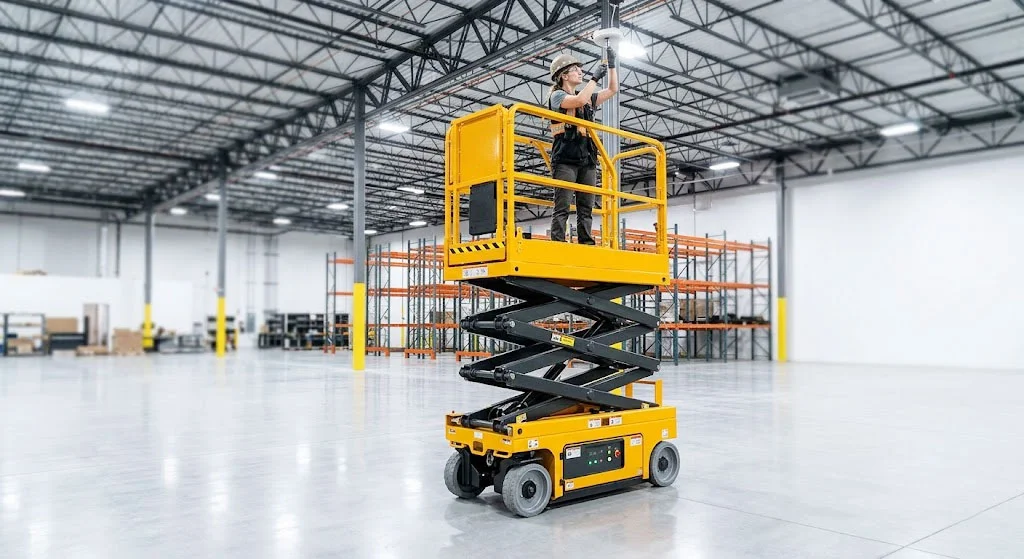
Electric slab models are the workhorses of the warehousing, retail, and indoor facility maintenance industries. Engineered with solid, non-marking rubber tires, these lifts operate strictly on smooth, level concrete surfaces (slabs). Because they run entirely on battery power, they produce zero emissions and operate with minimal noise.
If you are wondering how much is a small scissor lift for basic indoor tasks, the micro and compact categories offer highly accessible pricing. A micro electric lift with a 13-foot to 15-foot platform height generally costs between $12,000 and $14,500 new. The industry-standard 19-foot electric models fall squarely into the $13,500 to $16,500 range.
As you move up to standard and heavy-duty indoor applications—requiring working heights between 26 feet and 45 feet—the scissor lift price increases to $18,500 to $55,000. These larger electric models feature wider platforms and higher weight capacities to support multiple workers and heavy electrical or HVAC infrastructure components simultaneously.
Rough Terrain (RT) Scissor Lifts (Diesel/Gas/Hybrid)
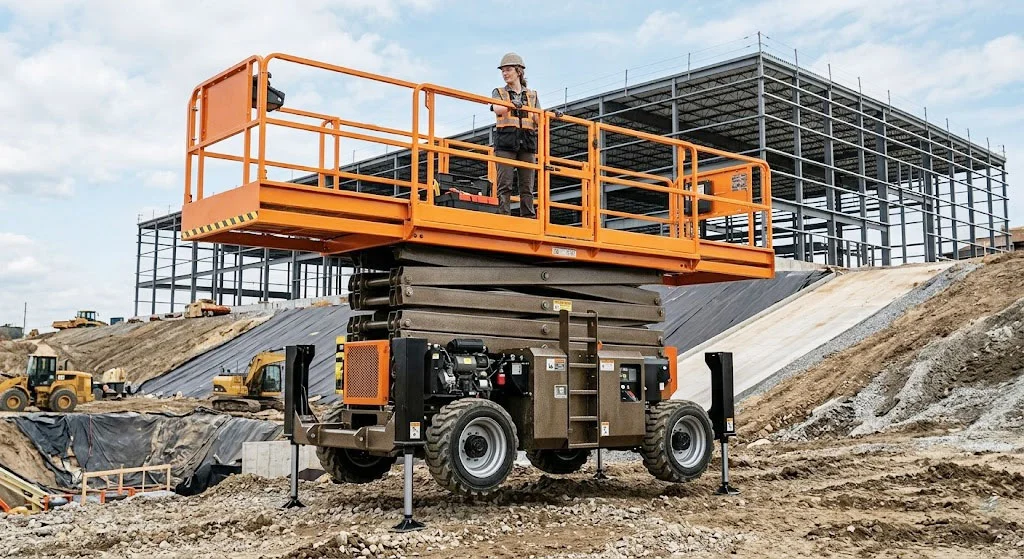
When your work moves outdoors to unimproved jobsites, muddy fields, or graded gravel foundations, an indoor electric lift cannot safely execute the task. You require a Rough Terrain (RT) scissor lift. These machines are engineered with heavy-duty chassis, four-wheel drive (4WD) capabilities, positive traction control, heavy tread or foam-filled tires, and hydraulic outriggers to level the machine on uneven slopes.
Because of this heavy engineering, the baseline price for scissor lift models built for rough terrain is substantially higher. A brand-new, mid-sized rough terrain lift with a 26-foot to 33-foot platform height will command between $40,000 and $65,000.
For massive infrastructure, industrial building framing, or high-altitude exterior glazing projects, operations look to large-scale diesel or hybrid rough terrain lifts with platform heights reaching 40 to 60 feet. These heavy-duty machines represent the premium tier of the market, with a new cost of a scissor lift in this bracket ranging from $65,000 to well over $120,000. They feature expansive roll-out deck extensions and massive lift capacities that frequently exceed 1,500 lbs.
Key Factors That Drive Scissor Lift Pricing
To accurately answer how much is a scissor lift, you must look under the hood. Lifts are not priced uniformly; manufacturers calculate costs based on material grades, structural engineering, and technological integration. Four primary variables dictate where a specific machine lands on the pricing spectrum.
Platform Height & Working Height
It is crucial to distinguish between platform height (the distance from the floor to the deck of the platform) and working height (the platform height plus an additional six feet to account for an average human’s reach).
Engineering a machine to lift personnel safely to greater heights requires a heavier base chassis to prevent tipping, thicker steel scissor arms, and more robust hydraulic cylinders. Consequently, every tier of height adds a predictable premium to the purchase price. For instance, jumping from a 19-foot platform to a 26-foot platform within the same manufacturer lineup typically adds $4,000 to $6,000 to your bottom line.
Lift Capacity (Weight Rating)
The maximum weight a platform can safely elevate affects the structural reinforcement required during manufacturing. Standard indoor models typically support between 500 and 800 lbs, which easily accommodates two workers and their basic hand tools.
However, if your crew is installing heavy commercial HVAC ductwork, fire suppression piping, or structural steel, you will require high-capacity models capable of lifting 1,000 to 2,500 lbs. High-capacity engineering requires dual hydraulic lifting cylinders and reinforced steel structures, which can elevate the baseline scissor lift cost by 15% to 35%.
Power Source & Battery Technology
The energy system driving your lift directly impacts both your initial capital expenditure and your long-term operational overhead.
Traditional Lead-Acid vs. Modern Lithium-Ion Batteries
Historically, electric scissor lifts relied exclusively on flooded lead-acid battery packs. Lifts equipped with lead-acid batteries feature a lower upfront purchase price. However, they demand strict maintenance schedules, including routine water top-offs, equalizing charges, and strict mitigation against deep discharging. Furthermore, lead-acid packs typically need complete replacement every 3 to 5 years, costing between $2,000 and $4,000.
Conversely, modern Lithium-ion (Li-ion) technology has revolutionized electric equipment fleets. Lifts built with integrated Li-ion systems require a much higher initial investment—often adding an upfront premium of $3,000 to $6,000. However, they deliver a significantly lower long-term total cost of ownership (TCO). Lithium batteries require absolutely zero maintenance, support opportunity charging during lunch breaks without memory degradation, and easily last 8 to 10 years, matching the working lifespan of the lift itself.
Diesel Engine Compliance and Emissions Standards
For rough terrain models, engine technology drives up prices. To comply with strict EPA Tier 4 Final emissions regulations in the United States or Stage V standards in Europe, diesel-powered lifts must utilize highly complex exhaust after-treatment systems, such as Diesel Particulate Filters (DPF) or Selective Catalytic Reduction (SCR). These compliant engines add thousands of dollars to the production cost, which is passed down to the buyer. This regulatory reality has caused a massive market surge in dual-fuel (Gas/LPG) and pure hybrid rough terrain models.
Build Quality & Engineering Standards
The materials used during manufacturing alter the initial purchase price and dictate the machine’s ultimate lifespan. Premium brands build their chassis and scissor stacks out of high-tensile, heavy-gauge steel, utilizing high-quality robotic welding. They integrate sealed electrical connectors, premium hydraulic pumps, and advanced onboard diagnostics systems.
While choosing an asset built to these rigorous engineering standards results in a higher initial scissor lift price, it shields your business from constant repair bills, guarantees ready access to replacement parts, and preserves a high resale or trade-in value down the road.
Hidden Costs to Consider When Buying a Scissor Lift
When calculating how much is a scissor lift, look beyond the initial invoice price. Owning an aerial work platform introduces several ongoing operational expenses that must be factored into your long-term budgeting.
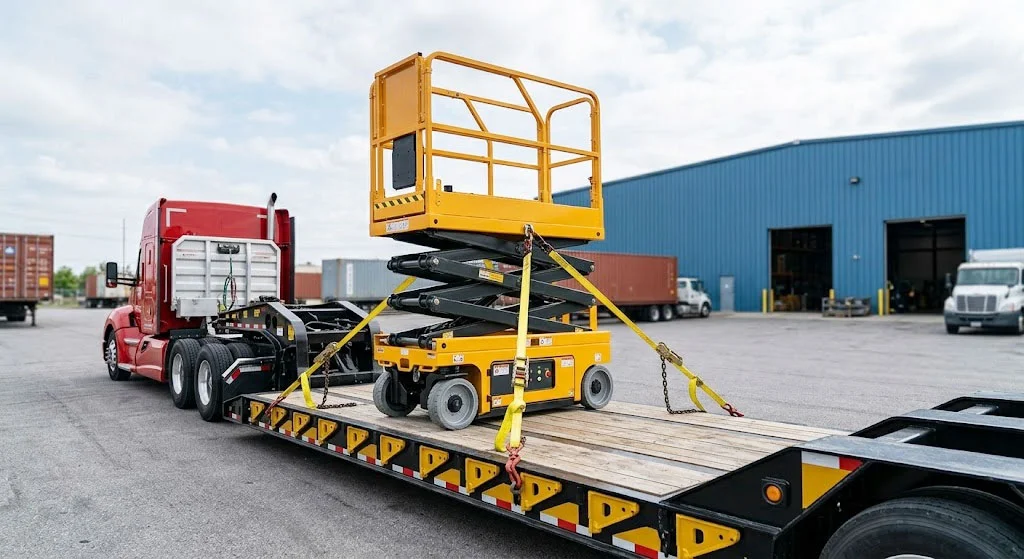
- Freight and Delivery Logistics: Scissor lifts are incredibly heavy, dense machines. Even a small 19-foot electric slab lift weighs approximately 2,500 to 3,300 lbs, while a large rough terrain model can weigh over 10,000 lbs. Because they cannot be driven on public roads, you must pay for professional flatbed transport. Depending on the distance from the dealer to your facility, freight charges can add $300 to $1,500+ per delivery.
- Annual Inspections and OSHA Compliance: To maintain compliance with Occupational Safety and Health Administration (OSHA) and American National Standards Institute (ANSI) regulations, every scissor lift must undergo a comprehensive inspection every single year. These structural and mechanical evaluations must be performed by a qualified mechanic and generally cost between $300 and $800 per year, excluding the cost of any required repairs.
- Preventative Maintenance and Wear Items: Over the course of the machine’s lifespan, components will inevitably degrade. For electric models, this means replacing batteries and charging units. For rough terrain models, you must budget for routine engine oil changes, hydraulic fluid flushes, filter replacements, and new sets of foam-filled or pneumatic tires. Annual preventative maintenance parts and labor average $500 to $1,000 for electric models, and $1,500 to $3,000 for diesel-powered rough terrain models.
- Operator Training and Safety Certification: OSHA requires that every employee who steps onto an aerial work platform be formally trained and certified on that specific class of equipment. Providing proper safety training courses for your crew costs approximately $100 to $300 per operator.
Buying Direct vs. Local Dealers: Maximizing Value
Once you have identified the right equipment specifications for your application, your final hurdle is choosing the right procurement channel. Where you buy your machinery greatly influences both the transaction price and the level of support you receive over the lifecycle of the equipment.
The Role of Tier-1 Manufacturers and Suppliers
When exploring the market, most buyers first look to global tier-1 scissor lift manufacturers like JLG, Genie, and Skyjack. Purchasing an asset from an established scissor lift manufacturer guarantees top-tier build quality, comprehensive safety engineering, and reliable engineering support. However, these marquee domestic brands carry premium pricing and can sometimes involve long manufacturing backlogs during peak construction seasons.
To optimize equipment budgets, many procurement managers look for an alternative scissor lift supplier or specialized international trading firms. Working with an overseas partner, such as a verified china scissor lift supplier, has become a highly popular strategy for acquiring reliable equipment at a vastly reduced capital layout.
Due to massive production economies of scale, lower raw material costs, and highly advanced automated manufacturing facilities, a certified supplier can deliver factory-new electric or micro scissor lifts at pricing that aggressively undercuts domestic brands—often saving buyers 20% to 40% upfront. If you choose this procurement route, it is vital to partner with an established supplier that maintains a robust domestic parts warehouse and provides reliable warranty support to prevent long lead times for components.
Local Equipment Dealers
The alternative to direct factory sourcing is working through an authorized local equipment dealership. While local dealers markup the base machine price to cover their overhead margins, they provide significant localized benefits:
- Custom in-house financing programs and flexible lease-to-own corporate structures.
- Immediate, on-site equipment inventory, eliminating weeks or months of factory shipping transit times.
- Dedicated, factory-trained field mechanics who can arrive at your facility within hours to perform emergency warranty repairs, maximizing machine uptime.
Conclusion
Answering the core question—how much is a scissor lift—requires evaluating your unique operational environment. If you operate an indoor fulfillment warehouse or manage light commercial properties, a compact, budget-friendly electric slab lift costing between $13,500 and $20,000 will perfectly maximize your productivity. If your projects involve rugged, unpaved outdoor construction environments, you must budget for a heavy-duty rough terrain model ranging from $40,000 to over $100,000.
Do not look at an aerial platform as a simple upfront expense; view it as a long-term tool for operational efficiency. By carefully weighing platform heights, opting for modern battery systems like Lithium-ion to reduce ongoing maintenance, budgeting for hidden delivery and compliance costs, and sourcing through an optimal equipment supplier, you will ensure your business secures the highest possible ROI while keeping your crew safe at any height.
Ready to find the ideal lifting solution for your next project? For customized quotes, competitive direct-factory pricing, or expert machinery recommendations, our team is here to help you navigate your choices seamlessly. Get in touch with us today via our active communication channels:
- Email: info@klingtec.com
- WhatsApp: +86 188 6686 3188
FAQs
How much does a scissor lift cost on average?
The average scissor lift cost ranges from approximately $6,000 to over $50,000 depending on size, type, and features.
How much is a small scissor lift?
A small electric slab scissor lift typically costs between $6,000 and $10,000.
Why are rough terrain scissor lifts more expensive?
Rough terrain lifts require heavier-duty engineering, larger engines, four-wheel drive systems, and outdoor durability features, which increase the overall scissor lift price.
Is it cheaper to buy directly from a manufacturer?
In many cases, yes. Buying directly from a scissor lift manufacturer or a reputable China scissor lift supplier can reduce dealer markups and lower the overall purchase price.
What is the biggest factor affecting scissor lift price?
Platform height is usually the biggest pricing factor. Taller lifts require more materials, stronger structures, and more advanced hydraulic systems.
Are lithium-ion scissor lifts worth the higher cost?
Although lithium-ion lifts have a higher upfront price for scissor lift equipment, they often reduce long-term maintenance and charging downtime, making them a valuable investment for many operations.