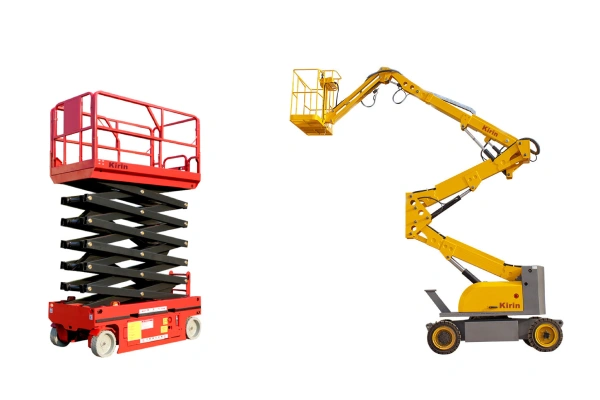
The scissor lift is one of the most recognizable and essential pieces of equipment on nearly every construction site, warehouse, and maintenance operation. Its ability to provide a stable, versatile, and spacious work platform for elevated tasks makes it indispensable. But for those new to the world of aerial work platforms (AWPs), the fundamental question remains: how high can a scissor lift go?
The short answer is that while standard models typically reach up to a maximum working height of around 56 to 70 feet (17 to 21 meters), highly specialized models can push that limit even further, some reaching platform heights of over 100 feet (30 meters).
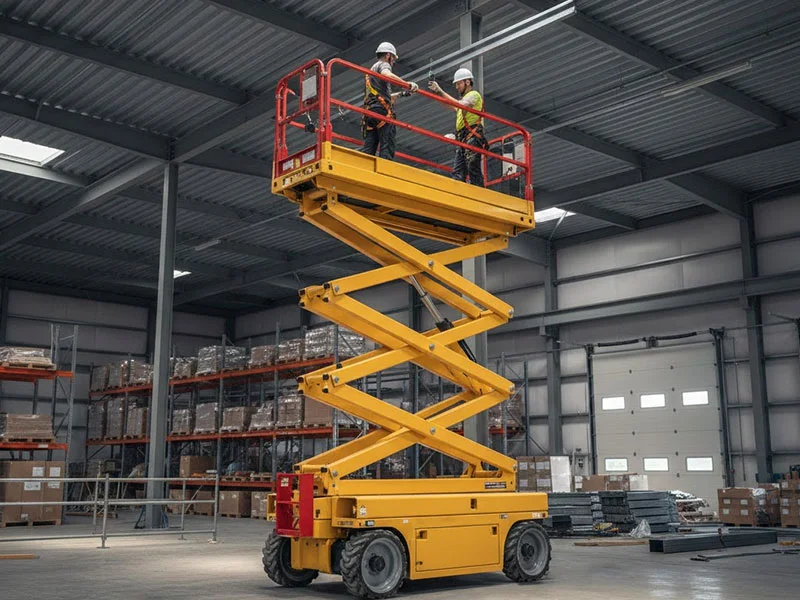
However, selecting the right machine is about more than just a single number. The maximum height is entirely dependent on the lift’s type, model, power source, and, most critically, the difference between its rated platform height and its actual working height. This comprehensive guide will break down the essential terminology, explore the maximum reach for different scissor lift categories, and detail the factors that determine precisely how high can a scissor lift go.
Understanding Key Terminology: Platform vs. Working Height
When researching or renting a scissor lift, you will encounter two primary measurements of vertical reach. Understanding the distinction between them is crucial for both safety and efficiency, as choosing the wrong height can leave your crew stretching dangerously or simply unable to complete the job.
A. Platform Height (The “Rated” Height)
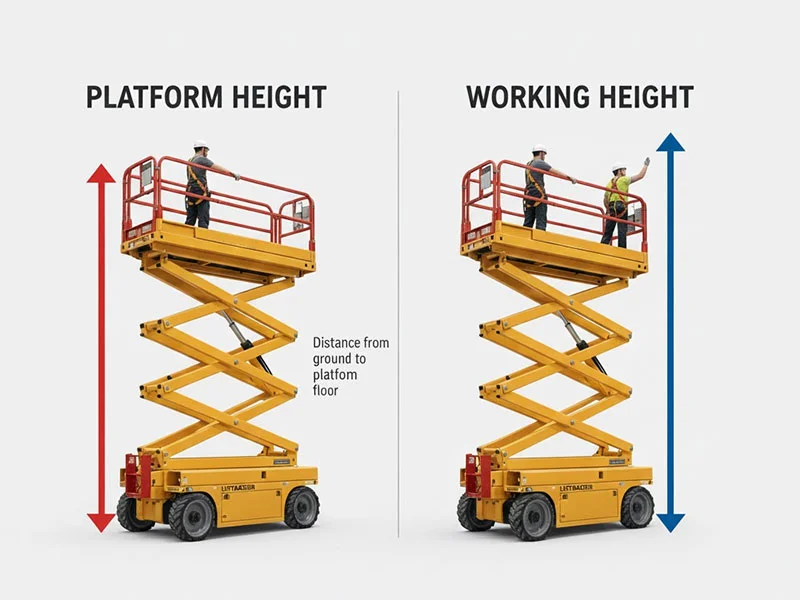
- Definition: The Platform Height is the distance from the ground to the floor of the elevated work platform when the lift is fully extended.
- Significance: This is the measurement most often used in a machine’s model name or specifications (e.g., a “40-foot scissor lift” has a 40-foot platform height). It represents the maximum elevation the machine’s lift mechanism can achieve.
B. Working Height (The Practical Height)
- Definition: The Working Height is the maximum practical vertical reach an operator can comfortably achieve while standing on the fully extended platform.
- Calculation: The industry standard for calculating working height is to add the average vertical reach of a person (approximately 6 feet or 2 meters) to the maximum platform height.
- Example: A scissor lift with a 40-foot Platform Height will have a 46-foot Working Height (40 ft+6 ft=46 ft).
When you ask, “How high can a scissor lift go?”, you are typically asking for the working height, as this determines the highest point your team can actually work on, whether installing ductwork, painting a wall, or repairing exterior siding. Always size your lift based on the required working height for your specific task.
Maximum Heights by Scissor Lift Type
The ultimate answer to how high can scissor lifts go is dictated by the lift’s design and its intended operating environment, which primarily separates them into two major categories: indoor electric lifts and outdoor rough-terrain lifts.
A. Indoor/Electric Lifts (Slab Lifts)
Also known as slab lifts, these are electric-powered machines with non-marking tires designed for smooth, flat, finished surfaces like concrete slabs, warehouse floors, or finished building interiors. Their design prioritizes compactness, low weight, and quiet, zero-emission operation.
The height range for electric scissor lifts is extensive, from compact micro-lifts to some of the tallest models available for indoor work.
| Platform Height (Metric) | Approx. Platform Height (Imperial) | Approx. Working Height (Imperial) | Primary Use Case |
| 3m Scissor Lift | 10–12 ft | 16–18 ft | Low-level access, ceiling tiles, light maintenance, small retail settings. This is often the smallest lift available. |
| 6m Scissor Lift | 19–20 ft | 25–26 ft | Extremely popular for indoor work, fitting through standard double doors, warehouse inventory, and electrical work. |
| 8m Scissor Lift | 26 ft | 32 ft | Mid-range height, still compact enough for many indoor/outdoor slab applications, capable of reaching high bay lighting. |
| 10m Scissor Lift | 32 ft | 38 ft | Accessing two to three stories of a building, complex indoor ductwork, and maintenance in large industrial facilities. |
| 12m Scissor Lift | 40 ft | 46 ft | Higher-reach indoor/slab work, such as stadium or convention center maintenance, providing access to multiple levels. |
| 14m Scissor Lift | 45–46 ft | 51–52 ft | Near the maximum practical height for a standard electric slab lift, suitable for very high indoor ceilings and multi-story interior construction. |
Key Takeaway: Electric slab lifts typically range from 10 to 46 feet in platform height, giving them a working height of up to 52 feet. They are perfect when you need to know how high can a compact scissor lift go in a tight space.
B. Outdoor/Rough Terrain Lifts (Diesel Lifts)
Designed for the demanding environment of an undeveloped construction site, rough terrain (RT) lifts are typically powered by diesel or dual-fuel engines. They feature powerful engines, four-wheel drive, and rugged, high-traction tires.
Because they are built on a wider, heavier, and more stable chassis, RT lifts can safely achieve much greater vertical heights.
- Common Range: Rough terrain lifts typically start where the large electric lifts leave off, with platform heights ranging from 30 feet up to 60 feet.
- Maximum Reach: The largest, most common rough-terrain models have platform heights of 60 feet (18.3 meters), resulting in a towering 66-foot working height.
- Specialized Models: For extreme height requirements on a stable surface, manufacturers have introduced highly specialized, large-format scissor lifts that can reach platform heights of 80 to over 100 feet (30+ meters), giving them a working height of over 106 feet. These are massive machines, often used for major industrial construction or shipbuilding, demonstrating just how high does a scissor lift go when engineering stability is prioritized.
The Ultimate Answer to How High Can a Scissor Lift Go: While the majority of jobs are covered by lifts up to a 46-foot working height, the maximum height for a standard, widely available rental scissor lift is approximately 70 feet (60-foot platform + 6-foot operator reach). For specialized, high-capacity industrial projects, the ceiling is even higher, reaching over 100 feet.
Factors That Limit/Determine Height
The platform height is not simply a matter of adding more scissor segments. Several engineering and safety factors limit the maximum reach of any given model:
A. Weight and Capacity
Every lift has a maximum rated load capacity (often called platform capacity), which is the total weight the lift can safely support on its platform. This capacity must include:
- The weight of all operators.
- The weight of tools, equipment, and materials (e.g., steel beams, large windows, pallets of drywall).
- The weight of any platform extension deck.
The Rule: There is an inverse relationship between height and capacity. Generally, the higher the lift, the lower its maximum rated capacity is at its peak elevation, as the stability requirements become stricter. You must ensure the chosen lift has enough capacity to handle both the weight and the necessary height. If you are dealing with a heavy load, you might need a dedicated cargo scissor lift which prioritizes capacity over extreme height.
B. Stability and Base Size
The stability of a scissor lift is a product of its base footprint (length and width) and its overall weight.
- Taller Lifts = Wider Base: As the lift height increases, the base must be proportionately larger to maintain a safe center of gravity and prevent tipping, especially in wind or during minor platform movements. This is why a 60-foot rough terrain lift is significantly wider and heavier than a 19-foot electric lift.
- Ground Conditions: Rough terrain lifts are designed with a wider stance and sometimes feature automatic leveling stabilizers or outriggers to compensate for uneven ground, ensuring maximum stability even when the answer to how high will a scissor lift go is at its limit.
C. Power Source
The power source indirectly determines height by limiting the overall size and stability of the machine:
- Electric (Slab) Lifts: Limited by battery life and the need to maintain a compact design for indoor use. This restricts them to the lower-to-mid height range (typically up to 46 feet working height).
- Diesel/Dual-Fuel (Rough Terrain) Lifts: These use powerful, large engines that can manage the weight and operation of much larger, heavier frames, allowing them to safely reach the highest working heights (up to 70 feet or more for common models).
Scissor Lifts vs. Boom Lifts: What if I need to go higher?
If your answer to how high can a scissor lift go doesn’t meet your job requirements, you need to consider a Boom Lift (also known as a cherry picker or aerial work platform).
| Feature | Scissor Lift | Boom Lift (Articulating/Telescopic) |
| Vertical Reach (Working) | Up to 70 feet (standard), 100+ feet (specialized) | Up to 185 feet (56 meters) or more |
| Horizontal Reach | None (only moves straight up/down) | Excellent (Can reach over obstacles and out to the side) |
| Platform Size | Large and Spacious (can hold multiple workers and tools) | Small (typically fits 1-2 workers and minimal tools) |
| Stability at Height | Highly stable, vertical-only movement | Less stable, can sway due to boom length |
| Best For | Vertical access, carrying heavy loads, spacious work area. | High-altitude work, reaching over obstacles, facade inspection. |
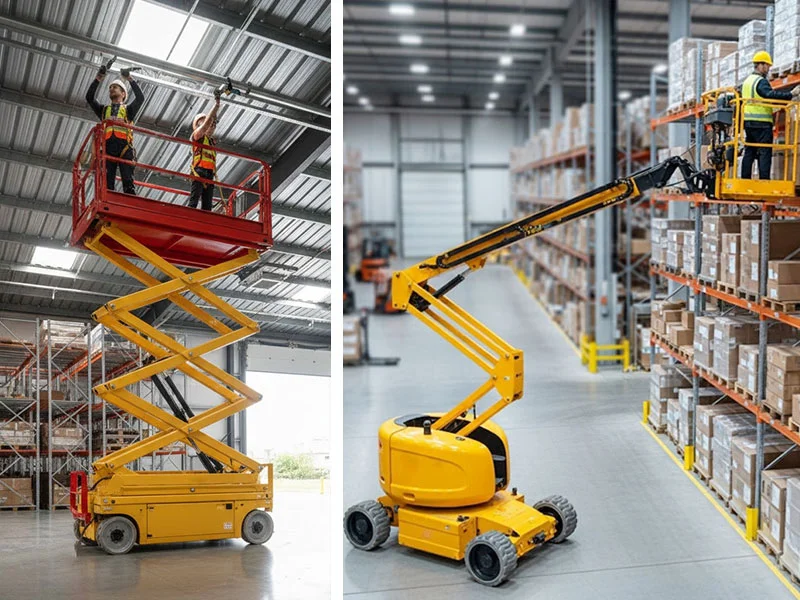
The Tipping Point: If you need to work above a 70-foot working height, or if your work requires reaching out and over an obstruction (like a roof, pipe, or retaining wall), a scissor lift is not the correct tool. In these scenarios, a boom lift is the only safe and practical option. Boom lifts are specifically engineered for extreme heights and horizontal outreach, providing the versatility a scissor mechanism simply cannot match.
Conclusion
Choosing the right aerial work platform starts with accurately answering the question, “how high can a scissor lift go?” The answer is multifaceted, ranging from a modest 16-foot working height for a micro-lift to over 100 feet for a highly specialized, heavy-duty industrial unit.
For most day-to-day operations, remember the distinction:
- Indoor/Slab Lifts: Max working height around 52 feet.
- Outdoor/Rough Terrain Lifts: Max working height around 70 feet (standard rental fleets).
By understanding the difference between platform height and working height, factoring in your load capacity requirements, and selecting the correct lift type for your terrain, you can ensure your project proceeds safely, efficiently, and at the precise elevation you need.
Before starting any job, always consult the manufacturer’s operational manual for the exact maximum capacity and height of your specific model. Safety should always be the top priority when operating machinery at elevated heights.
FAQs
What is the highest a standard rental scissor lift can go?
The highest a standard, widely available rough-terrain scissor lift can go is typically a 60-foot platform height, resulting in a 66-foot working height. Electric slab lifts usually max out at a 46-foot platform height (52-foot working height).
Why is a boom lift preferred over a scissor lift for higher jobs?
Boom lifts offer two critical capabilities a scissor lift cannot: higher reach (up to 185 feet or more) and horizontal outreach. Since a scissor lift only travels vertically, it is not suitable for tasks that require reaching out over a large obstacle.
Do all scissor lifts have the same weight capacity?
No. Weight capacity (or rated load capacity) varies significantly based on the lift’s size, type, and height. Smaller electric lifts might have a capacity of 500-800 lbs, while large rough-terrain models can exceed 1,500 lbs. Capacity is often reduced when the platform is fully extended, making it critical to know how high does scissor lift go before calculating your allowable load.
Is a “good scissor lift” defined by its maximum height?
Not necessarily. A good scissor lift is one that is properly sized for the job. A 19-foot compact electric lift is the best choice for a narrow, indoor aisle where a massive 60-foot lift would be unusable. The “good” factor depends on maneuverability, capacity, and the right working height for the application.