For centuries, the challenge of working safely and efficiently at height has driven innovation, moving from simple ladders and elaborate scaffolding to modern, sophisticated machinery. Today, virtually every major construction, maintenance, and industrial project relies on a critical piece of equipment to help workers reach elevated areas: the elevated work platform.
If you’ve ever seen a crew repairing a highway sign, installing window panes on a skyscraper, or trimming trees near a power line, you’ve witnessed an elevated work platform in action. These powerful machines have revolutionized the way work gets done above ground level, replacing the often time-consuming and less secure methods of the past. But what exactly is an aerial work platform, and why is it so essential in countless industries worldwide?
In this comprehensive guide, we’ll delve into the core definition, explore the different types, discuss their applications, and cover the vital safety requirements that govern their use. Understanding the function and classification of the elevated work platform is the first step toward safe and effective elevated operations.
The Core Definition of an Elevated Work Platform (EWP)
The term elevated work platform covers a broad category of mechanized equipment. Getting to a precise definition is essential for anyone who operates, rents, or works around this machinery.
A. What is an EWP?
An elevated work platform (EWP) is a mobile machine specifically designed to lift personnel, along with their tools and materials, to a working position at height. The primary function of an aerial work platform is to provide temporary, safe, and secure access to elevated areas that would otherwise be difficult or impossible to reach.
Unlike fixed-position solutions like scaffolding, an elevated work platform offers mobility and flexibility, allowing operators to quickly and easily reposition the platform. This versatility makes the elevated work platform an indispensable asset in modern worksites.
B. Alternative Terminology:
While elevated work platform is a widely accepted term, you’ll often encounter several other names in the industry, including:
- MEWP (Mobile Elevated Work Platform): This is perhaps the most common alternative and is the standardized term used in many international regulatory and safety guidelines (e.g., ANSI in North America, and ISO). The mobile descriptor simply emphasizes the machine’s ability to be driven or moved. The mewp meaning is synonymous with aerial work platform.
- Aerial Work Platform (AWP): Another very popular term, which clearly denotes the function of elevating workers into the air.
- Aerial Lift: Often used interchangeably with AWP, particularly in North America.
- Cherry Picker: This is a common, non-technical nickname, particularly for boom-style lifts, stemming from their original use in orchards for picking fruit.
Whether you hear the term elevated work platform, mobile elevated work platform, or mewps, they all refer to the same class of safety-critical access equipment.
C. Key Components:
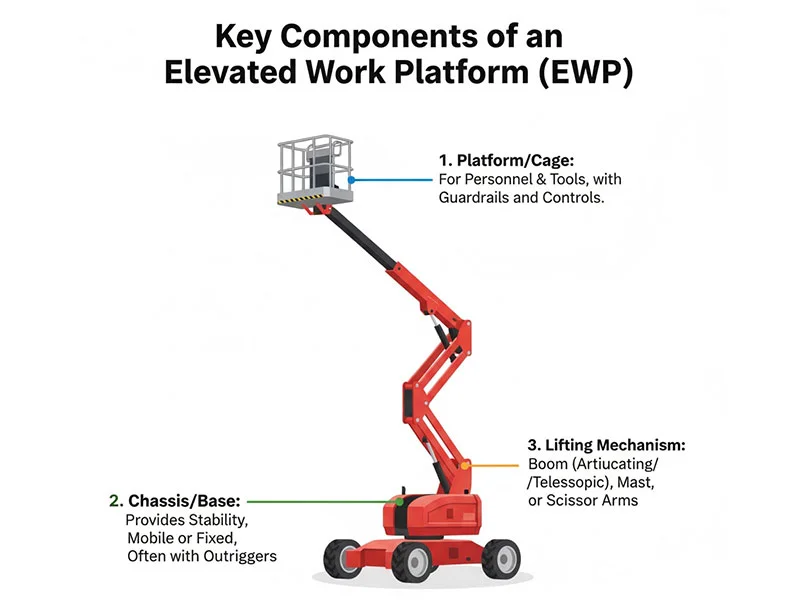
Despite the different designs, every elevated work platform shares three fundamental components necessary for its operation:
The Platform (Cage/Basket)
This is the workspace itself—the structure where the operator and other authorized personnel stand, along with their tools and materials. It features guardrails and a firm floor to prevent falls, and it’s the location for the operator controls used to maneuver the platform and base. Workers on an aerial work platform are typically required to wear personal fall protection equipment.
The Chassis/Base (Mobile or Fixed)
The chassis is the machine’s foundation, providing stability and support. It can be self-propelled (allowing the operator to drive it from the platform), towed (trailer-mounted), or vehicle-mounted (like a bucket truck). Many heavy-duty elevated work platforms use outriggers or stabilizers—hydraulically extended supports—to increase the footprint and prevent tip-overs, ensuring the stability of the elevated work platform.
The Lifting Mechanism (Boom, Mast, or Scissor Arms)
This is the heart of the elevated work platform, the structure that extends and retracts to raise and lower the platform.
- Boom: Used on boom lifts, this is an articulated (jointed) or telescopic (straight extending) arm that allows for both vertical height and horizontal outreach.
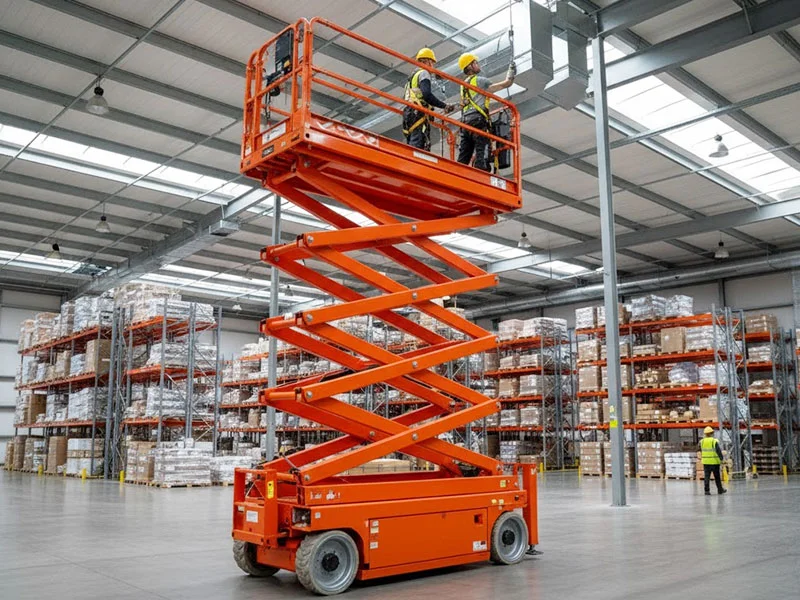
- Scissor Arms: A series of crossing supports that extend in a vertical, crisscross fashion to raise the platform straight up.
- Mast: A vertical column that elevates the platform directly overhead, commonly found on vertical mast lifts.
Major Types and Classifications of Elevated Work Platforms
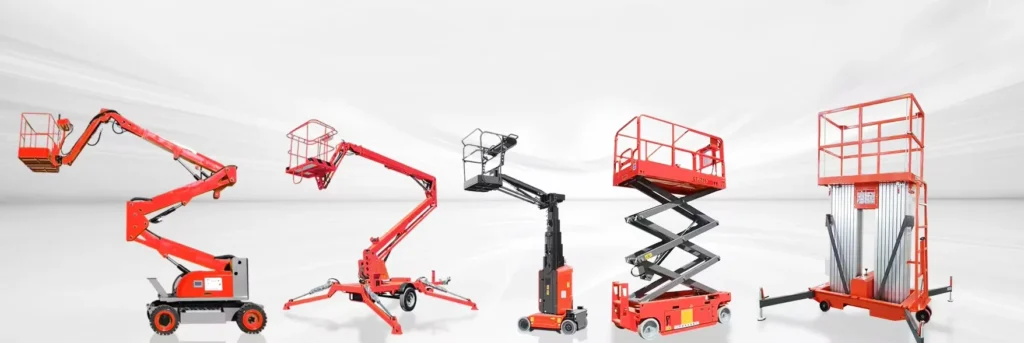
The world of elevated work platforms is diverse, with each design tailored to meet specific job site requirements regarding height, reach, and maneuverability. Regulators generally classify elevated work platforms into categories based on their movement and control locations (e.g., Group A/B, Type 1/2/3). However, for practical understanding, they are best defined by their structure:
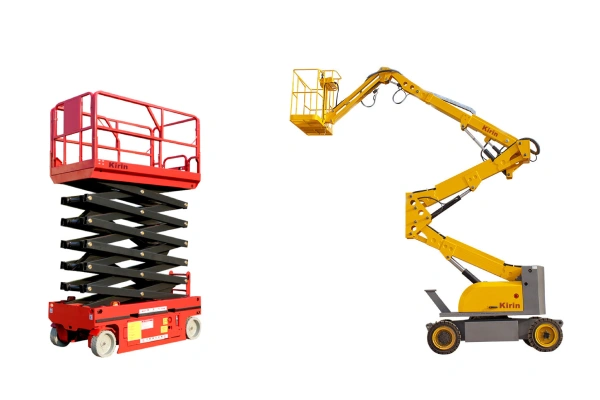
1. Scissor Lifts
- Design: The name comes from the distinct crisscrossing, jointed supports (like a giant pair of scissors) that extend to raise and lower the platform. They are a highly common type of elevated work platform.
- Movement: They provide vertical-only elevation. They do not offer horizontal reach beyond the machine’s base.
- Advantages: They have a larger platform (offering a greater workspace for multiple workers or materials) and typically boast a higher lift capacity than other EWPs. They are ideal for straight-up access tasks like installing ceiling panels, painting large walls, or carrying out warehouse inventory.
2. Boom Lifts (Articulating and Telescopic)
Boom lifts are the most versatile type of elevated work platform, offering significant horizontal outreach.
Articulating Boom Lifts (Knuckle Booms):
- Design: Feature multiple hinged sections (knuckles) in the boom.
- Movement: Excellent for reaching up and over obstacles, as the multiple joints allow the platform to navigate around obstructions like utility poles, machinery, or complex building architecture. They are highly effective as an aerial work platform for tight spaces.
Telescopic Boom Lifts (Straight Booms):
- Design: Feature a single, straight boom that extends out from the base.
- Movement: Designed for maximum reach and speed of elevation. They provide the greatest horizontal and vertical reach available from any aerial work platform and are often used in wide-open construction sites.
3. Vertical Mast Lifts (or Personal Lifts)
- Design: Smaller, more compact lifts that use a vertical mast system for elevation.
- Movement: Provide quick, straightforward vertical access, often maneuverable through standard doorways.
- Advantages: They are lightweight, perfect for indoor tasks on finished floors where space is limited, such as theatrical rigging, internal maintenance, or retail store display work. Many are manually pushed into position before elevation, though self-propelled models exist.
Applications and Industries Where EWPs Are Essential
The use of elevated work platforms spans virtually every industry that requires temporary access to high locations. The versatility and safety of the elevated work platform make it irreplaceable in numerous scenarios.
- Construction: Perhaps the most visible application. Elevated work platforms are used for steel erection, roofing, siding, masonry work, and installing window walls on high-rise structures.
- Maintenance & Facilities Management: For tasks like replacing light fixtures in high ceilings, cleaning windows on multi-story buildings, performing HVAC and utility repairs, and general exterior building upkeep.
- Industrial & Warehousing: In large factories and distribution centers, scissor lifts and vertical mast lifts are the preferred elevated work platform for inventory stocking, equipment maintenance, and accessing overhead conveyor systems.
- Utilities & Telecommunications: Vehicle-mounted boom lifts (bucket trucks) are the specialized mobile elevated work platform used by line workers for repairing and installing power lines, street lights, and communication cables, often at great heights.
- Aviation: Used for inspecting and maintaining the wings and tails of large aircraft in hangars.
- Film & Entertainment: Used to position lighting, cameras, and rigging in large studios, stadiums, and concert venues.
In short, wherever a ladder is too risky or scaffolding is too cumbersome, an aerial work platform provides the safe, productive alternative.
Safety and Compliance with Elevated Work Platforms
Given that an elevated work platform places personnel at significant heights, safety and compliance are paramount. Operating a mobile elevated work platform is considered high-risk, and strict regulatory standards must be followed to prevent accidents, which often involve falls, tip-overs, and electrocutions. The safe use of any elevated work platform is a legal and ethical requirement.
Key Safety Principles for Operating an Elevated Work Platform:
- Operator Training and Certification: All operators must undergo comprehensive, formal training specific to the type of elevated work platform they will use. This training covers pre-start inspections, safe operating procedures, load limits, and emergency protocols.
- Pre-Operation Inspection: A thorough inspection of the aerial work platform must be completed before every shift. This includes checking tires, controls, fluid levels, emergency features, and the integrity of the lifting mechanism and platform guardrails.
- Site Assessment: The work area must be evaluated for hazards such as uneven ground, potholes, soft soil, overhead power lines (electrocution is a major risk), insufficient floor loading capacity (indoors), and high wind conditions. The elevated work platform must only be used on a firm, level surface unless rated and stabilized for use on an incline.
- Fall Protection: Personnel on a boom-type aerial work platform are typically required to wear a full-body harness and lanyard connected to an approved anchor point on the platform. Regulations vary for scissor lifts, but workers must always be protected from falling.
- Load Limits: Never exceed the manufacturer’s specified load capacity for the aerial work platform platform, which includes the weight of personnel, tools, and materials.
Conclusion
The elevated work platform is much more than a simple lifting device; it’s an engineered solution for safe and efficient work at height. From the simplest vertical mast lift used indoors to the towering telescopic boom lift on a construction site, the aerial work platform is an essential piece of equipment driving productivity and safety across numerous global industries.
By understanding the core definition, recognizing the alternative terms like mewps, knowing the various types of elevated work platforms, and, most importantly, adhering strictly to safety and compliance protocols, workers and businesses can leverage these powerful machines to complete challenging projects securely and effectively. The future of construction and maintenance will continue to rely heavily on the innovation and safety provided by the modern aerial work platform.
FAQs
What is the primary difference between a scissor lift and a boom lift?
A scissor lift provides vertical-only elevation and typically has a larger platform and higher capacity. A boom lift offers both vertical and horizontal outreach (known as ‘reach’ or ‘outreach’), allowing operators to access areas over obstacles.
What does MEWP stand for?
MEWP stands for Mobile Elevated Work Platform. It is the common term used in global safety standards and is synonymous with elevated work platform and Aerial Work Platform (AWP). Understanding the mewp meaning is crucial for safety compliance.
Do I need special training to operate an elevated work platform?
Yes. All operators of any type of aerial work platform must be formally trained and, in many jurisdictions, certified or licensed. Training is required to ensure the operator understands safe operating procedures, pre-use inspections, and emergency handling specific to that class of elevated work platform.
Can I drive an elevated work platform with the platform raised?
Many self-propelled mobile elevated work platforms are designed to be driven while elevated, but only on firm, level ground, at slow speeds, and with specific safety precautions in place. Always consult the manufacturer’s manual and local safety regulations for the specific aerial work platform model.