In the fast-paced world of modern infrastructure, the ability to reach new heights—literally—is a fundamental requirement. Whether it’s a sprawling residential complex or a massive industrial facility, construction lifts have become the backbone of the job site. No longer are contractors relying solely on cumbersome scaffolding; instead, they utilize precision-engineered machinery to move personnel, tools, and materials safely and efficiently.
This comprehensive guide explores the various types of construction lifts, their specific applications, and how to choose the right one for your next big project.
The skyline of any modern city is a testament to engineering prowess, but those soaring structures wouldn’t exist without the mechanical “muscle” provided by construction lifts. These machines are designed to overcome the limitations of gravity, providing stable platforms for workers and heavy-duty transport for materials.
As projects become more complex and safety regulations more stringent, understanding the nuances of construction lifts is essential for project managers, site foremen, and developers alike. Choosing the right construction lift can be the difference between a project that finishes ahead of schedule and one that is plagued by costly delays and safety hazards.
What Are Construction Lifts?
At its core, a construction lift is a type of aerial work platform (AWP) or material handling machine used to provide temporary access for people or equipment to inaccessible areas, usually at height. While many people use the term “cherry picker construction” or “man lift” interchangeably, construction lifts encompass a wide range of specialized machinery.
These units are typically powered by electric motors, internal combustion engines (diesel or dual-fuel), or hydraulic systems. They are categorized based on their movement capabilities—some move only vertically, while others offer telescopic reach or articulated joints to navigate around obstacles.
Why Construction Lifts Are Important in Modern Projects
Modern construction demands a level of precision and speed that manual labor cannot achieve alone. Here is why construction lifts are indispensable:
Improved Worker Safety
Safety is the number one priority on any job site. Unlike ladders or basic scaffolding, construction lifts offer enclosed platforms, fall protection anchor points, and emergency shut-off systems. Using a construction lift significantly reduces the risk of falls, which remain a leading cause of injury in the industry.
Increased Efficiency
Time is money. A construction lift allows workers to reach their destination in seconds rather than minutes. Furthermore, these lifts can carry heavy tools and materials up with the worker, eliminating the need for separate pulley systems or multiple trips up a ladder.
Heavy Load Handling
Manually carrying heavy items like HVAC units, steel beams, or pallets of bricks is physically taxing and dangerous. Specialized construction lifts are designed to handle thousands of pounds, ensuring that materials are positioned exactly where they are needed without straining the crew.
Versatility Across Job Sites
From rough terrain models with 4WD capabilities to compact electric units designed for indoor flooring, construction lifts are built for every environment. Whether you are working on a muddy field or a finished marble lobby, there is a construction lift designed for that specific terrain.
Main Types of Construction Lifts
Scissor Lifts: The Vertical Workhorse
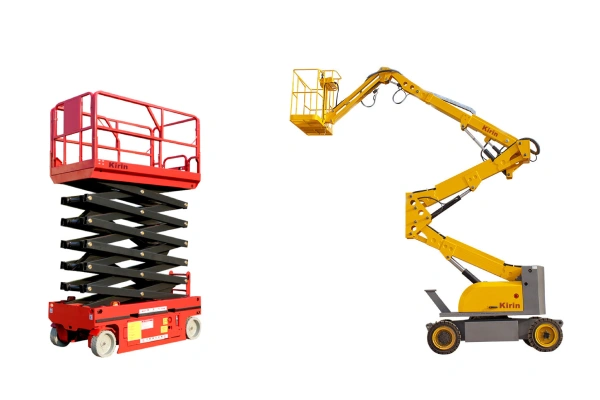
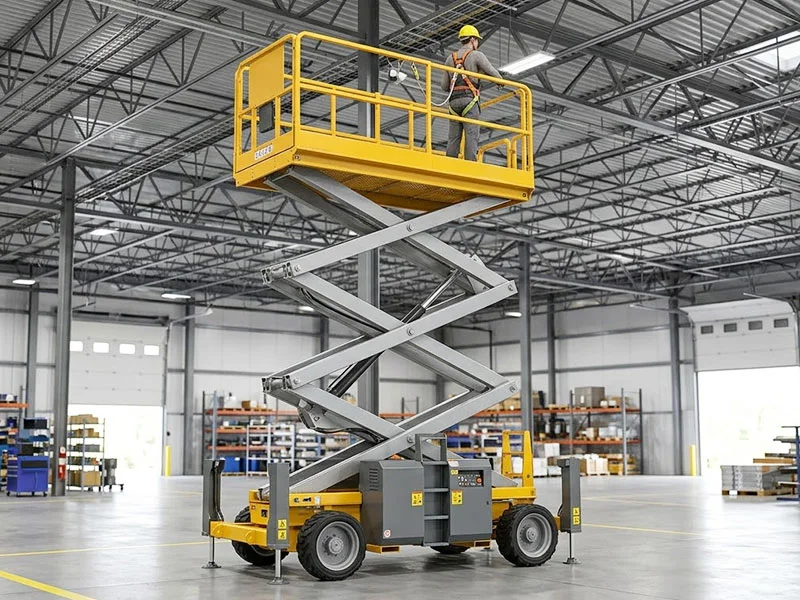
A scissor lift is a construction lift that moves strictly on a vertical plane. Its signature feature is the “pantograph” (the X-shaped folding braces) that extends to push the platform upward.
- Mechanical Advantage: Because the platform is supported by the entire base, these lifts offer the highest weight capacities and the largest work areas (often called “decks”).
- Modern Use: Ideal for tasks where multiple workers and heavy materials (like ductwork or stacks of drywall) need to stay at a height for an extended period.
- Key Fact: Most indoor scissor lifts are electric and use “non-marking” tires to protect finished flooring.
Boom Lifts: Reach and Versatility
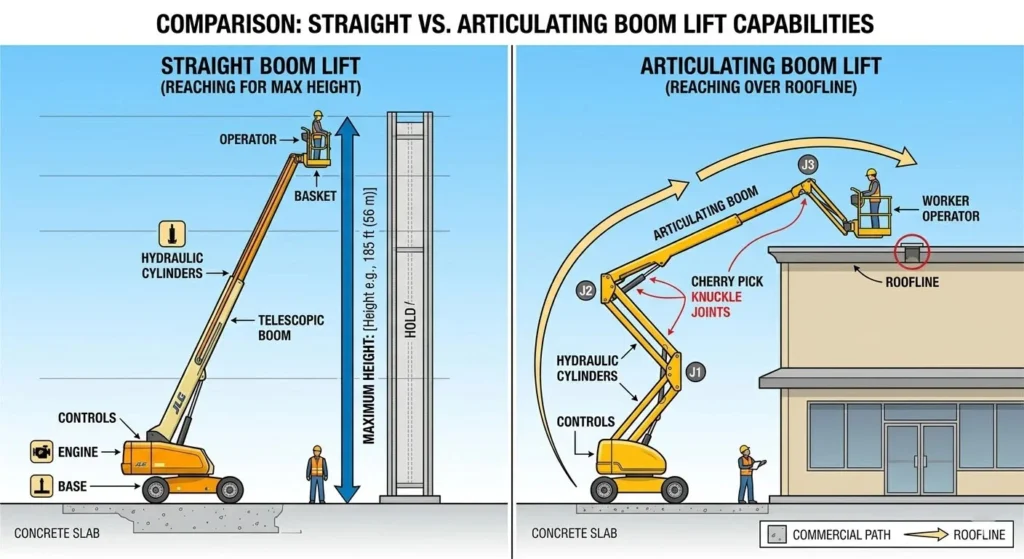
The construction boom lift is the most recognizable piece of aerial equipment. Unlike scissor lifts, booms use a hydraulic arm to move the bucket. They are categorized into two main styles:
- Telescopic Boom Lifts: Also known as “S-Booms” (straight booms). These extend straight out and up. They offer the greatest reach and are perfect for work that requires maximum distance from the base.
- Articulating Boom Lifts: Often referred to in the trade as cherry picker construction equipment. These have “knuckles” in the arm that allow the operator to reach up, over, and behind obstacles like walls or machinery.
Vertical Mast Lifts: The Compact Solution
When a project requires a lift for construction in a confined space—such as a narrow retail aisle or a crowded data center—the vertical mast lift is the go-to.
- Mechanical Advantage: They have a very small footprint and a zero-turn radius. The mast extends straight up like a telescope.
- Modern Use: These are frequently used for light maintenance, electrical “fit-outs,” and stock management in warehouses where a scissor lift would be too wide to pass through doors.
Construction Hoists: The Site Elevator
For high-rise development, a mobile construction lift isn’t enough. You need a construction hoist. These are temporary elevators buckled to the side of a building or a crane tower.
- Mechanical Advantage: They use a rack-and-pinion system to climb a vertical mast at high speeds.
- Modern Use: These are the primary method for transporting large crews (personnel hoists) or massive pallets of materials (material hoists) to the 20th, 40th, or 60th floor of a skyscraper.
Telehandlers: The Hybrid Lifter
The telehandler (telescopic handler) is a hybrid between a forklift and a construction boom lift.
- Mechanical Advantage: It features a telescopic boom equipped with various attachments—most commonly forks. This allows it to “reach” into the second or third story of a building to deliver a pallet of bricks.
- Modern Use: Essential for the early stages of a project, such as framing and masonry, where materials need to be moved across muddy, unpaved terrain.
Aerial Work Platforms (AWP): Portable Access
Often called “man lifts” or “push-arounds,” these are the most basic construction lifts.
- Mechanical Advantage: They are lightweight and often fit through a standard doorway. Many are not self-propelled; they are pushed into place by hand and then stabilized with outriggers.
- Modern Use: Perfect for schools, hospitals, and office buildings where heavy machinery would damage the floor or where the work is light (e.g., changing a single bulb or inspecting a sprinkler head).
How to Choose the Right Construction Lift
Selecting the wrong construction lift can result in equipment that can’t reach the work area or, worse, a machine that is unstable for the terrain. Consider these factors:
Working Height Requirements
Measure the exact height you need to reach. Remember that “platform height” is where your feet are, while “working height” is usually about six feet above that. Ensure your construction lift has a buffer to avoid overextending the hydraulics.
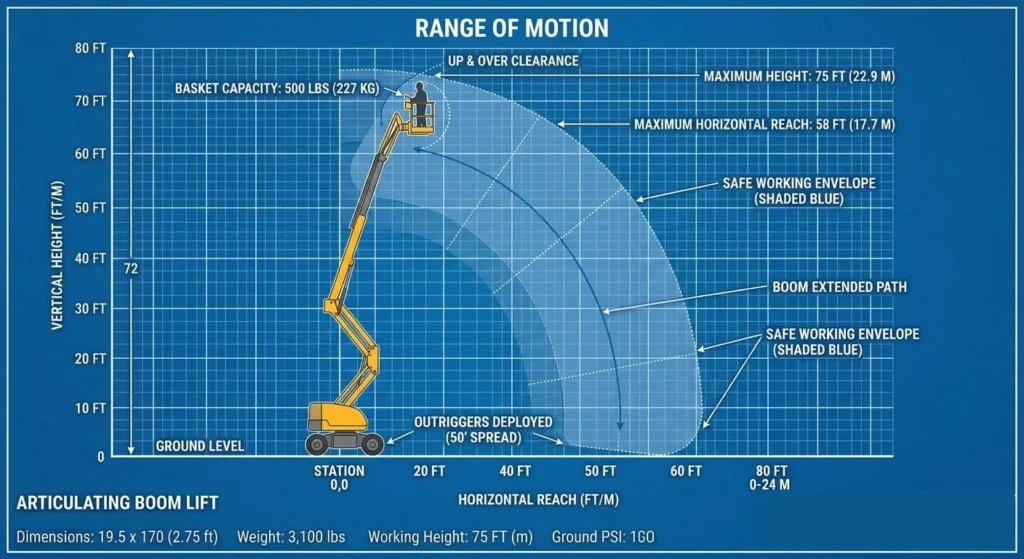
Load Capacity
Every construction lift has a strict weight limit. This must include the weight of the operator, their tools, and any materials being transported. Exceeding this limit is a major safety violation and can cause the lift to tip.
Job Site Conditions
- Indoor: Look for electric construction lifts with non-marking tires to avoid fumes and floor damage.
- Outdoor: You may need a construction lift with a diesel engine and outriggers for stability on uneven ground.
Maneuverability
If you are working in a warehouse with narrow aisles, a compact vertical mast lift is better than a wide scissor lift. If you need to reach over a finished structure, an articulating construction boom lift is your best bet.
Safety Features
Check for modern safety features such as tilt sensors, descent alarms, and emergency lowering valves. A high-quality construction lift should feel stable even at its maximum extension.
Safety Tips When Using Construction Lifts
Operating construction lifts requires specialized training. Here are the “Golden Rules” of lift safety:
- Inspect Before Use: Always perform a pre-start inspection of the hydraulics, tires, and controls.
- Wear a Harness: On boom-style construction lifts, a full-body harness and lanyard are mandatory to prevent being ejected from the platform.
- Check the Ground: Never operate a lift for construction on a slope unless the machine is specifically rated for it and outriggers are deployed.
- Clear the Area: Ensure a “danger zone” is established around the base of the construction lift to protect ground workers from falling objects.
- Watch for Power Lines: Maintain a minimum distance of 10 feet from overhead power lines.
Conclusion
As the construction industry evolves, construction lifts will only become more advanced, incorporating electric “green” technology and automated leveling systems. Whether you are using a construction boom lift for a high-rise exterior or a scissor lift for interior HVAC work, these machines are the keys to a productive and safe site.
By understanding the specific strengths of each construction lift, you can optimize your resources, protect your workers, and ensure that your project reaches new heights of success.
Would you like me to create a detailed comparison table of the weight capacities and maximum heights for the most popular construction lift models?
FAQs
What is the difference between a cherry picker and a boom lift?
In the context of construction lifts, a “cherry picker” is a type of articulating boom lift. The name comes from its original use in orchards, but in construction, it refers to any lift with a jointed arm that can reach over obstacles.
Do I need a license to operate construction lifts?
Yes, in most regions (including the US under OSHA), operators must be trained and certified to use construction lifts. This ensures they understand load limits and emergency procedures.
Can I use an indoor scissor lift outside?
Generally, no. Indoor construction lifts often lack the wind-rating and terrain-handling capabilities of outdoor models. Always check the manufacturer’s “Outdoor Rating” before using a lift for construction outside.
How much weight can a standard construction lift hold?
Capacity varies wildly. A small AWP might only hold 300 lbs, while a heavy-duty rough-terrain scissor lift can hold up to 2,500 lbs or more. Always check the load chart on your specific construction lift.