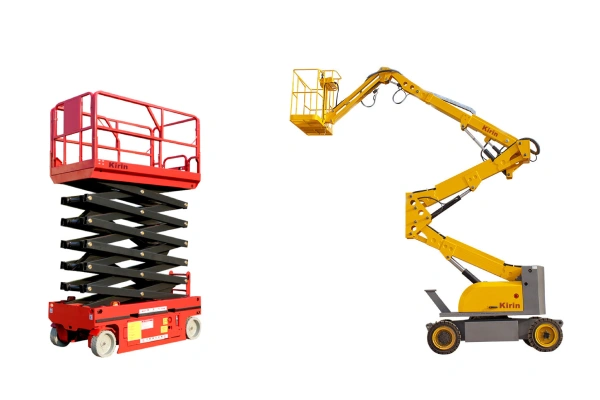
The modern construction site is a dynamic, vertical environment. To meet the demands of building taller, faster, and safer, construction professionals rely on a fleet of specialized machines designed to elevate workers and materials: the construction lift. Often referred to as Mobile Elevating Work Platforms (MEWPs) or aerial work platforms, these indispensable machines are the backbone of high-access work.
Selecting the wrong construction lift for a job can lead to costly delays, reduced productivity, and, most importantly, safety hazards. This comprehensive guide will break down the essential types of construction lift equipment, detailing their unique mechanisms, key applications, and how to choose the right one for your project, ensuring every aspect of your job—from drywall installation to structural steel erection—is completed efficiently and securely.
Understanding Construction Lifts
A construction lift is any piece of heavy machinery designed to safely and efficiently move personnel, tools, and materials to elevated work locations. They provide a stable, protected platform that dramatically increases worker safety and productivity compared to traditional methods like ladders and scaffolding.
The primary role of a construction lift is to replace the need for extensive, time-consuming setup of scaffolding or the inherent instability of ladders. Modern construction lift equipment offers a range of movement—straight vertical lift, horizontal outreach, and the ability to maneuver around obstacles—making them essential for nearly every phase of a building project. From compact indoor models to massive rough-terrain versions, the diversity of the construction lift market ensures there’s a machine for every job site condition and work requirement.
The Workhorse: Scissor Lifts
The scissor lift for construction is arguably the most common and recognizable lift for construction. Named for its signature crisscross folding supports, or ‘scissors,’ this mechanism allows the platform to move exclusively straight up and straight down. A key feature of the scissor lift in construction is its large, spacious platform, which can accommodate multiple workers, substantial tools, and materials, making it a true workhorse.
The applications for a construction scissor lift are broad, including:
- Interior Finishing: Drywall, ceiling grid work, HVAC installation, electrical, and lighting maintenance.
- Exterior Jobs: Facade work, painting, window installation, and siding on flat, paved surfaces.
- Warehousing: Stocking, inventory management, and maintenance in industrial settings.
The stability of the design means scissor lifts for construction typically offer higher platform capacities than boom-style construction lift equipment, but their lack of horizontal reach requires them to be positioned directly below the work area.
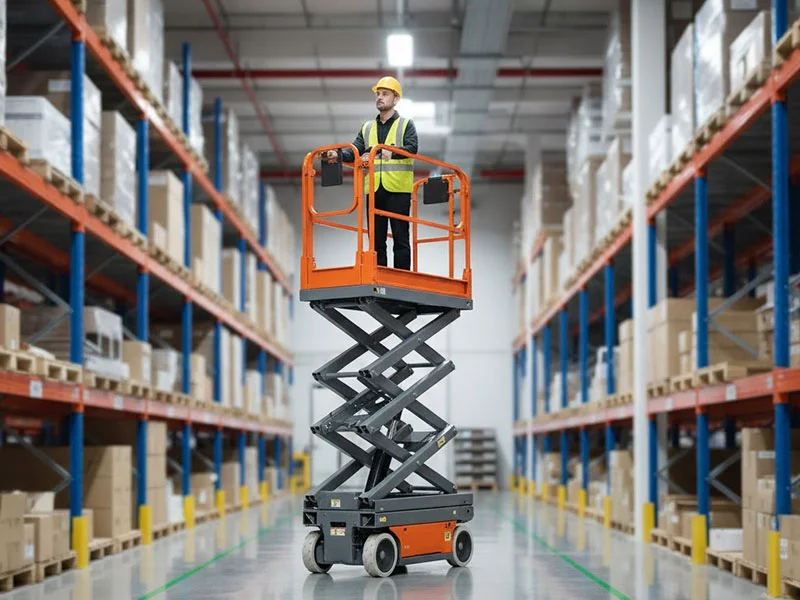
Electric Scissor Lifts
- Key Features: Powered by rechargeable batteries, equipped with non-marking tires, and are virtually silent and emission-free during operation.
- Ideal Use: Primarily designed for indoor use on finished flooring, warehouses, and tight spaces. Their compact size and zero-emission operation are mandatory for environments where air quality is a concern or where floor surfaces must be protected. The smaller turning radius of most electric construction scissor lift models makes them highly maneuverable in narrow aisles and congested areas.
Rough Terrain Scissor Lifts
- Key Features: Powered by diesel, gasoline, or propane engines, featuring large, rugged pneumatic tires, four-wheel drive, and often incorporating leveling outriggers.
- Ideal Use: Built to handle the challenges of an unfinished outdoor construction site, this type of lift for construction can operate safely on mud, gravel, and uneven ground. They are vital for the initial phases of construction, such as structural steel work, exterior utility installation, and setting up temporary structures on challenging terrain. Their engines provide the power needed to ascend slopes and move heavy loads across a constantly changing job site.
The Reach Specialists: Boom Lifts
Where a scissor lift construction model excels at vertical, straight-up access, a boom lift—also known as a cherry picker or basket crane—is the ultimate solution for tasks requiring significant horizontal outreach and the ability to maneuver up and over obstacles. The defining feature of this construction lift is a long, hydraulically-powered arm, or boom, that extends from the base chassis to the work platform.
Type A: Articulating (Knuckle) Boom Lifts
- Key Features: The boom arm is segmented with multiple hinged joints, or ‘knuckles,’ allowing it to bend and articulate in various ways. They often include a jib—a small, final section of the boom near the platform—for even finer positioning.
- Ideal Use: This versatile construction lift is indispensable for work sites with significant overhead obstacles, such as navigating around utility lines, structural steel, or reaching over building edges. They are the preferred choice for detailed exterior maintenance, intricate installation work, and reaching hard-to-access nooks and crannies where a straight-line approach is impossible. Their maneuverability makes them popular for indoor applications where tight spaces and fixed objects are common.
Type B: Telescopic (Straight) Boom Lifts
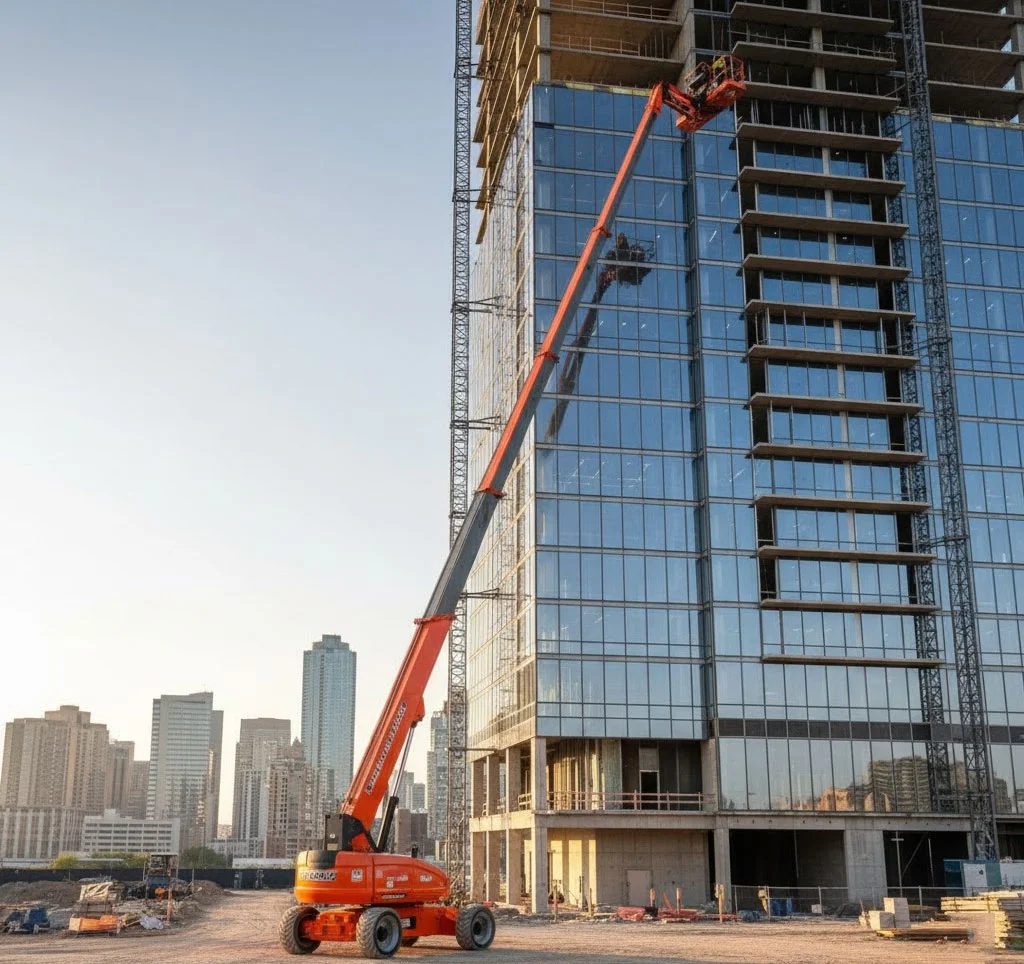
- Key Features: The boom is a straight, telescoping arm that extends out in a single, unbending line. They are often called “stick booms” for their appearance.
- Ideal Use: Telescopic boom lifts are built for maximum height and horizontal reach. They are the workhorses when the access point is far away from the machine’s base and there are no immediate obstacles to circumvent. Common applications include:
- High-Rise Construction: Structural steel erection and facade work at extreme heights.Utility Work: Inspecting bridges, large-scale industrial maintenance, and cell tower work.
- Open Sites: Where a long, straight reach is the most efficient path to the work area. They generally offer a greater overall reach than articulating models.
Type C: Towable Boom Lifts
- Key Features: A lighter-weight articulating or telescopic boom mounted on a trailer chassis, allowing it to be towed by a standard pickup truck or SUV. They are stabilized by manual or hydraulic outriggers once on site.
- Ideal Use: Perfect for smaller contractors, rental companies, or projects that require a quick, temporary construction lift solution across multiple, smaller job sites. They are cost-effective, easy to transport, and ideal for tasks like residential painting, tree trimming, gutter cleaning, and light commercial maintenance.
Forklifts: Lifting and Transporting Materials
While often categorized separately, specialized forklifts play a crucial material-handling role as a primary construction lift on any site. They are primarily designed for lifting and transporting heavy loads, but their ability to elevate materials to working heights makes them essential lift for construction equipment.
The Telescopic Handler (Telehandler)
- Key Features: A hybrid machine that combines the lifting capability of a forklift with the reach of a crane. It features a telescoping boom arm and various interchangeable attachments (forks, buckets, winch) at the end.
- Role in Construction: The telehandler is the definitive material-handling construction lift. It can lift loads—like pallets of shingles, bricks, or lumber—to high floors or across trenches. Its rough-terrain capability, large tires, and four-wheel drive allow it to navigate rugged job sites, making it invaluable for moving materials from the delivery truck to the point of installation, often replacing the need for a separate crane in many scenarios.
Rough Terrain Forklifts
- Key Features: Similar to industrial forklifts but built with a heavy-duty chassis, large pneumatic tires, and powerful engines for navigating uneven and unimproved ground conditions.
- Role in Construction: Used primarily to move heavy palletized materials, equipment, and storage containers across the immediate work area. While they offer less vertical and horizontal outreach than a telehandler, they are crucial for ground-level logistics and efficient material staging on challenging surfaces.
Personnel Lifts (Vertical Mast Lifts)
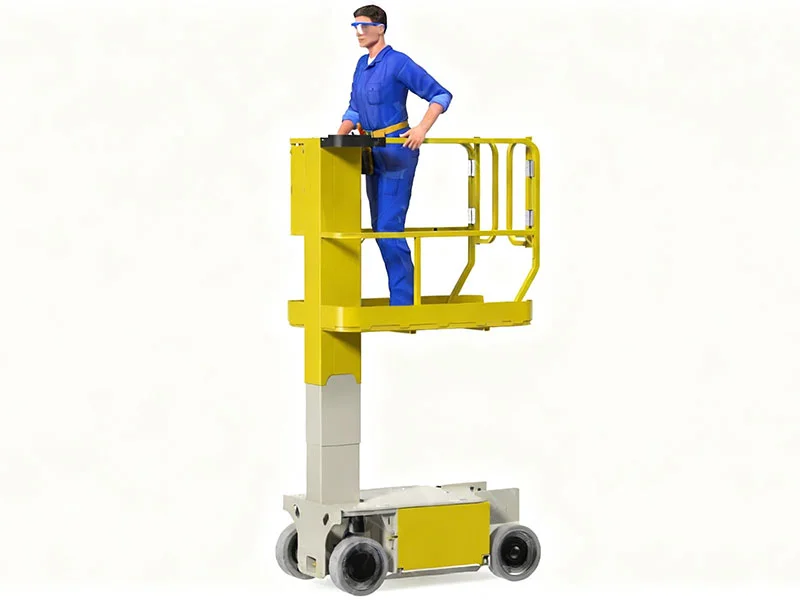
Personnel lifts, also known as vertical mast lifts or “man lifts,” represent the most compact and agile form of construction lift equipment. They are designed almost exclusively for elevating a single worker and their tools.
- Key Features: Utilize a single, telescopic mast column to achieve straight vertical lift. They have an extremely small footprint, are lightweight, and typically run on electric power. Many models are narrow enough to fit through standard doorways and can be moved in passenger elevators.
- Ideal Use: These lifts are the indoor specialists where space is at a premium. They are commonly used for:
- Light Maintenance: Changing light bulbs, servicing ductwork, or accessing ceiling tiles in finished buildings.
- Retail/Office Work: Installation of signage, sprinklers, or security equipment in confined spaces.
- Quick Access: Tasks that require rapid, vertical access in areas too tight for a construction scissor lift or boom lift.
Choosing the Right Construction Lift
Selecting the optimal construction lift for your project is a critical decision that impacts safety, schedule, and budget. It requires a systematic evaluation of your specific job site and task requirements.
Key Selection Factors
| Factor | Consideration | Recommended Construction Lift Type |
| Required Movement | Vertical Only: Do you work directly above the lift base? | Scissor Lifts, Vertical Mast Lifts |
| Vertical & Horizontal: Do you need to reach out or up and over obstacles? | Articulating or Telescopic Boom Lifts | |
| Work Surface | Flat/Finished Indoor: Concrete, finished flooring, tight aisles. | Electric Scissor Lift, Vertical Mast Lift |
| Rough/Uneven Outdoor: Dirt, gravel, mud, slopes. | Rough Terrain Scissor Lift, Telehandler, Diesel Boom Lift | |
| Required Height/Reach | Moderate Height (up to 50ft), Large Area: Plenty of vertical work space. | Scissor Lift |
| Extreme Height (50ft+), Long Reach: Maximize vertical and horizontal distance. | Telescopic Boom Lift | |
| Capacity (Personnel & Material) | Multiple Workers/Heavy Materials: Maximize payload and platform space. | Scissor Lifts, Telehandlers (for material) |
| One Worker/Light Tools: Small, precise work in tight spaces. | Vertical Mast Lifts | |
| Site Access & Transport | Need to be towed between sites: Easy mobilization. | Towable Boom Lift |
| Tight Access (Doorways/Elevators): Compact design is essential. | Vertical Mast Lift, Narrow Electric Scissor Lift |
By rigorously assessing these factors, a project manager can confidently specify the construction lift that ensures maximum efficiency and the highest level of safety. For instance, a detailed exterior painting job that requires maneuvering over an entry awning will necessitate an articulating boom lift, while the installation of a ceiling grid in a new warehouse will be best served by a spacious electric construction scissor lift. The right construction lift not only gets the job done but transforms how the job is executed.
Summary
The world of construction lift equipment is diverse, offering specialized solutions for nearly every elevated task on a job site. From the stable, high-capacity vertical access provided by a construction scissor lift to the expansive reach of a telescopic boom, each machine is engineered to solve a specific set of challenges. The consistent application of the correct construction lift ensures projects are completed on time, within budget, and, most importantly, with an uncompromising commitment to worker safety. By understanding the core distinctions between vertical lifts (scissor and mast lifts), horizontal outreach specialists (boom lifts), and material handlers (forklifts and telehandlers), project teams can make informed decisions that drive productivity from the ground up.
Frequently Asked Questions
What is the main difference between a scissor lift and a boom lift?
The main difference lies in their movement capability. A construction scissor lift only moves straight up and down (vertical access) and has a large platform for more workers and materials. A boom lift, or aerial work platform, can move vertically and horizontally, extending the work platform up and over obstacles, but typically has a smaller platform capacity. Both are vital types of construction lift equipment.
Is a safety harness required when using a scissor lift?
Safety regulations for scissor lifts for construction vary. For certain types of scissor lifts, particularly those with fixed guardrails, a harness may not be explicitly required by OSHA (Occupational Safety and Health Administration) in the United States, but fall protection may be required by the manufacturer or specific company policy. For boom lifts, a safety harness and lanyard are virtually always mandatory because of the potential for ejection from the platform due to the boom’s whipping action. Always follow the manufacturer’s instructions and local safety regulations for any construction lift.
What is a telehandler, and is it considered a construction lift?
A telehandler (telescopic handler) is a type of forklift that features a long, telescoping boom arm. It is considered a construction lift because its primary role is to lift and place materials to elevated positions, often acting as a combination of a forklift, a small crane, and a work platform when fitted with an aerial basket. It’s the most common rough-terrain material lift for construction.
When should I choose an electric construction lift over a diesel one?
You should choose an electric construction lift (like an electric scissor lift construction model) whenever working indoors, in enclosed spaces, or on finished flooring. They produce zero emissions and operate quietly, which is essential for air quality and noise control. Diesel-powered construction lift equipment is preferred for outdoor, rough-terrain, and heavy-duty tasks where maximum power and long operating cycles are needed.