Investing in a cherry picker machine is a significant decision for any business involved in high-altitude work. Whether you are managing a warehouse, overseeing a construction site, or maintaining municipal infrastructure, having the right aerial access solution is the difference between a project that is profitable and one that is bogged down by inefficiency or safety risks.
This comprehensive guide is designed to help you navigate the complexities of the market. From understanding technical specifications to evaluating long-term costs, these 7 smart buying tips will ensure you select a cherry picker machine that delivers maximum ROI and safety.
Why Choosing the Right Cherry Picker Machine Matters
The term “one size fits all” does not apply to aerial work platforms. Selecting an unsuitable cherry picker machine can lead to several operational bottlenecks:
- Safety Hazards: Using a machine with insufficient reach or stability for a specific terrain increases the risk of tip-overs or structural failure.
- Reduced Productivity: If the horizontal reach is too short, operators must constantly reposition the base, wasting valuable man-hours.
- Financial Waste: Over-specifying a machine means paying for height and power you don’t need, while under-specifying leads to rental costs for supplemental equipment.
- Compliance Issues: Different regions have strict safety standards; the wrong machine might not meet local site requirements.
Choosing the right cherry picker machine ensures your team can work confidently, reach the most difficult spots, and complete jobs on schedule.
What Is a Cherry Picker Machine?
Definition and Primary Uses
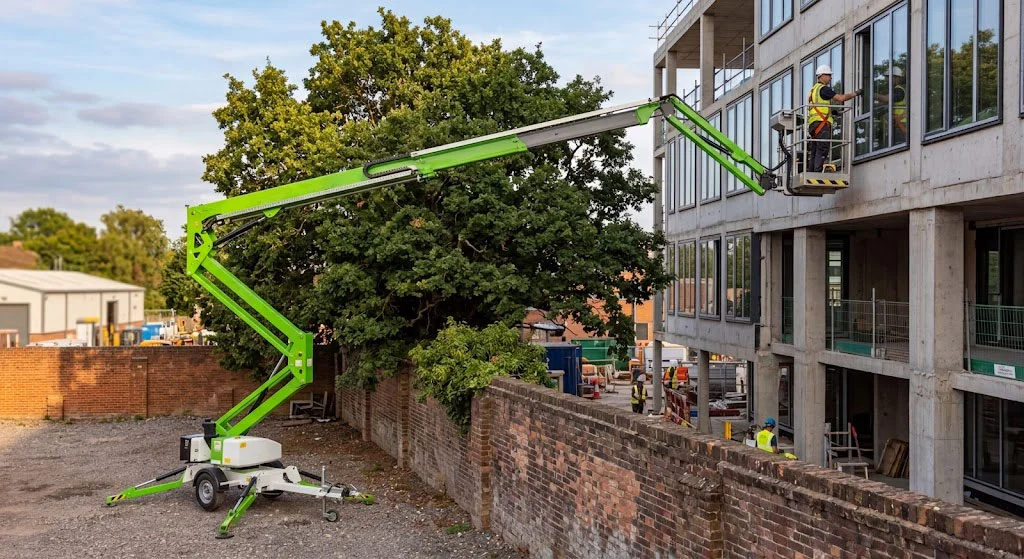
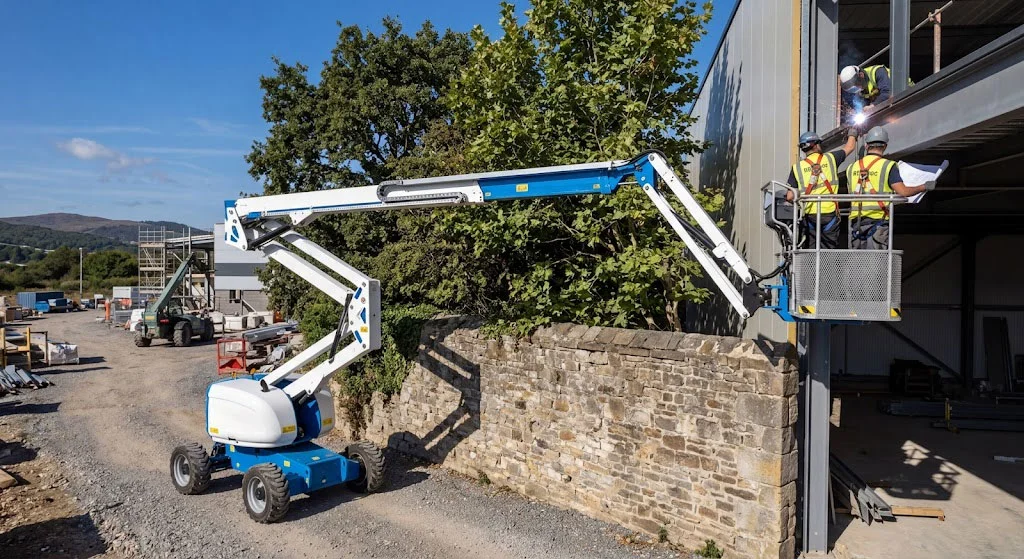
A cherry picker machine—formally known as an aerial work platform (AWP) or boom lift—is a hydraulic crane-like mechanism with a platform or bucket at the end of a long, extendable arm. Originally designed for orchards (hence the name), it is now the gold standard for lifting personnel, tools, and materials to elevated areas.
Common Industries
The versatility of the cherry picker machine makes it indispensable across various sectors:
- Construction: Installing HVAC systems, cladding, and steel frames.
- Utilities: Maintaining power lines, street lights, and telecommunications.
- Logistics & Warehousing: High-shelf inventory management and facility maintenance.
- Landscaping: Tree trimming and urban forestry.
Main Types of Cherry Picker Equipment
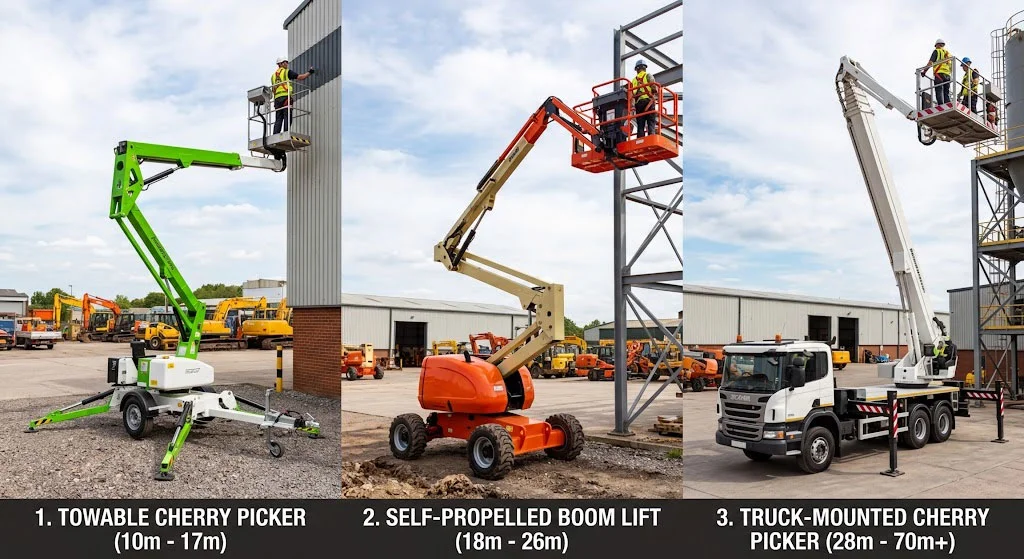
- Towable Models: These are cost-effective and highly portable. You can hitch a towable cherry picker machine to a standard pickup truck, making it ideal for multi-site residential or light commercial work.
- Self-Propelled Boom Lifts: These offer the highest level of flexibility. The operator can drive the unit while the platform is elevated, significantly increasing efficiency on large jobsites.
- Truck-Mounted Units: Also known as a cherry picker lift truck, these are integrated into a truck chassis. They offer unmatched mobility for large-scale operations across cities or highways.
Key Factors to Consider Before Purchasing
Before diving into specific brands, you must define the technical “must-haves” for your cherry picker machine.
Working Height and Horizontal Reach
Working height is the maximum vertical reach plus the height of the operator. However, horizontal reach (outreach) is often more critical. If you need to reach over a parked car or a structural obstacle, you need a lift cherry picker with a telescopic or articulating boom that extends outward, not just upward.
Load Capacity and Platform Size
Every cherry picker machine has a rated capacity. Consider the weight of:
- The operator(s).
- Hand tools and heavy equipment (like drills or saws).
- Materials being installed (like window panes or light fixtures). Ensure the platform size allows for a comfortable range of motion for the crew.
Power Source: Electric vs Diesel vs Hybrid
- Electric: Best for indoor use. They are quiet and produce zero emissions, perfect for shopping malls or food processing plants.
- Diesel: Best for outdoor, rugged construction sites. They provide high torque and can operate for long shifts without recharging.
- Hybrid: Offers the best of both worlds, allowing for indoor/outdoor versatility.
Terrain Compatibility
Where will the cherry picker machine be used?
- Slab Surfaces: Require non-marking tires and low ground pressure.
- Rough Terrain: Require 4WD, oscillating axles, and high-grip lugs to navigate mud, sand, or gravel.
Tip #1: Define Your Application Before Buying
The most common mistake is buying a cherry picker machine based on price rather than application. Ask yourself:
- Are there obstacles? If you need to reach “up and over” a wall, you need an articulating boom. If you just need straight height, a telescopic boom is better.
- Is the space confined? Some cherry picker equipment is designed with a narrow chassis to fit through standard doorways.
- What is the duty cycle? Will it run 8 hours a day or just 2 hours a week?
Defining the application prevents you from buying a machine that sits idle because it can’t perform the specific tasks required by your projects.
Tip #2: Evaluate Total Cost of Ownership (TCO)
The sticker price of a cherry picker machine is only the beginning. To understand the true cost, you must factor in:
- Fuel/Energy Costs: How much will it cost to keep the lift cherry picker running daily?
- Insurance: Heavy machinery requires specific liability coverage.
- Depreciation: Some brands hold their value much better than others in the secondary market.
- Transportation: How much does it cost to move the cherry picker machine from one site to another? (Towable models score high here for cost-savings).
A cheaper upfront machine might have significantly higher maintenance costs, making it more expensive over a five-year period.
Tips #3: Prioritize Safety Features and Compliance
Safety is non-negotiable when working at heights. A high-quality cherry picker machine should include:
- Emergency Descent System: Allows the platform to be lowered manually if power fails.
- Tilt Alarms and Load Sensors: Alerts the operator if the machine is on an unsafe incline or is overloaded.
- Secondary Guarding: Physical or electronic barriers that prevent the operator from being crushed against overhead obstacles.
- Standard Compliance: Ensure the cherry picker machine meets CE, ANSI, or ISO standards relevant to your region.
Tip #4: Choose the Right Manufacturer or Supplier
Not all manufacturers are created equal. When selecting a supplier for your cherry picker equipment, look for:
- Track Record: How long have they been in the industry? Established manufacturers usually have better-engineered hydraulic systems.
- Support Network: Can they provide parts quickly? A cherry picker machine waiting for a spare part from overseas is a liability.
- Customization: Do they offer options like platform power-to-air lines or specialized lighting packages?
Tip #5: Consider Ease of Operation and Training
A sophisticated cherry picker machine is useless if your team can’t operate it.
- Intuitive Controls: Look for proportional controls that allow for smooth, precise movements.
- Diagnostic Screens: Modern cherry picker machine models often feature onboard displays that show battery life, load weight, and error codes for faster troubleshooting.
- Training Availability: Does the supplier offer operator certification? In many regions, it is illegal to operate a lift cherry picker without a valid license (e.g., IPAF or OSHA training).
Tip #6: Check Maintenance Requirements and Serviceability
Reliability is the backbone of any fleet. Before purchasing a cherry picker machine, review the maintenance manual:
- Accessibility: Are the engine components, hydraulic filters, and battery swing-out trays easy to reach?
- Commonality of Parts: Does the machine use standard components that any local mechanic can service?
- Warranty: What does the manufacturer cover? A 1-2-5 warranty (1 year for the whole machine, 2 years for the drivetrain, 5 years for the structure) is a sign of a confident manufacturer.
Tip #7: Decide Between Buying New vs Used Equipment
Buying New
- Pros: Full warranty, latest safety features, highest reliability, and better financing options.
- Cons: Higher initial capital investment.
Buying Used
- Pros: Significantly lower purchase price.
- Cons: Higher risk of mechanical failure, shorter lifespan, and potential lack of service history.
If your cherry picker machine will be used daily, buy new. If it is for occasional use, a well-maintained used unit from a reputable dealer can be a smart move.
Common Buying Mistakes to Avoid
- Ignoring the Turning Radius: A cherry picker machine with a large tail-swing can be dangerous in tight warehouse aisles.
- Forgetting Ground Conditions: Buying a heavy diesel unit for use on a delicate indoor gym floor will result in costly property damage.
- Underestimating Future Needs: Don’t just buy for the job you have today; buy for the jobs you plan to take on next year.
- Neglecting the “Jib”: A jib is an extra small boom at the end of the main arm. It provides “fine-tuning” movement that is essential for reaching over obstacles.
Cherry Picker Machine vs Other Aerial Lifts
| Feature | Cherry Picker Machine (Boom Lift) | Scissor Lift | Vertical Mast Lift |
| Reach Type | Vertical + Horizontal | Vertical Only | Vertical Only |
| Outreach | Excellent (Over obstacles) | None | Very Limited |
| Capacity | Low to Moderate | High (Multiple People) | Low (One Person) |
| Footprint | Moderate to Large | Small | Very Small |
| Best For | Complex Exterior Work | Large Platforms/Indoor | Indoor Maintenance |
While a scissor lift is great for painting a flat wall, only a cherry picker machine can reach over a fence, across a ditch, or into the center of a tree canopy.
Conclusion
Selecting the right cherry picker machine is a strategic investment in your company’s operational capability. By defining your application, calculating the total cost of ownership, and prioritizing safety and serviceability, you move beyond just “buying a machine” to “securing a solution.”
The best cherry picker equipment isn’t necessarily the most expensive one—it’s the one that consistently reaches the heights you need while keeping your operators safe and your overhead low.
If you are ready to find the perfect lift cherry picker for your next project or need technical advice on which model suits your terrain, our team is here to help. We provide expert guidance to ensure you get the most reliable equipment for your specific industry needs. For personalized quotes or product specifications, feel free to reach out to us directly via Email at info@klingtec.com or send us a message on WhatsApp at +86 188 6686 3188. Let’s get your team to the right height, safely and efficiently.
FAQs
Can I drive a cherry picker machine on a public road?
Generally, no. Most self-propelled models are for site use only. However, a cherry picker lift truck (truck-mounted) is fully road-legal and can be driven at highway speeds.
How often does a cherry picker machine need inspection?
Most jurisdictions require a professional “thorough examination” every 6 to 12 months, in addition to daily pre-start checks by the operator.
Can a cherry picker machine be used in high winds?
Every lift cherry picker has a maximum wind speed rating (usually around 12.5 m/s or 28 mph). Never operate the machine if winds exceed the manufacturer’s limit.
What is the difference between a telescopic and articulating cherry picker machine?
A telescopic boom extends like a telescope (straight and long), offering great reach. An articulating boom has “knuckles” that allow it to bend around obstacles.
Do I need a special license for a cherry picker machine?
Yes, in most countries, operators must undergo specialized training (such as IPAF in Europe or OSHA-compliant training in the US) to safely operate cherry picker equipment.