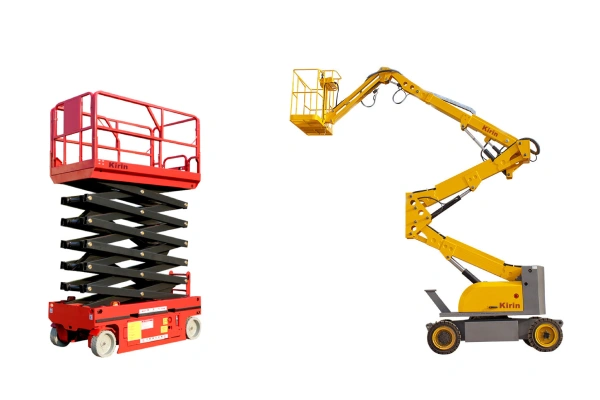
Working at significant heights is a necessity across countless industries, from construction to utility maintenance. While ladders and scaffolding have their place, the need for a mobile, safe, and highly maneuverable solution led to the development of an iconic piece of equipment: the cherry picker lift.
This machine, officially known as a boom lift or a Mobile Elevating Work Platform (MEWP), has become an indispensable tool on nearly every major worksite. This post will break down what a cherry picker lift is, delve into the core mechanism—the hydraulic system—that makes it work, and explore the different types available for various jobs.
What Exactly is a Cherry Picker Lift?
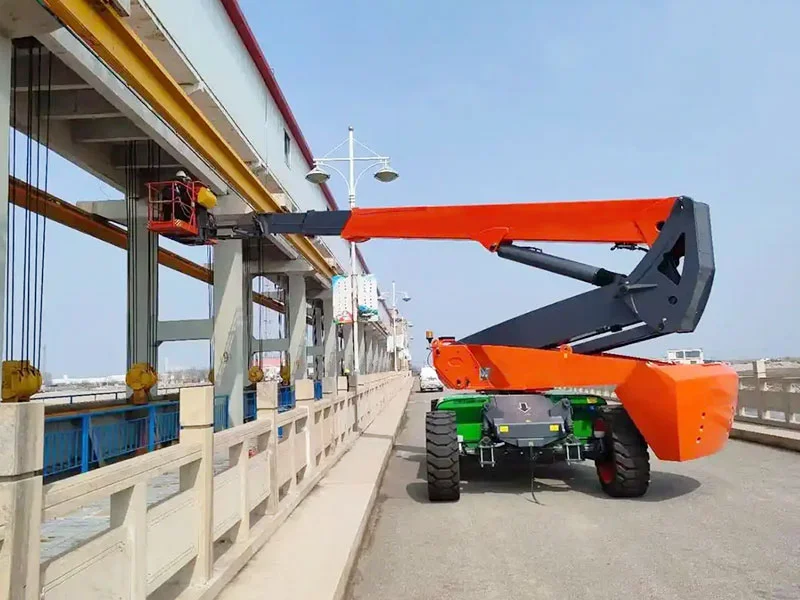
A cherry picker lift is a type of aerial work platform that consists of a work platform or bucket at the end of a hydraulic boom (or arm), which is mounted on a base (often a truck, trailer, or self-propelled chassis).
The colloquial name, “cherry picker,” stems from its original function: a machine designed to safely and efficiently lift workers to pick fruit, particularly cherries, from tall orchard trees. Today, the term applies broadly to any boom lift used for temporary access to elevated areas. Its main purpose is to provide a stable and secure platform for workers and their tools to perform tasks at height.
Whether you call it a boom lift, a basket crane, or a cherry picker machine, its core function remains the same: elevating a person to a precise location safely.
How the Cherry Picker Lift Works
The ability of a cherry picker lift to hoist a heavy basket and boom to extreme heights while maintaining stability is a testament to clever engineering, with the hydraulic system being the undisputed core of the operation.
A. The Power Source
A cherry picker lift requires a power source to run its hydraulic pump. This is typically one of three options, depending on the machine and its application:
- Diesel/Gasoline Engines: Common for large, outdoor cherry picker boom lift models (like those used in heavy construction) that need maximum power and are less restricted by noise or emissions.
- Electric Motors: Ideal for indoor or noise-sensitive environments (like warehouses or indoor maintenance). These lifts use large rechargeable batteries.
- Hybrid (Bi-Energy): Offers the flexibility to switch between an internal combustion engine and an electric motor, making them versatile for mixed indoor/outdoor use.
B. The Hydraulic System (The Core Mechanism)
The physics that allows a relatively compact cherry picker lift to raise heavy loads to great heights lies in Pascal’s Principle, which states that pressure applied to an enclosed fluid is transmitted equally throughout the fluid.
The Components:
- Hydraulic Pump: Driven by the power source, this pump draws hydraulic fluid (specialized oil) from the reservoir and pushes it into the system at high pressure. This fluid is the medium that transmits the force.
- Hydraulic Cylinders: These are the muscle of the cherry picker lift. A cylinder consists of a piston inside a barrel. When the pressurized fluid is directed into the cylinder, it pushes the piston rod outward, causing the boom sections to extend and lift.
- Control Valves: These are the “traffic cops” of the hydraulic system. The operator’s joystick sends a signal to these valves, which precisely control the direction and flow rate of the pressurized hydraulic fluid. This allows the operator to lift, lower, extend, and rotate the boom with fluid and stable movements.
- Pressure Relief Valves: A crucial safety component. If the pressure in the system exceeds a safe limit (e.g., due to overloading), this valve opens to divert excess fluid back to the reservoir, preventing damage or failure.
- Check/Counterbalance Valves: These are vital for safety, particularly when a worker is elevated. They prevent the hydraulic fluid from flowing back out of the cylinder unless the operator actively commands a descent. This means that even if a hose bursts or the engine fails, the platform will remain safely locked in its position, preventing a sudden, uncontrolled drop.
The collective action of these components allows a small amount of force applied to the fluid to generate the massive lifting force required to operate the cherry picker lift.
C. The Maneuverability
The versatility of a cherry picker lift comes from the design of its boom, categorized by how it extends.
Telescoping vs. Articulating:
Telescoping (Straight Boom):
- Features a single, straight boom that extends out like a telescope.
- Best for: Jobs requiring maximum vertical and horizontal reach in a clear, straight line, such as working on high-rise facades or large power lines. A telescopic cherry picker often achieves the greatest heights.
Articulating (Knuckle Boom):
- Features multiple sections or “knuckles” that are hinged, allowing the boom to bend and fold over or around obstacles.
- Best for: Complex work sites like factories or urban areas where the operator needs to reach a spot that is blocked by roofs, pipes, or other structures.
D. Stabilization and Safety
Given the forces involved and the height reached, stability is paramount. All cherry picker lifts use a massive base and counterweights. Additionally, many models, especially truck and trailer-mounted ones, use outriggers or stabilizers. These are hydraulic legs that extend outward and push down into the ground, creating a wide, solid, and level foundation before the boom can be raised.
Types of Cherry Picker Lifts
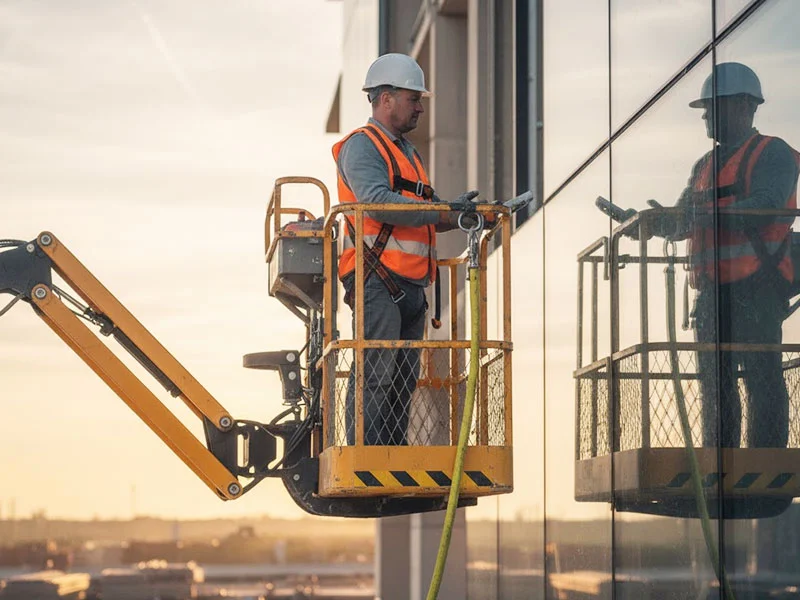
The diverse applications of the lift cherry picker have led to several distinct types, each optimized for different working environments and height requirements.
A. Truck-Mounted/Vehicle-Mounted Lifts
These are boom lifts permanently mounted onto the chassis of a truck or van.
- Key Advantage: Exceptional mobility. They can be driven quickly between different job sites, making them the preferred choice for utility companies (electrical, cable, telephone) and municipal services (street light repair).
- Stabilization: They rely on the vehicle’s mass and often require robust hydraulic outriggers for stability.
B. Self-Propelled Boom Lifts (The common construction site models)
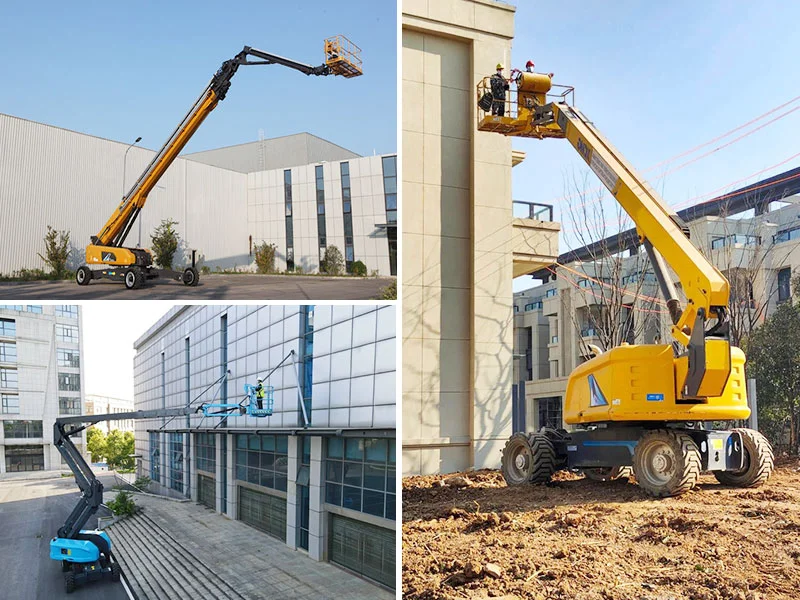
These are lifts that drive themselves around a worksite from the platform’s control station. They are specifically designed for the rugged demands of construction and industrial settings.
- Articulating Boom Lift: Offers unmatched flexibility for working in areas with overhead obstacles or tight corners.
- Telescopic Boom Lift: Provides maximum reach and speed for positioning the worker directly to the side or above the work area in open spaces. A common sight in cherry picker construction applications.
C. Trailer-Mounted/Towable Lifts
These lifts are lighter and mounted on a trailer that can be towed by a standard vehicle.
- Key Advantage: High portability and low cost. Once on site, they are detached and stabilized with outriggers, often using their own small engine or battery pack.
- Best for: Contractors or individuals who need occasional, moderate-height access across multiple residential or light commercial sites.
Primary Applications of the Cherry Picker Lift
The initial purpose of fruit-picking is now only a tiny fraction of the work performed by these machines. The cherry picker equipment is now a fundamental part of modern industrial life.
- Construction: Lifting workers to install cladding, structural steel, or work on roofing and facade elements.
- Utilities & Maintenance: Servicing power lines, street lights, traffic signals, and telecommunications equipment.
- Building Maintenance: Window cleaning, gutter repair, exterior painting, and facility inspections on multi-story buildings.
- Arboriculture (Tree Work): Safely trimming and pruning tall trees.
- Filming & Events: Providing a high, stable camera platform for sporting events and movie filming, or setting up stage lighting and rigging.
Safety and Operation
The height and power of a cherry picker lift necessitate rigorous safety protocols. The most critical aspect of safe operation is proper training.
- Pre-Operation Check: Operators must inspect all controls, tires, fluid levels, and the hydraulic system for leaks or damage. The operator must also verify the load capacity is not exceeded.
- Site Assessment: The machine must only be operated on level, stable ground. Hazards like overhead power lines, pits, or soft soil must be identified and mitigated.
- Fall Protection: Anyone in the basket must wear a full-body harness and be securely tethered to an anchor point in the platform. This is the last line of defense against a fall.
- Weather: Never operate the cherry picker lift in high winds (typically above 28 mph) or during electrical storms, as these conditions significantly compromise stability and worker safety.
Conclusion
The cherry picker lift is an ingenious solution to the perennial challenge of working at height. Its strength and stability, derived almost entirely from a robust hydraulic system, have cemented its status as a foundational piece of cherry picker equipment in the construction, utility, and maintenance sectors worldwide. By understanding what it is and how its different components work together, operators can ensure maximum efficiency and, most importantly, safety on the job site. The evolution of the humble fruit picker is truly a remarkable feat of engineering.
FAQs
What is the maximum height a cherry picker lift can reach?
While smaller models might reach 30 to 40 feet, the largest telescopic boom lifts can easily reach over 180 feet, with some specialized models exceeding 200 feet.
Is a cherry picker lift the same as a scissor lift?
No. A cherry picker lift (boom lift) uses an articulated or telescopic arm to offer both vertical and horizontal outreach. A scissor lift uses a cross-bracing mechanism to only move the platform straight up and down and has no significant horizontal reach.
What is the main safety feature of the hydraulic system?
The most critical safety feature is the check or counterbalance valve in the hydraulic cylinders, which automatically locks the fluid in place. This prevents the boom from collapsing, even in the event of a power or hose failure.