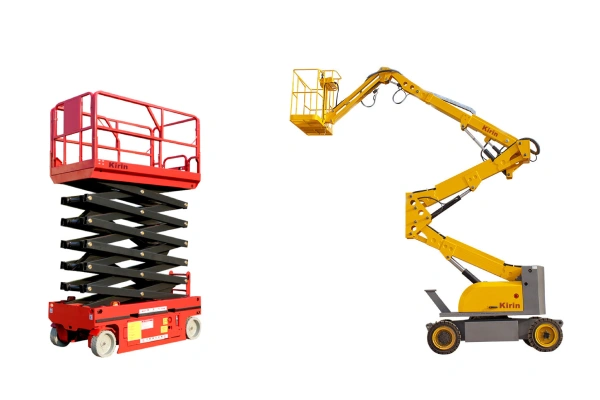
Navigating a job site requires precision, especially when you are working with aerial platforms. If you are using a towable boom lift, you might find yourself in a tight spot where a truck simply won’t fit. This leads many operators to a crucial question: Can you move a towable boom lift by hand?
The short answer is yes, but it is rarely as simple as just “pushing” it. Moving a multi-thousand-pound piece of machinery requires an understanding of physics, safety protocols, and the mechanical limits of your specific model. In this comprehensive guide, we will explore the 7 key facts you must know to determine if manual movement is a viable—and safe—option for your project.
What Is a Towable Boom Lift?
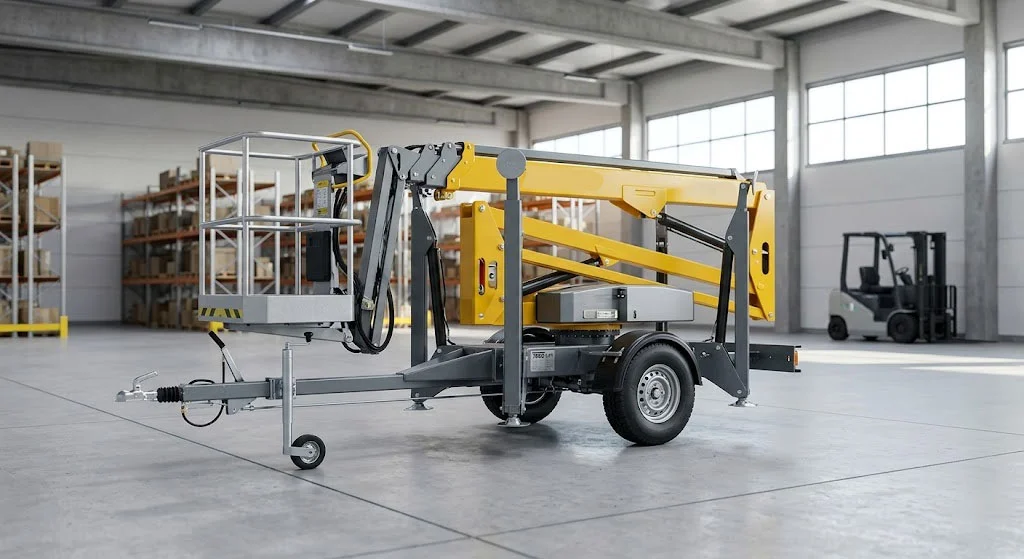
Before we dive into the mechanics of manual movement, we need to define exactly what we are dealing with. A towable boom lift (also known as a trailer-mounted lift) is an aerial work platform designed to be towed behind a vehicle with a standard hitch. Unlike self-propelled boom lifts, which have their own drive motors to move around a site while the platform is raised, towable lifts are generally “static” during operation.
Definition and Basic Structure
A towable boom lift consists of a hydraulic arm (the boom) attached to a trailer chassis. It is designed for portability, allowing users to transport it at highway speeds and then set it up in residential or commercial areas for tasks like painting, tree trimming, or light maintenance.
Key Components
To understand if can you move a towable boom lift by hand, you must look at these four components:
- Chassis: The heavy steel frame that provides the structural integrity of the lift.
- Wheels: Usually two large wheels designed for towing, though some models have a third jockey wheel at the front.
- Tow Bar: The “handle” of the machine where the hitch is located.
- Outriggers: These are the “legs” that stabilize the lift. They must be fully retracted for any movement to occur.
Typical Weight Range and Sizes
Weight is the biggest factor in manual maneuverability. Most towable boom lifts weigh between 2,000 lbs and 5,000 lbs (900 kg to 2,270 kg). While this is lighter than a massive self-propelled unit, it is still equivalent to pushing a small SUV or a loaded trailer.
Can You Move a Towable Boom Lift by Hand?
So, can you move a towable boom lift by hand? Yes, it is physically possible for most standard models, but only under specific, ideal conditions.
Specific Conditions for Manual Movement
Manual movement is intended for “micro-positioning.” If you are six inches off from your target or need to rotate the lift slightly to clear a doorway, doing it by hand is common practice. However, you should never attempt to “trek” across a job site manually.
Limitations and Safety
The primary limitations are weight and inertia. Once 3,000 pounds starts rolling, it doesn’t want to stop. If you are on anything other than a perfectly flat, hard surface, the risk of the lift “running away” from you or pinning an operator against a wall is extremely high.
Critical Note: Always consult the manufacturer’s manual. Some modern towable lifts are equipped with “drive and set” options—small electric motors on the wheels—that allow you to move them via remote. If your lift has this, manual pushing should be your last resort.
Fact 1: The Weight of the Boom Lift
The most significant factor in answering can you move a towable boom lift by hand is the gross vehicle weight (GVW).
Light-Duty vs. Heavy-Duty
- Light-Duty (e.g., 30-foot reach): These often weigh around 2,500 lbs. Two strong adults can usually maneuver these on flat concrete.
- Heavy-Duty (e.g., 50-foot reach): These can exceed 4,500 lbs. Attempting to move these by hand without mechanical assistance is dangerous and often impossible for a small crew.
Manufacturer Specifications
Always check the data plate located on the chassis. This plate lists the exact weight. You should also check if the manufacturer has a “maximum manual force” rating, which tells you how much weight the brakes and tires are designed to handle during manual positioning.
Fact 2: Ground Surface and Terrain
The ground beneath the wheels dictates 90% of your success. Because towable boom lifts have a high “ground pressure” (weight concentrated on just two wheels), they react poorly to soft surfaces.
Flat vs. Uneven Ground
On a polished concrete warehouse floor, a single person might be able to nudge a small lift. On grass or dirt, the wheels will sink slightly, creating a “rut” that requires immense force to overcome. If the ground is uneven, the lift may tilt, shifting the center of gravity and making it unpredictable.
Indoor vs. Outdoor
Indoor environments are generally safer for manual movement because they are level and climate-controlled. Outdoors, you must contend with wind (which can act as a sail against the boom) and debris. A single pebble in the path of a 3,000-lb tire can act like a wheel chock, stopping you dead in your tracks.
Fact 3: Wheel Design and Condition
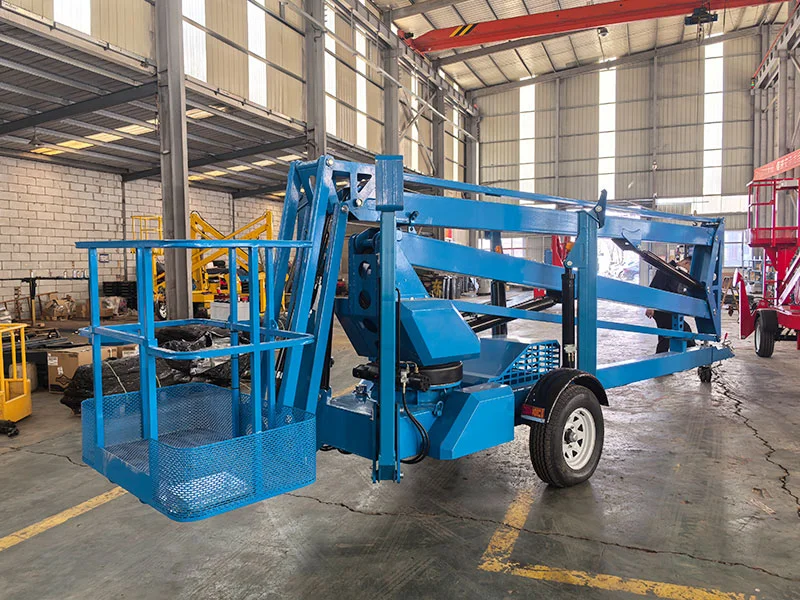
The ease with which can you move a towable boom lift by hand depends heavily on the “rolling resistance” of the tires.
- Pneumatic Tires: These are air-filled. If they are even slightly under-inflated, the “footprint” of the tire increases, making it significantly harder to push.
- Solid/Foam-Filled Tires: These don’t go flat, but they are incredibly heavy. They provide less “bounce,” which is good for stability but makes them harder to get moving from a standstill.
Maintenance Impact
If the wheel bearings are not greased or the brakes are dragging, manual movement becomes a recipe for a back injury. Before attempting to move the lift, ensure the wheels spin freely when the unit is jacked up.
Fact 4: Slope and Incline
This is where manual movement becomes life-threatening. Never attempt to move a towable boom lift by hand on an incline greater than 1 degree.
The Physics of Slopes
Gravity is a powerful force. On a 5-degree slope, a 4,000-lb lift is effectively pulling with hundreds of pounds of force. A human being cannot “man-handle” that weight if it gains momentum.
- The Risk: The lift can jackknife, run over the operator, or crash into structures.
- The Limit: If you can see the slope with your naked eye, it is likely too steep for manual movement.
Fact 5: Safe Ways to Move a Lift by Hand
If you have determined that the weight and terrain are safe, follow this step-by-step process to answer the question: how can you move a towable boom lift by hand safely?
Step-by-Step Process
- Inspect the Path: Clear all debris, tools, and cords. Ensure the path is dry.
- Retract Everything: Ensure the boom is fully stowed and outriggers are completely up.
- Check the Brakes: Locate the parking brake. Have one person assigned specifically to “brake duty”—their only job is to pull the lever if the lift moves too fast.
- Use the Tow Bar: Use the tow bar as your lever. Do not push on the boom itself, as this can damage the hydraulic cylinders or sensors.
- Push Slowly: Use your legs, not your back. Maintain a steady pace. If you have to “lunge” to get it moving, it’s too heavy for manual movement.
Importance of PPE
Always wear steel-toed boots. If a 3,000-lb tire rolls over a standard sneaker, the injury will be catastrophic. High-visibility vests and gloves are also recommended to ensure the “brake operator” and “pusher” can see each other’s hand signals.
Fact 6: When You Should NOT Move It by Hand
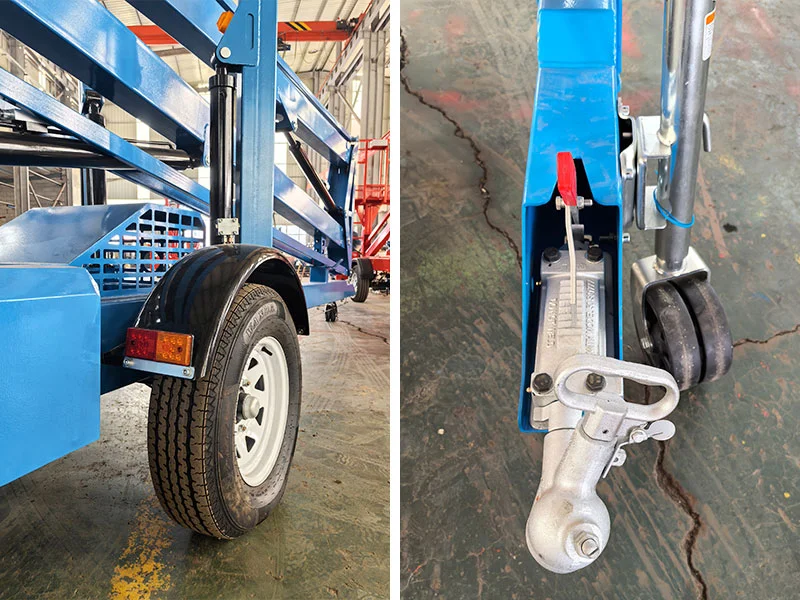
Knowing when to say “no” is the hallmark of a professional operator. You should abandon manual movement if:
- The model weight exceeds your team’s physical capacity (generally anything over 3,000 lbs for two people).
- The surface is gravel, mud, or wet grass.
- You are working alone (unless using a powered dolly).
- There is any visible incline.
- Weather conditions include high winds or rain, which reduce traction for your boots.
Fact 7: Tools That Make Moving Easier
If you find that you frequently need to move your lift in tight spaces where a truck cannot go, stop asking can you move a towable boom lift by hand and start looking at mechanical aids.
Trailer Dollies
A manual trailer dolly provides a handle and a third set of wheels. This takes the tongue weight off the operator and allows for much tighter turns.
Powered Tugs
Electric trailer dollies (powered tugs) are a game-changer. These battery-operated devices hitch to the tow bar and do the heavy lifting for you. They have built-in braking systems and can move lifts across packed gravel or slight inclines with ease.
Winches
If you need to move the lift into a very tight shed or up a slight ramp, a fixed winch is the safest method. By anchoring a winch to a solid point, you can “crawl” the lift forward with total control.
Manual Movement vs. Towing with a Vehicle
When deciding can you move a towable boom lift by hand or if you should use a vehicle, consider the “Rule of 10.” If you need to move the lift more than 10 feet, use a vehicle.
- Vehicle Benefits: Instant braking, massive torque, and protection for the operator.
- Manual Benefits: High precision for final placement within inches of a wall or obstacle.
Using a vehicle is always the preferred method for safety. Only move by hand when the vehicle physically cannot fit or when the risk of the vehicle damaging the turf is too high.
Common Mistakes to Avoid
To ensure safety, avoid these frequent errors:
- Ignoring the Brakes: Forgetting to disengage the parking brake (which burns out the brake pads) or forgetting to engage it once the lift is in position.
- The “Solo Push”: Attempting to move a 3,000-lb machine alone. You cannot push and steer at the same time effectively.
- Pushing on the Boom: This can throw the sensors out of alignment, leading to costly “out of level” errors that prevent the lift from rising.
- Moving with the Platform Raised: This is a fatal mistake. Even a few inches of elevation significantly raises the center of gravity.
Safety Tips and Best Practices
- Communication: Use clear verbal commands like “Heave,” “Stop,” and “Brake.”
- Chock the Wheels: Always have wheel chocks ready. As soon as the lift reaches its destination, kick the chocks under the tires before doing anything else.
- Check the Tongue Weight: Ensure the front of the lift isn’t so heavy that it buries the jockey wheel into the ground.
FAQs
Can one person move a towable boom lift alone?
Technically, a single person can move a very small (2,000 lb) lift on a flat, greased surface, but it is not recommended. You lack the ability to steer and brake simultaneously, which creates a significant safety hazard.
How much does a towable boom lift weigh?
Most models range from 2,500 to 4,500 lbs. For example, a standard 35-foot towable lift typically weighs around 3,400 lbs. Always check the specific manufacturer’s weight rating.
Is it safe to move a boom lift on gravel?
No. Moving a towable boom lift by hand on gravel is nearly impossible because the small surface area of the tires causes them to sink and “plow” the rocks. You will likely need a vehicle or a powered tug for gravel surfaces.
What equipment helps move it more easily?
A powered trailer dolly or a motorized jockey wheel are the best tools. They provide the torque needed to move the lift without physical strain on the operator.
Conclusion
Understanding the answer to can you move a towable boom lift by hand is vital for site efficiency and worker safety. While you can move these machines manually for minor adjustments on flat, hard ground, you must respect the immense weight and potential energy they hold. Always prioritize mechanical assistance when available, and never underestimate the danger of a slight incline. By following the 7 key facts outlined above—weight, terrain, tires, slope, proper technique, knowing when to stop, and using the right tools—you can ensure your job site remains productive and accident-free.
If you have more questions about equipment handling or are looking for high-quality lifting solutions, our team is here to help. You can reach us via Email at info@klingtec.com or send us a message on WhatsApp at +86 188 6686 3188. We look forward to supporting your next project.