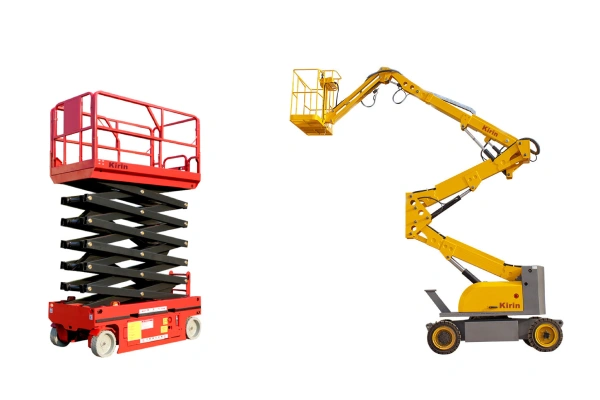
When your project requires reaching new heights, choosing the right aerial platform isn’t just a matter of convenience—it’s a matter of safety, efficiency, and budget. Two of the most common solutions in the industry are bucket lifts and bucket trucks. While they both serve the primary purpose of elevating a worker to a high-access area, they are built for very different environments.
In this guide, we will break down the fundamental differences between these two pieces of equipment, explore their pros and cons, and help you decide which one is the right fit for your specific job site.
What Are Bucket Lifts?
Definition of Bucket Lifts
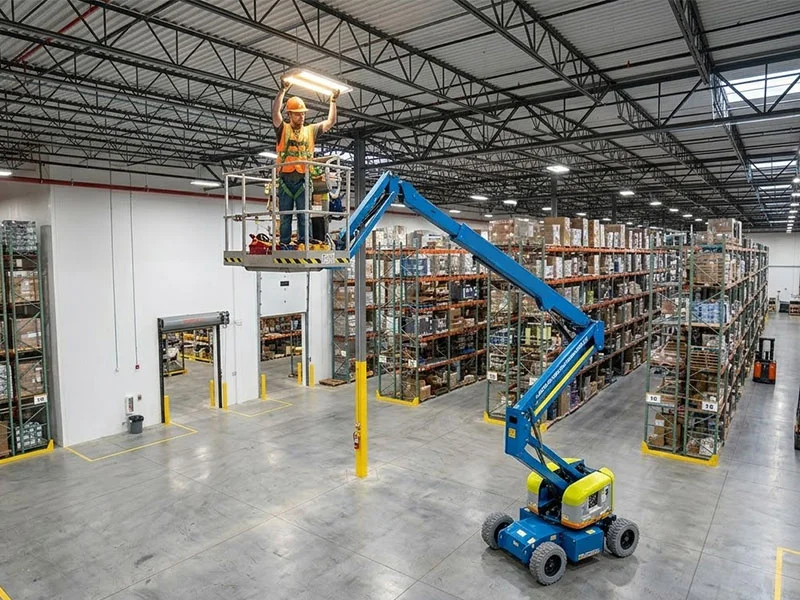
Bucket lifts are compact, often towable or self-propelled aerial work platforms designed to lift personnel and tools to elevated work areas. Unlike their truck-mounted counterparts, bucket lifts are independent units that do not require a heavy-duty truck chassis to operate. They are frequently used in environments where space is at a premium or where the ground cannot support the weight of a massive vehicle.
Common Types
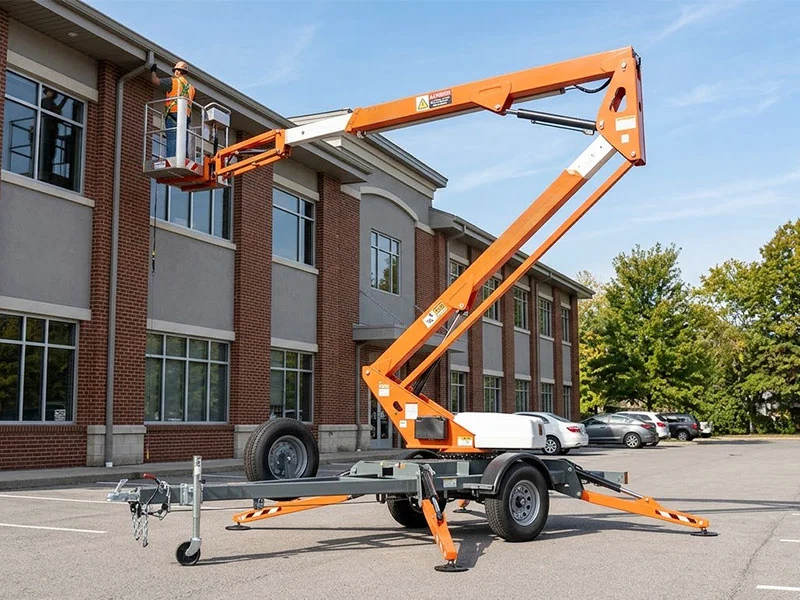
- Towable Bucket Lifts: Often called “cherry pickers,” these are mounted on a trailer frame and can be towed by a standard pickup truck.
- Self-Propelled Lifts: These feature their own drive system, allowing the operator to move the base of the lift while the platform is elevated (common in warehouse settings).
- Trailer-Mounted Lifts: These are specifically designed for easy transport between various job sites and are popular among DIYers and small contractors.
Key Features and Components
A standard bucket lift consists of a base (either wheeled or on outriggers), a hydraulic lifting mechanism (boom), and a secure platform or “bucket” for the operator. Most modern bucket lifts include intuitive controls at both the base and within the bucket itself for precise positioning.
Typical Working Heights and Capacities
Most bucket lifts offer a working height ranging from 30 to 65 feet. While they have a smaller footprint, their weight capacity is usually limited to one or two workers and their immediate tools, typically ranging from 300 to 500 lbs.
Common Industries Using Bucket Lifts
Bucket lifts are the workhorses of the following sectors:
- Interior facility management
- Retail and warehouse maintenance
- Small-scale painting and window cleaning
- Light construction and HVAC installation
What Are Bucket Trucks?
Definition of Bucket Trucks
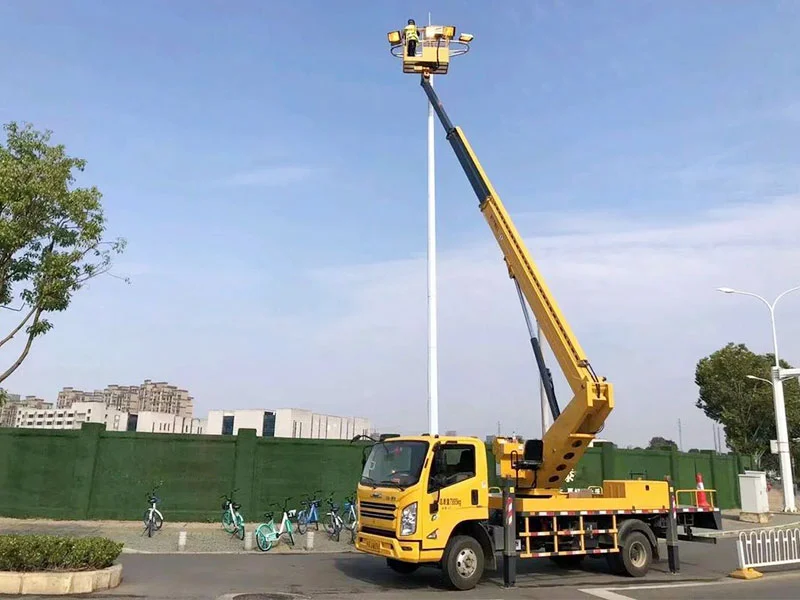
A bucket truck, technically known as a “utility truck” or “aerial device,” is a heavy-duty commercial vehicle equipped with a hydraulic boom and a bucket. Because the lift is integrated directly into the truck’s chassis, it offers a level of power and stability that smaller bucket lifts cannot match.
Key Components
A bucket truck is comprised of three main parts:
- Truck Chassis: The vehicle itself (usually a Class 4-7 truck).
- The Boom: The arm that extends upward, which can be telescopic or articulating.
- The Bucket: The reinforced basket where the worker stands.
Types of Bucket Trucks
- Telescopic: The boom extends straight out like a telescope, perfect for reaching directly up and over.
- Articulating: The boom has “knuckles” or joints, allowing it to bend around obstacles like power lines or tree branches.
- Insulated: These are specifically designed for utility work, using fiberglass and other non-conductive materials to protect workers from electrical shocks.
Typical Height Ranges and Capabilities
Bucket trucks can reach staggering heights, often starting at 35 feet and extending up to 150 feet or more for specialized utility models. Because they are mounted on a heavy truck, they offer significantly more stability in high-wind conditions.
Common Industries Using Bucket Trucks
- Telecommunications and electrical utility repair
- Municipal maintenance (streetlights and signs)
- Commercial forestry and tree trimming
- External building inspections
Bucket Lifts vs. Bucket Trucks: 7 Key Differences
Understanding the nuances between these two machines is critical for project planning. Here are the seven key areas where bucket lifts and bucket trucks diverge.
1. Mobility and Transportation
The most obvious difference is how they get to the job. A bucket truck is a street-legal vehicle; you simply drive it to the site. Bucket lifts, however, must be towed or hauled on a trailer. This makes the bucket truck superior for jobs requiring travel between multiple locations in a single day.
2. Setup and Operation
Bucket lifts usually require manual or hydraulic outriggers to be deployed before the boom can be raised. This setup can take several minutes. Bucket trucks also use outriggers, but their sheer weight often allows for a faster setup on level pavement, and they are much quicker to reposition along a roadside.
3. Reach and Height Capabilities
When it comes to raw verticality, bucket trucks win. While a bucket lift is excellent for heights up to 50 feet, projects involving high-voltage lines or skyscraper maintenance demand the 100+ foot reach of a specialized bucket truck.
4. Cost Comparison
Bucket lifts are significantly more affordable, both to purchase and to rent. A towable bucket lift might rent for a fraction of the daily cost of a bucket truck. Additionally, bucket lifts have lower fuel and insurance costs because they aren’t registered road vehicles.
5. Flexibility and Versatility
Bucket lifts offer superior flexibility in tight spaces. You can man-handle a small bucket lift through a double door into a gymnasium—something impossible for a truck. Conversely, bucket trucks are more versatile in “stop-and-go” environments like repairing a line of streetlights.
6. Safety Considerations
Both require fall protection (harnesses). However, bucket trucks are often “insulated,” making them the only safe choice for working near live electrical wires. Bucket lifts are generally not insulated and should be kept far away from power sources.
7. Maintenance Requirements
A bucket truck requires maintenance for both the aerial lift and the truck engine/drivetrain. Bucket lifts have simpler mechanical systems, usually involving just a small electric motor or gas engine and a hydraulic pump, leading to lower long-term maintenance overhead.
Pros and Cons of Bucket Lifts
Advantages
- Cost-Effective: Bucket lifts are the budget-friendly choice for small businesses.
- Easy to Transport: Can be moved with a standard SUV or pickup.
- Ideal for Indoor Use: Electric bucket lifts produce zero emissions and have non-marking tires for gym floors or malls.
Disadvantages
- Limited Height: You won’t be reaching the top of a cell tower with a bucket lift.
- Terrain Sensitive: Most small bucket lifts struggle on soft mud or steep inclines compared to a 4WD bucket truck.
Pros and Cons of Bucket Trucks
Advantages
- High Reach: Unmatched vertical and horizontal outreach.
- Roadside Efficiency: Perfect for infrastructure work.
- Faster Repositioning: Move the truck ten feet forward in seconds.
Disadvantages
- High Cost: High purchase price, high fuel consumption, and high insurance.
- Licensing: Many larger bucket trucks require a Commercial Driver’s License (CDL).
- Size: They are far too large and heavy for indoor applications or delicate landscaping.
Best Use Cases for Bucket Lifts
Where do bucket lifts truly shine? Here are the scenarios where a bucket lift is the undisputed champion:
- Indoor Maintenance: Changing light bulbs in a warehouse or hanging banners in a convention center. The compact nature of bucket lifts allows them to navigate aisles easily.
- Residential Painting: For a two-story home, a towable bucket lift is much safer and faster than a ladder, without the footprint of a massive truck on the driveway.
- Tight Job Sites: When working in an alleyway or a fenced-in backyard, a bucket lift can be maneuvered into places a truck simply cannot go.
- Short-term Tasks: If you only need to reach a height of 30 feet for an hour, the ease of unhooking a towable bucket lift makes it the logical choice.
Best Use Cases for Bucket Trucks
Bucket trucks are the kings of the outdoors. You should opt for a truck when:
- Utility Line Work: Whether it’s fiber optic installation or repairing power lines after a storm, the insulated boom of a bucket truck is a non-negotiable safety feature.
- Tree Trimming: Arists prefer bucket trucks because they can carry heavy saws and equipment in the truck bed and reach high into the canopy.
- Signage Maintenance: For highway signs or tall “big box” store logos, the stability and height of a bucket truck are essential.
- Emergency Response: When a traffic light goes out, a bucket truck can be on-site and operational in minutes.
How to Choose Between Bucket Lifts and Bucket Trucks
Selecting the right equipment requires a cold, hard look at your project parameters. Ask yourself these four questions:
- Where is the job? If it’s indoors or on a fragile surface (like a running track), choose a bucket lift. If it’s on a highway or a rugged construction site, choose a truck.
- How high do you need to go? Anything over 60 feet generally pushes you into bucket truck territory.
- What is the budget? If you are looking to minimize costs, bucket lifts offer a much lower barrier to entry.
- How often will you move? If you are working at one spot all day, a bucket lift is fine. If you are hitting 20 different poles in a day, you need a truck.
Quick Decision Checklist
| Feature | Bucket Lift | Bucket Truck |
| Indoor Access | Yes | No |
| Street Legal | No (Must be towed) | Yes |
| Max Height | ~65 ft | 150+ ft |
| Power Source | Electric/Gas | Diesel/Gas |
| CDL Required | No | Often Yes |
Safety Tips for Using Bucket Lifts and Bucket Trucks
Regardless of whether you choose bucket lifts or trucks, safety is paramount. High-access work is inherently risky.
- Proper Operator Training: Never operate a bucket lift without being OSHA-certified or having undergone specific equipment training.
- Regular Equipment Inspections: Check hydraulic lines for leaks and ensure the boom lift bucket is free of structural cracks before every shift.
- Fall Protection: Always wear a full-body harness with a lanyard attached to the designated anchor point in the bucket.
- Weather Considerations: High winds are the enemy of aerial platforms. Most bucket lifts are rated for winds under 28 mph, but always check the manufacturer’s manual.
- Level Ground: Ensure the outriggers are on firm, level ground. Use “pads” or “cribbing” if the soil is soft to prevent the lift bucket from tipping.
Conclusion
Choosing between bucket lifts and bucket trucks doesn’t have to be a headache. If you need portability, indoor access, and affordability, bucket lifts are your best bet. However, if your work takes you to extreme heights or requires traveling long distances on public roads, the bucket truck is the industry standard for a reason.
By understanding the specific reach, mobility, and cost implications of each, you can ensure your team stays safe and your project stays on schedule.
FAQs
Are bucket lifts the same as boom lifts?
Generally, yes. “Bucket lift” is a more colloquial term often used for smaller, towable units, while “boom lift” is the broader industry term that encompasses all telescopic and articulating aerial platforms.
Which is cheaper: bucket lift or bucket truck?
Bucket lifts are almost always cheaper. They have lower upfront costs, lower insurance premiums, and are much less expensive to rent on a daily basis.
Do bucket trucks require a CDL?
It depends on the Gross Vehicle Weight Rating (GVWR). Many small bucket trucks (under 26,000 lbs) can be driven with a standard license, but larger utility trucks almost always require a Commercial Driver’s License (CDL).
Can bucket lifts be used outdoors?
Absolutely. Many bucket lifts are designed with gas or diesel engines specifically for outdoor construction and maintenance. However, they are more sensitive to uneven terrain than heavy trucks.