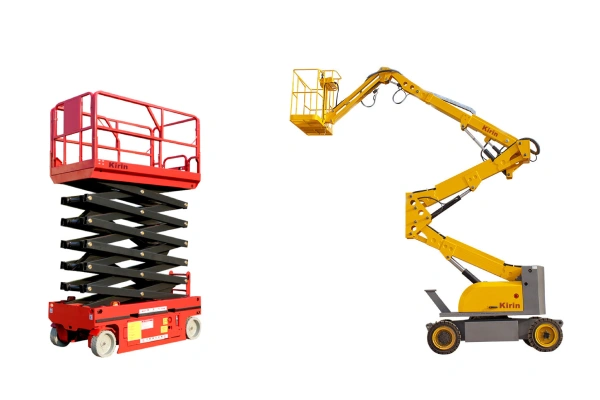
Transporting heavy machinery is a logistical challenge that requires precision, the right equipment, and a deep understanding of safety protocols. When it comes to boom lift transport, the stakes are particularly high. These machines are top-heavy, possess complex hydraulic systems, and represent a significant financial investment. Whether you are moving equipment between job sites or delivering a new unit to a client, mastering the art of boom lift transport is essential for operational efficiency.
In this comprehensive guide, we will explore the nuances of boom lift transport, covering everything from the types of lifts you’ll encounter to the granular details of securing your load for a long haul.
Types of Boom Lifts Commonly Transported
Before discussing the logistics of boom lift transport, it is vital to understand the specific characteristics of the machines being moved. Not all lifts are created equal, and their design dictates the transport method.
Articulating Boom Lifts
Often called “knuckle booms,” these machines feature multiple sections that “articulate,” allowing the operator to reach over and around obstacles. Because they can fold into a relatively compact shape, they are popular in tight urban construction sites. However, their multiple pivot points mean that during boom lift transport, the secondary arms must be strictly secured to prevent shifting.
Telescopic Boom Lifts
Known as “stick booms,” these offer straight-line reach. They generally have a larger footprint and a higher center of gravity when compared to articulating models. Their length often requires specialized trailers, making boom lift transportation for telescopic models a bit more demanding in terms of spatial planning.
Typical Industries Requiring Transport
- Construction: Moving lifts between multi-story development sites.
- Maintenance & Facilities: Transporting lifts to bridges, stadiums, or high-rise exteriors for repairs.
- Warehousing & Logistics: Utilizing compact lifts for high-bay inventory management and rack installations.
Why Proper Boom Lift Transport Matters
Why is there such a focus on the specific protocols of boom lift transport? It comes down to the physics of the machine. Boom lifts are “top-heavy” by nature. Even when the boom is stowed, the weight of the counterweight and the hydraulic systems creates a specific center of gravity that, if tilted too far during transit, can cause a trailer to flip.
Furthermore, improper boom lift transportation can lead to:
- Hydraulic Failure: Vibrations and shifts can damage sensitive valves if the boom isn’t locked.
- Structural Strain: Bouncing during transit can stress the boom’s pins and bushings.
- Legal Liability: Failing to follow DOT (Department of Transportation) or local transport regulations regarding tie-down points can result in massive fines.
Types of Transport Methods for Boom Lifts
Choosing the right “vessel” for your boom lift transport depends on the weight of the machine and the distance of the journey.
Trailer Transport
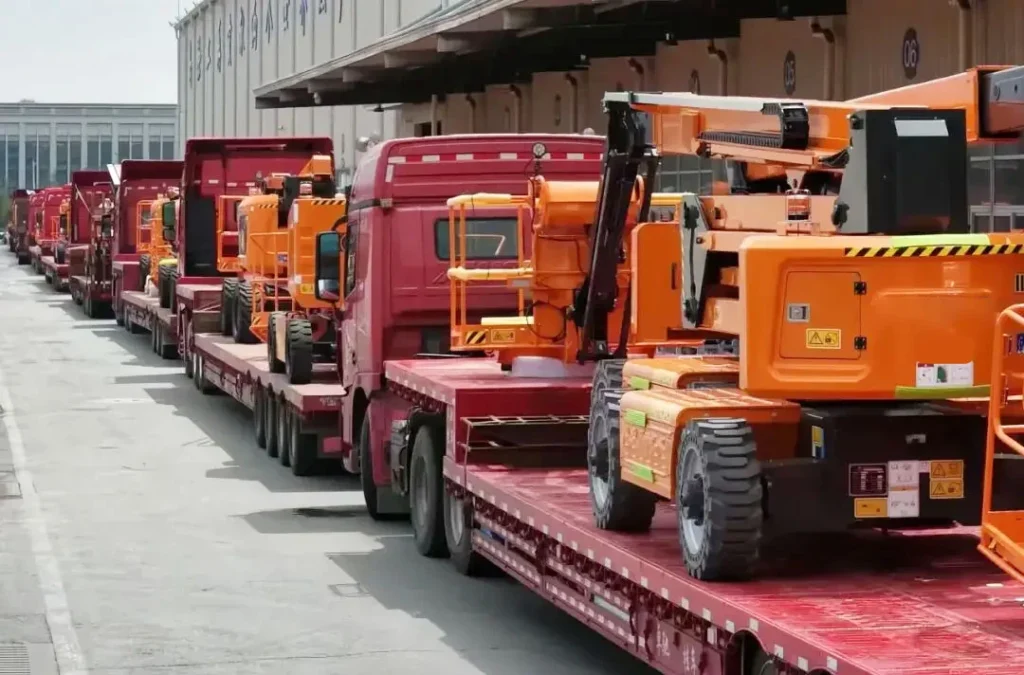
This is the most common method for boom lift transportation. Depending on the size of the lift, you might use:
- Flatbed Trailers: Standard for smaller, towable booms.
- Step-Deck (Drop-Deck) Trailers: Ideal for taller lifts to ensure they stay under the legal height limit for overpasses.
- Lowboy Trailers: Reserved for the largest telescopic booms that require a very low center of gravity.
Truck-Mounted Transport
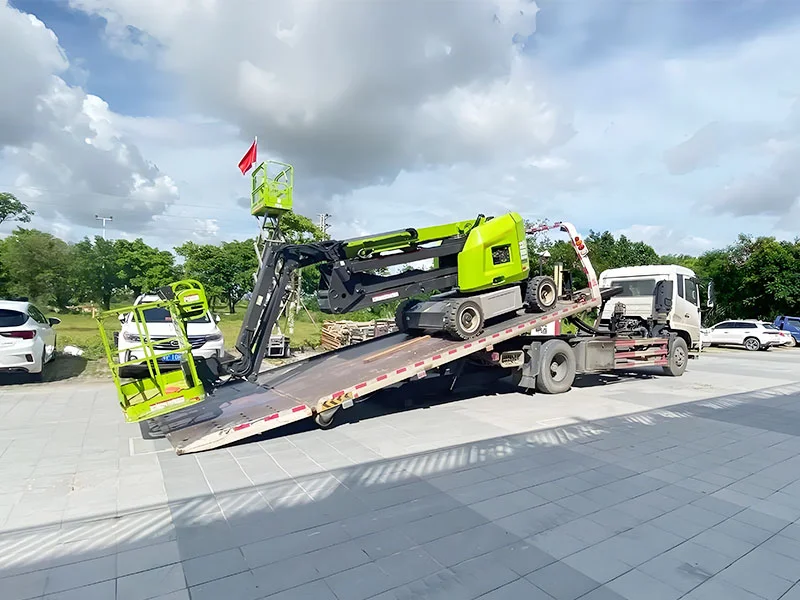
Some smaller boom lifts are integrated directly onto a truck chassis. While this simplifies the “transport” aspect (as the machine is the vehicle), it still requires the boom to be hydraulically locked and the outriggers retracted and pinned before hitting the highway.
Self-Propelled Movement (Short Distances)
Can you drive a boom lift to a neighboring site? Yes, but only for very short distances. Most boom lifts have a “travel speed” of only 3–5 mph. Moving a lift this way is only efficient for moving across a single large campus or between adjacent lots. For anything more than a quarter-mile, professional boom lift transport is required to prevent excessive tire wear and drivetrain heat.
How Do You Secure and Transport a Boom Lift?
Success in boom lift transport is found in the details. Following a standardized process ensures nothing is missed. Here is the step-by-step breakdown of how to transport a boom lift.
Pre-Transport Inspection
Before the machine even touches a ramp, perform a “walk-around.” Check for:
- Leaking hydraulic fluid (which can make the trailer deck slippery).
- Tire pressure (uneven pressure can cause the lift to lean during loading).
- Functionality of the emergency stop and ground controls.
Preparing the Boom Lift
The machine must be in its most stable “stowed” position. Rotate the turntable so the boom is centered over the drive axle. For articulating lifts, ensure the “knuckles” are fully lowered. Ensure the platform is empty of all tools, debris, or materials, as these can become projectiles during boom lift transportation.
Loading the Equipment
Loading is the most dangerous phase of boom lift transport.
- Alignment: Ensure the trailer and the lift are on level ground.
- Ramp Safety: Use high-traction ramps. If the deck is metal, use wood blocking to prevent sliding.
- Low Speed: Drive the lift up the ramp at the lowest possible speed setting.
- Direction: Generally, you should back the boom lift onto the trailer so the heavy counterweight is toward the front of the trailer (improving tongue weight), though you must always consult the manufacturer’s manual for model-specific weight distribution.
Securing the Boom Lift
Once the machine is positioned, shut off the engine and engage the parking brake. You must use heavy-duty chains and binders.
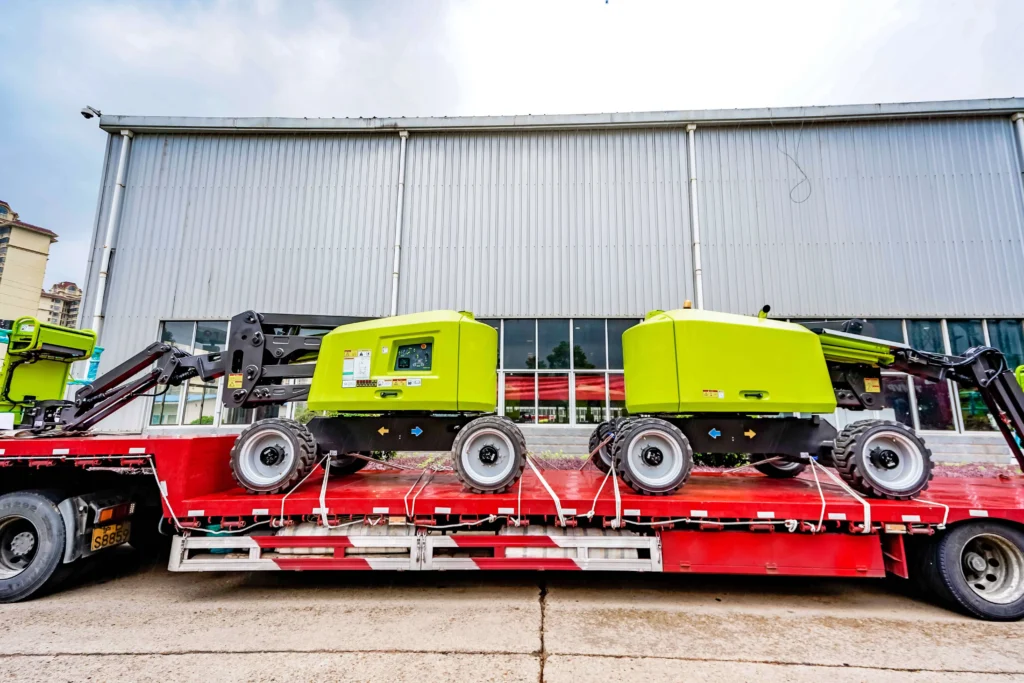
- Four-Point Tie Down: Use at least four tie-down points—two at the front and two at the rear.
- Angles: Chains should be pulled tight at opposite angles to prevent forward, backward, or lateral movement.
- Boom Security: The boom itself often needs a separate nylon strap to prevent “bouncing” that could damage the hydraulic cylinders during boom lift transport.
Transporting Safely
The driver must be aware of the “high-profile” nature of the load. Avoid sudden lane changes and take turns wider than usual. Within the first 25 miles of boom lift transportation, the driver should pull over to inspect the chains, as vibrations can cause tie-downs to settle or loosen.
Unloading Procedures
Unloading is the reverse of loading but requires extra caution as the “downward” momentum can be harder to control. Ensure the area behind the trailer is clear of personnel and obstacles before beginning the descent.
Safety Tips for Boom Lift Transport
- Height Clearances: Always measure the total height of the lift once it is on the trailer. Even if the manufacturer says the lift is 8 feet tall, the trailer adds another 2–3 feet. Bridge strikes are a leading cause of total loss in boom lift transport.
- Weight Limits: Ensure the Gross Vehicle Weight Rating (GVWR) of your truck and trailer exceeds the weight of the lift by a comfortable margin.
- Weather Awareness: Wind is a major factor in boom lift transportation. A high-profile boom lift acts like a sail. If crosswinds exceed 35 mph, it is often safer to delay transport.
Common Mistakes to Avoid
Even experienced operators can fall into bad habits. Avoid these frequent pitfalls in boom lift transport:
- Improper Securing of the Lift: Using frayed straps instead of rated chains or failing to use the designated tie-down D-rings on the chassis.
- Skipping Pre-Transport Inspection: A small hydraulic leak at the start of the trip can lead to a complete brake failure or a fire by the end of it.
- Using the Wrong Trailer Type: Overloading a single-axle trailer with a heavy articulating lift is a recipe for a highway disaster.
- Ignoring Weather Conditions: Ice on a trailer deck makes loading nearly impossible without specialized equipment.
Costs of Boom Lift Transport
Budgeting for boom lift transportation requires looking at several variables. Prices are rarely “flat rate.”
Factors Affecting Cost:
- Distance: Long-haul boom lift transport usually charges by the mile, while local moves might have a flat “hook-up” fee.
- Equipment Size and Weight: Larger telescopic lifts require heavier trailers and more fuel-intensive trucks, increasing the price.
- Transport Method: Hiring a professional heavy-haulage company is more expensive than using your own fleet but includes the cost of insurance and specialized permits.
Renting vs. Hiring Professional Transport Services
If you only move a lift once a year, hiring a professional service for boom lift transport is almost always more cost-effective. They handle the permits for “oversize” loads and bring the expertise required to navigate tight sites. However, for firms with constant movement, investing in a dedicated lowboy trailer and training staff on how to transport a boom lift can provide a better ROI over time.
Conclusion
Mastering boom lift transport is about more than just getting a machine from Point A to Point B; it is about protecting your investment and ensuring the safety of everyone on the road. By understanding the specific needs of articulating and telescopic lifts, following a rigorous loading and securing protocol, and choosing the right transport method, you can eliminate the risks associated with boom lift transportation.
Effective boom lift transport begins with preparation. Always consult your equipment manual, use the correct grade of chains, and never rush the loading process. Whether you are looking for equipment that is easy to move or need professional advice on the best lifting solutions for your project, our team is ready to assist. For technical specifications or expert guidance on our latest models, feel free to reach out to us via email at info@klingtec.com or message us directly on WhatsApp at +86 188 6686 3188. With these safe, easy, and cost-effective methods, your project will stay on schedule and your equipment will remain in peak condition.
FAQs
Can you drive a boom lift on the road?
In almost all jurisdictions, it is illegal to drive a standard boom lift on public roads. They lack the necessary safety features (turn signals, headlights, license plates) and their slow speed creates a major traffic hazard. Furthermore, their solid or foam-filled tires are not designed for the heat generated by road travel. For any distance involving public thoroughfares, professional boom lift transport is required.
How many tie-down points are needed for boom lift transportation?
Standard DOT regulations usually require a minimum of four anchor points for heavy equipment. However, for larger telescopic booms, many experts recommend a fifth tie-down specifically for the boom arm to prevent vertical oscillation during boom lift transport.
Do I need a permit for boom lift transport?
If the width of the lift exceeds 8.5 feet or the height on the trailer exceeds 13.5–14 feet (depending on the state/region), you will likely need an “Oversize Load” permit. Always verify dimensions before starting your boom lift transportation journey.