Selecting the right aerial work platform (AWP) is more than just picking a machine that goes high. To ensure job site safety and efficiency, you must master the science of boom lift reach. Whether you are painting a high-rise, repairing electrical lines, or managing a massive construction site, understanding the nuances of how a machine extends—and where it cannot go—is critical.
In this comprehensive guide, we will break down everything you need to know about boom lift reach, how to interpret a boom lift reach chart, and how to select the perfect piece of equipment for your specific project needs.
What Is Boom Lift Reach?
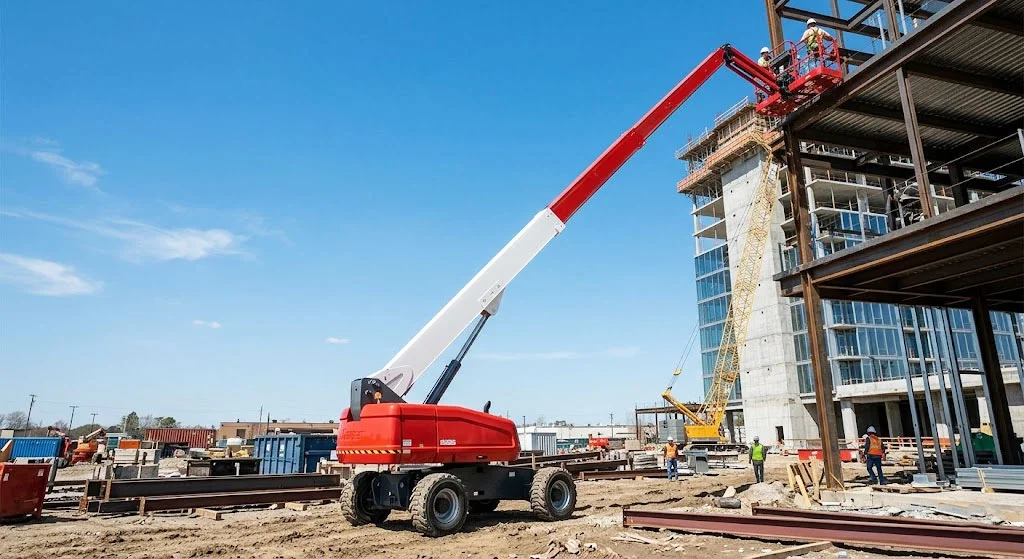
When we talk about boom lift reach, we are describing the total spatial area that the platform can access. Many beginners make the mistake of looking only at the maximum height of the machine, but “reach” is a three-dimensional concept. It involves both the vertical ascent and the horizontal extension required to get over, under, or around obstacles.
Definition of Boom Lift Reach
Simply put, boom lift reach refers to the maximum distance the platform can travel from the center of the machine’s base. This includes both vertical elevation and horizontal outreach.
Vertical Reach: Platform Height vs. Working Height
One of the most common points of confusion in the industry is the distinction between these two terms:
- Platform Height: This is the measurement from the ground to the floor of the platform when the lift is fully extended.
- Working Height: This is a theoretical measurement that accounts for the reach of the person standing on the platform. It is typically calculated by adding 6 feet (or 2 meters) to the platform height. If you need to change a lightbulb at 60 feet, you need a machine with a 54-foot platform height.
Horizontal Reach (Outreach)
Horizontal reach, or outreach, is the distance the boom can extend outward from the chassis. This is vital for jobs where the machine cannot be parked directly beneath the work area—such as working over a swimming pool, a busy highway, or sensitive landscaping.
Why Does Reach Matter More Than Just Lift Height?
While vertical height gets you up, boom lift reach gets you to the work. A machine might have a 100-foot vertical capacity, but if its horizontal outreach is limited, you won’t be able to reach a spot that is 40 feet away from the base. Understanding the “envelope” or the “range of motion” ensures you don’t rent a machine that leaves you a few feet short of your target.
Types of Boom Lifts and Their Reach Capabilities
Different jobs require different types of movement. Choosing between a straight or an articulating boom depends entirely on the boom lift reach profile required by your site.
Telescopic (Straight) Boom Lifts
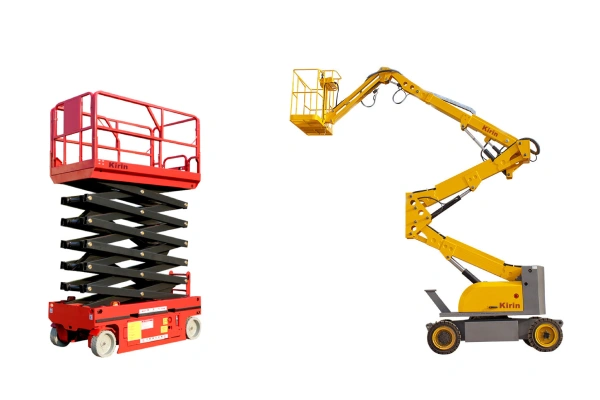
Telescopic booms are often referred to as “S-lifts.” They feature a straight arm that extends like a telescope.
- Best for: Projects requiring maximum boom lift reach and height.
- Capabilities: These machines offer the greatest horizontal outreach. Because they don’t have “knuckles,” they provide a very stable platform at extreme heights. However, they require a lot of room to maneuver and cannot “reach over” obstacles.
Articulating (Knuckle) Boom Lifts
Articulating booms, or “Z-lifts,” have multiple sections that “fold,” allowing the boom to bend.
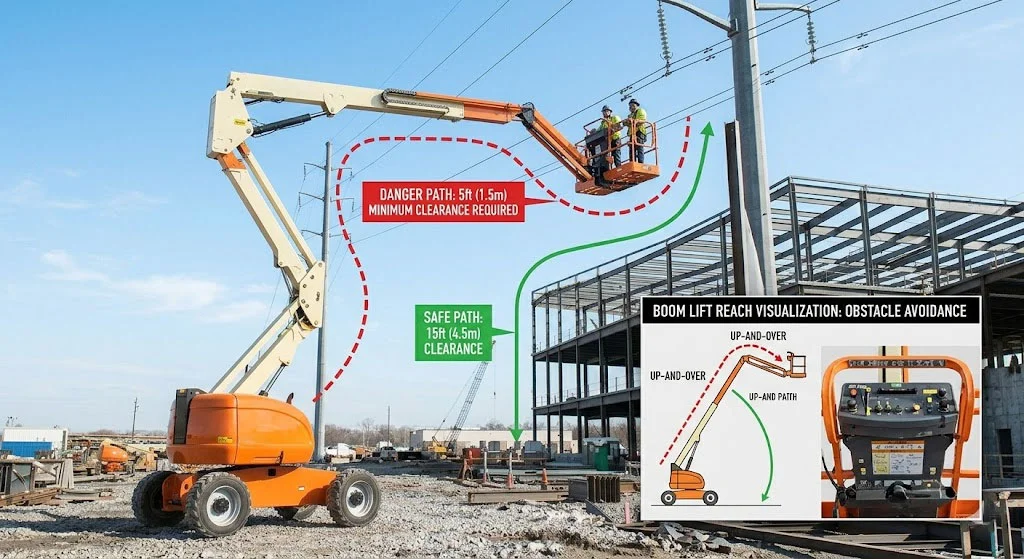
- Best for: “Up-and-over” applications.
- Capabilities: These are ideal for reaching over walls, machinery, or structural beams. While their total boom lift reach might be less than a telescopic lift of the same size, their versatility in tight spaces is unmatched.
Towable and Compact Boom Lifts
For smaller jobs or sites with weight restrictions, towable (trailer-mounted) or compact (atrium) lifts are used.
- Capabilities: These offer a surprising amount of boom lift reach for their footprint. Compact “spider lifts” can fit through standard doorways but use outriggers to provide a stable base for reaching heights of 60 to 100 feet.
How to Read a Boom Lift Reach Chart
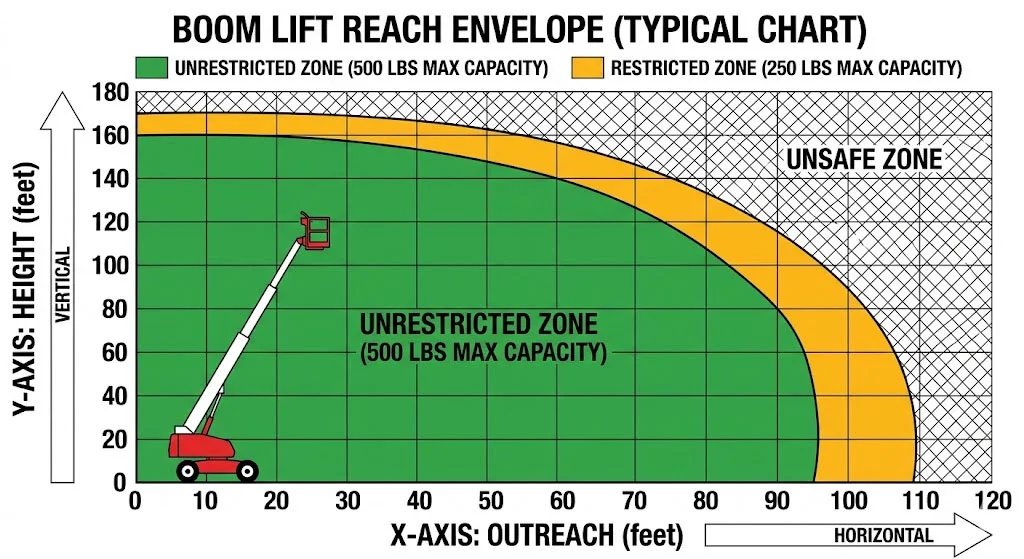
The boom lift reach chart is the most important document in your equipment manual. It is a graphical representation of the machine’s “operating envelope.”
To read a boom lift reach chart, follow these steps:
- Identify the X and Y Axes: The vertical axis (Y) represents the height from the ground. The horizontal axis (X) represents the distance from the center of the machine’s rotation.
- Locate Your Target Work Point: Find the height and horizontal distance you need on the grid.
- Check the Envelope: If your target point falls within the shaded area, the machine can reach it.
- Note Capacity Zones: Many charts have multiple shaded regions. The inner region usually represents the “unrestricted” zone (full weight capacity), while the outer edges represent the “restricted” zone (reduced weight capacity).
If you are unsure, a boom lift reach estimator tool—often provided by rental companies—can help you input your site dimensions to see if a specific model fits.
Key Factors That Affect Boom Lift Reach
The maximum boom lift reach listed in a brochure is often the “best-case scenario.” Several real-world factors can limit that reach:
Platform Load Capacity
As a boom extends further horizontally, the leverage on the base increases. To prevent tipping, machines often have sensors that limit outreach based on the weight in the basket. If you have two workers and heavy tools, your boom lift reach will be significantly less than if you had a single worker.
Weight Restrictions and How They Reduce Outreach
Modern high reach boom lift models use “envelope management” systems. If the system detects a load exceeding 500 lbs, it may automatically stop the boom from extending past a certain horizontal point to maintain the center of gravity.
Ground Conditions and Slope
Most boom lifts are rated for use on firm, level ground. If you are working on a slope, even a few degrees of tilt can trigger safety cut-offs. If the machine is not level, the safe boom lift reach is compromised, and the machine may refuse to extend to protect the operator.
Machine Configuration (Jib, Extension, Rotation)
- Jibs: A jib is a small additional boom section (usually 4–6 feet) near the platform. It provides “extra” boom lift reach and allows for finer positioning.
- Rotation: Most booms have 360-degree continuous rotation, but the stability and reach may vary slightly depending on whether the boom is extended over the side or the end of the chassis.
Wind and Environmental Conditions
High winds act as a force against the boom. Most manufacturers forbid the use of a high reach boom lift in winds exceeding 28 mph (45 km/h). Wind can cause the boom to sway, effectively reducing your precision and safe reach.
Common Mistakes When Interpreting Reach Charts
Misreading a boom lift reach chart can lead to costly delays or, worse, accidents.
- Confusing Working Height with Platform Height: As mentioned, if you rent a 60-foot lift for a 60-foot job, you’ll likely find yourself staring at the work from 6 feet below it.
- Ignoring Restricted Zones: Assuming you can carry full weight at maximum horizontal extension is a dangerous mistake. Always check the weight limits for the outer edges of the reach envelope.
- Overestimating Outreach at Maximum Height: A lift’s maximum horizontal outreach usually occurs at a mid-range height, not at its maximum vertical height. The envelope is usually curved, like a bow.
- Not Accounting for Obstacles: A chart shows a clear path. It doesn’t account for the tree branch, power line, or building eave that might be in your way.
How to Choose the Right Boom Lift Based on Reach
Selecting the right equipment requires a systematic approach. Don’t just guess; use these steps to ensure your boom lift reach is sufficient.
Step 1: Define Your Job Requirements
Measure the exact height of the work and the distance from where the machine will be parked. Remember to account for the “working height” (Platform Height + 6ft).
Step 2: Analyze Job Site Constraints
Are there obstacles you need to reach over? If so, you need an articulating lift. Is the ground soft or paved? This determines if you need a rough-terrain model or a lightweight electric model.
Step 3: Match Equipment to Reach Chart
Compare your measurements against a boom lift reach chart for specific models. If your work point is near the very edge of the envelope, consider renting the next size up. It is always better to have 10 feet of extra reach than to be 2 inches short.
Boom Lift Reach vs. Other Selection Factors
While boom lift reach is paramount, other factors will influence your final choice:
| Factor | Importance |
| Lift Capacity | Determines if you can carry heavy materials like HVAC units or glass panels. |
| Platform Size | Larger platforms allow more room for movement but can limit access in tight spots. |
| Power Source | Diesel is best for outdoor/rough terrain; Electric is required for indoor work. |
| Mobility | Four-wheel drive and oscillating axles are necessary for uneven construction sites. |
Safety Considerations When Working at Maximum Reach
Operating at the limits of boom lift reach requires extreme caution:
- Always wear a harness: At high elevations, even a small movement at the base is magnified at the platform (the “catapult effect”).
- Check overhead clearance: Ensure there are no power lines within the reach envelope.
- Do not use “cheaters”: Never stand on the guardrails or use ladders inside the basket to gain extra reach.
- Monitor the tilt alarm: If the alarm sounds, retract the boom and lower the platform immediately.
Pro Tips for Maximizing Boom Lift Efficiency
- Plan Positioning Before Lifting: Spend five minutes scouting the ground to find the spot that allows for the most boom lift reach without needing to move the base.
- Minimize Repositioning: Using a machine with a slightly larger horizontal outreach can allow you to cover more of a wall or structure from a single parking spot, saving hours of labor.
- Use the Right Lift Type: If you are working in a warehouse with shelving, an articulating lift is non-negotiable. If you are doing straight-up stadium lighting, a telescopic lift is your best friend.
- Regular Maintenance: Ensure hydraulic fluids are topped off. Sluggish hydraulics can make precise boom lift reach adjustments difficult and jerky.
Conclusion
Understanding boom lift reach is the foundation of a successful and safe project. By mastering the boom lift reach chart and recognizing the difference between vertical and horizontal needs, you can avoid the frustration of having the wrong equipment on-site. Whether you need a high reach boom lift for a skyscraper or a compact lift for a renovation, always prioritize the reach envelope over the sticker height.
When in doubt, consult with a technical expert to ensure your team can reach the job safely and efficiently. If you have questions about specific machinery specifications or need a recommendation for your next project, our team is ready to assist.
Contact Us Today:
- Email: info@klingtec.com
- WhatsApp: +86 188 6686 3188
FAQs
What is the highest reaching boom lift available?
The highest reaching boom lift currently on the market is the Snorkel 2100SJ, which offers a staggering platform height of 210 feet and a horizontal reach of 115 feet. JLG and Genie also offer models in the 180-foot range.
How much does a high reach boom lift extension go up to?
For most standard industrial models, high reach boom lift extensions go up to anywhere from 60 to 180 feet. Specialty models can exceed 200 feet for specific applications like wind turbine maintenance or high-rise construction.
Can I use a boom lift on a slope?
Most boom lifts are designed for slopes of 5% or less. Always check the machine’s specific rating. Using a high reach boom lift on an unlevel surface significantly reduces its safe boom lift reach and increases the risk of a tip-over.
Does the weight in the basket affect how far I can reach?
Yes. Most modern lifts have a “restricted” and “unrestricted” capacity. To achieve the maximum horizontal boom lift reach, you generally must stay within the lower weight limit (often 500 lbs or less).
How do I find a boom lift reach estimator?
Most major equipment manufacturers provide digital tools and mobile apps that act as a boom lift reach estimator, allowing you to visualize the machine’s range of motion before you rent.