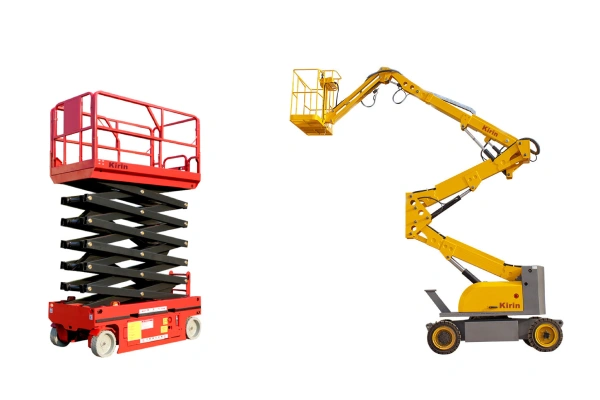
Working at height is a fundamental requirement across numerous industries, from construction and facility maintenance to warehousing and telecommunications. However, achieving safe and efficient elevated access presents a significant challenge. Among the most popular and reliable tools designed to meet this need are the boom lift and scissor lift. These two types of aerial work platforms (AWPs), also known as mobile elevating work platforms (MEWPs), dominate the height access market, each offering distinct capabilities, advantages, and limitations.
Understanding the difference between a boom lift and scissor lift is crucial for project managers, contractors, and safety officers. Choosing the wrong equipment can lead to inefficiencies, increased project costs, and, most importantly, compromise worker safety. This comprehensive guide dives deep into the characteristics, mechanisms, and the key pros and cons of both the boom lift and scissor lift, providing you with the information necessary to select the optimal solution for your next elevated task. Throughout this post, we’ll explore why the boom lift and scissor lift are essential tools and how to make an informed choice between them. We will also address the importance of proper training and, where applicable, boom and scissor lift certification.
Understanding the Boom Lift (Aerial Work Platform)
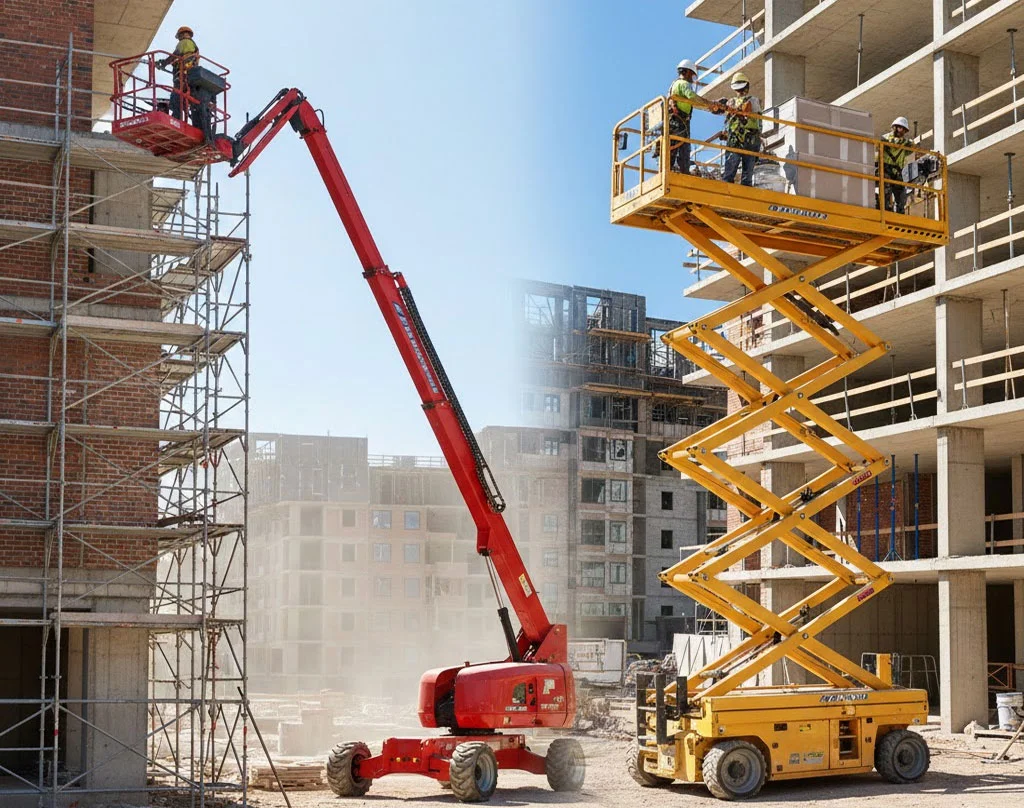
The boom lift, often simply called a “boom,” is the ultimate tool when you need to reach up and over obstacles. It’s instantly recognizable by its long, articulated arm, or “boom,” which extends the work platform in multiple directions. The versatility of the boom lift makes it an indispensable asset on complex job sites.
A. Description & Mechanism
A boom lift is a type of AWP characterized by a platform or bucket attached to the end of a hydraulic arm assembly. This arm, or boom, is mounted on a ground-level base, which can be wheeled (self-propelled) or truck-mounted. The key characteristic of the boom lift is its horizontal outreach, meaning it can extend out as well as up.
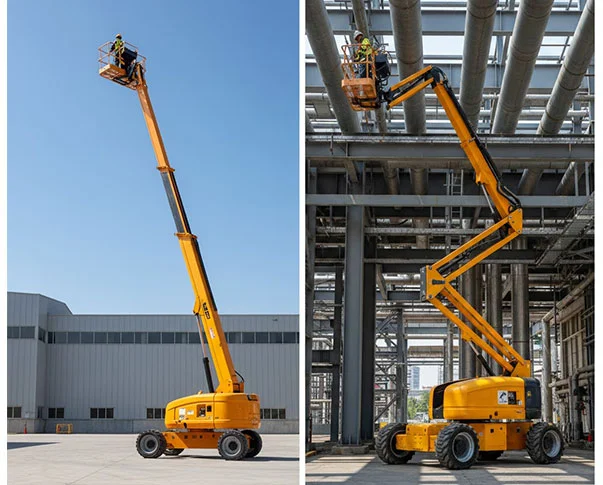
The two primary types of boom lifts are:
- Telescopic Boom Lift (Straight Boom/Stick Boom): This type features a single, straight arm that extends telescopically, like a telescope. It provides the greatest horizontal reach and is ideal for tasks requiring quick access to high, distant locations without navigating complex obstacles.
- Articulating Boom Lift (Knuckle Boom): This type features multiple hinged sections, or “knuckles,” in the arm assembly. These hinges allow the operator to maneuver the platform around obstacles, such as pipes, beams, or building overhangs. This superior maneuverability makes it perfect for congested or tight-access areas.
Mechanism: The operation relies on powerful hydraulic cylinders to extend, raise, and lower the sections of the boom. The base unit houses the engine, hydraulic pumps, and a turntable that allows the boom to rotate 360 degrees. The controls are located both on the ground and within the work platform, giving the operator precise control over the platform’s position in three-dimensional space. Boom lift and scissor lift operations require a high degree of operator skill and stability controls, often involving outriggers or counterweights to maintain balance, especially when the boom is fully extended.
B. Pros of the Boom Lift
The design of the boom lift offers distinct advantages that make it the superior choice in many scenarios:
- Superior Reach and Height: Boom lifts can achieve significantly greater working heights than scissor lifts, often reaching over 180 feet. More critically, they provide unmatched horizontal outreach, allowing workers to access areas inaccessible from directly beneath the work area.
- Versatility and Maneuverability (Articulating): The articulating “knuckle” boom allows the platform to navigate around structural obstacles, making it ideal for tasks like exterior building maintenance, bridge work, or installing utilities among existing infrastructure.
- Rough-Terrain Capability: Many boom lifts are equipped with powerful engines, four-wheel drive, and rugged tires, enabling them to operate safely and effectively on uneven, muddy, or sloped job sites—a capability where a scissor and boom lift with a powerful engine is a must.
- Adaptability: The platform can often be fitted with accessories like welding equipment, pipe racks, or tool holders, extending the range of tasks that can be performed at height.
- Precise Positioning: The controls allow for fine-tuning the platform’s location, essential for detailed work like facade restoration or complex rigging.
C. Cons of the Boom Lift
Despite their benefits, boom lifts also have disadvantages that must be considered:
- Higher Cost: Both the initial purchase price and rental rates for boom lifts are typically higher than for comparable scissor lifts, largely due to their complex mechanical structure and greater capabilities.
- Increased Complexity in Operation: Operating a boom lift, especially an articulating model, requires more training and skill. The potential for tip-over is higher due to the dynamic center of gravity shifts during extension and rotation, necessitating strict adherence to load charts and wind limitations. This is why boom and scissor lift certification is mandatory for operators.
- Smaller Work Platform: The platform on a boom lift is generally smaller than that of a scissor lift, limiting the number of personnel and the amount of material that can be lifted simultaneously.
- Slower Setup and Movement: While self-propelled, maneuvering a large boom lift and setting up its outriggers (if applicable) can take more time than positioning a simpler scissor lift.
- Greater Footprint: When the boom is fully retracted or extended, the overall space required for the machine to operate can be significant, restricting its use in very confined interior spaces.
Understanding the Scissor Lift
The scissor lift is the workhorse of vertical access. It provides a stable, generous work area and is the go-to choice for tasks requiring only straight vertical movement. Its compact design and ease of use make it exceptionally popular for indoor and simpler outdoor applications.
A. Description & Mechanism
A scissor lift is an AWP that moves the work platform straight up and down using a mechanism of crossed, folding supports—resembling a pair of scissors when collapsing or extending. This mechanism gives the lift its name.
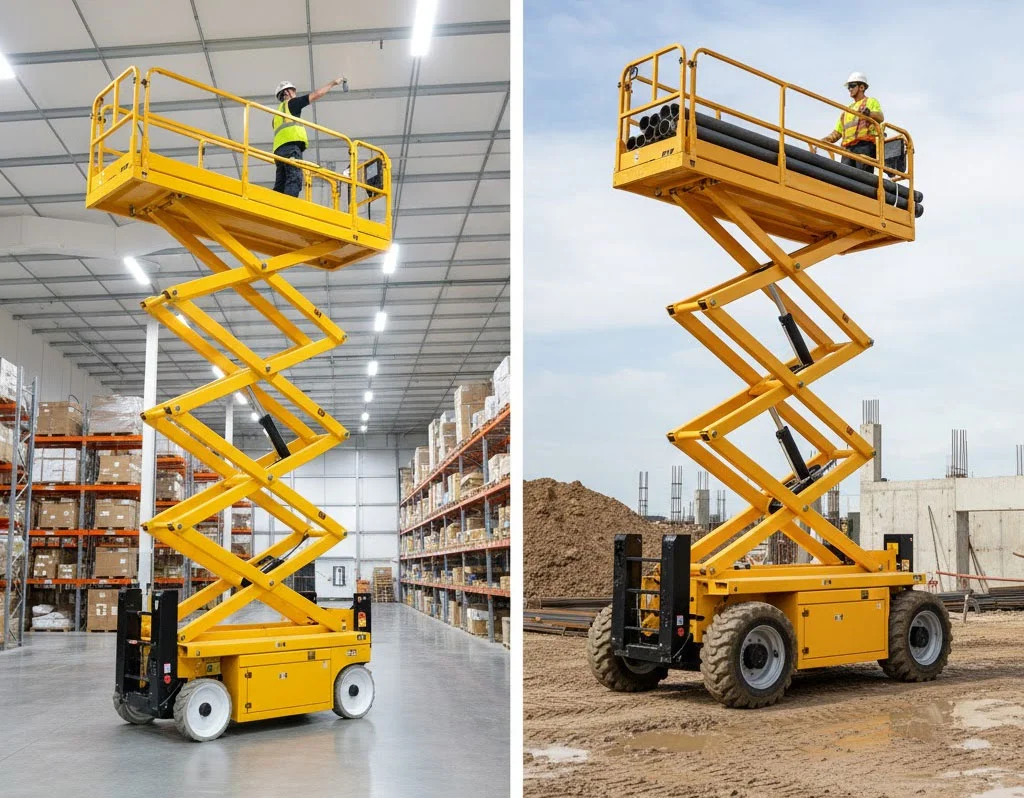
Scissor lifts come in two main varieties:
- Slab Scissor Lifts (Electric/Indoor): These are typically narrower, battery-powered, and designed with non-marking tires for use on smooth, level indoor floors (slabs), such as in warehouses, retail facilities, and finished office buildings.
- Rough Terrain Scissor Lifts (Diesel/Outdoor): These are larger, typically diesel-powered, and equipped with rugged, foam-filled, or pneumatic tires, and often have outriggers for leveling on uneven ground outdoors.
Mechanism: The lift operates using a series of interconnected, hinged supports. When hydraulic pressure is applied to the cylinders, the crossed supports are forced to pivot and straighten, raising the platform vertically. As the pressure is released, the supports fold back in, lowering the platform. Because the entire assembly raises directly over the base, the machine’s center of gravity remains relatively stable, meaning it can handle heavier loads and larger platforms compared to a boom lift of similar height. The vertical-only movement is the principal difference between the boom lift and scissor lift. The maximum vertical height of most standard boom and scissor lifts in the scissor category is usually less than 60 feet.
B. Pros of the Scissor Lift
The strengths of the scissor lift center on stability, capacity, and simplicity:
- Large Work Platform and High Capacity: Scissor lifts boast a large, rectangular platform that can comfortably accommodate multiple workers, substantial tools, and heavy materials. Their lifting capacity is often much greater than a boom lift’s. For tasks requiring lifting heavy materials in a confined space, the boom lift and scissor lift comparison often favors the scissor lift.
- Excellent Stability: Due to their mechanism, which keeps the load directly over the center of the base, scissor lifts offer inherent stability. This makes them ideal for prolonged work sessions and tasks involving heavy lifting.
- Ease of Operation and Training: Operating a scissor lift involves simple controls—primarily up, down, and horizontal movement. This simplicity means less training is required, making the boom and scissor lift certification process often quicker for this type of equipment.
- Compact Storage and Maneuverability (Indoor): Electric slab scissor lifts are relatively narrow and can be easily maneuvered through standard doorways and aisles, making them perfect for internal maintenance and fitting out tasks.
- Cost-Effective: Scissor lifts are generally less expensive to purchase, rent, and maintain than boom lifts, making them the most economical choice for strictly vertical access needs.
C. Cons of the Scissor Lift
The simplicity and stability of the scissor lift come with certain limitations:
- Strictly Vertical Access: The main drawback is the lack of horizontal outreach. The platform can only move straight up and down. If the work area is blocked by an overhang, obstacle, or scaffolding, a scissor lift cannot access it. This is the biggest distinguishing feature between a scissor and boom lift.
- Limited Height: The maximum working height of most common scissor lifts is substantially lower than that of boom lifts, typically maxing out around 50–60 feet for standard models.
- Ground-Level Requirements: Standard slab scissor lifts require a flat, level, and firm surface to operate safely. They are not suitable for slopes or very rough terrain unless they are a specific, expensive rough-terrain model with outriggers. Even rough-terrain models have limitations on the slope they can handle compared to a boom and scissor lift designed primarily for rugged environments.
- Environmental Sensitivity (Electric Models): Electric scissor lifts, while quiet and emission-free, have limited battery life and cannot be used in areas where water or moisture could damage the electrical system.
Boom Lift vs. Scissor Lift: Choosing the Right Solution
The decision between a boom lift and scissor lift boils down to a thorough assessment of your project’s specific requirements. There is no universally “better” machine; there is only the right tool for the job. To choose correctly, consider the following critical factors. The keywords boom lift and scissor lift will appear frequently in this decision-making process.
| Feature | Boom Lift (Aerial Work Platform) | Scissor Lift | Best Choice When… |
| Movement | Vertical and Horizontal Outreach | Strictly Vertical | Boom Lift (Need to work over obstacles or reach distant points) |
| Work Height | Up to 180+ feet | Typically up to 60 feet | Boom Lift (Need to reach extreme heights) |
| Terrain | Excellent for Rough/Uneven Ground | Requires Level/Stable Ground (Slab Models) | Boom Lift (Working on construction sites or slopes) |
| Platform Size | Small (1-2 workers + limited tools) | Large (2-4 workers + substantial materials) | Scissor Lift (Need to lift heavy materials or have a large crew) |
| Cost | High Purchase/Rental/Maintenance Cost | Lower Purchase/Rental/Maintenance Cost | Scissor Lift (Budget is a primary concern) |
| Required Training | More complex, higher risk training | Simpler, lower risk training | Depends on Operator Experience (Both require boom and scissor lift certification) |
1. The Nature of the Work
- Obstacles: Is the work area above a building overhang, a tree, or another obstacle? If horizontal outreach is needed, a boom lift and scissor lift comparison immediately eliminates the scissor lift. The boom lift is the clear winner for tasks like tree trimming, bridge inspection, or roofing where the lift must be set up at a distance.
- Straight Vertical Access: Are you replacing lights in a warehouse, installing drywall, or painting a flat wall? If the work is directly above the machine, the superior capacity and stability of the scissor lift make it the most efficient choice.
2. Location and Ground Conditions
- Indoor/Finished Floors: For interior use, especially in clean environments, the quiet, compact, and non-marking electric scissor lift is usually preferred.
- Rough Terrain: On outdoor construction sites, a diesel-powered, four-wheel-drive boom lift or a specialized rough-terrain scissor lift is necessary. The boom and scissor lifts designed for rough terrain typically have greater ground clearance and stability systems.
3. Capacity and Personnel
- Heavy Lifting/Multiple Workers: If you need to lift heavy HVAC units, large bundles of piping, or have a crew of three or four working together, the scissor lift’s larger platform and higher weight capacity are essential.
- One-Person Detail Work: If the task is detailed inspection, welding, or electrical work by a single person, the maneuverability and reach of the boom lift may be more important than platform size.
4. Safety and Training: The Importance of Certification
Regardless of whether you choose a boom lift and scissor lift, proper operator training is non-negotiable. All operators must be trained and certified in the safe operation of the specific type of equipment they are using. This boom and scissor lift certification covers crucial topics such as:
- Pre-operation checks and inspections.
- Understanding and adhering to load limits and wind ratings.
- Safe driving and positioning on site.
- The proper use of personal fall arrest systems (required for boom lifts, and often recommended or required for many scissor lifts).
Conclusion
The selection between a boom lift and scissor lift is a strategic decision that directly impacts project safety, efficiency, and cost.
- The boom lift offers unparalleled flexibility, capable of reaching high and maneuvering around complex obstacles. It is the specialist, excelling in demanding, high-reach, and rugged environments.
- The scissor lift is the high-capacity, stable workhorse for vertical access. It provides a safer, more economical, and more spacious platform for tasks that are directly above the machine.
By carefully evaluating the required height, the need for horizontal reach, the ground conditions, and the required platform capacity, you can confidently determine whether a boom lift and scissor lift is the optimal choice for your operations. Investing in the right AWP—and in mandatory boom and scissor lift certification for all operators—is the foundation of a successful and safe elevated work plan.
FAQs
Is a Boom Lift safer than a Scissor Lift?
Neither is inherently safer. Both boom and scissor lifts are safe when operated correctly, well-maintained, and used within their design specifications. However, boom lifts have a higher potential for tip-over due to dynamic shifts in the center of gravity and are therefore considered to have higher operational risk, necessitating mandatory personal fall protection (harnesses). Scissor lifts are more stable but are still subject to hazards like crush injuries and falls if operated improperly. Safety in a boom lift and scissor lift operation is entirely dependent on operator training and adherence to safety protocols.
Do I need special certification to operate a Boom Lift and Scissor Lift?
Yes. According to regulatory bodies (like OSHA in the US or similar organizations globally), any person operating a mobile elevating work platform (MEWP), which includes both a boom lift and scissor lift, must be properly trained and certified. This boom and scissor lift certification ensures the operator understands the specific machine’s controls, limitations, and safety procedures.
How do I know if I need a Telescopic or an Articulating Boom Lift?
Choose a Telescopic Boom Lift (Straight Boom) if you need to reach a high, distant point in a straight line with no obstacles in the way. They offer the greatest height and outreach.
Choose an Articulating Boom Lift (Knuckle Boom) if you need to maneuver the platform around obstacles, such as overhead pipes, structural beams, or building overhangs, to access the work area.
What is the primary advantage of a Scissor Lift over a Boom Lift?
The primary advantage is the size and capacity of the work platform. A scissor lift can typically lift more weight and accommodate more workers and materials than a boom lift and scissor lift of comparable size. This makes the scissor lift ideal for tasks requiring a large, stable workspace, such as installing large windows or extensive painting jobs.
What is the typical lifespan of a Boom Lift and Scissor Lift?
With proper maintenance and regular inspections, both the boom lift and scissor lift can have a long service life, often exceeding 15 to 20 years. Their lifespan is measured more often in hours of operation than in calendar years, and consistent preventative maintenance is the key factor in maximizing the equipment’s operational life.