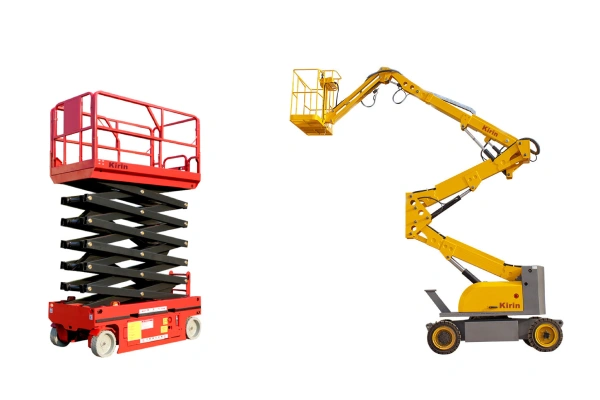
When your project demands working at significant heights, selecting the correct aerial work platform isn’t just a matter of convenience—it directly impacts your job site safety, project timeline, and bottom line. Two dominant options rule the heavy equipment industry: the articulating boom lift and the telescopic boom lift.
While both machines serve the fundamental purpose of elevating workers, tools, and materials, they do so through entirely different mechanical engineering profiles. Choosing the wrong one can lead to stalled work, inefficient maneuvering, or an inability to reach the work zone altogether.
This comprehensive guide breaks down the core distinctions of the articulating vs telescopic boom lift debate, exploring how each works, their unique advantages, and exactly how to choose the right equipment for your specific job site parameters.
What Is a Boom Lift?
A boom lift is a type of aerial platform (also called a cherry picker or elevated work platform) designed to lift personnel and equipment to elevated work surfaces. Unlike scissor lifts, which only move vertically up and down, boom lifts feature an extended arm connected to a rotating turntable base. This allows the operator to move the basket both vertically and horizontally, bypassing ground obstacles and accessing highly specific aerial vectors.
Driven by hydraulic systems, boom lifts are mounted on heavy-duty wheeled or tracked bases. They are indispensable tools across a massive spectrum of industries, including commercial construction, facility maintenance, utility repairs, aviation engineering, and warehouse operations.
What Is an Articulating Boom Lift?
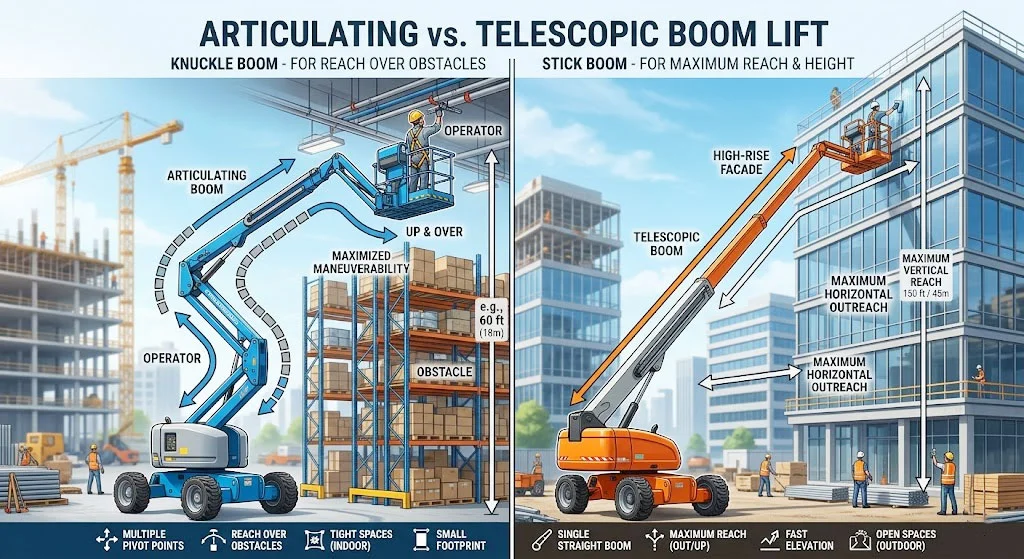
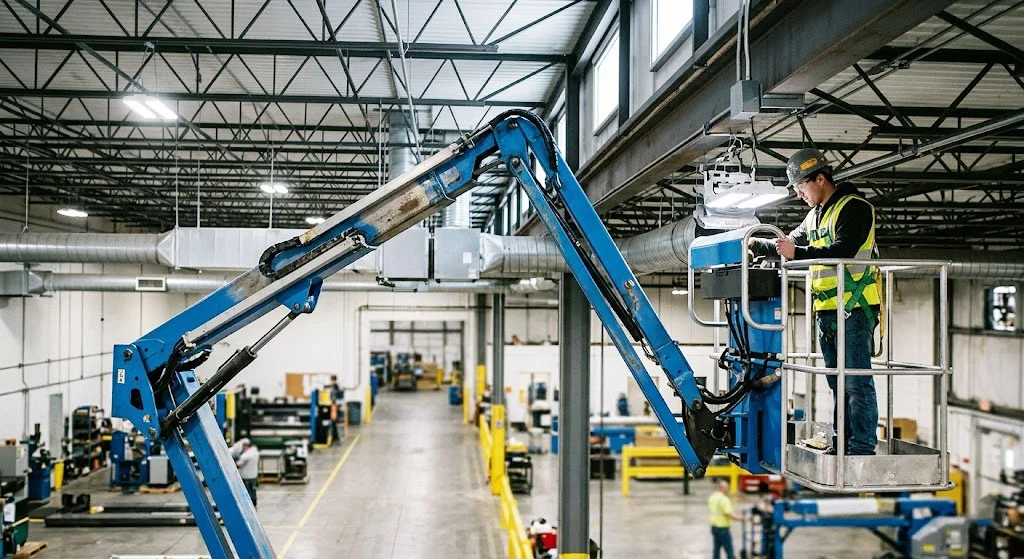
An articulating boom lift—frequently referred to in the field as a “knuckle boom”—is an aerial lift characterized by an arm built with multiple hinged sections. These joints allow the boom to bend, fold, and flex much like a human finger or arm.
How an Articulating Boom Lift Works
The primary mechanism behind an articulating vs telescopic boom lift of this style relies on independent hydraulic cylinders situated at each joint (or knuckle). As hydraulic fluid shifts pressure through the system, these knuckles can be adjusted individually. This allows the platform to rise vertically, bend over an obstacle, and then extend downward or horizontally toward a target.
Key Features of Articulating Boom Lifts
- Multiple pivot points: The signature knuckles allow the boom to achieve an “up-and-over” clearance. This means the base can sit on one side of a wall, roof line, or machinery asset while the basket drops down directly over the target work area.
- Compact maneuverability: Because the arm can completely fold in on itself, these lifts boast a remarkably small footprint when stowed. Their tailswing is usually minimal or zero, making them easier to spin and turn within narrow aisles or tight spaces.
- Enhanced positioning flexibility: Many models feature an additional small, articulating arm near the basket called a “jib.” This provides extra fine-tuning rotation and tilt right at the work face, keeping workers at the perfect angle.
Common Applications
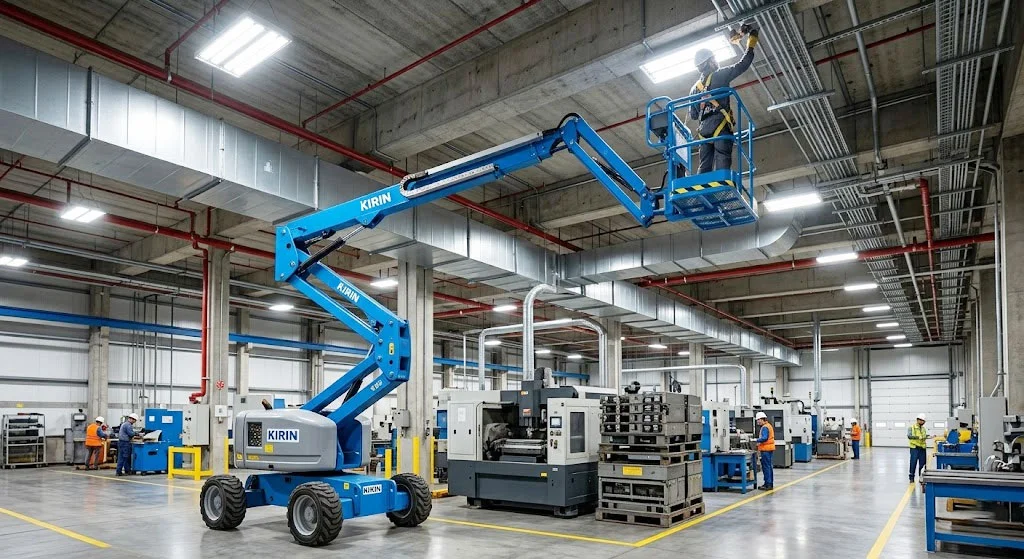
- Indoor maintenance: Perfect for commercial facilities, convention centers, and arenas where crews must work above fixed seating, warehouse shelving, or sensitive floor-mounted machinery.
- Tight job sites: Excellent for congested urban construction zones, narrow alleyways, and historical restorations where clearance around adjacent buildings is razor-thin.
- Working around structures and obstacles: Extensively used in electrical line maintenance, tree trimming, and complex structural inspections where navigating around piping, ductwork, and structural beams is a constant requirement.
Advantages of Articulating Boom Lifts
- Better access to hard-to-reach areas: If your target cannot be accessed via a straight line from the ground, an articulating lift is your only real solution. It weaves over, under, and around obstacles effortlessly.
- Ideal for confined spaces: The ability to stow compactly and rotate the turntable within a narrow radius keeps your job site moving forward without hitting nearby walls or structural pillars.
- Improved versatility: These machines transition seamlessly from low-level interior tasks to multi-story exterior work, acting as an all-in-one access tool.
Limitations of Articulating Boom Lifts
- Lower horizontal outreach compared to telescopic models: Because the energy and structural mass are distributed across multiple joints, these lifts cannot reach as far horizontally from the base as a straight boom can.
- Generally slower positioning: Reaching your destination takes a bit more time. Operators must coordinate multiple boom sections sequentially rather than relying on a simple, single-joystick telescope function.
- Potentially higher maintenance requirements: Every hinge, pivot, and knuckle represents an extra set of hydraulic hoses, pins, and seals. Over time, this inherently increases the number of potential wear items.
What Is a Telescopic Boom Lift?
A telescopic boom lift—often called a “straight boom” or “stick boom”—is an aerial lift featuring a straight, unbending arm that extends and retracts linearly, much like a telescope.
How a Telescopic Boom Lift Works
The machine functions via nested boom sections that slide inside one another. A combination of internal heavy-duty hydraulic cylinders and cable chains pushes these sections outward in a perfectly straight line. To alter position, the entire arm is raised, lowered, or rotated from the main turntable base.
Key Features of Telescopic Boom Lifts
- Long straight arm: Offers zero articulation, focusing instead on structural rigidity and maximum linear reach.
- Fast elevation capability: Because the extension mechanism is direct and linear, operators can travel from ground level to maximum height in a fraction of the time required by an articulating lift.
- Superior outreach: Provides unmatched horizontal reach, allowing the machine’s base to remain safely at a distance while the basket stretches out over unstable terrain or exclusion zones.
Common Applications
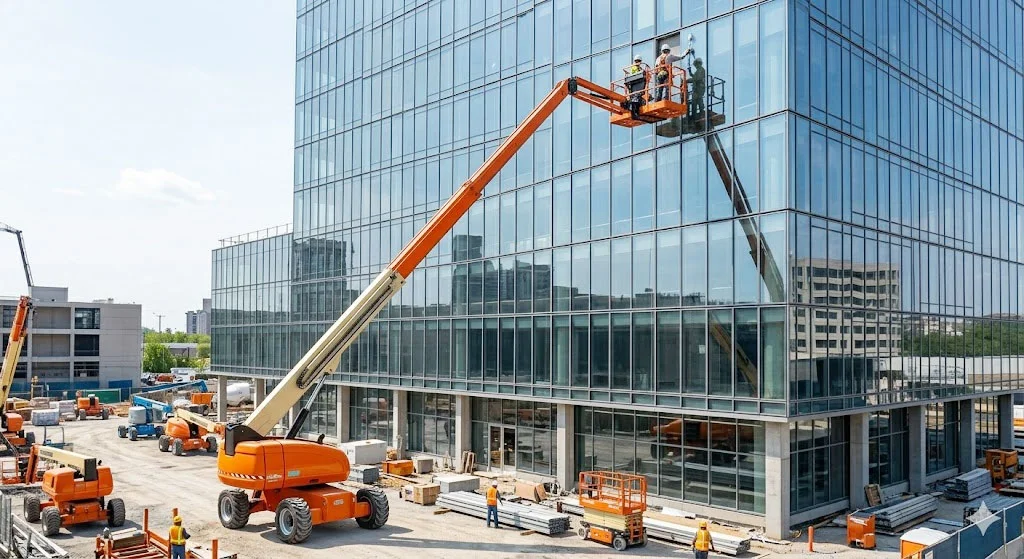
- Large outdoor construction projects: Essential for steel erection, commercial framing, and exterior finishing on expansive, open job sites.
- Bridge work: Ideal for parking underneath or adjacent to a bridge deck and extending the straight arm out over rivers or busy highways.
- Industrial sites: Frequently deployed in oil refineries, shipyards, and chemical plants where crews need straight-line paths up to high-altitude storage tanks and exhaust stacks.
- High-rise building projects: Used extensively for window installation, masonry cleaning, and exterior painting on mid-to-high-rise commercial architecture.
Advantages of Telescopic Boom Lifts
- Greater reach distance: If your project requires scaling heights above 100 feet while simultaneously extending outward, a straight boom is unrivaled.
- Faster operation: The simple, direct extension path means significantly faster cycle times, helping your team get to work faster.
- Excellent for open job sites: When there are no overhead obstructions blocking a straight trajectory, these lifts provide a rock-solid, highly stable work platform.
Limitations of Telescopic Boom Lifts
- Less maneuverable in tight spaces: The long, rigid design of the boom requires a substantial amount of operating clearance. It cannot bend around a corner or compress itself to slide through tight indoor pathways.
- Limited obstacle navigation: If a power line, tree branch, or structural beam sits between the lift base and the target, a telescopic boom cannot bypass it; it requires a clear, uncompromised line of sight.
- Requires more operating space: Due to their massive counterweights and elongated boom overhangs, these machines demand a much wider physical footprint on the ground to stay balanced.
Articulating vs. Telescopic Boom Lift: Key Differences
To help visualize how these two machine styles stack up against each other on the job site, let’s break down the core performance categories of the articulating vs telescopic boom lift dynamic:
| Feature / Metric | Articulating Boom Lift | Telescopic Boom Lift |
| Boom Path Geometry | Knuckled, multi-jointed (“up-and-over”) | Straight line, nested sections (“stick”) |
| Max Horizontal Outreach | Moderate | Superior / Maximum |
| Obstacle Navigation | Excellent (bends around barriers) | Poor (requires clear line of sight) |
| Setup / Stowed Footprint | Compact and compressed | Long and elongated |
| Cycle & Travel Speed | Slower (multi-step positioning) | Fast (direct extension) |
| Tailswing | Minimal to zero | Substantial (requires clearance) |
| Primary Environment | Confined spaces, indoor/outdoor mixed | Open spaces, heavy outdoor industrial |
Movement and Reach
The defining difference centers on how they travel through space. An articulating lift navigates complex structural environments by snaking its arm through openings. A telescopic lift moves strictly up, down, and out in a straight line, demanding a wide, completely unobstructed clearance path.
Horizontal Outreach
When comparing the articulating vs telescopic boom lift on pure outreach distance, telescopic lifts win comfortably. Because a straight steel tube handles cantilever forces more efficiently than a series of heavy hinges, straight booms can extend much further horizontally from their chassis without sacrificing stability or lifting capacity.
Maneuverability
Articulating models take the prize for tight spatial navigation. Their ability to fold up tightly reduces their overall transport length, allowing them to turn sharp corners inside facilities. Conversely, a stowed telescopic lift remains long and rigid, requiring wide turning radiuses.
Terrain Compatibility
Both styles offer rugged outdoor options, but because telescopic lifts are naturally heavier and designed for extreme heights, they are frequently paired with heavy-duty 4WD diesel systems and oscillating axles to navigate raw, unpaved construction grades. Articulating lifts are split more evenly between rough-terrain outdoor models and smooth-tired, non-marking indoor variants.
Platform Capacity
Telescopic lifts generally offer higher total weight capacities—often featuring unrestricted dual-capacity envelopes (e.g., 660 lbs unrestricted up to 1,000 lbs restricted). Articulating lifts tend to have slightly lower, fixed platform capacities (typically around 500 lbs) because managing weight across multiple flexion points strains hydraulic geometry.
Ease of Operation
Telescopic booms are usually considered easier for novice operators to master because the controls map directly to a simple coordinate plane: push forward to telescope out, pull back to telescope in. Articulating booms require a more experienced operator who can manage secondary and tertiary boom angles simultaneously without losing track of their surrounding clearances.
Maintenance Requirements
Because an articulating machine is mechanically more complex, it requires more intensive pre-operation checks, pin lubrication schedules, and hydraulic hose inspections. A telescopic lift is structurally simpler, meaning fewer moving components to service over the life of the machine.
Cost Comparison
Rental and purchase costs scale primarily with platform height, but dollar-for-dollar at identical platform heights, an articulating lift can sometimes carry a premium due to its complex joint engineering. However, the true cost comes down to job site efficiency: using a straight boom where an articulating boom is required will cost you more in wasted time and potential property damage.
How to Choose the Right Boom Lift for Your Project
When staring down the articulating vs telescopic boom lift decision, you can confidently zero in on the perfect asset by running your project through these five diagnostic questions:
- What is the exact nature of the obstructions? Look closely at the path between your ground parking spot and the elevated work target. Are there power lines, roof overhangs, or stationary machinery assemblies in the way? If yes, select an articulating lift. Is it a wide-open vertical wall? Opt for a telescopic lift.
- How much horizontal distance must you cover? Calculate how far away from the work zone the base of the lift must sit. If you need to stay parked 60 feet away across a ditch or manicured lawn while working high up on a wall, a telescopic boom lift will give you the horizontal reach you need.
- What are the physical constraints of the workspace? Measure your entry doors, gate clearances, and indoor aisle widths. If space is tight or you are working indoors, an articulating model is almost always the required choice.
- What is the total weight load? Calculate the weight of your workers plus their tools, replacement parts, and heavy equipment. Check the manufacturer load charts; if your cargo exceeds 500–600 lbs, a high-capacity telescopic lift may be legally required to execute the lift safely.
- What are the ground conditions? Are you operating on pristine, finished interior concrete, or are you tracking through thick, uncompacted mud on a fresh job site? This will dictate whether you need a compact electric lift or a rugged four-wheel-drive rough terrain model.
Best Applications for Articulating Boom Lifts
To give you a practical blueprint, an articulating machine delivers the highest return on investment in the following scenarios:
- Electrical and Plumbing Retrofits: Running conduit or pipe networks along a complex indoor ceiling grid over existing office cubicles or factory tooling equipment.
- Aviation and Hangar Maintenance: Reaching over the wide wingspans or tail assemblies of aircraft to service fuselage panels without moving the plane itself.
- Urban Tree Care: Safely wrapping around branches, power lines, and residential roofing systems to prune dangerous limbs over hanging structures.
Best Applications for Telescopic Boom Lifts
A telescopic machine is your best option when your project demands maximum raw height and linear speed:
- Steel Erection and Framing: Lifting massive structural steel beams rapidly to upper levels so ironworkers can quickly bolt them into place.
- Commercial Masonry and Glazing: Working along flat, unbroken exterior curtain walls where the platform can move directly up and down all day without navigating obstructions.
- Shipbuilding and Marine Repairs: Reaching up to the massive hulls of dry-docked container ships from the shipyard floor.
Electric vs. Diesel Boom Lifts
Once you have chosen your boom geometry, you must select your power plant. This choice is usually split between electric boom lifts and rugged diesel boom lift options.
Electric Boom Lifts
An electric articulating boom lift is the gold standard for indoor facilities. Powered by heavy-duty deep-cycle battery packs, these machines generate zero emissions, making them safe for enclosed air spaces. They run near-silently, preventing disruptive noise pollution in occupied commercial buildings, hospitals, or schools. Furthermore, they are almost universally equipped with non-marking solid rubber tires, ensuring polished warehouse floors or decorative tile surfaces remain undamaged.
Diesel Boom Lifts
For raw outdoor performance, a diesel telescopic boom lift or diesel articulating boom lift is unmatched. Diesel internal combustion engines supply the high torque required to drive large, foam-filled four-wheel-drive tires up steep, muddy grades and across uneven construction terrain. They are built with rugged, weather-sealed components designed to endure rain, dust, and sub-zero temperatures. Their main benefit is continuous uptime: you can simply refuel the tank from a job site fuel truck in minutes rather than waiting hours for an electric battery pack to recharge.
Safety Tips When Using Boom Lifts
No matter which asset wins your articulating vs telescopic boom lift assessment, aerial lift operations demand strict adherence to safety protocols to prevent tip-overs, falls, and structural collisions:
- Always Wear an OSHA-Compliant Harness: Every single occupant in a boom lift basket must wear a full-body harness connected via an approved lanyard to the factory-designated anchor point. In a boom lift, a sudden mechanical bounce or slip can throw an unrestrained worker out of the basket instantly.
- Conduct a Thorough Pre-Start Inspection: Walk around the machine before every single shift. Inspect hydraulic lines for leaks, check tire inflation or track condition, verify that the emergency lowering controls are fully operational, and look over electrical connections.
- Examine Ground Conditions: Boom lifts exert immense concentrated weight through their tires. Ensure the surface is stable, level, and free of hidden drop-offs, voids, vaults, or soft backfilled soil that could collapse under load.
- Maintain Clearance Protocols: Always look out for overhead electrical lines. Maintain an absolute minimum distance of 10 feet from energized high-voltage power lines unless you are a certified, insulated utility worker.
- Never Exceed the Rated Load Capacity: Overloading a basket alters the machine’s center of gravity, which can cause structural failure or a catastrophic tip-over. Account for your tools and equipment, not just your body weight.
Frequently Asked Questions
Which is better: articulating or telescopic boom lift?
Neither is universally better; it depends completely on your workspace architecture. An articulating lift is superior for navigating tight, obstacle-dense areas requiring up-and-over access. A telescopic lift is superior when your primary goals are maximum height, long horizontal outreach, and straightforward speed.
Are articulating boom lifts good for outdoor use?
Yes. While many people associate articulating models with indoor work, manufacturers build rugged, four-wheel-drive diesel articulating boom lift models specifically engineered to handle unpaved, uneven outdoor construction sites.
What is the maximum reach of a telescopic boom lift?
The largest telescopic booms available in the modern equipment industry can reach platform heights between 150 to 180 feet, providing access up to 15- to 18-story structures.
Which boom lift is easier to maneuver?
An articulating lift is much easier to maneuver into tight, complex areas because its arm folds in tightly, creating a shorter overall transport profile and minimal tailswing. However, a telescopic lift is simpler to control in terms of basic joystick layout.
Can boom lifts be used on uneven ground?
Yes, provided the machine is explicitly rated for rough terrain and remains within the manufacturer’s specified slope limits. Many rough-terrain lifts feature oscillating axles to maintain traction on uneven soil, and some are equipped with hydraulic outriggers to level the chassis before elevating the boom. Never operate a lift if the tilt-alarm sensor triggers.
Should I rent or buy a boom lift?
Renting is typically the most cost-effective path for specific, short-term, or seasonal projects because it eliminates storage costs, specialized transport logistical fees, and ongoing maintenance overhead. Buying makes financial sense if your company uses the asset consistently across multiple projects throughout the year, enabling you to amortize the high capital investment.
Conclusion
The debate between an articulating vs telescopic boom lift isn’t about finding a universally superior machine—it’s about choosing the right tool for your specific job site parameters. If your project demands weaving over interior piping networks, accessing tight urban courtyards, or reaching over structural obstacles, an articulating model is your ideal choice. If your job site is wide open and requires soaring straight into the air to install glass panels, erect steel, or reach extreme horizontal distances over rough terrain, a telescopic model will serve you best.
By taking the time to accurately measure your clearance zones, evaluate ground conditions, and map out your target heights, you will ensure a safe, efficient, and highly profitable project execution.
If you need expert assistance selecting the exact model for your next project or want to learn more about our high-performance heavy machinery line, the team at Kirin is ready to help. Get in touch with our factory technicians today via email at info@klingtec.com or message us directly on WhatsApp at +86 188 6686 3188 to get a custom equipment solution tailored to your operational needs.