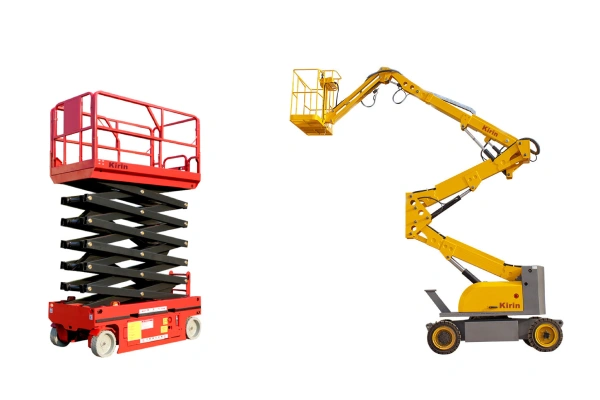
An articulating boom lift—often called a “knuckle boom”—is one of the most versatile and indispensable pieces of equipment on any job site. Its unique jointed arm, which bends and pivots like a knuckle, allows it to reach up, over, and around obstacles, providing unparalleled access in tight or complex spaces. However, choosing the right machine is all about understanding the proper articulating boom lift sizes and specifications.

This comprehensive guide will break down the crucial dimensions, common size categories, and power sources to help you select the perfect lift for your specific project, ensuring maximum safety and efficiency.
Key Dimensions and Specifications
Before you can determine which articulating boom lift sizes is right for your job, you must understand the key metrics used to classify and compare these machines.
A. Working Height: The Maximum Vertical Reach
The working height is arguably the most important metric. It represents the maximum height a worker can reach while standing on the platform. This measurement is typically calculated by taking the maximum platform height and adding about 6 feet (the average reach of a standing person).
- Measurement: Platform Height + 6 feet (approx.).
- Significance: This is the absolute highest point you can access with the lift. Always choose a machine with a working height that is safely above your maximum required access point.
B. Horizontal Outreach (Reach): Up and Over Capability
The horizontal outreach, or reach, measures the distance from the centerline of the lift’s chassis (base) to the farthest edge of the work platform. This is the articulating boom lift’s core strength, allowing it to navigate obstacles and reach work areas horizontally.
- Measurement: Distance from the lift’s center of rotation to the outermost edge of the elevated platform.
- Significance: This determines how far out you can reach to perform work over an obstruction (like a rooftop, parapet, or machinery) without having to drive the base closer.
C. Platform Capacity (Weight Limit): The Critical Load
Platform capacity refers to the maximum amount of weight—including workers, tools, and materials—that the basket can safely support. This is a crucial safety and productivity specification. Many modern articulating boom lifts offer dual capacity ratings:
- Unrestricted Capacity: A lower weight limit, typically 500 lbs to 600 lbs, that can be carried through the entire operating range of the lift.
- Restricted Capacity: A higher weight limit, often up to 1,000 lbs, that is permitted only within a specific, more limited operating range (usually closer to the lift base).
- Measurement: Measured in pounds (lbs) or kilograms (kg).
- Significance: Never exceed the platform capacity. Failing to account for the weight of your materials and the crew can lead to dangerous instability.
D. Stowed Dimensions (Transport Size): Footprint and Access
The stowed dimensions are the machine’s size when it is lowered and ready for transport or storage. These numbers are vital for logistics, transport, and ensuring the machine can navigate the job site and access point restrictions.

- Height: The stowed height determines if the lift can clear doorways, overhead structures, and fit onto a transport trailer.
- Width: The machine width is critical for passing through narrow aisles, standard doorways (which are typically 36 inches wide), or between equipment.
- Weight: The gross weight of the machine impacts the type of trailer required for transport and the permissible ground pressure on the job site.
| Dimension | Description | Typical Range |
| Working Height | Max height a worker can reach | 30 ft to over 150 ft |
| Horizontal Outreach | Max horizontal distance from the base | 18 ft to over 70 ft |
| Platform Capacity | Max allowable load (personnel + material) | 500 lbs (Unrestricted) to 1,000 lbs (Restricted) |
| Stowed Width | Width for transport/access | 3 ft 11 in (compact) to 8 ft 6 in (rough terrain) |
Breakdown of Common Articulating Boom Lift Sizes
Articulating boom lift sizes are generally categorized by their maximum working height. By segmenting the available range, you can quickly narrow down the best choice for your project’s scope.
A. Compact/Small Articulating Boom Lifts (Under 45 ft)
These smaller models are designed for jobs that require tight maneuverability and low-emission operation. They often feature narrow chassis and non-marking tires.
Best For:
- Indoor facility maintenance (lighting, HVAC, cleaning).
- Warehouse and industrial work in confined aisles.
- Low-rise exterior building tasks (two-to-three stories).
- Event setup in stadiums or convention centers.
Key Specs:
- Working Height: Around 35 ft to 51 ft.
- Horizontal Outreach: Typically 18 ft to 25 ft.
- Platform Capacity: Standard 500 lbs.
- Power: Usually Electric or Bi-Energy for fume-free operation.
- Stowed Width: Can be as narrow as 4 ft (e.g., Genie Z-30/20N).
B. Mid-Sized Articulating Boom Lifts (45 ft – 85 ft)
Mid-sized lifts are the workhorses of general construction, balancing significant height and reach with solid rough-terrain capability. This category includes the most commonly rented and purchased articulating boom lift sizes.
Best For:
- Commercial construction and exterior building maintenance.
- Industrial facility and refinery work.
- Bridge inspection and painting.
- Medium-to-large scale tree trimming and utility work.
Key Specs:
- Working Height: Around 51 ft to 91 ft. The 60-foot (66 ft working height) and 80-foot (86 ft working height) models are extremely popular.
- Horizontal Outreach: Varies widely, generally between 25 ft and 60 ft.
- Platform Capacity: 500 lbs (Unrestricted) up to 750 lbs or 1,000 lbs (Restricted/High Capacity models).
- Power: Primarily Engine-Powered (Diesel/Dual Fuel) for 4WD and rough terrain use, though larger electric models are emerging.

C. Large/High-Reach Articulating Boom Lifts (85 ft +)
When the job requires accessing the highest points while still navigating obstacles, these behemoths are necessary. They are typically used on major infrastructure and skyscraper projects.
Best For:
- High-rise construction and façade work.
- Telecommunications and utility tower maintenance.
- Stadium and venue construction/maintenance.
- Major infrastructure projects (e.g., elevated highways).
Key Specs:
- Working Height: 91 ft up to 156 ft (The largest articulating boom lift sizes can exceed 150 ft).
- Horizontal Outreach: Generally between 60 ft and 75 ft.
- Platform Capacity: 500 lbs (Unrestricted) up to 1,000 lbs (Restricted).
- Power: Almost exclusively Engine-Powered (Diesel) due to the power required for lift, weight, and rough terrain performance.
Power Source and Drivetrain: How They Impact Size and Use
The power source of an articulating boom lift is directly linked to its design, intended use, and maximum articulating boom lift sizes.
A. Electric/Battery Lifts: Indoor Precision
Electric boom lifts are powered by deep-cycle batteries and are the go-to choice for indoor or noise-sensitive environments.
- Size Impact: Electric models are generally confined to the Compact/Small and the lower end of the Mid-Sized categories (typically under 60 ft platform height).
- Key Features and Use:
- Zero Emissions: Essential for indoor use, food processing plants, and clean environments.
- Quiet Operation: Ideal for hospitals, schools, offices, and residential areas.
- Compact Dimensions: Often feature narrower chassis and zero tail-swing for navigating tight spaces.
- Tires: Usually equipped with non-marking tires to protect finished floors.
- Drivetrain: Typically 2-Wheel Drive (2WD) and best suited for flat, finished surfaces.
B. Engine-Powered (Diesel/Gas) Lifts: Outdoor Power
Engine-powered lifts, running on diesel or dual-fuel (gas/LPG), provide the power, speed, and torque necessary for demanding outdoor applications.
- Size Impact: These lifts dominate the Mid-Sized and Large/High-Reach categories, offering the greatest overall articulating boom lift sizes and reach capabilities (up to 150+ ft).
- Key Features and Use:
- Rough Terrain Capability: They often feature 4-Wheel Drive (4WD) and oscillating axles, allowing the machine to maintain stability and traction on uneven, muddy, or sloped surfaces.
- Gradeability: Engine power provides superior gradeability (the ability to climb slopes), often up to 45%.
- Speed: Generally capable of faster travel speeds across large outdoor sites when stowed.
- Engine Emissions: Require proper ventilation, making them primarily suited for outdoor or well-ventilated industrial indoor use.
Choosing the Right Articulating Boom Lift Size
Selecting the perfect size for your project requires a systematic approach that considers the environment, the scope of work, and the total load. By following these steps, you’ll ensure you rent or buy the most appropriate equipment from the various articulating boom lift sizes available.
A. Assess the Job Site Requirements: Height and Reach
This is the most critical first step. You must determine the absolute maximum height and horizontal distance you need to cover.
- Height: Measure the highest point of access required. Add about 6 feet to determine the minimum required Working Height. It’s always safer to rent a lift that slightly exceeds your need.
- Reach: Map out any obstacles—roof overhangs, utility lines, machinery—that you must maneuver up and over. The lift’s maximum Horizontal Outreach must be able to clear this distance.
- Access: Measure the narrowest access point (gate, doorway, aisle) the lift must pass through. This sets the maximum stowed width you can accommodate.
B. Consider the Terrain: Power and Tires
The ground conditions dictate the required power source and drivetrain.
- Smooth/Finished Surfaces (Indoor): Choose a Compact/Small Electric lift with non-marking tires. The flat surface doesn’t require high-power 4WD.
- Rough/Uneven Surfaces (Outdoor): Select an Engine-Powered (Diesel/Dual Fuel) lift with 4WD, aggressive tread tires, and oscillating axles for stability. These rough-terrain models can handle steep grades and challenging ground.
- Slopes: If the machine must drive up slopes while stowed, check the model’s gradeability percentage.
C. Account for Load: Capacity
Do not underestimate the weight of your entire working load.
- Personnel: How many workers will be in the platform? (Typically one or two).
- Tools & Materials: Factor in the weight of large components (HVAC units, windows, steel beams) or heavy equipment (welding gear, industrial tools).
- Safety Margin: Always choose a lift with a platform capacity that provides a comfortable safety margin above the total calculated load. If your calculated load is 480 lbs, an unrestricted 500 lbs capacity lift is cutting it close; a 600 lbs or dual-capacity lift would be a much safer choice.
Conclusion
Selecting the right articulating boom lift is a balancing act between working height, horizontal outreach, and platform capacity. By thoroughly assessing your job site—accounting for tight access points with stowed dimensions, rugged terrain with the power source, and load with capacity—you can confidently choose from the diverse articulating boom lift sizes on the market. The ultimate goal is always to maximize efficiency while upholding the highest standards of safety for your crew.
FAQs
What is the main difference between an articulating boom lift and a telescopic boom lift?
The main difference lies in the boom design. An articulating boom lift has multiple joints or “knuckles” in its arm, allowing it to bend and reach up and over obstacles. A telescopic boom lift (straight boom) has a straight arm that extends in a straight line, offering greater maximum vertical and horizontal reach, but less flexibility for navigating obstacles in confined spaces.
How is working height calculated for an articulating boom lift?
The working height is calculated by taking the maximum platform height (the height of the basket floor) and adding approximately 6 feet (the average height and vertical reach of a standing worker). For example, a lift with a 45-foot platform height has a 51-foot working height.
What does “Up and Over Clearance” mean?
Up and Over Clearance is a specific measurement for articulating boom lifts. It refers to the maximum vertical height the boom can clear over an obstacle from a short horizontal distance. This is crucial for navigating over parapet walls, equipment, or other immediate obstructions near the base of the machine.
What is the difference between restricted and unrestricted platform capacity?
Unrestricted Capacity is the maximum load the platform can carry throughout its entire working envelope (all possible reach and height combinations).
Restricted Capacity is a higher load limit that can only be carried when the platform is operating within a limited or restricted working area, usually a smaller zone closer to the base of the machine. Always confirm the machine’s capacity chart before lifting.