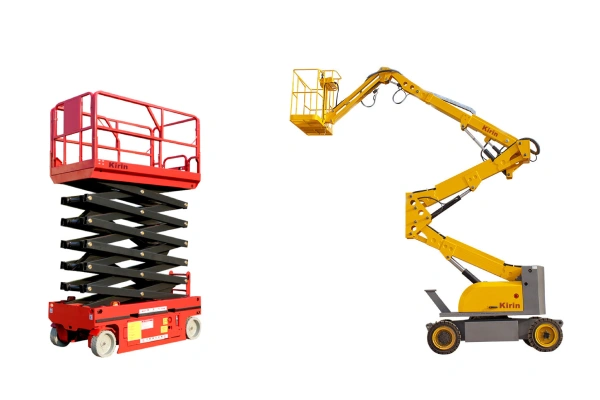
The construction, maintenance, and utility industries rely heavily on Aerial Work Platforms (AWPs), also known as Mobile Elevating Work Platforms (MEWPs), to safely lift workers and equipment to height. While these machines have largely replaced the inherent risks of ladders and traditional scaffolding, they introduce their own set of specific hazards. Falls, tip-overs, electrocutions, and crushing injuries are tragically common in AWP-related incidents.
The single most critical factor in preventing these accidents is a robust commitment to aerial work platform safety. This comprehensive guide provides an essential roadmap to understanding the equipment, preparing the site, training personnel, and following safe operating procedures to ensure every job performed at height is completed without incident. By diligently adhering to these guidelines, we can collectively drive down workplace injuries and fatalities.
Understanding the Equipment (AWP Classifications and Components)
AWPs are specialized machines with diverse capabilities. Recognizing the type of lift and its core safety features is the first step toward effective aerial work platform safety.
Types of aerial work platforms
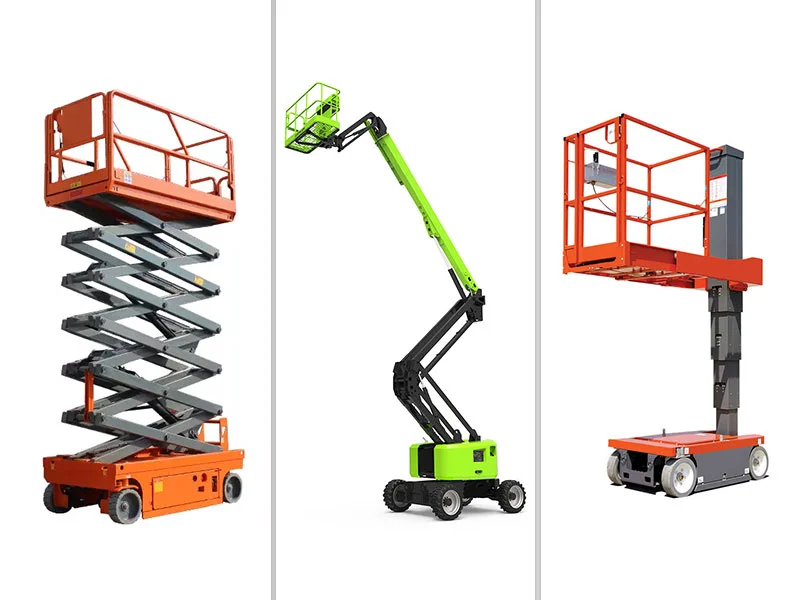
Aerial work platforms are generally categorized by their lifting mechanism and range of motion.
Scissor Lifts (Vertical Movement Only):
- Mechanism: These lifts use a crisscrossing, accordion-like support structure (the “scissor”) to raise and lower the platform strictly vertically.
- Best For: Tasks requiring a large platform area, high capacity, and use on stable, level surfaces, often indoors or on prepared outdoor slabs. Because they do not extend horizontally, their center of gravity is generally more stable.
- Classification Note: OSHA often classifies scissor lifts as mobile scaffolds rather than aerial lifts, but the same rigorous safety protocols apply.
Boom Lifts:
- Mechanism: These feature a powerful hydraulic arm, or boom, with a work platform at the end. They provide both vertical and horizontal reach.
- Best For: Reaching heights and difficult-to-access spots, especially where obstacles need to be maneuvered over or around. They often have greater mobility on rough terrain than scissor lifts.
- Telescopic Boom Lifts (Straight Booms): Have a straight arm that extends telescopically for the longest horizontal and vertical reach. Ideal for tasks requiring straight-line access at extreme heights.
- Articulating Boom Lifts (Knuckle Booms): Have multiple jointed sections or “knuckles” in the boom, allowing the platform to move up, over, and around obstacles for maximum maneuverability.
Vertical Mast Lifts/Personnel Lifts:
- Mechanism: Compact lifts that use a mast or vertical column to lift a small platform, typically for only one or two people.
- Best For: Low-level, lightweight tasks in tight or confined indoor spaces, often fitting through standard doorways.
Key Safety Components
Every aerial work platform is equipped with critical safety components that operators must be familiar with and inspect daily.
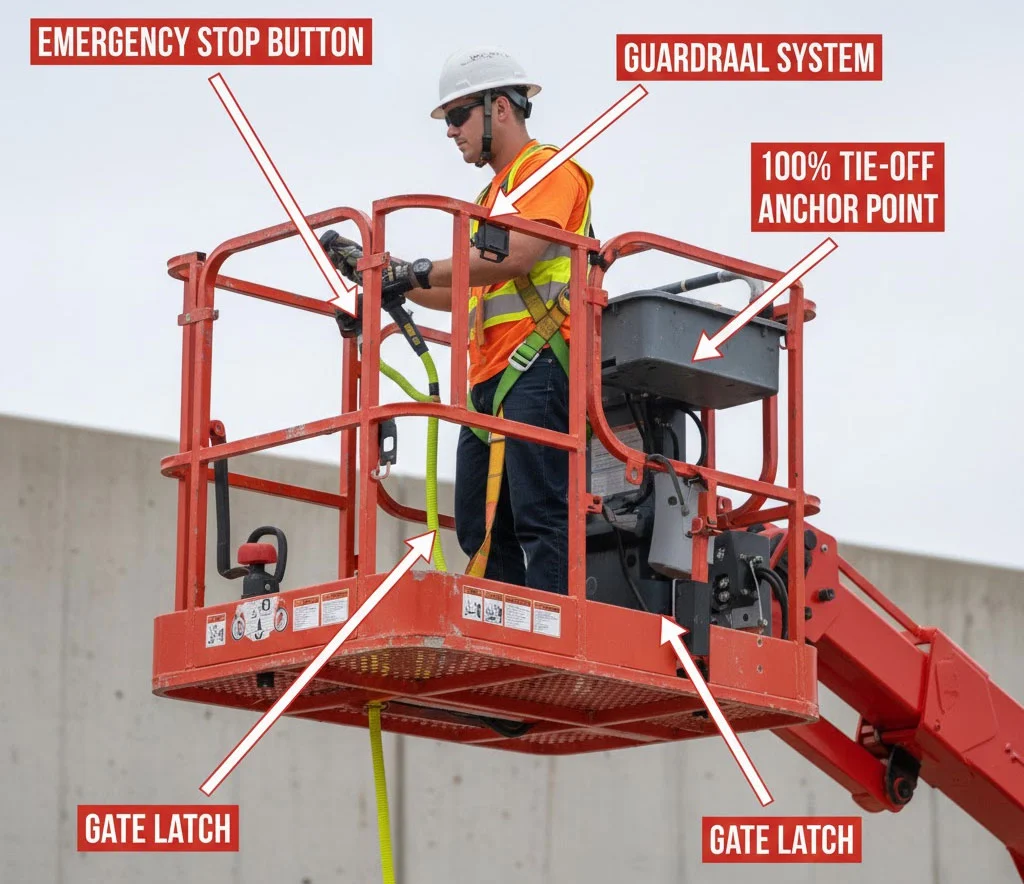
- Guardrails and Gates: The primary line of defense against falls. Guardrails must be intact, and gates (or chains) must be closed and secured at all times during elevation.
- Anchorages: Designated, manufacturer-approved points on the platform or boom for attaching a worker’s fall protection lanyard.
- Emergency Stop Buttons: Prominent, red buttons located on both the platform and the ground controls that immediately cut all power and stop all functions when depressed.
- Emergency Lowering Controls/Auxiliary Power: A secondary, ground-level system (often a hand pump or small auxiliary motor) used to safely lower the platform if the main power fails.
- Tilt Alarm/Sensor: An audible alarm that warns the operator if the machine exceeds its maximum allowable slope rating, indicating an imminent risk of tip-over.
- Pothole Protection (on some scissor lifts): Structural safety devices that deploy automatically when the lift is elevated to help prevent the machine from tipping if a wheel drops into a hole or depression.
- Outriggers/Stabilizers: Hydraulically or manually deployed supports used on some AWPs (especially boom lifts) to provide a wider, more stable base on uneven ground.
Pre-Operational Checks (The Walk-Around)
Before every shift, the operator must perform a thorough pre-start inspection—often called a walk-around—as mandated by safety standards. Do not operate a defective lift.
- Operational & Emergency Controls: Test both platform and ground controls. Verify the emergency stop buttons and emergency lowering function work.
- Visual/Structural: Check for dents, cracks, or welds in the boom, scissor arms, platform, and chassis. Inspect all warning placards and decals for legibility.
- Fluid Levels: Check hydraulic fluid, oil, fuel, and coolant levels. Look for any signs of leaks around hoses, cylinders, or pumps.
- Wheels and Tires: Inspect for damage, proper inflation (if pneumatic), or excessive wear. Check the wheel lug nuts for tightness.
- Guardrail System: Verify all guardrails, mid-rails, and gates/chains are present, properly secured, and free from damage.
- Safety Devices: Check the function of the tilt alarm, lights, horn, and any other manufacturer-installed safety devices.
Training and Certification (Personnel Safety)
The cornerstone of effective aerial work platform safety is operator competence. Only trained and authorized personnel should ever operate an AWP.
Mandated Training Requirements
Training must consist of both theoretical (classroom) instruction and practical, hands-on demonstration, following both OSHA (Occupational Safety and Health Administration) and ANSI (American National Standards Institute) standards. Training must cover:
- Specific Hazards: Detailed explanations of the electrical, fall, struck-by, and tip-over hazards inherent to AWP use.
- Correct Operation: Instruction on the correct use of all controls, recognizing load capacity limits, and safe travel procedures.
- Pre-Operation Inspections: Detailed knowledge of how and when to conduct the pre-start inspection and functional tests.
- Manufacturer Requirements: Understanding the specific warnings and limitations outlined in the manufacturer’s operational manual for the exact model being used.
- Rescue Procedures: Training for emergency lowering and rescue planning.
When Retraining is Required
Certification is typically valid for a set period (often three years), but retraining or re-evaluation is immediately required if:
- An accident or near-miss occurs involving the lift.
- Workplace hazards involving the lift are identified or change.
- The operator is assigned to a different type of aerial work platform (e.g., switching from a scissor lift to an articulating boom lift).
- The operator is observed operating the AWP improperly.
Site Assessment and Preparation (Preventing Tip-Overs and Collisions)
Most tip-over and instability incidents are caused by neglecting the conditions of the work site. A thorough site assessment is non-negotiable for aerial work platform safety.
Ground Conditions
The ground must be capable of supporting the full load of the AWP, including the machine’s weight, workers, tools, and materials.
- Stability and Levelness: The most critical check. The AWP must only be set up and operated on firm, level surfaces. Even a small slope can exceed the lift’s tilt rating, leading to catastrophic tip-over, particularly when the boom is extended.
- Holes, Drop-offs, and Debris: The operator must inspect the travel path and work area for potholes, ditches, drop-offs, floor openings, and unstable materials (like loose dirt or soft asphalt) that could cause a sudden shift or collapse.
- Outrigger Use: If the lift is equipped with outriggers or stabilizers, they must be fully deployed and placed on appropriate crane pads or cribbing to evenly distribute the weight and increase stability.
Overhead Hazards
Before raising the platform, always perform an overhead scan for potential contact hazards.
- Power Lines (The 10-Foot Rule): Electrocution is a major hazard. All personnel, tools, and the AWP itself must maintain a minimum 10-foot clearance from energized power lines, including communication cables. If work must occur closer, the power utility must de-energize and visibly ground the lines.
- Overhead Obstructions: Watch for low ceilings, beams, pipes, tree limbs, or any structure that the platform or boom could strike, causing a crushing hazard for workers or destabilizing the lift.
- Environmental Factors: Never operate an AWP in winds exceeding the manufacturer’s specified limit (usually around 28 mph), in severe weather (lightning, heavy rain, or ice), or in atmospheres with hazardous gases or vapors unless the lift is rated for it.
Traffic and Pedestrian Control
The area immediately surrounding the AWP, especially the swing radius of a boom lift or the area directly beneath a scissor lift, must be protected.
- Barricading: Use cones, safety tape, or guardrails to cordon off the area to prevent unauthorized personnel, pedestrians, or vehicles from entering the work zone.
- Ground Spotter: A qualified person on the ground should be designated to observe the operation, warn the operator of approaching hazards, and guide the AWP when traveling or maneuvering in tight spots or when the operator’s view is obstructed.
Safe Operation Procedures
Even with the correct equipment and a prepared site, accidents happen during operation. Following strict procedural steps is the final layer of aerial work platform safety.
Fall Protection (Mandatory)
Falls from AWPs are the leading cause of related fatalities. Fall protection is mandatory for all workers in a boom-style AWP.
- Full-Body Harness and Lanyard: Every person on a boom lift platform must wear a properly fitted full-body harness and an approved lanyard.
- 100% Tie-Off: The lanyard must be secured to the manufacturer-designated anchorage point on the platform or boom structure at all times—often referred to as 100% tie-off. Never attach the lanyard to an adjacent structure (like a pole or building) while in the platform.
- Scissor Lift Fall Protection: While guardrails are often considered adequate fall protection in scissor lifts, many safety protocols still require a harness and lanyard, especially for large, rough-terrain models. Always follow the specific site rules and manufacturer’s instructions.
- Keep all body parts and tools inside the guardrails: Workers must always stand firmly on the platform floor and never sit, climb, or lean over the guardrails, use ladders, or other makeshift devices to gain extra height or reach.
Load Management (Capacity Limits)
Overloading an AWP is a direct cause of instability and tip-over.
- Do Not Exceed Rated Capacity: The rated load capacity (clearly marked on the platform) is the total combined weight of all personnel, tools, and materials on the platform. This limit must never be exceeded.
- Account for All Weight: Even small items add up. Tools, cables, materials, and personal equipment must be factored into the total load calculation.
- Do Not Use as a Crane: AWPs are designed to lift personnel and their necessary tools—they must never be used as a crane to hoist or support materials outside of the platform or to lift heavy, oversized loads. This can compromise stability.
- Lateral Force: Be mindful of forces that can create instability, such as wind or manually pushing/pulling on an adjacent structure. Excessive lateral force can easily lead to a tip-over.
Prohibited Actions
To maintain the highest standards of aerial work platform safety, certain actions are strictly forbidden:
- Driving Elevated (Boom Lifts): Never drive a boom lift with the platform raised unless specifically permitted by the manufacturer’s manual and the path is clear, level, and free of hazards. In most cases, the platform must be fully stowed before travel.
- Disabling Safety Devices: Never tamper with, disconnect, or override any hydraulic, mechanical, or electrical safety device, such as limit switches or tilt sensors.
- Operating Defective Equipment: Any AWP found to be defective during the pre-operational check must be immediately removed from service, tagged (e.g., “Out of Service”), and only repaired by a qualified person before returning to use.
- Moving the Boom Too Quickly: All movements—raising, lowering, extending, retracting, and swinging—should be controlled and deliberate to avoid sudden, destabilizing shifts in the center of gravity.
Emergency Planning and Response
A well-defined emergency plan is a crucial part of aerial work platform safety to ensure a swift and safe response to any incident.
- Trained Rescue Plan: A plan must be in place to rescue workers stranded in an elevated platform due to machine failure, ground instability, or a medical emergency. This includes training all relevant personnel on the use of emergency lowering controls.
- Ground Personnel Awareness: Ground personnel must be trained to operate the ground-level controls to safely lower the platform in an emergency. They must only operate these controls with explicit permission from the platform operator, except in a life-threatening emergency.
- Contact Information: Emergency contacts (site supervisor, safety officer, fire/rescue) must be posted and accessible to all workers.
- Securing the Scene: In the event of an accident, secure the site immediately to prevent further injury, aid rescue operations, and preserve evidence for a thorough post-incident investigation.
Conclusion and Key Takeaways
Aerial work platform safety is not merely a box to check; it is a continuous, proactive process that requires vigilance and commitment from everyone on the job site. While the versatility of AWPs makes them indispensable tools, their safe operation is a team effort built on knowledge, inspection, and procedural discipline.
By committing to thorough training, conducting daily pre-operational checks, rigorously assessing the work environment, and following all load and fall protection guidelines, we can drastically reduce risk. Remember: the primary goal is to ensure that every worker who goes up comes down safely. This complete guide serves as your constant reminder that safety at height is always the highest priority.
FAQs
What is the minimum safe distance from power lines?
OSHA mandates a minimum clearance of 10 feet from all energized power lines, including communication cables. Never rely on the lift’s insulation alone; always assume power lines are live.
Are fall protection harnesses always required on a scissor lift?
While guardrails are the primary fall protection on a scissor lift, ANSI standards and many company safety protocols require a full-body harness and lanyard to be attached to the designated anchor point, especially on construction sites or rough-terrain models. Always follow the manufacturer’s instructions and the most stringent site-specific rule.
What is the first thing I should do if my AWP stops working while I am elevated?
Immediately attempt to use the platform’s emergency stop button and then reactivate the controls. If that fails, communicate the issue to ground personnel who are trained to use the emergency lowering controls located at the base of the machine to bring you down safely. Never attempt to climb out of the platform or down the boom structure.
What is the most common cause of fatal AWP accidents?
Falls from the platform and tip-overs are the leading causes of AWP-related fatalities. Tip-overs are frequently the result of uneven or unstable ground, excessive lateral force, or exceeding the lift’s load capacity. Consistent aerial work platform safety practices are the best defense against these risks.