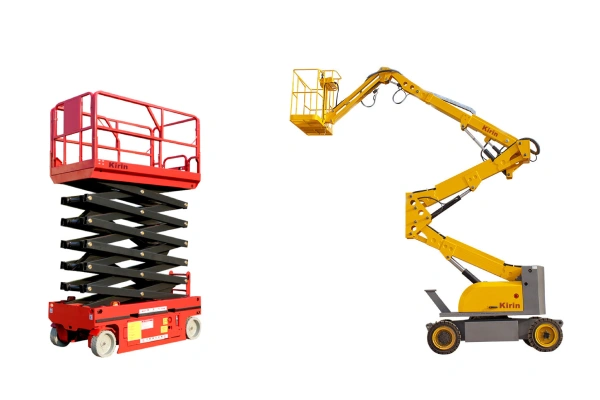
Maintaining a modern commercial or residential building is a complex puzzle. As architecture pushes higher and designs become more intricate, the methods we use to access those structures must evolve. Traditionally, facility managers relied on scaffolding or ladders, but these methods often fall short in the face of modern safety standards and tight project deadlines. This is why more professionals are turning to aerial platforms for building maintenance as their primary solution for work at height.
In this comprehensive guide, we will explore how aerial platforms for building maintenance are revolutionizing the industry, the specific types of machinery available, and why they are almost always a superior choice compared to legacy access methods.
What Are Aerial Platforms?
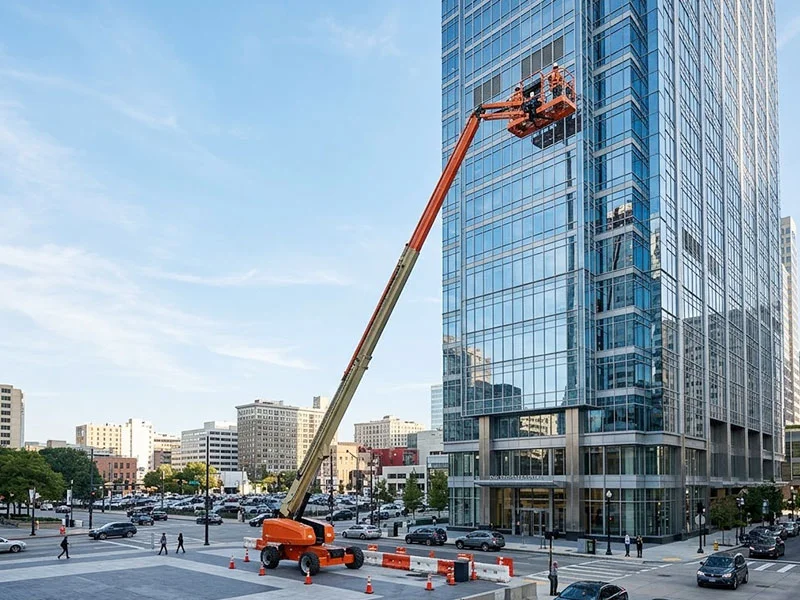
At its core, an aerial platform—also known as an Aerial Work Platform (AWP) or Mobile Elevating Work Platform (MEWP)—is a mechanical device used to provide temporary access for people or equipment to inaccessible areas, usually at height.
Unlike a permanent elevator or a static ladder, aerial platforms for building maintenance are mobile, adjustable, and designed specifically for the rigors of construction and facility management. They consist of a work platform (the “bucket” or “basket”), an extending mechanism (the “boom” or “mast”), and a powered base. Whether you are dealing with aerial platforms for maintenance on a single-story warehouse or aerial platforms for renovations on a skyscraper, these machines provide the stability required to perform precision tasks safely.
Key Benefits of Aerial Platforms for Building Maintenance
The transition from manual climbing to mechanized lifting isn’t just about convenience; it’s about optimizing every facet of the job. Here is why aerial platforms for building maintenance have become the industry standard.
Enhanced Safety
Safety is the paramount concern in any maintenance project. Falls from height remain one of the leading causes of workplace injuries globally. Aerial platforms for building maintenance mitigate this risk by providing a secure, enclosed workspace.
- Guardrails: Unlike ladders, platforms feature waist-high guardrails that prevent accidental slips.
- Emergency Controls: Modern lifts are equipped with emergency descent systems and tilt sensors that alert operators if the ground is uneven.
- Reduced Fatigue: Climbing a 30-foot ladder with tools is exhausting; fatigue leads to mistakes. A lift does the heavy lifting for you, keeping the technician fresh and focused.
Improved Efficiency and Productivity
Time is money in facility management. Setting up scaffolding can take days, whereas aerial platforms for building maintenance can be driven into position and raised in minutes.
- Mobile Positioning: Most lifts can be driven while extended (depending on the model), allowing workers to move along a facade without descending.
- Tool Storage: Platforms are large enough to hold heavy tools, replacement parts, and materials, reducing the number of trips up and down.
Cost-effectiveness
While the daily rental or purchase price of a lift might seem higher than a ladder, the total project cost is usually lower. When using aerial platforms for building maintenance, you significantly reduce labor hours. A job that takes four men three days to complete with scaffolding might take two men one day with a boom lift. Over time, the savings on man-hours and insurance premiums make aerial platforms for maintenance the most economical choice.
Versatility and Flexibility
Buildings aren’t always simple boxes. They have overhangs, landscaping, and tight alleyways. Aerial platforms for building maintenance come in various configurations—articulating, telescopic, and compact—to navigate these obstacles. Whether you are performing aerial platforms for glass positioning on a curved atrium or reaching over a fountain to fix a light, there is a machine designed for that specific geometry.
Common Applications in Building Maintenance
The utility of aerial platforms for building maintenance spans across almost every trade involved in property upkeep.
- Exterior Cleaning (Windows, Facades): High-pressure washing and window cleaning are much safer when the operator has a stable floor under their feet. Aerial platforms for maintenance allow for a more thorough clean than the “bosun’s chair” method.
- Painting and Coating: Achieving a uniform finish on a large building requires steady movement. Lifts provide the necessary reach for large-scale aerial platforms for renovations where painting or waterproofing is required.
- Electrical Repairs and Lighting Installation: Replacing parking lot LEDs or repairing high-ceiling warehouse lights is the bread and butter of scissor lifts.
- HVAC System Maintenance: Many commercial HVAC units or ductwork runs are located near the ceiling or on external ledges. Aerial platforms for building maintenance provide the lifting capacity needed to handle heavy compressors or motors.
- Inspection and Repair Work: Architects and engineers use lifts to perform close-up structural inspections, looking for cracks, water damage, or pest infestations that wouldn’t be visible from the ground.
Types of Aerial Platforms for Different Maintenance Needs
Selecting the right tool for the job is essential for safety and performance. Here are the primary categories of aerial platforms for building maintenance.
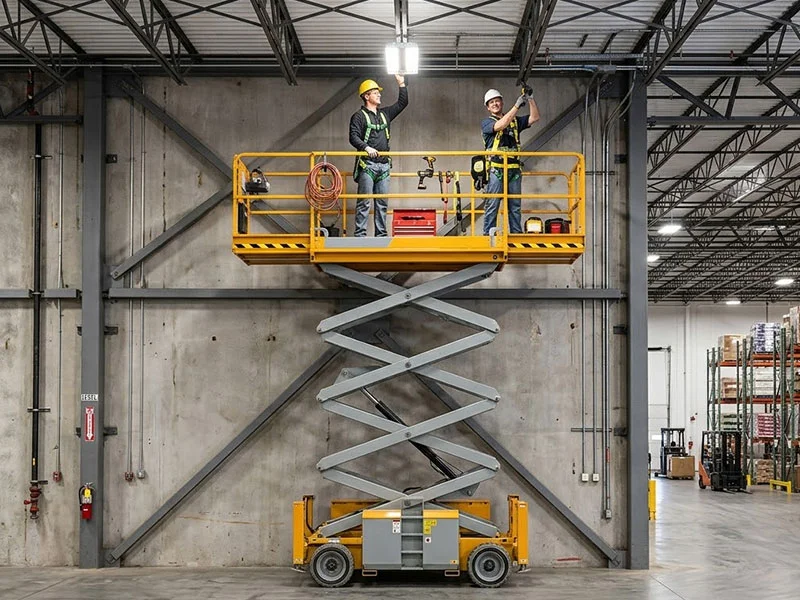
Scissor Lifts
Scissor lifts move exclusively in a vertical direction. They feature a large platform area, often with an extension deck, allowing multiple workers and heavy equipment to rise together.
- Best For: Tasks where you can get directly underneath the work area, such as ceiling repairs or indoor window cleaning. They offer the most stable work surface of all aerial platforms for maintenance.
Boom Lifts
Boom lifts (or cherry pickers) are the “all-access” pass of the maintenance world. They consist of a bucket at the end of a hydraulic arm.
- Telescopic Booms: Extend straight out—best for extreme height.
- Articulating Booms: Have “knuckles” that allow the arm to bend. These are ideal for reaching over obstacles and accessing tight spaces like rooflines or recessed windows.
Vertical Mast Lifts
These are the “compact cousins” of the scissor lift. They have a very small footprint and are designed to fit through standard doorways and into passenger elevators.
- Best For: Schools, hospitals, and offices where you need to perform aerial platforms for building maintenance in narrow hallways or between cubicles without disrupting the environment.
Aerial Platforms vs. Traditional Access Methods
For decades, scaffolding and ladders were the only options. However, when we compare them to aerial platforms for building maintenance, the “traditional” methods often appear outdated and risky.
| Feature | Scaffolding | Ladders | Aerial Platforms |
| Setup Time | High (Hours/Days) | Low (Minutes) | Medium (Minutes) |
| Mobility | Stationary | Manual Move | Self-Propelled |
| Safety Level | Moderate | Low | High |
| Reach | Fixed | Vertical Only | Multi-directional |
| Labor Needs | High (Team required) | Low (1-2 people) | Low (1 operator) |
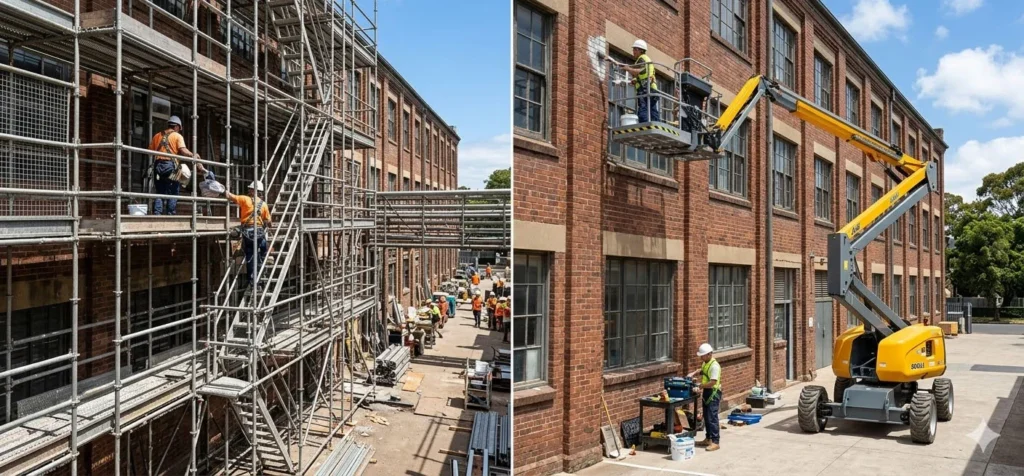
Aerial platforms for building maintenance are becoming the preferred choice because they eliminate the “dead time” of assembly. Furthermore, in specialized tasks like aerial platforms for glass positioning, a lift provides a level of precision and weight-bearing capacity that a person on a ladder simply cannot match.
Safety Considerations When Using Aerial Platforms
Even though aerial platforms for building maintenance are designed for safety, they must be operated with respect.
- Training and Certification: Operators must be trained on the specific make and model of the lift.
- Pre-Start Inspection: Check hydraulics, tires, and battery levels before every shift.
- Fall Protection: Even though the basket has rails, operators should wear a full-body harness and lanyard attached to a designated anchor point.
- Wind Speed: Aerial platforms for maintenance have specific wind-speed ratings. Never operate a lift in high winds, as the “sail effect” can tip the machine.
- Ground Conditions: Ensure the ground is firm and level. Use outriggers or spreader plates if the soil is soft.
Factors to Consider When Choosing an Aerial Platform
Not all aerial platforms for building maintenance are created equal. Before renting or buying, evaluate these five factors:
- Height and Reach Requirements: Determine your maximum working height (platform height + 6 feet) and your “outreach” (how far you need to reach horizontally).
- Weight Capacity: Consider the combined weight of the operator, their tools, and materials. Overloading a platform can trigger automatic shut-offs or cause instability.
- Indoor vs. Outdoor Use: Indoor jobs require non-marking tires and zero-emission power (electric). Outdoor jobs may require 4WD and rugged tires.
- Terrain Conditions: Is the surface paved, gravel, or mud? Rough-terrain aerial platforms for building maintenance are necessary for unfinished construction sites.
- Power Source:
- Electric: Silent and fume-free for interiors.
- Diesel/Gas: High torque and long run-times for exterior aerial platforms for renovations.
- Hybrid: The best of both worlds for transitioning between indoor and outdoor tasks.
Conclusion
As building designs grow more ambitious, the necessity for sophisticated access solutions grows with them. Aerial platforms for building maintenance offer an unparalleled blend of safety, speed, and versatility. By choosing aerial platforms for maintenance over traditional scaffolding, property managers can ensure that their structures remain in peak condition while protecting their most valuable asset: their workers.
Whether you are performing routine inspections or complex aerial platforms for glass positioning, investing in the right aerial equipment is an investment in the longevity and safety of your facility. From the compact vertical mast lift to the towering telescopic boom, aerial platforms for building maintenance are the engines that keep our modern skyline shining.
FAQs
What are aerial platforms used for in building maintenance?
They are used for any task requiring work at height, including window cleaning, HVAC repair, electrical work, facade painting, and structural inspections. Aerial platforms for building maintenance provide a stable workspace where ladders or scaffolding would be impractical.
Are aerial platforms safer than scaffolding?
Generally, yes. While scaffolding is safe when built correctly, it is prone to human error during assembly. Aerial platforms for maintenance feature built-in safety sensors, guardrails, and emergency descent systems that significantly reduce the risk of falls and structural collapse.
How much does it cost to use aerial platforms?
The cost varies based on the type of machine and the duration of use. Daily rentals can range from $150 for a small scissor lift to over $1,000 for a massive boom lift. However, when you factor in the reduced labor costs and faster completion times, aerial platforms for renovations are often more cost-effective than traditional methods.
What type of aerial platform is best for high-rise buildings?
For extreme heights, telescopic boom lifts are the preferred choice. However, if the building has complex architecture or requires reaching over obstacles, an articulating boom lift is better. For interior high-rise maintenance (like lobby atriums), specialized “spider lifts” or large scissor lifts are frequently used.