When working at height, choosing the right piece of equipment is crucial for safety, efficiency, and productivity. Two of the most common pieces of equipment used for elevated work are the aerial lift and the scissor lift. While they both serve the primary function of lifting personnel and materials, there are fundamental differences between them that dictate when and where each should be used. Understanding the key distinctions is essential for making an informed decision for your next project.

The modern worksite—whether in construction, maintenance, or warehousing—frequently requires personnel to work at significant heights. Ladders and scaffolding have largely been replaced by powered mobile equipment, which offers greater stability, mobility, and capacity. The choice between an aerial lift vs scissor lift is a decision based on the required height, reach, platform size, and terrain. Though often grouped under the general term “aerial work platform” (AWP) or “mobile elevating work platform” (MEWP), OSHA and industry standards define them differently, primarily regarding movement capabilities and safety requirements. This comprehensive guide will break down the differences and help you determine which lift is best suited for your specific needs.
Defining the Aerial Lift (Boom Lift)
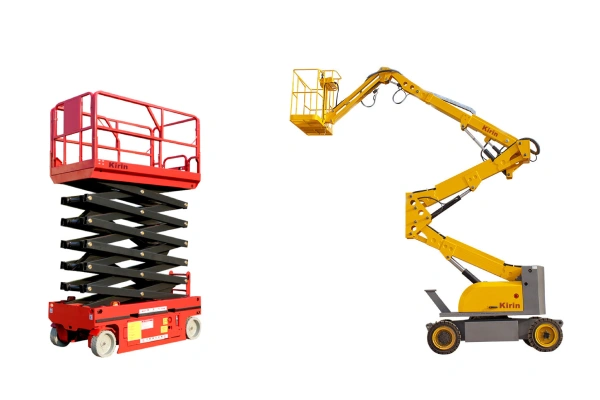
An aerial lift, often referred to as a boom lift or “cherry picker,” is a vehicle-mounted device used to elevate personnel. The defining characteristic of an aerial lift is its versatile, hinged, or telescopic hydraulic arm (or boom) that supports a work platform or bucket.
The ability of an aerial lift to extend both vertically and horizontally—and often to articulate or rotate—is its primary advantage. This multi-axis movement allows operators to maneuver the platform up and over obstacles, around corners, and into hard-to-reach areas without having to constantly reposition the base of the machine.
There are two main types of boom lifts:
- Articulating Boom Lifts: These feature multiple joints, or “knuckles,” in the boom arm, allowing them to bend and maneuver in tight, congested work areas and reach around fixed obstacles.
- Telescopic Boom Lifts: These have a straight, extendable arm, much like a telescope. They offer greater horizontal reach and the highest vertical reach compared to articulating lifts, making them ideal for high, open-area access.
Key Features:
- Movement: Vertical, horizontal, and often rotational.
- Reach: Can achieve much greater heights (often over 100 feet) and substantial horizontal outreach.
- Platform: Typically smaller, designed for one or two workers and minimal tools.
- Terrain: Models come in electric (for indoor/slab use) and rugged diesel (for rough, outdoor terrain).

Defining the Scissor Lift
A scissor lift is a type of aerial platform lift that is classified by OSHA as a form of mobile supported scaffold. The name comes from its distinct lifting mechanism: a series of crisscrossing, linked supports that extend in a scissor-like fashion to raise and lower the platform.
The movement of a scissor lift is strictly vertical—directly up and down from its base. Unlike the boom lift, the platform does not have lateral or horizontal outreach capabilities beyond a small, optional deck extension. This limitation means the entire machine must be positioned directly beneath the work area.
Scissor lifts are renowned for their stability and spacious work platforms. The substantial platform size and high load capacity allow them to hold multiple workers, tools, and heavy materials, making them a common sight in warehouses, retail environments, and slab construction.
Types of scissor lifts include:
- Electric/Slab Scissor Lifts: Designed for indoor use on smooth, level surfaces. They have non-marking tires and are battery-powered, producing zero emissions.
- Rough Terrain Scissor Lifts: Equipped with larger, rugged tires and powerful diesel or dual-fuel engines for safe operation on uneven, outdoor ground.
Key Features:
- Movement: Strictly vertical (straight up and down).
- Reach: Lower maximum height (typically up to 50–60 feet).
- Platform: Large, spacious platform with a high load capacity, suitable for multiple workers and heavy loads.
- Stability: Excellent stability, especially on level ground, due to the vertical-only movement and large base.

Core Comparison: Aerial Lift vs. Scissor Lift
The core differences between the two types of equipment boil down to four main categories: movement capability, reach and height, platform size and capacity, and fall protection requirements. This distinction is the heart of the aerial lift vs scissor lift debate for any project manager.
| Feature | Aerial Lift (Boom Lift) | Scissor Lift |
| Movement | Vertical, Horizontal, and often Rotational | Strictly Vertical (Straight Up and Down) |
| Reach & Height | High vertical reach (100+ ft) and excellent horizontal outreach. | Lower vertical reach (typically max 50–60 ft) with no significant horizontal outreach. |
| Platform Size | Small, typically accommodating 1–2 workers and light tools. | Large, spacious platform, accommodating multiple workers and heavy materials. |
| Load Capacity | Lower (typically around 500 lbs) | Higher (can exceed 1,000 lbs on many models) |
| OSHA Classification | Aerial Lift (§1926.453) | Mobile Supported Scaffold (§1926.451) |
| Fall Protection | Full-body harness and lanyard required at all times. | Guardrails are the primary form of fall protection; harness/lanyard typically not mandated if guardrails are compliant. |
Maneuverability vs. Capacity: The most significant difference is maneuverability. The boom on an aerial lift offers unparalleled flexibility, allowing it to navigate over and around obstacles. Conversely, the scissor lift platform provides a massive, stable workspace and superior weight capacity, but its vertical-only movement demands a clear path directly below the work area.
When to Choose Which Lift
Selecting the right equipment involves a careful assessment of the job site, the task at hand, and the resources you need to get to height. The fundamental question is: Do you need to get over an object or do you just need a stable workspace straight up?
A. Choose the Aerial Lift (Boom Lift) When:
- You need exceptional height: For tasks requiring work above 60 feet, such as high-rise maintenance, cell tower work, or exterior building construction.
- You need horizontal or angled reach: When you must access a work area that is not directly overhead, such as working on a bridge, trimming high trees, or reaching over rooftop equipment or excavations. The ability of the boom lift to move in multiple directions makes it ideal for these challenging positions.
- You are working in a tight or congested area: Articulating boom lifts can maneuver the basket around various obstacles that would block a larger scissor platform lift.
- You need maximum versatility: The multi-directional movement provides the most flexibility for jobs with varying access points.
B. Choose the Scissor Lift When:
- The job requires only vertical access: For tasks like installing ceiling panels, painting walls, hanging signage, or working on warehouse shelving that are directly overhead and at a lower height.
- You need a large workspace or high load capacity: If your job requires multiple people, heavy tools, or large quantities of materials on the aerial platform lift simultaneously, the larger scissor platform lift is the clear winner.
- You’re working indoors on a slab or flat surface: Electric scissor lifts are compact and designed for smooth-floor applications, making them a common choice for finished interior spaces where non-marking tires and zero emissions are required.
- Budget is a major factor: Scissor lifts are typically less expensive to rent or purchase than the more complex, higher-reaching aerial lifts.
Safety and Training
Regardless of whether you use an aerial and scissor lift, safety and proper training are paramount. While both lift types present fall hazards, the nature of the hazard, and thus the required safety protocols, differs based on their classification.
- Aerial Lift Safety: Because of the greater height and the extended horizontal reach (which increases the risk of tipping), OSHA requires a higher level of fall protection. Operators of aerial lifts (boom lifts) must wear a full-body harness and a lanyard attached to the boom or basket anchor point at all times. Training must cover the specific hazards of working at extreme heights and with multi-directional movement.
- Scissor Lift Safety: Scissor lifts, classified as scaffolds, have different requirements. The fully enclosed guardrails on a properly maintained scissor lift are considered adequate fall protection. Therefore, OSHA does not typically require a harness and lanyard for a scissor lift operator, provided the guardrail system meets all requirements. Training for scissor lifts focuses heavily on recognizing and avoiding hazards like tip-overs, which can occur if the lift is moved on uneven ground or if the maximum load is exceeded.
Training Requirements: OSHA mandates that only trained and authorized personnel be permitted to operate any type of elevating work platform, including both the aerial lift vs scissor lift. Training must cover:
- Proper operating procedures and controls for the specific machine.
- Pre-use inspection procedures.
- The nature of any electrical, fall, and falling object hazards.
- Safe movement and positioning around the worksite.
Conclusion
Choosing between an aerial lift vs scissor lift comes down to matching the machine’s capabilities to the job’s demands. The aerial lift offers unmatched flexibility and height, allowing access over and around obstacles. The scissor lift provides a stable, high-capacity, and spacious scissor lift platform for straight vertical work. By clearly defining the reach, capacity, and work environment of your project, you can confidently select the right tool to ensure a safe and efficient elevated work experience. Whether you need the precision of a boom or the power of a platform, understanding the aerial lift vs scissor lift distinctions is the first step to a successful job.
FAQs
Are scissor lifts considered aerial lifts?
Functionally, a scissor lift is a type of elevated work platform, but legally, OSHA classifies the scissor lift as a mobile supported scaffold rather than an “aerial lift” (which refers specifically to vehicle-mounted devices like boom lifts). This difference affects the applicable safety and training standards.
Which lift is safer, the aerial lift or the scissor lift?
When operated by a trained professional according to all safety protocols, both are safe. However, the aerial lift (boom lift) is used at greater heights and has more complex movement, necessitating the use of a full-body harness and lanyard at all times. Scissor lifts are generally more stable but have a risk of tip-over if driven on uneven terrain or overloaded.
Can you drive a lift while the platform is raised?
This depends on the specific manufacturer’s design and instructions. Some modern self-propelled models of both aerial and scissor lift equipment allow for slow movement in the elevated position, but only under very specific conditions (e.g., on a firm, level surface, and not exceeding a certain wind speed). Always consult the operator’s manual and job site rules.