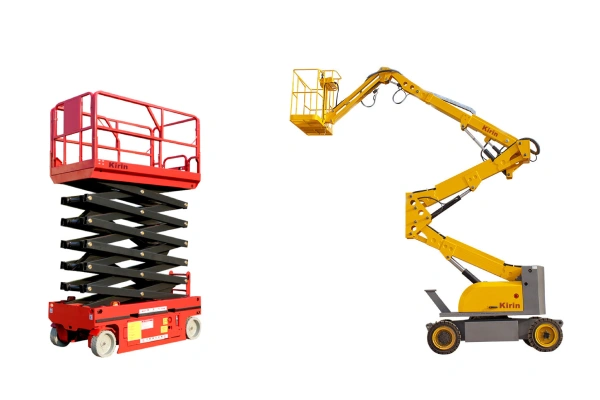
When managing a complex construction site, organizing a high-density warehouse, or overseeing a major industrial installation, selecting the correct material and personnel handling equipment directly impacts your bottom line. Two of the most common workhorses found on modern jobsites are the boom lift and the forklift.
While both are essential mechanical assets designed to improve operational efficiency, they serve fundamentally different purposes. Choosing the wrong machine not only delays your project timeline but also introduces severe workplace safety hazards.
This comprehensive guide breaks down the technical capabilities, operational limits, and cost differences of a boom lift vs forklift to help you make an informed decision for your next project.
Boom Lift Vs Forklift: What’s the Main Difference?
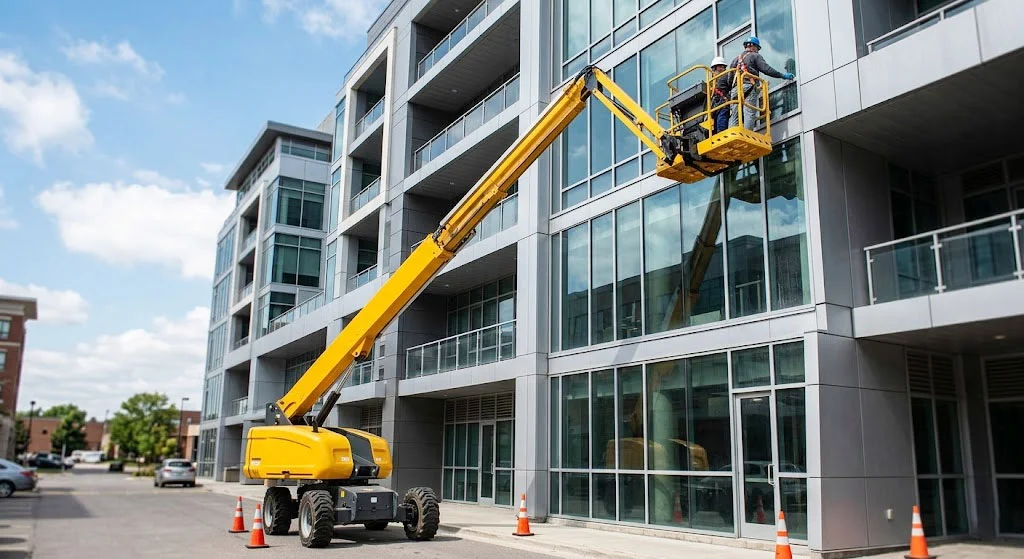
The fundamental distinction between a boom lift vs forklift lies in their primary engineering intent: boom lifts are engineered to lift personnel and their essential tools to extreme vertical and horizontal positions, whereas forklifts are built strictly to transport, stack, and handle heavy palletized materials along a vertical axis.
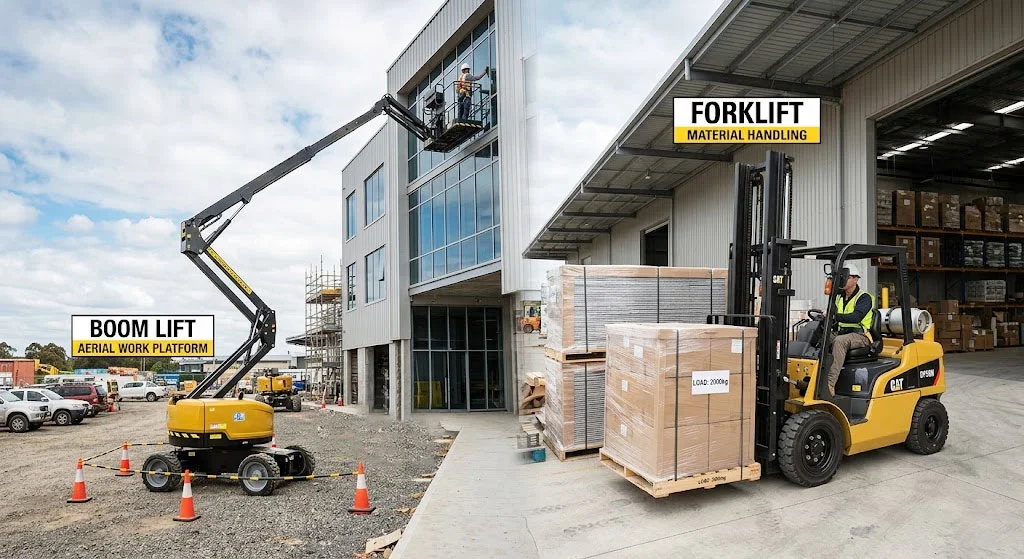
A boom lift relies on a hydraulic arm (boom) connected to a work platform, allowing workers to access hard-to-reach, elevated areas. Conversely, a forklift utilizes a vertical mast and a pair of steel forks to slide under heavy loads, lifting them straight up and down. Understanding this core difference in utility is the first step toward optimizing your fleet configuration.
Boom Lift Vs Forklift: Key Functional Differences
To understand how these machines perform under field conditions, we must analyze their core mechanical attributes across four primary functional areas.
Personnel Lifting Vs Material Handling
The structural architecture of each machine dictates its payload type. Boom lifts feature a secure aerial work platform or basket enclosed by guardrails, fully compliant with global fall protection standards. These platforms are equipped with integrated harness anchor points, allowing operators to work safely at extreme elevations.
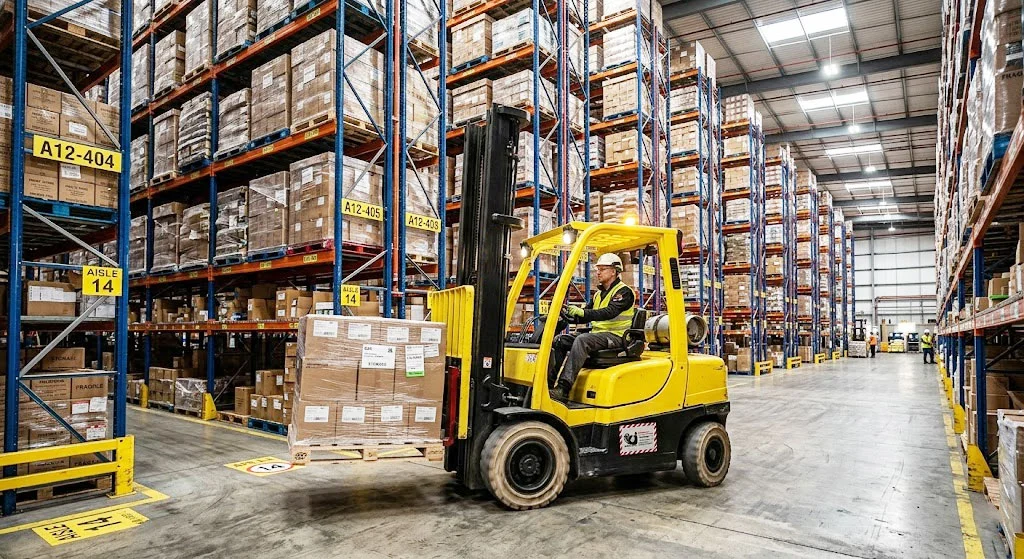
Forklifts, on the other hand, are heavy material handling powerhouses. They are designed with high-tensile steel forks and hydraulic masts optimized to lift heavy pallets, crates, and structural components.
Reach and Height Capabilities
When comparing vertical and horizontal reach, the two machines diverge significantly:
- Boom Lifts: Offer unmatched vertical elevations—often ranging from 30 feet to well over 180 feet. More importantly, articulating boom lifts provide horizontal “up-and-over” reach, allowing the platform to navigate over structural obstacles, piping, or machinery.
- Forklifts: Typically operate within a vertical range of 10 to 20 feet, though specialized high-reach telehandlers can extend up to 55 feet. Standard industrial forklifts offer zero horizontal outreach; they must be driven directly up to the face of the stack or rack to deposit a load.
Maneuverability and Workspace Access
Industrial indoor forklifts feature tight rear-wheel steering geometries, allowing them to turn tightly within narrow warehouse aisles. However, they require a clear, unobstructed path directly to the target storage rack.
Boom lifts require a larger footprint for their chassis, but their hydraulic arm minimizes the need for ground-level access. An operator can position the base of a boom lift several yards away from a building facade and extend the arm over fences, trenches, or inventory lines to reach the exact work area.
Stability and Load Distribution
Because a forklift carries immense material weight at the front of the machine, it relies on a heavy rear counterweight to maintain balance. The stability of a forklift follows a strict “stability triangle” principle between the front wheels and the center of the rear axle. If the load center shifts too far forward or the mast tilts excessively, the machine is prone to tipping.
Boom lifts rely on an expansive, heavy chassis footprint, outriggers (on larger models), and intelligent electronic tilt sensors to balance the dynamic center of gravity as the boom extends across various angles and distances.
Best Applications for a Boom Lift
Boom lifts excel in scenarios where technicians require stable, prolonged access to elevated, complex structural zones.
- High-Rise Facility Maintenance: Changing industrial LED lighting, repairing overhead HVAC ductwork, and servicing structural steel framing.
- Exterior Construction and Glazing: Installing curtain walls, window panes, insulation, and architectural facades on multi-story commercial buildings.
- Infrastructure Utilities: Servicing overhead electrical lines, telecommunication towers, and municipal bridge inspections.
- Industrial Painting and Sandblasting: Providing a steady aerial platform for shipyard workers, refinery maintenance crews, and storage tank coating applications.
Best Applications for a Forklift
Forklifts are the undisputed kings of high-volume logistics and bulk material transport where heavy payloads must be moved rapidly across ground surfaces.
- Warehouse Logistics and Fulfillment: Stacking palletized consumer goods, raw materials, and finished inventory into high-bay racking systems.
- Manufacturing Plants: Feeding heavy raw material components into assembly lines and transporting completed heavy machinery parts to shipping bays.
- Shipping Docks and Freight Terminals: Loading and unloading intermodal shipping containers, commercial flatbed trucks, and air freight pallets.
- Lumber Yards and Heavy Supply Depots: Moving bulk construction materials, bricks, concrete blocks, and structural timber packages across flat surfaces.
Boom Lift Vs Forklift Safety Considerations
Operating heavy machinery at any jobsite requires strict compliance with global safety regulations, such as OSHA (Occupational Safety and Health Administration) in the United States or CE and ISO standards in international markets.
When comparing a boom lift vs forklift, the primary safety risks differ based on their mechanics:
| Equipment Type | Primary Safety Risks | Key Required Mitigations |
| Boom Lift | Catapult effect, structural tip-overs, high-voltage electrocution, falls from height. | Mandatory full-body harnesses, lanyard attachment to approved anchor points, wind speed monitoring. |
| Forklift | Tip-overs due to offset load centers, pedestrian strikes, falling material hazards. | Overhead guard inspection, strict adherence to load capacity charts, pedestrian exclusion zones. |
Both machine types require operators to pass rigorous, formal training programs. Employers must verify that operators hold valid certifications tailored to the specific class of machine they intend to run.
Cost Comparison: Boom Lift Vs Forklift
From a capital expenditure (CapEx) and operational expenditure (OpEx) perspective, a boom lift is generally a more complex, precision-engineered machine than a standard forklift, which is reflected in its pricing.
- Acquisition Cost: A standard 5,000-lb capacity internal combustion forklift represents a significantly lower upfront investment compared to a 40-foot telescopic boom lift. The intricate hydraulic valving, multi-stage boom extensions, and advanced electronic stability systems drive up the manufacturing cost of boom lifts.
- Maintenance Expenses: Forklifts incur predictable maintenance cycles centered on tires, brake systems, and mast chains. Boom lifts demand specialized annual structural inspections, non-destructive testing (NDT) of critical welds, and calibration of platform capacity sensors to maintain regulatory compliance.
How to Choose Between a Boom Lift and Forklift
To determine the ideal equipment configuration for your fleet, work through the following four tactical criteria.
Consider Your Jobsite Requirements
Analyze the spatial limitations of your project. If you are operating within tight, finished indoor corridors with narrow clearances, an electric scissor lift or compact forklift is ideal. If you must work on an exterior building perimeter where ground obstacles prevent you from parking directly under the work zone, a boom lift is required.
Evaluate Load and Personnel Needs
Identify exactly what needs to be elevated:
- If you need to send two technicians, their toolboxes, and a replacement valve up to a pipe rack, you need a boom lift.
- If you need to move a 4,400-pound pallet of ceramic tiles from a delivery truck to a ground-level staging bay, you need a forklift.
Assess Terrain Conditions
Standard warehouse forklifts feature solid, non-marking cushion tires designed exclusively for smooth, poured concrete floors. Operating them on mud or loose gravel will result in the machine getting stuck or tipping over. If your jobsite consists of unpaved, uneven earth, you must opt for a rough-terrain boom lift or a rough-terrain telehandler equipped with deep-tread pneumatic tires and four-wheel drive.
Compare Productivity Goals
Evaluate the cycle times of your operations. Forklifts are built for rapid, repetitive horizontal cycles—picking, moving, and dropping loads every few minutes. Boom lifts are built for stability over time; the machine is driven into place, stabilized, and raised to a position where workers may remain for hours performing detailed technical installations.
Can a Boom Lift Replace a Forklift?
A common question among fleet managers is whether a boom lift can pull double duty as a forklift. The short answer is: No, a standard boom lift cannot replace a forklift.
Boom lift work platforms are strictly engineered for personnel lifting and light tool loads. They lack the structural fork attachments and carriage mechanisms required to lift heavy pallets. Attempting to hang heavy loads from the basket of a boom lift using chains or straps introduces severe structural stress, alters the machine’s designed center of gravity, and can trigger a catastrophic structural failure or tip-over.
Note: The only partial exception is a telescopic handler (telehandler), which is a hybrid machine capable of fitted attachments, but standard aerial boom platforms must never be used for heavy material transport.
Common Mistakes When Choosing Equipment
Avoid these three dangerous and costly operational mistakes on your jobsite.
Using a Forklift for Personnel Lifting
One of the most frequent safety violations is placing a worker directly on the forks of a forklift, or using an unapproved, homemade wooden crate as a work platform. Forklift hydraulic systems can drop rapidly if a line pressure failure occurs, and without engineered guardrails and harness anchors, falls are highly likely.
Choosing a Boom Lift for Heavy Material Transport
Overloading a boom lift basket with heavy construction materials (such as stacks of drywall, cement bags, or heavy steel beams) overrides the machine’s safety margin. Most boom lifts have a strict platform capacity limit between 500 lbs and 1,000 lbs. Exceeding this limit will cause the onboard safety systems to lock down the machine, or worse, cause the boom to buckle.
Ignoring Terrain Requirements
Deploying a two-wheel-drive industrial machine onto a muddy, sloped construction site is a recipe for operational failure. Always audit the path of travel. Ensure that ground-bearing pressure capacities match the machine’s total weight, particularly when operating heavy boom lifts over underground parking structures or soft soils.
Frequently Asked Questions About Boom Lift Vs Forklift
Is a boom lift safer than a forklift?
Both machines are highly safe when operated within their engineered limits by trained professionals. Statistically, forklifts are involved in more workplace incidents annually, but this is primarily due to their high frequency of use in high-traffic warehouse environments alongside pedestrians. Boom lift incidents, while less frequent, often carry higher severity due to the extreme heights involved.
Can a forklift lift workers legally?
Yes, but only if the forklift is fitted with an OSHA-compliant, commercially manufactured personnel platform (often called a man basket) that is securely locked to the fork carriage, features proper guardrails, and incorporates an integrated fallback protection tie-off point. The forklift must also remain stationary while the platform is elevated.
Which equipment is better for outdoor construction?
For structural framing, exterior cladding, roofing, and utility installations, a rough-terrain boom lift is superior due to its high reach and ability to clear ground obstacles. For moving heavy bundles of lumber, rebar, or brick pallets across an outdoor site, a rough-terrain forklift or telehandler is the appropriate choice.
What is the average height of a boom lift?
The most widely used commercial boom lifts feature vertical reach heights between 40 feet and 60 feet. However, compact towable models can start as low as 30 feet, while heavy-duty industrial telescopic boom lifts can extend up to 180 to 185 feet.
Which is more expensive: a boom lift or a forklift?
A boom lift is significantly more expensive to purchase, rent, and maintain than a standard material handling forklift of comparable age. The advanced structural steel engineering, multi-axis hydraulic controls, and extensive electronic safety sensor arrays account for this price premium.
Do boom lifts and forklifts require OSHA certification?
Yes. Under OSHA regulations (29 CFR 1910.178 for forklifts and 29 CFR 1910.67 / 1926.453 for aerial lifts), operators must complete a comprehensive training program that includes both formal classroom instruction and a hands-on practical evaluation. Proper forklift and boom lift certification records must be maintained by the employer to avoid stiff regulatory penalties.
Conclusion
Choosing between a boom lift vs forklift ultimately depends on your primary payload: if your priority is lifting technicians to complex, elevated work surfaces safely, prioritize a boom lift. If your daily operations revolve around moving heavy, palletized materials rapidly across a facility floor, a forklift is the correct tool for the job. Securing the right equipment not only protects your workforce but ensures your project runs at peak operational efficiency.
As a dedicated source manufacturer of high-performance hydraulic elevators and heavy lifting equipment, we design custom material and personnel handling solutions engineered to meet strict international safety standards. Whether you are finalizing a project layout or expanding your fleet, our professional technical team is ready to assist you with free technical support and tailor-made equipment specs.
Contact us today to discuss your jobsite requirements:
- Email: info@klingtec.com
- WhatsApp: +86 188 6686 3188