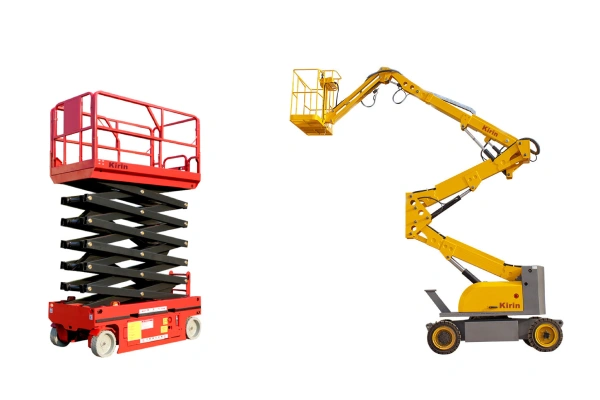
Aerial work platforms have revolutionized how we approach high-altitude tasks in construction, maintenance, and industrial facilities. At the heart of these massive machines lies a sophisticated network of systems known collectively as boom lift controls. Whether you are operating an articulating knuckle boom or a straight telescopic model, mastering boom lift controls is the single most critical factor in ensuring both project efficiency and job site safety.
Operating an aerial lift requires a granular understanding of how these machines interpret user inputs. Boom lift controls are not merely a set of buttons and joysticks; they are the interface between the operator and an intricate system of hydraulic valves, electrical actuators, and safety limit switches. For anyone tasked with managing or operating these machines, a deep dive into the dual-control architecture—consisting of the ground station and the basket console—is essential to accident prevention.
What Are Boom Lift Controls?
To appreciate how an aerial platform functions, one must first ask: what exactly are boom lift controls used for? In simple terms, boom lift controls are the specialized electronic and hydraulic interfaces that allow operators to govern the movement, orientation, extension, and driving capabilities of an aerial work platform. These systems translate human intent into mechanical action, guiding the boom arm through three-dimensional space and enabling precise positioning near structures.
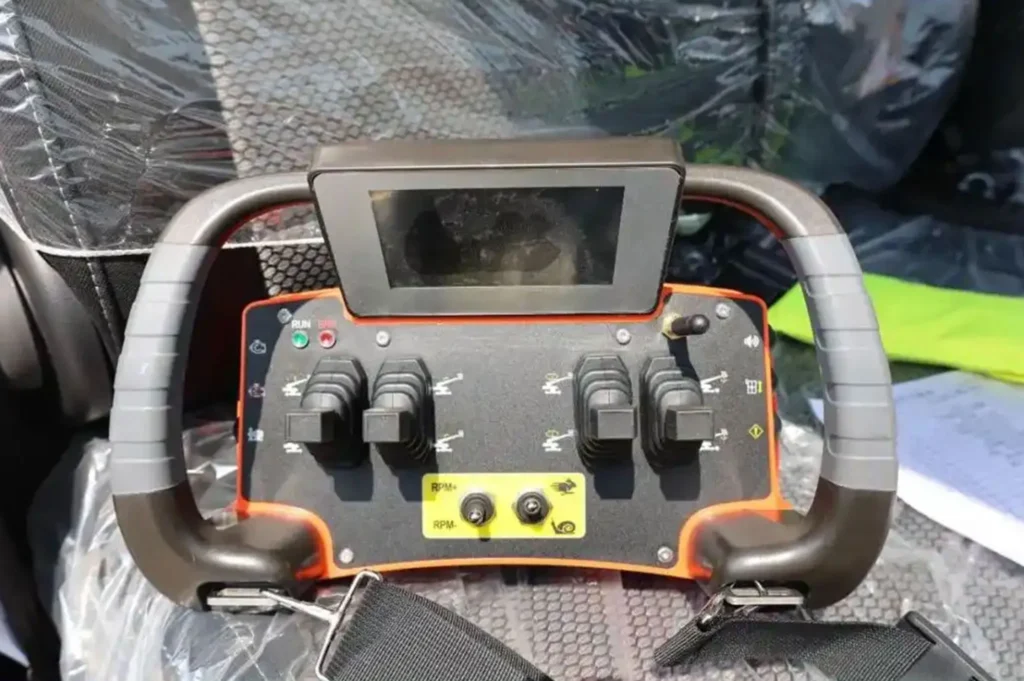
The primary objective of modern boom lift controls is to provide seamless, multi-axis maneuverability while enforcing strict safety parameters. A standard boom lift control panel incorporates proportional joysticks, toggle switches, push-buttons, and digital display screens. Proportional joysticks are particularly vital to modern boom lift controls; they ensure that the speed of the boom’s movement corresponds directly to how far the operator deflects the lever. This prevents jerky movements that could destabilize the basket or throw an operator off balance at high elevations.
Beyond basic movement, boom lift controls govern critical secondary functions. These include engine start/stop sequences, auxiliary power activation, platform leveling adjustments, and emergency shutoff protocols. Because these machines operate at extreme heights, boom lift controls are hardwired to an array of safety sensors, such as load-sensing systems and tilt alarms, which automatically restrict specific movements if safe operating limits are breached.
Overview of Ground Station Controls
The dual-station design is a universal standard in modern aerial lifts, and the first half of this system is the ground station. Strategically positioned on the turntable or chassis of the machine, the boom lift ground controls serve as the primary command center for pre-operation setups, troubleshooting, and emergency recovery operations.
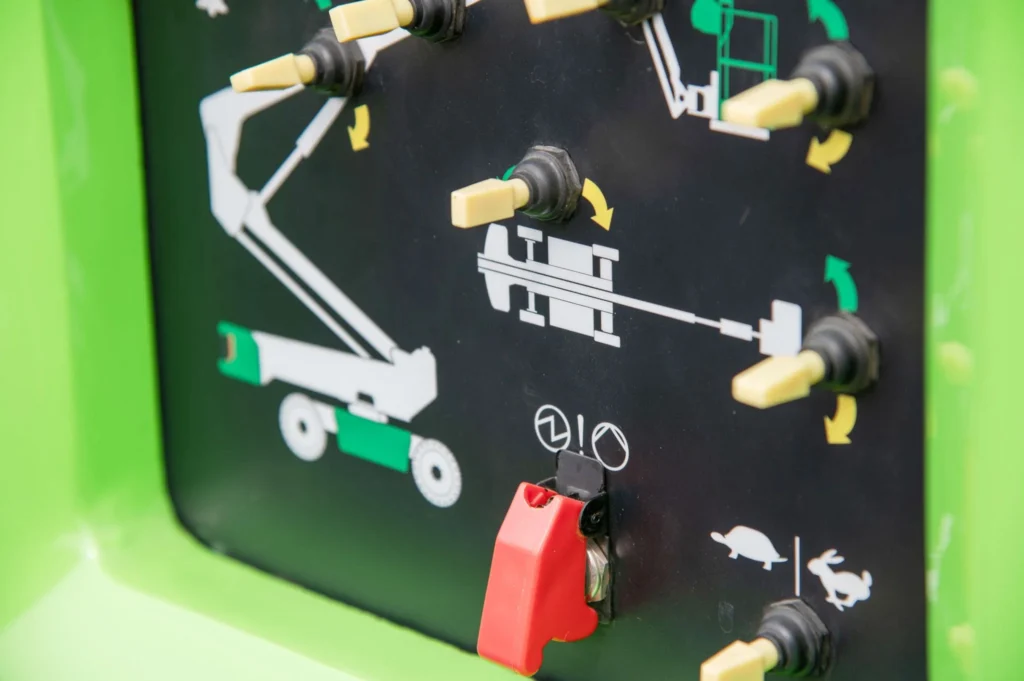
The ground station features a comprehensive boom lift control panel designed to replicate almost all functions found in the basket, with one notable exception: drive and steer capabilities are typically omitted from the ground layout for safety reasons. From this lower console, a technician or support crew member using the boom lift ground controls can start the engine, elevate the primary boom, extend the telescoping sections, rotate the turntable 360 degrees, and tilt the platform.
A primary role of the boom lift ground controls is to facilitate daily pre-start inspections. Before any operator ascends into the sky, the ground station is utilized to run functional tests on all hydraulic cylinders and limit switches. This ensures that the system responds accurately to boom lift controls before it carries human cargo. Furthermore, the ground panel houses the master key switch, which determines whether control authority is granted to the ground team or transferred completely up to the aerial basket.
Understanding Basket Console Controls
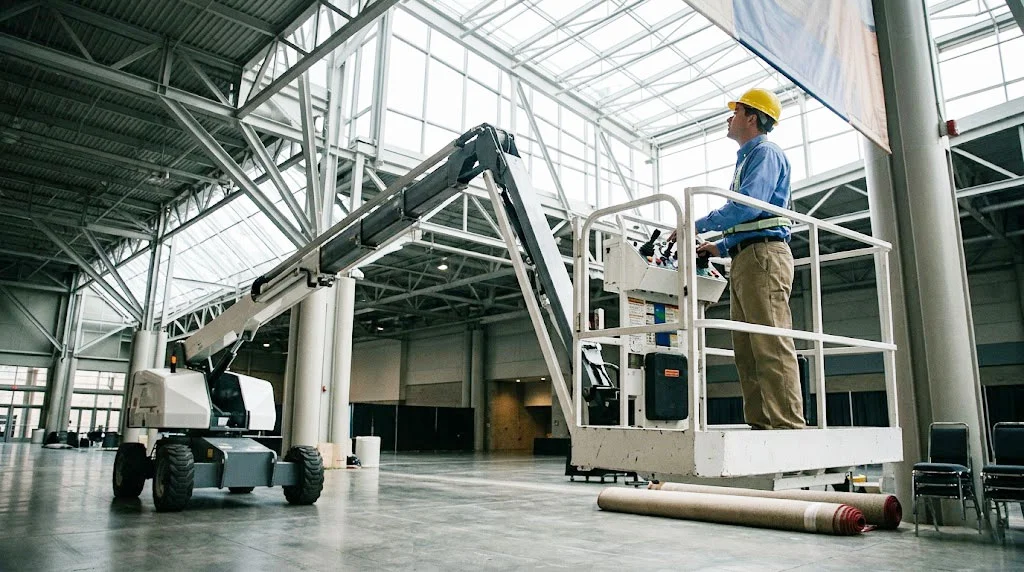
Once control authority is transferred away from the ground, the aerial boom lift control panel inside the work platform becomes the active command center. The basket console is where the operator spends the entirety of the work shift, manipulating joysticks to maneuver around structural obstacles, power lines, and architectural elements.
An aerial boom lift control panel is highly specialized, prioritizing ergonomics and situational awareness. The central feature of any basket console is the drive/steer joystick. Unlike the ground team, the operator in the basket must use boom lift controls to drive the entire chassis across the job site, even when elevated. This requires an acute sense of spatial orientation, as the boom lift controls can feel reversed depending on the rotation of the turntable relative to the drive chassis.
To shield these sensitive electronics from harsh weather, falling debris, and UV degradation, many fleets utilize a durable boom lift control box cover. When flipped open, the cover reveals an organized matrix of switches managed by the primary boom lift controls: the function enable switch (often a foot pedal or trigger that must be depressed to allow any movement), boom lift, telescope, basket rotate, and jib articulation. Additionally, modern baskets may feature a specialized boom lift crane remote control configuration or tethered console, allowing operators to step to the edge of the basket for a clearer line of sight during hyper-precise docking maneuvers.
Ground Controls vs. Basket Controls: Key Differences
Understanding the demarcation between ground stations and basket consoles is fundamental to safe operations. While both systems manipulate the same hydraulic valves, their operational intent, layout, and override hierarchies differ significantly within the overarching system of boom lift controls.
The most obvious difference lies in mobility functions. The basket console includes comprehensive drive, steer, and axle-extension controls, empowering the elevated worker to reposition the machine without descending. Conversely, boom lift ground controls deliberately lack these drive mechanics to prevent an individual on the ground from inadvertently moving the wheels while an operator is elevated, which could cause catastrophic tip-overs or crush injuries.
Another critical differentiator is the safety override hierarchy built into boom lift controls. In standard operating mode, the basket console holds operational priority, allowing the worker in the sky to fine-tune their position. However, the ground station functions as the ultimate fail-safe. If an operator becomes incapacitated due to a medical emergency, a toxic gas leak, or an electrical arc flash, the ground crew can use the master key switch to completely isolate the basket console. Once overridden, the ground boom lift controls allow the ground crew to safely retract and lower the basket, bringing the worker back to earth safely.
Visual feedback mechanisms also vary between the two stations. Basket consoles frequently utilize simplified indicator lights (such as load warnings or tilt alerts) that demand immediate operator attention. Ground panels often feature detailed digital diagnostic screens that display specific fault codes, system pressures, and engine metrics, making them more suited for mechanical troubleshooting than rapid tactical adjustments.
Essential Safety Practices for Using Boom Lift Controls
Operating an aerial lift demands rigorous adherence to safety protocols, as a single error at the boom lift control panel can have severe consequences. The first and most critical rule of managing boom lift controls is validating the “Function Enable” system. Whether it is a foot pedal on the basket floor or a trigger switch built into the side of the joystick, this device ensures that accidental bumps or falling tools do not trigger unintended machine movements. Operators must never bypass, tie down, or wedge open a function enable switch on any boom lift controls.
Another indispensable safety protocol is maintaining an unobstructed workspace around the basket console. A protective boom lift control box cover should always be utilized when the machine is shut down to prevent moisture entry or ice accumulation, which can cause electrical shorts and uncommanded movements within the boom lift controls. During operation, workers must ensure that tools, tool lanyards, and materials do not drape over the joysticks.
Before touching any part of the boom lift controls, operators must visually confirm the direction orientation arrows painted on the chassis. When the turntable is rotated 180 degrees, pushing the drive joystick forward will move the machine backward relative to the operator’s field of view. Checking these color-coded arrows (usually yellow and blue) before activating the boom lift controls prevents accidental drive movements into walls or drop-offs. Finally, emergency stop buttons—prominently colored red—must be tested at both stations before every shift to guarantee that all power can be cut instantly if a crisis develops.
Common Problems With Boom Lift Controls
Like any industrial machinery subjected to harsh environments, boom lift controls can experience mechanical and electrical failures over time. One of the most widespread issues stems from environmental moisture ingress. Rain, high-humidity environments, and pressure-washing can force water into unsealed electrical connections, leading to sporadic joystick responsiveness or complete system lockouts. Utilizing a high-quality boom lift control box cover when the lift is idle is the most effective preventative measure against this type of degradation in boom lift controls.
Another frequent complication involves the physical degradation of joysticks and toggle switches. Heavy-duty construction environments expose the aerial boom lift control panel to concrete dust, sand, and grit. This fine debris can penetrate the rubber boots surrounding joysticks, grinding down internal potentiometers and causing “control drift.” Control drift occurs when boom lift controls fail to return to a true neutral position, causing the boom to creep slowly even when the operator’s hand is removed from the lever.
Wiring harness friction and corrosion also plague older models. Because the boom arm extends and retracts thousands of times throughout its lifespan, the internal communication cables experience constant flexing. Over time, these wires can fray or break inside the track, interrupting the signal between the basket console and the main hydraulic valves. When this occurs, the diagnostic screen on the boom lift ground controls becomes invaluable, pinpointing the specific open-circuit or short-circuit fault code to accelerate the repair process.
Technological Advancements in Boom Lift Controls
The landscape of aerial lift engineering is evolving rapidly, with manufacturers integrating advanced electronics to enhance safety and user intuition. One major leap forward is the transition from traditional hardwired configurations to secondary boom lift crane remote control systems and wireless radio-frequency (RF) consoles. These wireless boom lift controls give operators the freedom to step out of the basket (while remaining safely harnessed) or guide a compact spider lift through narrow doorways from a distance, drastically improving visibility.
Artificial intelligence and sensor fusion are also redefining how a boom lift control panel operates. Modern boom lift controls now incorporate intelligent envelope management. Instead of abruptly stopping when the machine reaches its maximum physical reach, the integrated electronic control unit (ECU) smoothly slows down the hydraulic flow as the basket approaches its structural boundary. This provides a dampened, comfortable stop, minimizing structural stress on the boom and reducing operator fatigue.
Furthermore, telematics and remote diagnostics have integrated directly with boom lift controls. Fleet managers can now monitor control inputs, detect operator errors, and view system error codes in real-time from a cloud dashboard. If an operator reports a malfunction in the boom lift controls, a factory technician hundreds of miles away can log into the machine’s control system, analyze the voltage outputs of the basket console, and determine whether a sensor needs replacement—all without stepping foot on the physical job site.
Frequently Asked Questions About Boom Lift Controls
What are boom lift controls used for?
Boom lift controls are utilized to safely dictate all operational movements of an aerial platform. This includes driving and steering the chassis, rotating the turntable, raising or lowering the primary and secondary boom sections, telescoping the boom arms, and adjusting the angle and rotation of the operator’s work basket. They allow workers to position themselves precisely at elevated heights to perform tasks like painting, electrical work, or structural construction.
Can ground controls override basket controls?
Yes, boom lift ground controls are specifically designed with ultimate override authority for safety and emergency recovery purposes. By turning the master key switch at the ground station away from “basket mode” to “ground mode,” the ground crew completely cuts off operational power to the basket console. This allows ground personnel to safely use the boom lift controls to lower the platform if the operator in the sky becomes incapacitated or trapped.
Are boom lift controls standardized across brands?
While the fundamental operational logic and safety icons are highly consistent across the industry due to strict ANSI and ISO standards, the physical layout of boom lift controls is not completely standardized across brands. A JLG control panel will feel and look slightly different from a Genie, Snorkel, or Skyjack console. Operators must always review the specific machine’s manual and perform a layout orientation before operating unfamiliar boom lift controls.
What should I do if the boom lift controls stop working?
If your boom lift controls stop responding while elevated, remain calm and ensure your safety harness is securely anchored. First, verify that the red emergency stop button has not been accidentally bumped or depressed. Check the foot pedal or trigger function enable switch to ensure it isn’t jammed with debris. If the basket controls remain completely unresponsive, communicate with the ground crew so they can use the ground boom lift controls or the manual emergency descent system to bring you down safely.
Do operators need certification to use boom lift controls?
Yes, operating boom lift controls legally requires specialized training and formal certification. Regulatory bodies such as OSHA in the United States, alongside standards organizations like ANSI and AWPT, mandate that all operators undergo comprehensive classroom instruction and practical, hands-on evaluations. This training ensures that operators understand load capacities, stability rules, and emergency override protocols before managing boom lift controls on a commercial job site.
How often should boom lift controls be inspected?
Boom lift controls must undergo a rigorous inspection at least twice daily: once during the pre-start inspection before the work shift begins, and again prior to any new operator taking control of the machine. These inspections should check for smooth joystick operation, functional emergency stop buttons, proper safety interlocks, and clean, legible control placards on the boom lift control panel. Additionally, a certified mechanic must perform deep system calibrations during annual vehicle inspections.
Conclusion
Mastering the nuances of boom lift controls is an absolute prerequisite for successful high-altitude industrial work. The calculated interplay between the grounded technical capabilities of boom lift ground controls and the agile, high-altitude responsiveness of the basket console ensures that complex projects can be completed swiftly without compromising human safety.
By understanding how these dual interfaces communicate, respecting safety overrides, protecting equipment with a boom lift control box cover, and staying informed on technological shifts like wireless boom lift crane remote control systems, operators and fleet managers can maintain an accident-free, highly efficient workplace.
If you are looking to upgrade your fleet, require specialized equipment maintenance, or need expert guidance on choosing the right machine for your job site, our team is ready to assist. You can reach out directly to us via email at info@klingtec.com or connect with our support specialists on WhatsApp at +86 188 6686 3188. Prioritizing education regarding boom lift controls is not just about moving a machine—it is about ensuring every single worker returns home safely at the end of the day.