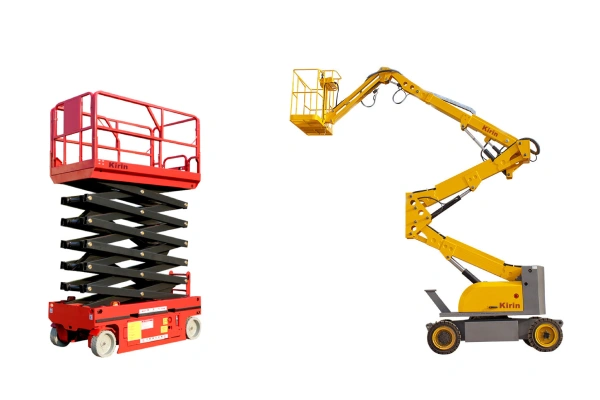
When planning a construction project or facility maintenance task, understanding boom lift weight is just as critical as knowing the machine’s maximum reach. Whether you are operating on a reinforced concrete slab, a manicured lawn, or a high-rise construction site, the boom lift weight determines how you transport the machine, where you can safely park it, and whether the ground beneath it will hold.
In this complete guide, we will break down everything you need to know about boom lift weight, from average ranges by type to the technical factors that make these machines so heavy.
What Is the Average Boom Lift Weight?
The question “How much does a boom lift weight?” does not have a single answer because these machines range from compact, towable units to massive telescopic giants. However, for general planning purposes, the average boom lift weight typically falls between 10,000 lbs and 45,000 lbs (4,500 kg to 20,400 kg).
While a small electric articulating lift might weigh around 12,000 lbs, a high-reach telescopic model used in industrial shipyards can easily exceed 60,000 lbs. It is important to distinguish between the machine’s self-weight and its boom lift weight capacity (the amount of weight the platform can hold), as these two figures serve entirely different safety functions.
Boom Lift Weight by Type
The architecture of the boom—how it folds, extends, and balances—drastically impacts the overall boom lift weight.
Articulating Boom Lift Weight
Articulating boom lifts, often called “knuckle booms,” feature multiple sections that “articulate,” allowing the operator to reach over and around obstacles. Because these machines require complex joint systems and significant counterweights to remain stable while the arm is bent, their weight is substantial.
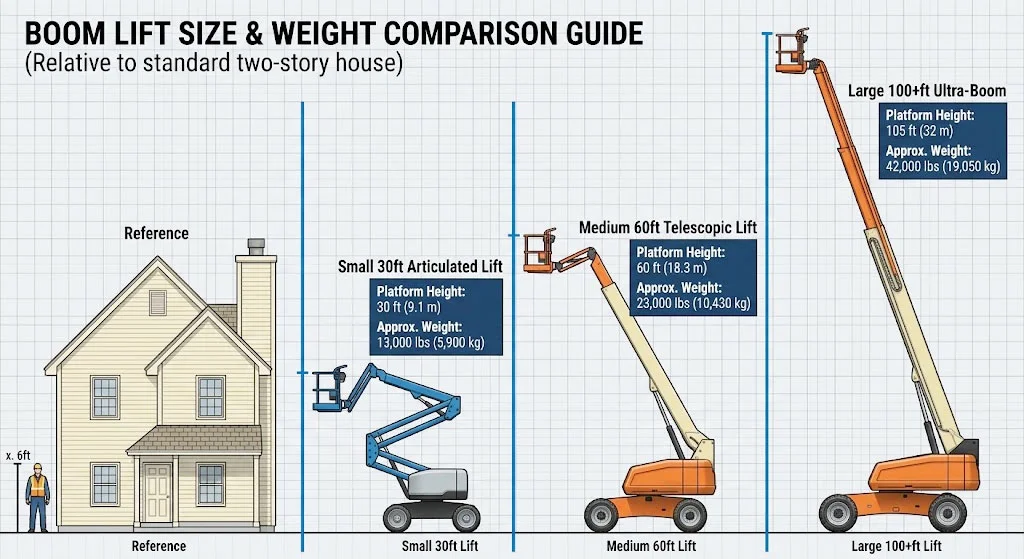
- Small Articulating Lifts (30–45 ft): Usually weigh between 12,000 and 16,000 lbs.
- Large Articulating Lifts (60–80 ft): Often range from 25,000 to 38,000 lbs.
Telescopic Boom Lift Weight
Telescopic boom lifts, or “stick booms,” extend straight out. To maintain a center of gravity while the boom is extended horizontally at great distances, these machines require massive bases. Consequently, the boom lift’s weight capacity for a telescopic model is usually higher than that ofan articulating model of the same height.
- 60 ft Telescopic Lift: Typically weighs around 23,000 to 28,000 lbs.
- 120+ ft Telescopic Lift: Can weigh between 40,000 and 65,000 lbs.
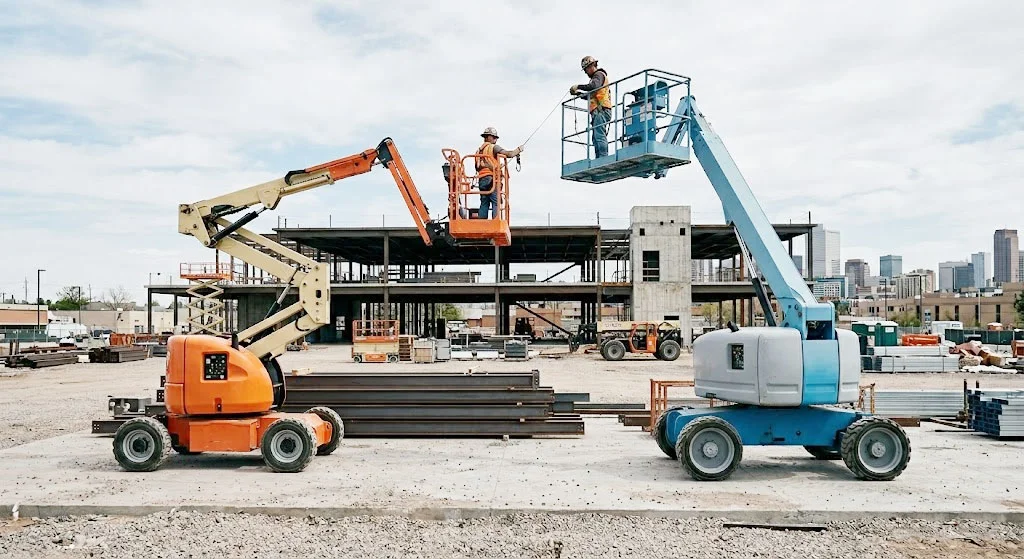
Trailer-Mounted Boom Lift Weight
If your job site requires low ground pressure, a trailer-mounted (or towable) lift is the solution. These are the “lightweights” of the industry. By using outriggers to create a wide footprint rather than relying on a heavy chassis for stability, the boom lift weight is significantly reduced.
- Typical Weight: 3,000 to 8,000 lbs.
Towable vs. Self-Propelled Boom Lifts
The difference in the boom lift’s weight between these two is massive. A self-propelled lift must be heavy enough to remain stable while driving with the boom extended. A towable lift stays stationary when in use, allowing for a much lighter frame. If you are working on sensitive flooring or need to tow the equipment with a standard pickup truck, the lower boom lift weight of a towable unit is a major advantage.
Boom Lift Weight by Height and Reach
As a rule of thumb, the higher you go, the heavier the machine must be. This is a matter of pure physics: as the boom extends, the leverage acting on the base increases. To prevent the machine from tipping, manufacturers must add weight to the chassis.
How Platform Height Affects Weight
Weight doesn’t just increase linearly with height; it often increases exponentially. A 40-foot lift might weigh 13,000 lbs, but a 135-foot lift can weigh over 45,000 lbs. The increased boom lift weight provides the necessary ballast to counter the weight of the platform and the operator at full extension.
Sample Weight Ranges
To help you visualize the requirements for your next project, here are the typical boom lift weight benchmarks:
- 30–40 ft boom lifts: These are common for indoor warehouse work or light exterior painting. A typical 40 ft boom lift weight is approximately 12,000 to 15,000 lbs.
- 60–80 ft boom lifts: These are the workhorses of general construction. A 60 foot boom lift weight usually lands around 22,000 to 26,000 lbs, while an 80 ft boom lift weight can jump to 35,000 lbs.
- 100+ ft boom lifts: Reserved for high-rise work and massive infrastructure projects. These “ultra-booms” feature a boom lift weight starting at 40,000 lbs and reaching up to 90,000 lbs for the tallest models in the world.
Trade-offs Between Reach and Portability
Choosing a higher reach always comes at the cost of portability. A heavy 60-ft boom lift requires a specialized low-boy trailer and a semi-truck for transport, whereas a smaller 30-ft model might be moved on a smaller flatbed.
Factors That Affect Boom Lift Weight
Beyond height and type, several technical specifications influence the final boom lift weight.
Engine Type (Electric vs. Diesel)
Electric boom lifts are primarily designed for indoor use. They carry heavy lead-acid or lithium-ion battery packs, which actually act as part of the counterweight. Diesel-powered units, intended for rough terrain, require heavy-duty engines, larger fuel tanks, and reinforced drive systems, often making them heavier than their electric counterparts.
Material Construction
Most industrial lifts are made of high-strength steel. While some specialized manufacturers use lightweight alloys for the upper boom sections to reduce the “top-heaviness” of the machine, the chassis almost always remains solid steel to ensure a low center of gravity.
Platform Size and Load Capacity
The boom lift’s weight capacity (how much the basket can hold) influences the machine’s total weight. If a lift is rated for a “High Capacity” (e.g., 1,000 lbs instead of the standard 500 lbs), the entire structure must be beefed up, increasing the overall boom lift weight.
Additional Features
- 4WD and Oscillating Axles: Add significant mechanical weight to the drivetrain.
- Outriggers: While they allow for a lighter chassis, the outrigger assemblies themselves add weight.
- Insulation: High-voltage insulated booms for utility work use fiberglass components, which can change the weight distribution.
Why Boom Lift Weight Matters
Knowing how much does a boom lift weight isn’t just a technicality—it is a logistical and safety necessity.
Transportation and Logistics
Transporting a 20,000-lb machine is vastly different from transporting a 40,000-lb machine. You must ensure that your transport trailer and truck have the appropriate Gross Vehicle Weight Rating (GVWR). High boom lift weight may also require special permits for road travel in certain jurisdictions.
Job Site Surface Conditions
This is perhaps the most critical factor. Every surface has a “Load Bearing Capacity.”
- Concrete: Can usually handle high boom lift weight, but thin slabs may crack.
- Soil/Grass: Heavy lifts will sink. You may need to use “swamp pads” or “outrigger pads” to distribute the boom lift weight over a larger area.
- Indoor Flooring: Gym floors or decorative tile often cannot support a standard boom lift weight, requiring the use of lightweight “spider lifts” or towable models.
Safety Considerations
Stability is the primary reason boom lifts are heavy. However, excessive weight on an incline can lead to “runaway” scenarios if brakes are not maintained. Always check the machine’s gradeability rating in conjunction with its weight.
How to Choose the Right Boom Lift Weight
When selecting a machine, don’t just look for the tallest one. Consider the following:
- Match Weight to Conditions: If you are working on a suspended slab or a parking garage, you must verify the maximum floor load. In these cases, a lower boom lift weight is your top priority.
- Reach vs. Maneuverability: A heavier lift usually has a larger footprint. If you are working in a tight alleyway, you might sacrifice 5 feet of reach to get a lighter, narrower machine that can actually fit into the workspace.
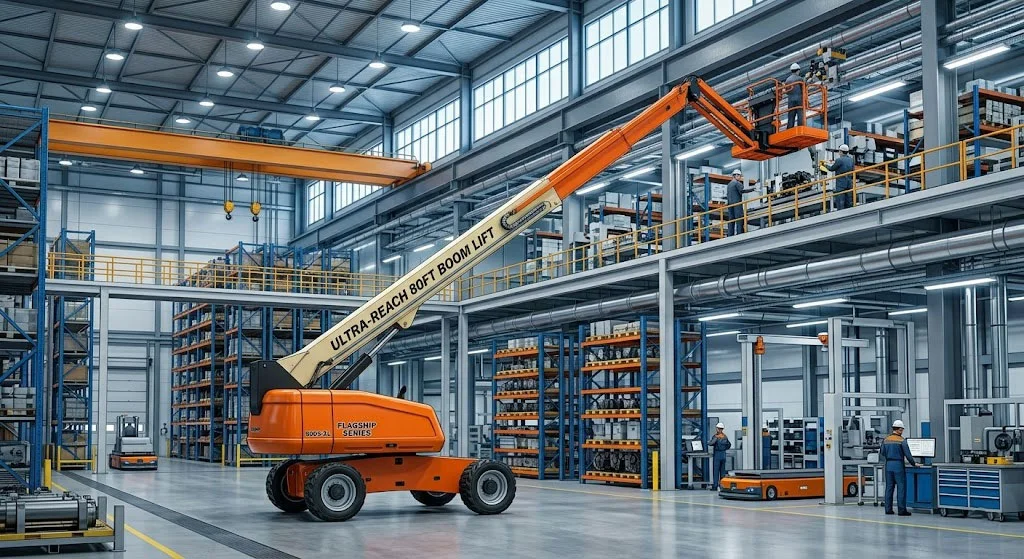
Boom Lift Weight Comparison Table
The following table provides a quick reference for comparing different models and their typical applications.
| Type | Platform Height | Approx. Boom Lift Weight | Typical Applications |
| Towable Boom | 35 ft | 3,400 lbs | Residential painting, tree trimming |
| Electric Articulating | 30 ft | 13,000 lbs | Warehouse maintenance, indoor HVAC |
| Diesel Articulating | 45 ft | 15,500 lbs | Exterior construction, general contracting |
| Telescopic Stick | 60 ft | 23,000 lbs | Steel erection, bridge inspection |
| Diesel Articulating | 80 ft | 35,000 lbs | Industrial facility repair |
| Ultra Telescopic | 135+ ft | 45,000+ lbs | Shipyards, stadium construction |
FAQs About Boom Lift Weight
How much does a 60 ft boom lift weigh?
A standard 60 ft boom lift weight is generally between 22,000 lbs and 26,000 lbs. Telescopic models tend to be on the heavier end of that scale, while articulating models may be slightly lighter depending on the chassis width.
What is the lightest boom lift available?
The lightest boom lifts are trailer-mounted (towable) models or “spider lifts” (compact crawlers). Some towable models weigh as little as 3,000 lbs, making them easy to move with a standard SUV.
Does a heavier boom lift mean better stability?
Generally, yes. A higher boom lift weight in the chassis acts as a counterweight. However, stability also depends on the footprint (width and length) of the machine and whether it uses outriggers. A lighter machine with wide outriggers can be just as stable as a heavy machine with a narrow wheelbase.
Can the ground support a heavy boom lift?
This depends on the “ground pressure,” usually measured in Pounds per Square Inch (PSI). Even if the total boom lift weight is high, large pneumatic tires or tracks can spread that weight out. Always consult a structural engineer if you are operating a heavy lift on a rooftop, bridge, or suspended floor.
Conclusion
Whether you are looking at an 80 ft boom lift weight for a major industrial project or a compact 40 ft boom lift weight for local facility management, the mass of your machine is a foundational factor in your project’s success.
By understanding how much does a boom lift weight, you can better plan your logistics, ensure the safety of your operators, and protect the integrity of your job site surfaces. Always prioritize checking the specific manufacturer specifications, as boom lift weight can vary even between similar models from different brands.
For high-quality lifting solutions designed for maximum stability and performance, contact us at info@klingtec.com or reach out via WhatsApp at +86 188 6686 3188. Our team of experts is ready to help you find the perfect balance between reach, boom lift weight capacity, and portability for your next project.