When it comes to aerial work platforms, most people immediately think of the standard wheeled units seen in warehouse aisles. However, when the job site moves from a flat concrete floor to a muddy construction zone, a steep slope, or a delicate lawn, the standard equipment often falls short. This is where the tracked scissor lift comes into play.
A tracked scissor lift is a powerful, versatile alternative to traditional wheeled lifts, designed to go where others cannot. Whether you are looking for a tracked scissor lift for sale to upgrade your fleet or simply researching the technology behind these “spider-like” machines, this guide provides a comprehensive look at everything you need to know.
What Is a Tracked Scissor Lift?
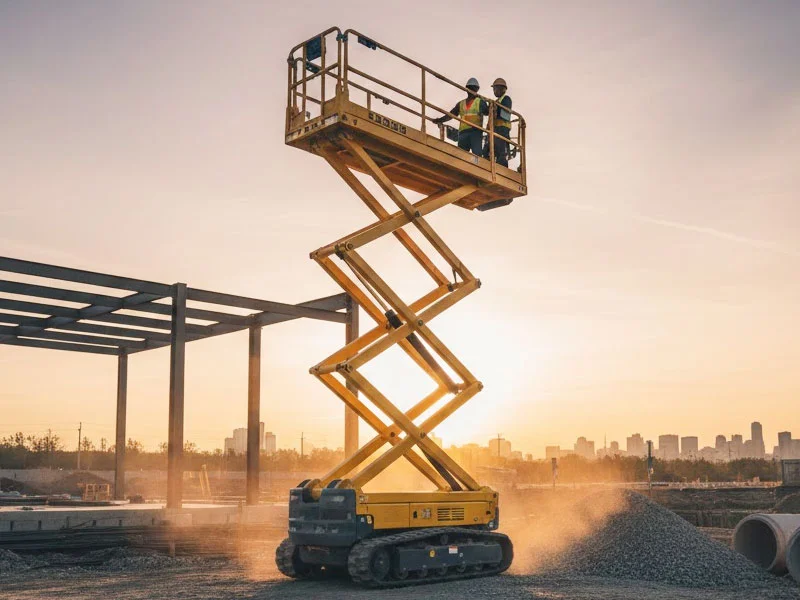
A tracked scissor lift, also commonly referred to as a crawler scissor lift, is an aerial work platform that utilizes a series of folding supports—arranged in a crisscross “X” pattern—to provide vertical lift. What distinguishes a track mounted scissor lift from its counterparts is its undercarriage. Instead of the typical four wheels, it features a continuous track system (often made of durable rubber) similar to that of an excavator or a tank.
The primary purpose of a track mounted scissor lift is to provide a stable, elevated working surface in environments that are “unfriendly” to wheels. This includes:
- Rough Terrain: Mud, sand, gravel, and loose soil.
- Fragile Surfaces: Manicured turf or indoor flooring with strict weight-distribution requirements.
- Sloped Ground: Inclines that would cause a standard lift to lose traction or become unsafe.
Because of its design, a tracked scissor lift offers a unique combination of high lifting capacity and extreme mobility, making it an indispensable tool for modern construction and maintenance.
How Tracked Scissor Lifts Work
The mechanical DNA of a tracked scissor lift combines two distinct engineering systems: the scissor mechanism and the crawler drive system.
The Scissor Mechanism
The “lift” part of a tracked scissor lift operates via hydraulic cylinders. When hydraulic fluid is pumped into the cylinders, it forces the intersecting supports to pull together, extending the platform vertically. This movement is strictly linear—meaning the track mounted scissor lift moves straight up and down, unlike a boom lift which can move diagonally.
The Tracked Drive System
The “tracked” part refers to the propulsion. A tracked scissor lift is driven by high-torque hydraulic motors that rotate the tracks. These tracks provide a much larger surface area (contact patch) with the ground than tires.
- Traction: The lugs on the tracks “bite” into soft ground.
- Weight Distribution: The weight of the track mounted scissor lift is spread over a wider area, preventing the machine from sinking into the mud.
Self-Leveling Technology
Many modern models, such as the China tracked scissor lift variants becoming popular globally, include bi-leveling or self-leveling technology.This allows the tracked scissor lift to adjust its base to compensate for slopes of up to 20° while keeping the platform perfectly level for the operator.
What Makes a Tracked Scissor Lift Different?
To truly understand the value of a tracked scissor lift, it is helpful to compare it to the standard wheeled models most contractors are familiar with.
| Feature | Wheeled Scissor Lift | Tracked Scissor Lift |
| Ground Pressure | High (concentrated on 4 points) | Low (distributed across tracks) |
| Terrain | Smooth, hard surfaces (concrete) | All-terrain (mud, grass, gravel) |
| Stability | Limited on slopes | High (often self-leveling) |
| Maneuverability | Tight turning radius on flat ground | Can turn 360° on its own axis (zero-turn) |
| Indoor Use | Standard (non-marking tires) | Specialized (non-marking rubber tracks) |
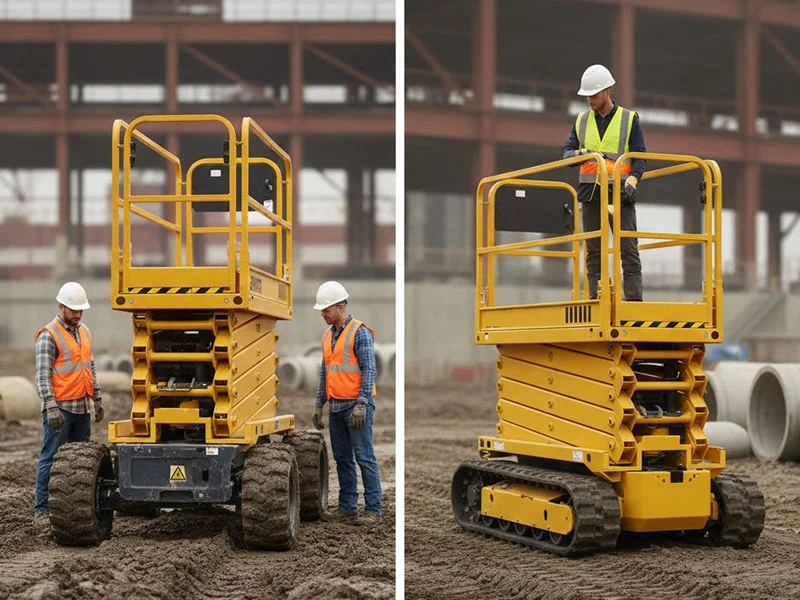
A small tracked scissor lift can often fit through a standard doorway, just like a wheeled unit, but it has the added benefit of being able to climb over a curb or navigate a debris-strewn site to get to that doorway—something a wheeled unit simply cannot do.
Key Benefits of Using a Tracked Scissor Lift
Investing in a track-mounted scissor lift offers several strategic advantages for businesses in the construction, landscaping, and facility management sectors.
Unmatched Terrain Capability
The most obvious benefit of a track mounted scissor lift is its ability to handle “off-road” conditions. On a construction site that has just experienced heavy rain, a wheeled lift will get stuck, leading to costly downtime. A tracked scissor lift continues to operate efficiently in mud and soft soil.
Superior Slope Management
Standard lifts require a nearly flat surface (usually within 2° to 3°) to operate safely. A tracked scissor lift equipped with outriggers or bi-leveling tracks can operate on significant inclines. This is vital for tasks like tree trimming on a hillside or installing siding on a house built on sloped terrain.
Low Ground Pressure
For indoor applications or landscaping work, a track mounted scissor lift is much gentler on the surface. Because the tracks distribute the machine’s weight, a small tracked scissor lift is less likely to crack a tile floor or leave deep ruts in a customer’s expensive lawn.
Increased Safety and Stability
The wide footprint of a tracked scissor lift provides a lower center of gravity. When the platform is extended to its maximum height, the machine feels significantly more stable than a wheeled version, especially if there is a slight wind or the ground is not perfectly solid.
Primary Applications & Use Cases
Where exactly would you see a track mounted scissor lift in action? Its versatility allows it to span across multiple industries.
Outdoor Construction & Infrastructure
On new building sites where the pavement hasn’t been poured yet, the track-mounted scissor lift is the king of the site. It is used for:
- Installing steel structures and framing.
- Exterior painting and sandblasting.
- Bridge inspection and maintenance.
Landscaping & Forestry
Arborists often choose a small tracked scissor lift to navigate between trees in a backyard. The tracks allow the machine to roll over roots and soft garden beds without causing damage, providing a stable platform for high-reach pruning.
Facilities Management (Indoor/Outdoor)
Large stadiums, airports, and shopping malls use the track mounted scissor lift for maintenance. A China tracked scissor lift model with non-marking white rubber tracks is perfect for moving from the outdoor parking lot (rough terrain) directly onto the polished indoor lobby floor.

Utility and Telecom
For repairing overhead lines in remote areas, a tracked scissor lift can travel over ditches and uneven fields that a service truck might struggle to navigate.
Choosing the Right Tracked Scissor Lift
If you are browsing a tracked scissor lift for sale listing, the options can be overwhelming. To choose the right one, consider these critical factors:
Working Height vs. Platform Height
Remember that “working height” is typically 2 meters (or about 6 feet) higher than the “platform height.” If you need to reach a 10-meter ceiling, you need a track mounted scissor lift with at least an 8-meter platform height.
Lift Capacity
How many people and tools will be on the platform? A small tracked scissor lift might have a capacity of 230 kg (500 lbs), while heavy-duty models can exceed 1,000 kg.
Power Source: Electric vs. Diesel
- Electric/Lithium: Best for indoor use or residential areas where noise and emissions are a concern.
- Diesel: Best for heavy-duty, all-day outdoor use where charging isn’t available.
Transportability
Check the weight of the track mounted scissor lift. If you plan to move it between jobsites frequently, ensure your trailer and truck can handle the gross weight of the machine.
Conclusion
The tracked scissor lift has revolutionized the way we think about aerial access. By removing the limitation of “flat ground only,” these machines have opened up new possibilities for efficiency and safety on the job site. From the compact agility of a small tracked scissor lift to the rugged power of a large China tracked scissor lift, there is a model suited for every challenge.
Whether you are looking for a tracked scissor lift for sale to own your equipment or simply need to understand how a track mounted scissor lift works for your next project, the investment in this technology pays off in reduced downtime, increased safety, and the ability to take on jobs that your competitors can’t reach.
FAQs
Can a tracked scissor lift be used indoors?
Yes, many tracked scissor lift models come with non-marking rubber tracks specifically designed for indoor use. Electric or lithium-powered models are ideal for these environments.
Is a tracked scissor lift more expensive than a wheeled one?
Generally, yes. The complex engineering of the track system and the inclusion of features like self-leveling mean a tracked scissor lift for sale will typically cost more than a standard wheeled unit. However, the ROI is often higher due to its versatility.
How do I maintain the tracks on my lift?
Regular maintenance involves checking the track tension, cleaning out debris (mud/rocks) from the undercarriage, and inspecting the rubber for tears or excessive wear.
Can I drive a tracked scissor lift while the platform is raised?
Many models allow for “drive at height,” but the speed is significantly reduced for safety, and it is usually restricted to relatively level surfaces.