The construction, maintenance, and warehousing industries all share a common challenge: safely and efficiently reaching elevated work areas. While ladders and scaffolding have their place, the sheer scale of modern projects often demands a more robust, mobile, and versatile solution. This is where the man lift comes into play.
A man lift—also broadly categorized as a Mobile Elevating Work Platform (MEWP) or aerial work platform—is a crucial piece of man lift equipment designed to raise personnel and their tools to heights for a variety of tasks. These machines offer a safe, stable, and productive alternative to traditional methods, revolutionizing how work gets done above ground level.
However, the term “man lifts” encompasses a diverse family of machines, each with unique capabilities suited for specific environments and tasks. Choosing the wrong type of man lift machine can lead to inefficiency, unnecessary costs, or, critically, safety risks.
This complete guide will break down the three primary types of man lifts—Scissor Lifts, Boom Lifts (Articulating & Telescopic), and Vertical Mast/Personnel Lifts—to help you determine which piece of equipment is the perfect fit for your next elevated challenge.

Type 1: Scissor Lifts
The scissor lift is arguably one of the most recognizable and commonly used types of man lifts, prized for its large platform size and high weight capacity.
A. Core Mechanism & Functionality:
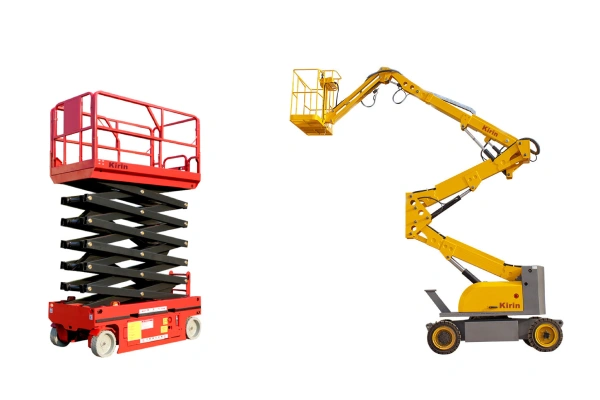
A scissor lift gets its name from its distinctive lifting mechanism. The platform is supported by linked, crisscrossing metal supports—a structure known as a pantograph.
- Vertical Movement Only: Unlike other man lifts, the scissor lift is designed for purely vertical movement. The platform travels straight up and straight down from the base.
- Power Sources: Scissor lifts are powered by electricity (battery-powered, ideal for indoor use, often referred to as slab scissors) or fuel (diesel or dual-fuel, typically for outdoor and rough-terrain applications). The power source drives hydraulic or pneumatic cylinders, which extend and contract the pantograph “legs” to raise and lower the platform.
B. Key Advantages (Pros):
- Large Work Area: Scissor lifts offer the most spacious platform among man lifts, accommodating multiple workers, tools, and materials. Many models also feature deck extensions for even greater reach.
- High Capacity: They generally boast a higher platform weight capacity than other aerial man lift types, making them ideal for tasks involving heavy equipment or materials (e.g., masonry, large HVAC components).
- Stability: Due to their relatively large base and substantial weight, they are inherently stable when working on level ground.
- Indoor Use Options: Electric models are quiet, emit zero fumes, and feature non-marking tires, making them the preferred choice for indoor work on finished floors. A 1 man scissor lift (a smaller, more compact version) is excellent for tight internal spaces.
C. Limitations (Cons):
- No Horizontal Reach: The main drawback is the lack of outreach. The man lift machine must be positioned directly beneath the work area.
- Terrain Sensitivity: Standard electric scissor lifts require a smooth, level surface. Rough-terrain models are available but are larger and less maneuverable.
- Limited Height: Scissor lifts typically have a lower maximum working height compared to boom lifts, generally topping out between 30 and 50 feet, though some models can go higher.
D. Common Applications:
- Warehouse inventory management, stock-picking, and shelving work.
- Installing overhead utilities, ductwork, and lighting in large commercial buildings.
- Exterior tasks like façade installation, painting, and window washing on straight-up building faces.
- Maintenance and construction tasks in indoor venues like stadiums and convention centers.

Type 2: Boom Lifts (Articulating & Telescopic)
Often referred to as a “cherry picker” or man basket lift, the boom lift is the quintessential machine for reaching high areas with considerable horizontal distance, maneuvering around or over obstacles that would halt a scissor lift. This category of man lifts offers unparalleled flexibility in access.
A. Core Mechanism & Functionality:
Boom lifts utilize a hydraulically controlled arm, or “boom,” mounted on a rotating turntable base. A small work platform (the man basket lift) is fixed to the end of the boom. The combination of the rotating base and the extending/bending boom sections gives these man lifts a massive working envelope.
B. Subtype 2A: Articulating Boom Lifts (Knuckle Booms):
- Mechanism: The boom features multiple hinged joints, or “knuckles,” allowing the arm to bend and articulate.
- Functionality: This design is specifically for navigating up, over, and around existing obstacles, such as piping, roof edges, machinery, or landscaping. They offer excellent ‘up-and-over’ access.
- Best For: Complex access points and tight, congested work areas.
C. Subtype 2B: Telescopic Boom Lifts (Straight Booms):
- Mechanism: The boom consists of straight, overlapping sections that extend outward like a telescope.
- Functionality: They provide the greatest maximum horizontal reach and the highest possible vertical reach among all man lifts. The motion is powerful and direct.
- Best For: Tasks requiring great height or long, straight horizontal outreach, where the work area is directly accessible from the lift’s base.
D. Key Advantages (Pros):
- Exceptional Reach: Boom lifts can reach working heights exceeding 185 feet and offer significant horizontal outreach, making them the best option for high-rise exterior work.
- Maneuverability (Articulating): Articulating models can get to spots impossible for other man lifts, navigating complex building shapes and industrial infrastructure.
- Rough Terrain Capability: Most boom lifts are engine-powered and built with four-wheel drive and heavy-duty tires, easily handling uneven, muddy, or sloped outdoor construction sites.
E. Limitations (Cons):
- Smaller Platform & Capacity: The platform is generally smaller than a scissor lift’s, typically accommodating one or two workers plus light tools (man basket lift).
- Less Stable at Max Reach: Operating at maximum extension requires extreme caution and a perfectly stable base, as the center of gravity is significantly higher.
- Cost and Transport: Boom lifts are typically heavier, larger, and more expensive to rent or purchase and transport than other types of man lifts.
F. Common Applications:
- Exterior construction, steel erection, and roofing projects.
- Bridge inspection and maintenance.
- Electrical work, including power line and street light maintenance.
- Tree trimming and arboriculture (the original “cherry picker” use).
- Outdoor painting and signage installation high above the ground.
Type 3: Vertical Mast/Personnel Lifts
Vertical mast lifts, often simply called personnel lifts or push-around man lifts, are the most compact and lightweight members of the MEWP family, designed specifically for one-person tasks in confined spaces.
A. Core Mechanism & Functionality:
These compact man lifts feature a small platform supported by a single, vertically extending mast column, which telescopes straight upward from a small base.
- Compact Design: They have a minimal footprint, making them ideal for interior work where space is severely limited.
- Power & Mobility: They are almost always electric-powered (battery) for clean, quiet indoor use. Some models are “push-around” (manually moved to position), while self-propelled units are driven from the platform.
- Outriggers: Due to their small base and high center of gravity, most vertical mast lifts require manual outriggers or stabilizers to be deployed for safe operation once elevated.
B. Key Advantages (Pros):
- Fits in Tight Spaces: The narrow chassis allows them to fit through standard single or double doorways and be transported in freight elevators, making them perfect for interiors of finished buildings.
- Lightweight: Their low weight makes them safe to use on delicate or finished floors without risk of damage.
- Low Clearance: Excellent for work beneath ceiling fixtures or in areas with low overhead obstacles, where the compact size is a necessity.
- Cost-Effective: As a 1 man scissor lift alternative, they are generally the lowest-cost rental option for light, vertical-only indoor tasks.
C. Limitations (Cons):
- Very Low Capacity: Designed for one worker plus light tools; weight capacity is low (often 300-500 lbs).
- Vertical-Only Access: Like scissor lifts, there is no horizontal outreach; they must be positioned directly under the work area.
- Setup Time: Push-around models and those requiring outriggers have some setup time before the operator can be elevated.
D. Common Applications:
- Facility and commercial building maintenance (changing light bulbs, accessing ceiling tiles, fixing HVAC).
- Retail display setup, high-shelf stock-picking, and mall maintenance.
- Auditorium and theatre lighting and rigging work.
- Any single-person task in narrow aisles, tight corners, or finished indoor environments.

Quick Comparison Chart: Key Man Lift Differences
| Feature | Scissor Lift | Boom Lift (Articulating & Telescopic) | Vertical Mast/Personnel Lift |
| Primary Movement | Vertical (Straight Up/Down) | Vertical & Horizontal Outreach | Vertical (Straight Up/Down) |
| Horizontal Outreach | Minimal/None | Excellent (Highest Reach Available) | Minimal/None |
| Platform Size | Largest (Accommodates multiple workers) | Small (Typically 1-2 workers – man basket lift) | Smallest (Typically 1 worker) |
| Weight Capacity | Highest (Heavy materials/tools) | Medium (Tools and light materials) | Lowest (Light tools only) |
| Ideal Terrain | Paved/Slab (Electric) or Rough Terrain (Diesel) | Rough Terrain & Paved | Finished Floors (Indoor) |
| Maneuverability | Good (Wide turning radius) | Excellent (Articulating) to Fair (Telescopic) | Excellent (Fits through doorways) |
| Best For | Heavy vertical work, multi-person tasks | High reach, overcoming obstacles, long outreach | Tight indoor spaces, light maintenance |
Choosing the Right Man Lift for the Job
Selecting the correct man lift is a decision based on four primary factors. Always use the rule of selecting the machine that is just enough to do the job safely and efficiently. Over-specifying means higher costs and more cumbersome equipment.
1. Determine the Required Height and Outreach:
- Maximum Working Height: How high is the tallest point you need to reach? (Add 6 feet to your platform height requirement to account for the operator’s reach.)
- Horizontal Reach: Do you need to get over an obstacle or reach an area where the lift base cannot be positioned directly beneath it?
- Yes: You need a Boom Lift (Articulating for obstacles, Telescopic for maximum straight reach).
- No: A Scissor Lift or Vertical Mast Lift will suffice.
2. Evaluate the Work Environment and Terrain:
- Indoors on Finished Floors: You need a machine with non-marking tires and zero emissions. Look for electric Scissor Lifts or Vertical Mast/Personnel Lifts.
- Outdoor Construction/Uneven Ground: You need a rough-terrain model. Look for diesel-powered Boom Lifts or Rough-Terrain Scissor Lifts.
- Tight Space/Doorway Access: The smallest option, the Vertical Mast Lift, is likely your only choice.
3. Calculate Capacity Requirements (Personnel & Materials):
- Multiple Workers/Heavy Loads: If you need two or more workers and heavy materials (e.g., HVAC units, brick pallets), a Scissor Lift is necessary due to its high capacity and large platform.
- Single Worker/Light Tools: A Vertical Mast Lift or small Boom Lift (if outreach is needed) is appropriate. Always check the specific model’s maximum capacity and never overload any man lift machine.
4. Consider Mobility and Frequency of Repositioning:
- Frequent Moves: A self-propelled Boom Lift or Scissor Lift is best, as the operator can reposition the machine from the platform.
- Static/Infrequent Moves: A push-around Personnel Lift is an economical choice for simple tasks that only require occasional repositioning.
Conclusion
Man lifts are indispensable tools that elevate safety and productivity in countless industries. From the high-capacity, vertical reach of a scissor lift to the incredible versatility of an articulating boom lift, and the compact necessity of a vertical mast lift, the right man lift equipment is out there for every task. By carefully assessing your job site’s specific needs for height, outreach, capacity, and terrain, you can confidently select the perfect machine to ensure your crew works safely and effectively at any elevation.
FAQs
What is the primary difference between a scissor lift and a boom lift?
The primary difference is motion. A scissor lift only moves vertically (straight up and down) and provides a large platform with high capacity. A boom lift offers both vertical and significant horizontal outreach, allowing it to navigate over and around obstacles, though it has a smaller platform.
Is a “cherry picker” the same as a man lift?
Yes, “cherry picker” is a common, informal term for a boom lift, specifically the articulating type, historically used for picking fruit. The term man lift is a general category that includes boom lifts, scissor lifts, and vertical mast lifts.
Can a man lift be used for lifting materials only, or just personnel?
Man lifts (MEWPs) are specifically designed and certified for lifting personnel and their tools. While they can lift materials, the primary purpose is to provide a safe, elevated workspace. For lifting heavy, bulk materials only, a different piece of equipment, such as a telehandler or forklift, is generally more appropriate and efficient.
Are there specific safety training requirements for operating a man lift?
Yes. OSHA (Occupational Safety and Health Administration) and equivalent bodies worldwide require that all operators of man lifts (MEWPs) must be properly trained and certified on the specific type of equipment they will be using. This training covers safe operation, pre-use inspections, and recognizing potential hazards.