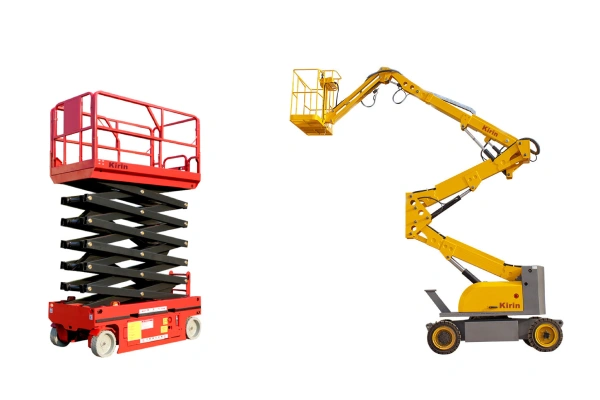
Aerial lifts are indispensable tools across industries like construction, maintenance, warehousing, and retail. They offer a safer, more efficient alternative to ladders and scaffolding for tasks at height. Within the category of compact lifts, the vertical mast lift and the mast boom lift represent two distinct design philosophies. Both are typically smaller than traditional scissor lifts or telescopic boom lifts, making them excellent choices for indoor work or tight outdoor spaces. However, the fundamental difference lies in their lifting mechanism and horizontal reach capability.
The vertical mast lift is characterized by a direct, vertical-only lift, resembling a compact elevator. The mast boom lift, conversely, introduces an articulating or telescoping arm—a boom—that extends both vertically and horizontally, fundamentally changing its utility. Understanding this core mechanical difference is the first step in differentiating the mast boom lift from its purely vertical counterpart.

Understanding the Vertical Mast Lift
The vertical mast lift, often simply called a mast lift, push-around vertical lift, or personal lift, is designed for straight, unhindered vertical elevation.
Mechanical Design and Operation
The defining characteristic of the vertical mast lift is its mast assembly. This system consists of interlocking, telescoping sections—often hydraulic or electric—that rise directly upward from the base. The worker platform (basket) is attached to the top of this mast.
- Vertical-Only Movement: The platform moves in a perfectly straight line, perpendicular to the ground. There is essentially zero horizontal outreach. Any required repositioning horizontally must be accomplished by moving the entire chassis of the machine.
- Compact Base: Vertical mast lifts typically have a very small footprint. Some models, especially the lighter push-around versions, are narrow enough to fit through standard single doorways.
- Power Source: They are predominantly electric-powered (battery-driven), making them ideal for indoor use where exhaust fumes are a concern. Electric operation also contributes to quiet performance, suitable for working in occupied buildings or noise-sensitive environments.
- Maneuverability: Many vertical mast lifts, especially self-propelled models, feature zero-turn radius steering or highly agile drive systems, allowing them to navigate congested spaces like narrow warehouse aisles or retail display areas.
Common Applications
Vertical mast lifts are the perfect choice for tasks that are directly overhead and require minimal setup.
- Warehouse and Inventory Management: Stocking shelves, retrieving items, and performing routine inspections in narrow aisles.
- Facilities Maintenance: Changing light bulbs, maintaining HVAC systems, installing overhead signage, and performing ceiling repairs in offices, schools, and hospitals.
- Retail Environment: Setting up displays, changing out large signs, or performing cleaning tasks after hours without disrupting the public.
- Aviation Maintenance: Reaching specific spots on aircraft fuselages or wings in hangars where maneuverability is key.
Key Benefits
- Small Footprint: Excellent for tight, congested indoor work.
- Precise Vertical Positioning: Simple controls for straight-up access.
- Low Emissions and Noise: Perfect for indoor and noise-sensitive sites.
- Lower Cost: Generally less expensive to rent or purchase than a mast boom lift.

Understanding the Mast Boom Lift
The mast boom lift—sometimes referred to by specific model names like a vertical mast boom or a compact articulating boom—is a hybrid machine that offers the compactness of a mast lift with the outreach capability of a traditional boom lift. The fundamental difference from the vertical mast lift is the presence of an articulating boom arm situated on top of or extending from the vertical mast structure.
Mechanical Design and Operation
The structure of the mast boom lift allows for multi-directional movement, which is its defining advantage.
- Dual Mechanism: It features a vertical mast section that raises the boom assembly, plus a secondary boom arm (or multiple arms) that can articulate (pivot) or telescope (extend) out and over obstacles. This is what makes it a mast boom lift and not just a simple vertical lift.
- Horizontal Outreach: Unlike the vertical mast lift, the mast boom lift can position the platform away from the machine’s base, allowing workers to access areas that are over fixed objects like machinery, shelving, or partitions. The horizontal reach is a key specification for any mast boom lift model.
- Up-and-Over Capability: The articulated nature of the mast boom lift allows for the “up-and-over” movement crucial for reaching over obstacles. This means the platform can be raised vertically and then extended horizontally.
- Power and Drive: Like vertical mast lifts, the mast boom lift is often battery-electric powered for indoor and quiet operation. Self-propelled drive and proportional controls are standard, giving the operator precise control over both the drive and the boom functions.
Common Applications
The versatility of the mast boom lift makes it suitable for complex access jobs where simple vertical access isn’t enough.
- Facilities Maintenance Over Obstacles: Reaching lights, pipes, or ventilation systems located directly above stationary equipment that cannot be moved. For instance, a mast boom lift could be used to repair a ceiling light over a large assembly line machine.
- Complex Architectural Access: Performing finishing work, painting, or installation in areas with complex building geometry, such as vaulted ceilings or around structural beams.
- Industrial Maintenance: Accessing machinery for inspections or repairs in a factory setting where floor space is limited and equipment is in the way.
- High-Rise Interior Work: The compactness of the mast boom lift allows it to be transported via freight elevators, making it ideal for interior work on the upper floors of high-rise buildings. The extra reach of the mast boom lift is highly valued in these confined, elevated environments.
Key Benefits
- Obstacle Clearance: Unmatched ability to work “up-and-over” fixed obstacles.
- Horizontal Reach: Provides necessary outreach without having to move the entire machine.
- Increased Versatility: Suitable for a wider range of indoor and tight-space applications compared to purely vertical lifts. The added function makes the mast boom lift a significantly more versatile machine.
- Compact Footprint with Boom Utility: Offers the space-saving size of a mast lift combined with the functionality of a small articulating boom.
Core Differences: Reach, Size, and Power
The primary differences between these two types of lifts stem directly from their mechanical design, resulting in distinct performance characteristics, which is why a mast boom lift is selected for different tasks than a vertical mast lift.
1. Reach and Movement: The Defining Factor
| Feature | Vertical Mast Lift | Mast Boom Lift |
| Primary Movement | Straight Vertical (1 axis) | Vertical + Articulating Horizontal (2+ axes) |
| Horizontal Reach | Negligible (must move the whole chassis) | Significant (up to 15+ feet in some models) |
| Up-and-Over Capability | None | Yes, designed for it |
| Max Working Height | Typically lower (15–30 ft) | Typically higher (20–40 ft) |
| Working Envelope | A column directly above the base | A partial sphere/dome above and around the base |
The single most important distinction is the boom extension. A vertical mast lift is limited to a column of access directly above its chassis. A mast boom lift, by incorporating an articulating arm, extends the working area into a dome shape, allowing the worker to reach areas significantly offset from the machine’s center. This outreach is the raison d’être of the mast boom lift.
2. Size and Weight
While both are considered compact, the mast boom lift is generally larger and heavier than its vertical-only counterpart.
- Footprint: A vertical mast lift has a minimal base, often no wider than a standard dolly. A mast boom lift requires a slightly larger and heavier base for stability to counteract the forces created by the extended boom arm.
- Weight: Due to the added hydraulic components, structural steel, and counterbalance requirements for the boom, the mast boom lift is almost always heavier. This can be a factor when working on weight-sensitive flooring, such as in theaters, museums, or older office buildings.
- Storage/Transport: The sleek, boxy nature of the vertical mast lift makes it easier to tuck away or load onto transport. The mast boom lift’s folded boom mechanism, while still compact, often requires more vertical clearance when stowed.
3. Power and Controls
- Power: Both types are overwhelmingly electric-powered for indoor use.
- Controls: Vertical mast lifts have very simple “up/down” controls. The mast boom lift requires more complex, proportional controls to manage the multiple functions: mast up/down, boom extension/retraction, and boom articulation (pivot), making operation slightly more involved but far more flexible. The sophisticated hydraulics required for the mast boom lift contribute to its greater complexity and cost.

Choosing the Right Lift for the Job
Selecting between a vertical mast lift and a mast boom lift boils down to a single question: Do you need to reach over an obstacle?
Select the Vertical Mast Lift When:
- The access point is directly overhead. (e.g., changing a single light bulb in a hallway ceiling).
- Working space is extremely narrow. (e.g., between tall, close-set warehouse shelving).
- Floor weight restrictions are severe.
- Simplicity and speed of setup are the priority.
- Budget is the main constraint (vertical mast lifts are typically the most cost-effective solution for straight vertical access).
Select the Mast Boom Lift When:
- You need “up-and-over” capability. (e.g., servicing a ventilation unit located above a permanent desk structure). The ability of the mast boom lift to articulate is the primary driver for its selection.
- The work requires horizontal outreach. (e.g., reaching across a production line or accessing a soffit that is set back from the aisle).
- The working height is at the upper end of the compact lift range (30–40 feet, which some vertical mast lifts can’t achieve).
- Maximum versatility is needed in a single, compact machine. The mast boom lift excels in mixed-use environments.
Safety Considerations
Regardless of the lift chosen, all operators must be properly trained and certified for the specific equipment they are using.
- Load Capacity: Always check the platform capacity. A mast boom lift often has a slightly lower capacity than a vertical mast lift of similar size because the load is offset from the center of gravity when the boom is extended.
- Outriggers/Stabilizers: Some larger vertical mast lifts and many mast boom lift models require the use of outriggers (stabilizing legs) to achieve their full working envelope safely, especially when the boom is fully extended on a mast boom lift.
- Ground Conditions: While both are generally indoor machines, if used outdoors, the stability of a mast boom lift with a fully extended boom is more sensitive to uneven ground, necessitating careful site assessment.
Conclusion
The vertical mast lift and the mast boom lift are both compact, valuable tools for elevated access, particularly in indoor and confined spaces. The choice between them hinges entirely on the nature of the task. If your work is strictly vertical and requires maximum maneuverability in the tightest of spaces, the simplicity and small footprint of the vertical mast lift are ideal. However, if your job demands the flexibility to reach over fixed objects, around corners, or across a significant horizontal distance while maintaining a relatively small chassis size, the mast boom lift is the superior, necessary investment.
Understanding the core distinction—the boom—will ensure you select the safest, most efficient, and most cost-effective machine for every job at height. When you see a worker elevated away from the machine’s base, you know they’re operating a specialized mast boom lift.
FAQs
Are there different types of Mast Boom Lifts?
Yes. The most common type is the articulating mast boom lift, which uses hinged boom sections to achieve its “up-and-over” reach. Less common in the compact category are models that use a telescoping boom on a mast, which provides straight-line horizontal extension instead of the angled reach of an articulating mast boom lift.
Can a Vertical Mast Lift be used outdoors?
Generally, vertical mast lifts are designed for indoor, firm, level surfaces. Some manufacturers offer “rough terrain” or outdoor-rated vertical mast lifts, but these are less common. Outdoor work often requires the greater stability and tire options of a scissor lift or a dedicated mast boom lift model rated for outdoor use, especially due to wind load considerations.
Which lift is easier to transport?
The standard vertical mast lift is typically easier to transport. Its smaller size, lower weight, and lack of an extending boom often mean it can be hauled in a standard utility van or on a smaller trailer. While the mast boom lift is still compact, its heavier weight and slightly more complex stowed dimensions might require a dedicated equipment trailer.
Is the cost difference significant between a Vertical Mast Lift and a Mast Boom Lift?
Yes, the cost difference can be notable. Due to the added complexity of the hydraulic systems, the multiple boom sections, and the advanced stability engineering, a mast boom lift will almost always have a higher purchase price and a higher rental rate than a comparable vertical mast lift with the same maximum vertical height. This premium pays for the highly valuable horizontal outreach capability of the mast boom lift.
What is the maximum height I can expect from a Mast Boom Lift?
While compact, a mast boom lift can offer impressive reach. Many popular models top out with working heights between 30 and 40 feet (9 to 12 meters). For heights beyond this, you would typically need to move up to a larger, non-mast-based articulating or telescopic boom lift. The compact design of the mast boom lift has a practical limit.