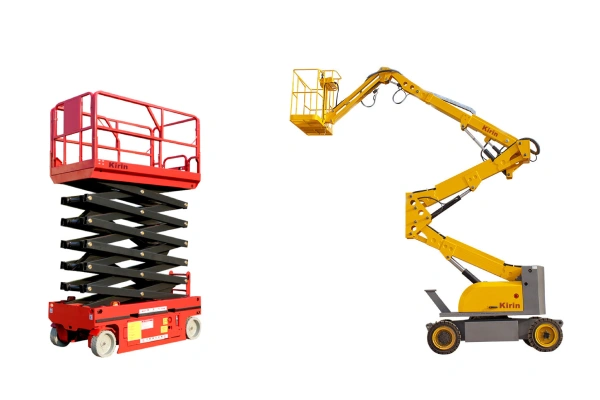
When it comes to aerial work platforms, few machines are as versatile and indispensable as the boom lift. Whether you’re a construction professional, a maintenance worker, or a arborist, a boom lift provides the elevation and reach needed to tackle jobs at height. But before you can get to work, you’re faced with a critical decision that significantly impacts the machine’s performance, stability, and suitability for the job at hand: choosing between a boom lift with tires or a boom lift on tracks.
The choice between a boom lift with tires and a boom lift with tracks is not a simple matter of preference. It’s a strategic decision that depends on a wide range of factors, from the terrain you’ll be working on to the weight and stability requirements of your project. Each option has its own unique set of advantages and disadvantages, and understanding these is key to maximizing efficiency, ensuring safety, and getting the most out of your equipment investment.
This comprehensive guide will delve deep into the world of boom lift mobility systems. We’ll explore the distinct characteristics of boom lift tires and boom lift tracks, provide a detailed head-to-head comparison, and help you navigate various use case scenarios to determine which is the right choice for your specific needs. By the end of this post, you’ll be equipped with the knowledge to make an informed decision and confidently select the perfect boom lift for your next project.
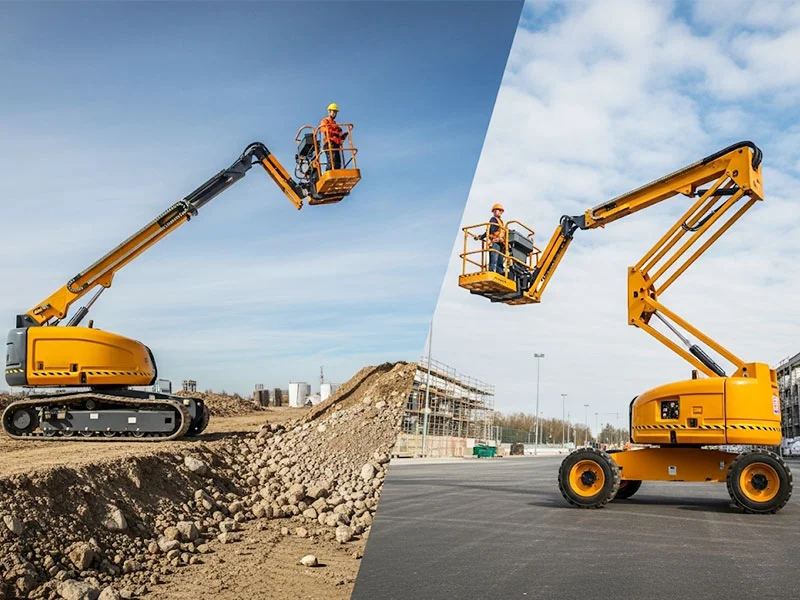
Understanding Boom Lift Tires
Boom lift tires are the most common and traditional choice for aerial work platforms. These machines are designed for mobility on a variety of surfaces and are the workhorses of many industries. The specific type of boom lift tires can vary greatly, from standard pneumatic tires to solid, foam-filled, or non-marking options.
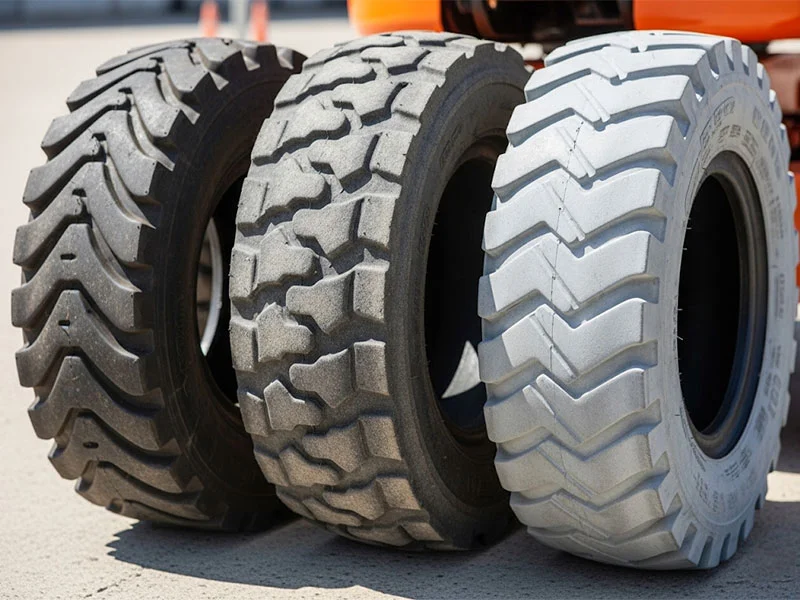
Types of Boom Lift Tires:
- Pneumatic Tires: These are the most basic type of boom lift tires. They are air-filled, providing excellent cushioning and a smooth ride. This makes them ideal for paved surfaces and relatively smooth terrain. However, they are susceptible to punctures, which can lead to downtime and maintenance costs.
- Foam-Filled Tires: To combat the risk of punctures, many boom lift tires are filled with a polyurethane foam. This makes the tires solid and flat-proof. While they are heavier and provide a stiffer ride than pneumatic tires, their reliability and durability on job sites with sharp debris are invaluable.
- Solid Tires: Made entirely of rubber, solid boom lift tires are the ultimate in puncture resistance. They are extremely durable and have a long lifespan. The main drawbacks are their weight and the lack of a cushioned ride, which can be jarring on uneven ground.
- Non-Marking Tires: Primarily used for indoor applications or on delicate surfaces like polished concrete or finished floors, non-marking boom lift tires are made from a compound that prevents scuff marks. These are essential for jobs in warehouses, gymnasiums, and commercial buildings.
The key benefit of boom lift tires is their versatility and speed. They can travel relatively quickly over long distances on paved roads and hard-packed surfaces. This makes a boom lift with tires the go-to option for large construction sites, urban areas, and facilities where the machine needs to move frequently between different work areas. The ease of maintenance and widely available replacements for boom lift tires also contribute to their popularity.
Understanding Boom Lift Tracks
A boom lift on tracks, often referred to as a track-mounted or tracked boom lift, is a machine designed for supreme performance on challenging terrain. Instead of wheels, these lifts are equipped with continuous tracks similar to those found on excavators or bulldozers.
Key Features of Boom Lifts with Tracks:
- Weight Distribution: The primary advantage of a boom lift on tracks is its ability to distribute the machine’s weight over a much larger surface area. This results in a significantly lower ground pressure compared to a machine with boom lift tires. This feature is crucial for preventing damage to sensitive surfaces like lawns, golf courses, and landscaped areas.
- Superior Traction: The continuous tracks provide a much larger contact patch with the ground, offering exceptional traction and grip. This allows a boom lift with tracks to navigate steep slopes, muddy conditions, soft ground, and uneven terrain that would be impassable for a machine with boom lift tires.
- Increased Stability: The broader base and lower center of gravity of a boom lift with tracks contribute to enhanced stability, especially on slopes and challenging landscapes. This can be a critical safety advantage in certain applications.
A boom lift with tracks is the specialized tool for specialized jobs. They are often used in forestry, utility work, pipeline construction, and other applications where the work environment is rugged and unpredictable. The trade-off for this superior off-road capability is a slower travel speed and higher maintenance costs associated with the track system.
Head-to-Head Comparison: Tires vs. Tracks
To help you visualize the differences, here’s a quick comparison of a boom lift with tracks and a boom lift with tires.
| Feature | Boom Lift with Tires | Boom Lift with Tracks |
| Terrain | Paved roads, concrete, asphalt, hard-packed ground. | Soft ground, mud, sand, snow, slopes, uneven terrain. |
| Ground Pressure | High, concentrated at the four tire contact points. | Low, distributed over a large surface area. |
| Speed | Faster travel speed, suitable for long-distance movement. | Slower travel speed, less efficient for long hauls. |
| Maneuverability | Generally good, but can get stuck in soft ground. | Excellent on challenging terrain, but slower to turn. |
| Cost | Lower initial purchase and maintenance costs. Boom lift tires are relatively inexpensive to replace. | Higher initial purchase and maintenance costs due to complex track systems. |
| Stability | Good on level, solid surfaces. | Superior on uneven terrain and slopes. |
| Applications | Warehouses, industrial facilities, urban construction, paved job sites. | Forestry, landscaping, utility work, pipeline construction, rough terrain. |
| Surface Damage | Can leave tire marks or create ruts in soft ground. | Minimizes damage to delicate surfaces like grass and landscaping. |
The choice between boom lift tires and tracks boils down to a fundamental trade-off: speed and surface versatility versus superior traction and low ground pressure. A boom lift with tires is the generalist, while a boom lift with tracks is the specialist.
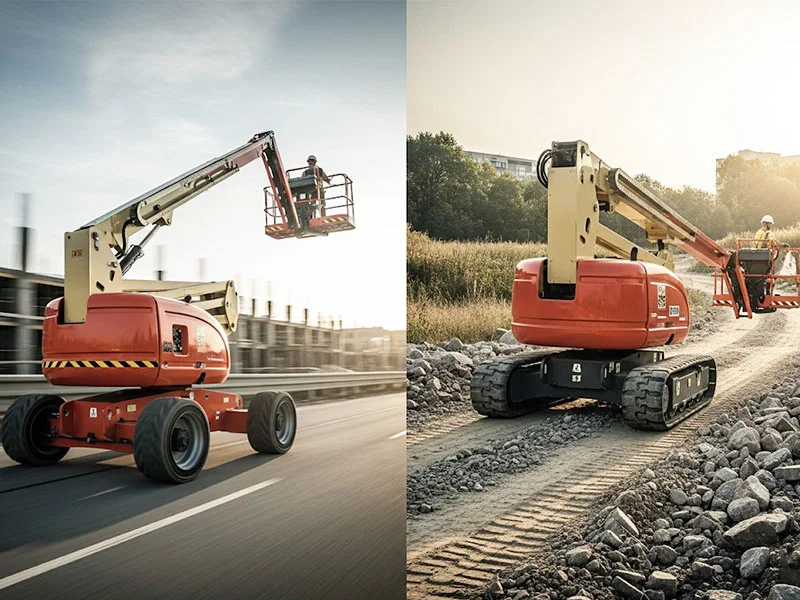
Making the Right Choice: Use Case Scenarios
To make the best decision, consider these specific use cases and which mobility system is the clear winner for each.
Scenario 1: Urban Construction Site
- The Job: A new high-rise is being built in a city center. The ground is a mix of concrete, asphalt, and hard-packed dirt. The boom lift needs to move quickly from one side of the site to the other and occasionally access a temporary road.
- The Winner: A boom lift with tires. The smooth surfaces and need for quick movement make the speed and maneuverability of a wheeled lift ideal. The risk of puncturing boom lift tires is low, and the overall efficiency is high.
Scenario 2: Landscaping or Golf Course Maintenance
- The Job: Pruning trees and maintaining lights in a large, well-manicured park or golf course. The ground is a mix of grass, soft soil, and some paved paths. Preventing damage to the turf is a top priority.
- The Winner: A boom lift on tracks. The low ground pressure of a boom lift on tracks ensures that the expensive landscaping and delicate grass are not damaged. The superior traction allows the machine to operate on soft, wet ground without getting stuck or creating ruts.
Scenario 3: Utility Work in a Remote, Rural Area
- The Job: Servicing power lines that run through a mountainous, rural region. The terrain is a mix of steep slopes, rocky outcroppings, and muddy patches.
- The Winner: A boom lift on tracks. This is the perfect job for a boom lift with tracks. The machine needs the stability and traction to navigate steep, uneven slopes safely. A boom lift with tires would likely be unable to access many of the work areas and would be a significant safety risk.
Scenario 4: Indoor Warehouse Maintenance
- The Job: Replacing light fixtures and performing general maintenance in a large warehouse with a polished concrete floor.
- The Winner: A boom lift with non-marking boom lift tires. The machine needs to be able to move freely without leaving scuff marks or damaging the expensive flooring. The stable, flat surface makes a wheeled lift with non-marking boom lift tires the only viable option.
Scenario 5: Bridge Inspection or Maintenance
- The Job: Inspecting the underside of a bridge from a paved shoulder.
- The Winner: A boom lift with tires. The entire operation is on a hard, paved surface. The speed and stability of a wheeled machine make it the most efficient choice for this kind of work. The specific type of boom lift tires may be foam-filled for puncture resistance from roadside debris.
The use of a boom lift on tracks is a game-changer for those who regularly face off-road challenges, while a boom lift with tires remains the go-to for most general construction and maintenance tasks. The durability and variety of boom lift tires, from foam-filled to non-marking, make them a versatile and reliable choice for a wide range of jobs.
Conclusion
Choosing between a boom lift with tires and a boom lift with tracks is a decision that has a direct impact on the success, safety, and profitability of your project. It’s not about which one is “better” but rather which one is the “right” one for your specific application.
A boom lift with tires is the clear choice for projects on firm, level surfaces where speed and maneuverability are paramount. The wide array of available boom lift tires, from puncture-proof to non-marking, allows for a high degree of specialization and versatility.
On the other hand, a boom lift on tracks is the essential tool for jobs in harsh, off-road environments. Its ability to navigate soft ground, steep slopes, and uneven terrain makes it indispensable for applications where a traditional boom lift with tires would be rendered useless.
By carefully evaluating the terrain, the required stability, and the specific needs of your project, you can confidently choose the right machine for the job. Remember, the right equipment is not just an investment in a machine—it’s an investment in safety, efficiency, and the successful completion of your work at height.
FAQs
Can I use a boom lift with tires on soft ground?
It is not recommended. While some boom lifts with tires may be able to handle slightly uneven or wet ground, they are prone to getting stuck and can cause significant damage by creating ruts. This is where a boom lift with tracks excels.
Are a boom lift on tracks and a boom lift with tracks the same thing?
Yes, these terms are often used interchangeably to describe a tracked boom lift. The same goes for boom lift with tires, which simply means a standard wheeled boom lift.
Are boom lift tires expensive to replace?
The cost of boom lift tires varies depending on the type and size. Foam-filled and solid boom lift tires are more expensive than pneumatic ones but offer greater durability and reliability.
Which type of boom lift is safer?
Safety depends on the application. A boom lift with tracks can be safer on slopes and unstable ground due to its superior stability. A boom lift with tires is safer for high-speed travel on level, stable ground. Always follow manufacturer guidelines and safety procedures.
What is the maintenance difference between a boom lift with tires and one with tracks?
Boom lift tires generally require less maintenance and are easier to replace. The track system on a boom lift with tracks is more complex and requires regular inspection and maintenance to ensure proper tension and function, which can lead to higher long-term costs.